How to Diagnose Problems on a Bonsai Tree

A bonsai tree can look perfectly healthy one week and suddenly develop yellow leaves, weak growth, brown tips, sticky foliage, or unexpected leaf drop. The difficult part is that several very different problems can create almost the same symptoms.
Learning how to diagnose problems on a bonsai tree helps you avoid making the situation worse with unnecessary fertilizer, pesticides, pruning, or repotting.
The best approach is systematic. Check what changed, identify where the symptoms began, inspect the tree closely for pests or disease, evaluate watering and growing conditions, and only then decide what treatment is justified.
Quick Answer
To diagnose problems on a bonsai tree, first check watering, drainage, light, temperature, and recent care changes. Then inspect the leaves, branches, trunk, soil, and roots for pests or disease. Look for patterns rather than one symptom alone. Avoid fertilizing, spraying, or repotting until you have identified the most likely cause.
Start With the Symptoms, Not the Treatment
One of the easiest mistakes in bonsai care is seeing yellow leaves and immediately assuming the tree needs fertilizer.
Yellowing is a symptom, not a diagnosis.
A useful plant-diagnostic process separates symptoms from signs. Symptoms are changes in the plant, such as wilting or leaf spots. Signs are direct evidence of the cause, such as insects, webbing, fungal growth, or insect waste. This distinction is also emphasized in Penn State Extension’s plant problem diagnosis guidance. (Penn State Extension)
Before doing anything drastic, ask:
- Which part of the bonsai looks unhealthy?
- Did the problem appear suddenly or gradually?
- Is new growth affected, old growth affected, or both?
- Is the damage on one branch or throughout the tree?
- Have watering, light, temperature, fertilizer, or location changed recently?
- Can you actually see insects, webbing, scale, mold, or damaged roots?
Patterns usually tell you more than individual leaves.
Use This 7-Step Bonsai Diagnosis Process
1. Identify the Bonsai Species First
You cannot accurately judge a bonsai without knowing what kind of tree it is.
A ficus, juniper, Japanese maple, Chinese elm, pine, and azalea do not respond to environmental conditions in exactly the same way.
For example, a tropical bonsai may react badly to cold temperatures, while many temperate trees naturally lose their leaves in autumn.
Before diagnosing a problem, determine:
- Species or likely species
- Evergreen or deciduous
- Tropical, subtropical, or temperate
- Indoor or outdoor growing requirements
- Current growing season
Normal seasonal behavior should not be mistaken for disease.
A deciduous bonsai losing leaves in autumn may be completely healthy. The same degree of leaf loss during active spring growth deserves closer attention.
2. Think About What Changed Recently
A bonsai’s recent history is one of your best diagnostic tools.
Problems often appear after:
- Moving the tree indoors or outdoors
- Repotting
- Heavy root pruning
- Major branch pruning
- Wiring
- Fertilizing
- A heat wave
- Frost exposure
- Several days of heavy rain
- Missing a watering
- Changing soil
- Applying pesticide
- Buying the tree and moving it to a new environment
Do not ignore timing.
If a tree began dropping leaves two days after being moved from a bright outdoor location into a darker room, environmental stress is more likely than a mysterious disease.
If decline started several weeks after repotting, root damage, poor drainage, incorrect watering, or inappropriate timing should be investigated.
Check the Leaves Carefully
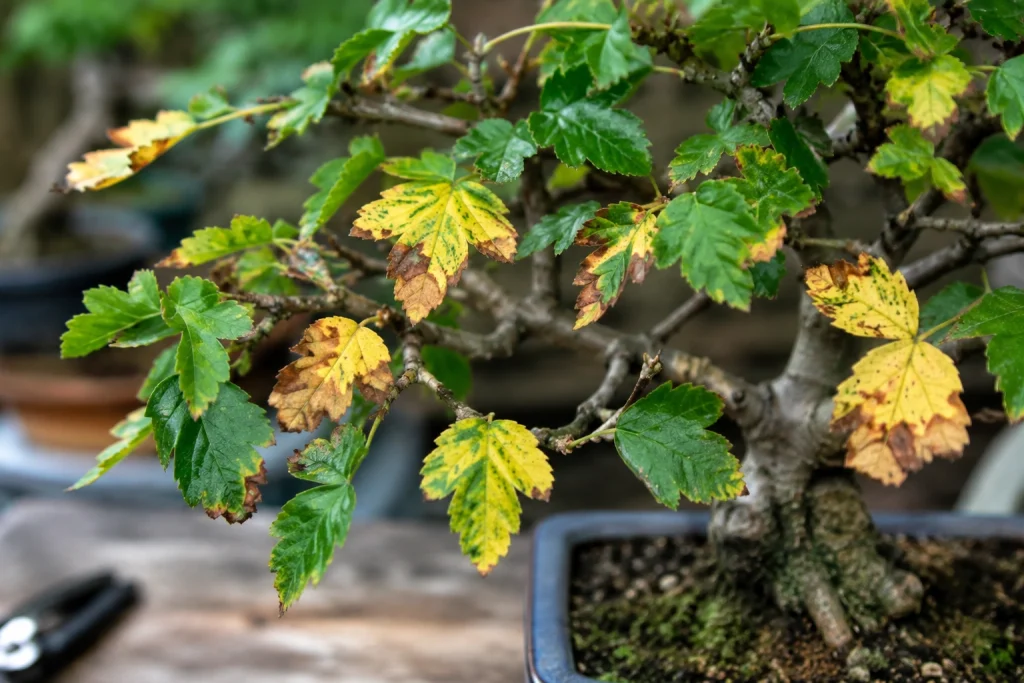
Leaves often show the earliest visible evidence that something is wrong.
Inspect both the upper and lower surfaces.
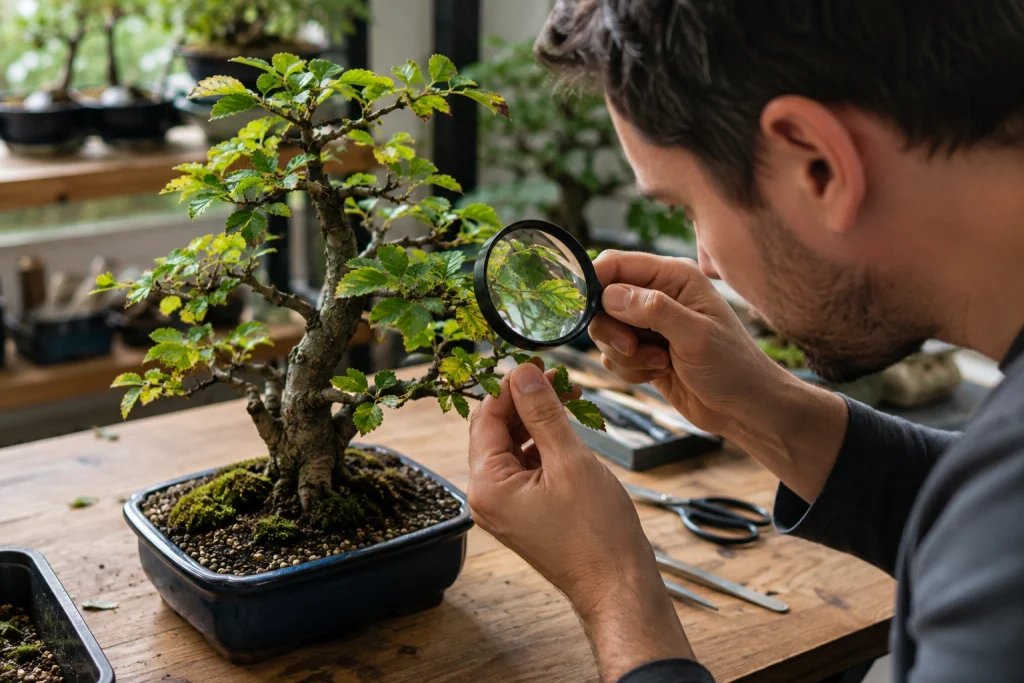
A small hand lens can be useful because spider mites, young scale insects, and other pests can be difficult to see clearly with the naked eye.
What Different Leaf Symptoms May Mean
| Warning sign | Possible causes | What to check next |
|---|---|---|
| Yellow leaves | Overwatering, root stress, nutrient issues, low light, pests | Soil moisture, roots, leaf undersides |
| Crispy brown edges | Underwatering, heat, wind, low humidity, salt buildup | Watering history and exposure |
| Blackening leaves | Cold injury, severe root trouble, disease | Temperature, roots, stem condition |
| Fine pale speckling | Spider mites or other sap-feeding pests | Undersides and fine webbing |
| Sticky leaves | Aphids, scale, or other honeydew-producing insects | Branches, stems, leaf undersides |
| Circular or irregular spots | Fungal or bacterial disease, physical damage | Pattern, moisture, progression |
| Curled new growth | Aphids, stress, chemical injury | Young shoots and pests |
| Sudden leaf drop | Water stress, temperature change, relocation, root problems | Recent environmental changes |
Leaf spotting deserves particular attention when lesions continue increasing in number or size. According to the University of Minnesota Extension’s guidance on leaf spot diseases, some diseases can also produce visible fungal structures or colored spores that help separate disease from simple environmental damage. (University of Minnesota Extension)
Do not diagnose disease simply because you see a brown patch. Sun scorch, fertilizer damage, rubbing, broken leaves, and water stress can also injure foliage.
Inspect for Common Bonsai Pests
Pests are easier to diagnose when you find the pest itself rather than relying only on plant damage.
Check:
- Leaf undersides
- Young shoots
- Branch forks
- Trunk crevices
- Around buds
- Soil surface
- Drainage holes
- Protected areas underneath dense foliage
Aphids
Aphids are small, soft-bodied insects that commonly gather around tender growth.
Possible clues include:
- Curled or distorted new leaves
- Sticky honeydew
- Clusters of tiny insects
- Weak new shoots
The University of Minnesota describes aphids as small, soft-bodied insects that occur in several colors and may be winged or wingless. (University of Minnesota Extension)
Spider Mites
Spider mites may create fine pale speckling before the bonsai looks seriously unhealthy.
Look for:
- Tiny moving dots
- Fine webbing
- Bronzed or dull foliage
- Progressive weakening in hot, dry conditions
A magnifying lens is particularly useful here.
Scale Insects
Scale often looks like small brown, tan, white, or gray bumps attached to leaves or branches.
Because adult scale can remain relatively motionless, beginners sometimes mistake them for part of the bark.
Check suspicious bumps carefully rather than automatically scraping normal bark features from the tree.
Mealybugs
Mealybugs often appear as white, cottony clusters in protected areas.
Inspect branch joints and leaf bases closely.
Fungus Gnats
Tiny dark flies around the soil may be fungus gnats.
They are especially useful as an environmental clue because persistently wet soil can encourage them. University of Minnesota Extension guidance on indoor plant insects also notes that overwatering and poor drainage can contribute to root rot while encouraging fungus gnat problems. (University of Minnesota Extension)
Finding fungus gnats does not automatically mean they are causing your bonsai’s decline. The underlying moisture problem may matter more.
Check the Soil and Watering
Water problems are among the first things to investigate when a bonsai declines.
Because bonsai containers are shallow and hold relatively little soil, conditions can change quickly.
Signs the Bonsai May Be Staying Too Wet
Look for:
- Soil remaining wet much longer than expected
- Poor drainage
- Moss or algae developing excessively on constantly wet surfaces
- Weak or yellowing foliage
- Reduced vigor
- Soft or unhealthy roots
- Fungus gnats
Do not assume “more water” is safer.
Roots need both moisture and oxygen. Constantly saturated soil can create poor root-zone conditions and increase disease risk. (University of Minnesota Extension)
Signs the Bonsai May Be Too Dry
Possible clues include:
- Drooping leaves
- Dry, crispy edges
- Rapidly drying soil
- Shrinking soil pulling away from the pot
- Weak tender growth
- Sudden foliage damage during hot weather
However, wilting can occur with both excessively dry soil and badly damaged roots.
That is why watering based only on wilted foliage can make a root problem worse.
Check the soil before adding more water.
Examine Drainage and Soil Structure
Good bonsai soil should allow water and air to move through the root zone appropriately for the species and climate.
When watering, observe what happens.
Water should normally penetrate the root ball instead of simply sitting on top for a long time.
Problems may arise when:
- Soil has broken down into dense particles
- Organic material has compacted
- Drainage holes are obstructed
- Roots have become extremely dense
- The wrong soil mix was used
- The root ball has become so dry that water runs around it instead of soaking through it
Do not repot automatically because drainage seems slow.
Repotting is stressful, especially for an already weak bonsai. First rule out blocked drainage holes, watering technique, and other simple causes.
Check the Roots Only When Necessary
Root inspection can provide valuable information, but repeatedly removing a bonsai from its pot can damage fine roots.
If the tree is seriously declining and root trouble is strongly suspected, inspect cautiously.
Healthy root appearance varies between species, but actively functioning roots are generally firm rather than soft and decomposing.
Warning signs include:
- Soft or mushy roots
- Large areas of dead roots
- Unpleasant rotting odor
- Severely compacted root mass
- Persistently saturated soil
Do not aggressively root-prune a severely stressed bonsai just because some roots look unhealthy.
Removing too much functioning root tissue may push an already weak tree beyond recovery.
Expert Tip:
Expert Tip: Before repotting a sick bonsai, photograph the foliage, soil surface, pot, and drainage condition and record when it was last watered. Many apparent “root problems” can be diagnosed from the tree’s recent care history without disturbing the roots.
Inspect the Trunk and Branches
Next, look beyond the foliage.
Check for:
- Cracked or damaged bark
- Cankers or sunken areas
- Unusual swelling
- Insect holes
- Loose bark
- Dead branch tips
- Wire cutting deeply into bark
- Mechanical injuries
- Dieback progressing along branches
Some bonsai intentionally contain deadwood, which means deliberately preserved dead sections used as a styling feature.
A jin is a dead branch that has been stripped and preserved for artistic effect.
Do not confuse intentional deadwood with new disease or dieback.
A recently dying branch usually presents differently because the change is new and was not part of the established design.
Determine Whether the Problem Is Localized or Widespread
The distribution of damage can dramatically narrow the diagnosis.
One Branch Is Affected
Consider:
- Wire injury
- Broken branches
- Localized pest infestation
- Canker or infection
- Poor branch positioning
- Physical damage
The Whole Tree Is Affected
Investigate:
- Watering
- Root health
- Temperature
- Light
- Soil
- Major environmental change
- Fertilizer or chemical injury
Only New Growth Is Affected
Consider problems involving:
- Sap-feeding pests
- Nutrient availability
- Tender growth exposed to cold or heat
- Chemical injury
- Root function
Only Older Leaves Are Yellowing
A few old leaves naturally aging may not indicate a serious problem.
The concern increases when yellowing is rapid, widespread, or accompanied by weak growth, pests, abnormal roots, or branch dieback.
Could the Problem Be Disease?
Plant diseases can be fungal, bacterial, viral, or caused by other pathogens, but beginners often overdiagnose disease.
Environmental stress is common and can create disease-like symptoms.
Disease becomes more suspicious when you see:
- Spots increasing consistently
- Similar lesions appearing on many leaves
- Visible fungal growth or spores
- Sunken stem lesions
- Progressive branch dieback
- Abnormal tissue associated with persistent wet conditions
- The problem spreading to nearby plants
Penn State Extension recommends considering environmental and management problems alongside pests and pathogens when diagnosing poor plant health rather than assuming every symptom is infectious. (Penn State Extension)
When disease is suspected, isolate the bonsai from other vulnerable plants while investigating.
Do Not Fertilize a Sick Bonsai Automatically
Fertilizer is food for growth, not medicine for every unhealthy tree.
If a bonsai is declining because its roots are damaged, adding a strong fertilizer dose may increase stress rather than solve the original problem.
First determine whether the tree can actively grow.
When appropriate, fertilization should consider:
- Species
- Growing season
- Tree vigor
- Root health
- Fertilizer strength
- Recent repotting
- Current environmental conditions
A pale leaf alone does not prove nutrient deficiency.
Be Careful With Pesticides and Fungicides
Do not spray first and diagnose later.
When an actual pest has been identified, begin with the least disruptive effective approach appropriate for that pest and bonsai species.
If using a pesticide, make sure the product is labeled for the intended plant and pest and follow all label instructions. The EPA’s pesticide label guidance explains that pesticide labels contain legally enforceable directions for safe and proper use. (US EPA)
This matters especially with bonsai because foliage is concentrated, containers are small, and some species can be sensitive to certain products.
Never assume that a treatment safe for one ornamental plant is automatically suitable for every bonsai species.
Keep a Simple Bonsai Health Record
Diagnosis becomes much easier when you know what happened before symptoms appeared.
Keep notes on:
- Watering
- Fertilizing
- Repotting
- Pruning
- Pesticide treatments
- Weather extremes
- Indoor or outdoor moves
- New pests
- First appearance of symptoms
Take photographs from the same angle every few days.
This helps you determine whether a problem is actually progressing or whether damaged leaves simply remain visible while healthy new growth develops.
Common Mistakes Bonsai Owners Should Avoid
- Treating yellow leaves with fertilizer immediately. Yellow foliage has many possible causes.
- Watering on a rigid schedule. Check the soil and tree instead of automatically watering every day.
- Using pesticide without identifying a pest. You may expose the tree to unnecessary chemicals without solving the problem.
- Repotting every unhealthy bonsai. Root work adds stress and may be badly timed.
- Moving the tree repeatedly. Constant changes in light and temperature make diagnosis harder.
- Diagnosing from one damaged leaf. Look for patterns across the entire tree.
- Ignoring leaf undersides. Many important pests hide there.
- Pruning heavily while the tree is weak. The bonsai needs healthy foliage and roots to recover.
- Changing several things simultaneously. If you repot, spray, fertilize, prune, and relocate the tree at once, you may never learn what caused the original problem.
When to Ask an Experienced Bonsai Grower or Arborist
Some problems are difficult to diagnose safely at home.
Seek experienced help when:
- A valuable or old bonsai is declining rapidly
- Major branches are dying
- The trunk shows suspicious cankers or extensive decay
- Root rot appears severe
- You suspect a serious infectious disease
- You cannot identify an unusual pest
- The tree requires major root work while already weak
- Several bonsai develop the same symptoms
- Treatment attempts have failed
- You are unsure whether a major branch or root should be removed
For unusual or regulated plant pests, the USDA Animal and Plant Health Inspection Service maintains information on important plant pests and diseases. (APHIS)
A local extension service, plant diagnostic laboratory, experienced bonsai club member, certified arborist, or qualified horticulturist may also be able to help.
When requesting assistance, provide clear photographs and information about the species, location, watering routine, soil, recent treatments, and when the symptoms began.
FAQs
How do I know if my bonsai is sick or just stressed?
Stress often follows an identifiable event such as repotting, relocation, extreme temperatures, or watering problems. Disease is more suspicious when symptoms continue spreading or you find signs such as fungal growth, progressive lesions, or abnormal tissue. Examine the entire tree before deciding.
Why are my bonsai leaves turning yellow?
Yellow leaves can result from excessive water, poor drainage, root stress, insufficient light, pests, seasonal leaf aging, nutrient problems, or other environmental conditions. Check the soil, roots, growing environment, and leaf undersides before fertilizing.
How can I tell whether my bonsai has root rot?
Possible warning signs include persistent wet soil, declining foliage, weak growth, unpleasant odor, and soft or decaying roots. However, similar symptoms can have other causes. Avoid unnecessary root disturbance unless root trouble is strongly suspected.
Should I repot a sick bonsai?
Not automatically. Repotting can add significant stress. First diagnose watering, drainage, pests, environmental conditions, and other causes. Emergency root work may sometimes be necessary, but severe cases are better handled with experienced guidance.
How do I check my bonsai for pests?
Examine leaf undersides, young shoots, branch joints, trunk crevices, and the soil surface using bright light and, ideally, a magnifying lens. Look for insects, webbing, sticky residue, scale-like bumps, cottony material, eggs, or unusual feeding damage.
Can too much water make a bonsai look like it needs water?
Yes. Root problems caused by persistently poor growing conditions can interfere with water uptake, so the foliage may wilt even though the soil is wet. Always check soil moisture before responding to wilt by watering again.
Should I remove damaged bonsai leaves?
A few badly damaged or clearly diseased leaves may sometimes be removed, but avoid stripping large amounts of foliage from a stressed tree. Leaves still containing healthy green tissue may continue contributing to the tree’s recovery.
Conclusion
Learning how to diagnose problems on a bonsai tree is mostly about slowing down and gathering evidence before treating the tree.
Start with the species and recent care history. Inspect the leaves, branches, trunk, soil, drainage, and roots. Determine whether the damage is localized or widespread, and look for direct evidence of pests or disease.
Most importantly, change one thing only when you have a good reason to change it. Avoid automatically fertilizing, spraying, pruning, or repotting an unhealthy bonsai.
Careful observation gives you a much better chance of correcting the real problem without adding unnecessary stress. If your bonsai looks unhealthy today, begin with a thorough inspection and record what you find before choosing your next care step.