
Scale Insects on Bonsai Trees: Complete Guide

Quick Answer
Scale insects on bonsai are sap-feeding pests that look like small brown, tan, gray, white, or waxy bumps attached to leaves and branches. Isolate the tree, confirm the pest, remove manageable colonies, and target exposed young crawlers with an appropriate treatment such as horticultural oil or insecticidal soap, following scale insect management guidance from UC IPM.
What to check first
- Fixed bumps: Scale usually stays firmly attached to stems, branches, leaf veins, or foliage.
- Sticky honeydew: Soft scales can produce sugary residue that coats leaves and nearby surfaces.
- Sooty mold: Black fungal growth may develop on honeydew without directly infecting the bonsai tissue.
- Yellow foliage: Heavy feeding can weaken growth and contribute to yellowing or premature leaf drop.
- Moving crawlers: Newly hatched scale insects have legs and can move before settling to feed.
Before spraying
- Check several leaves and branches, because scale can be confused with mealybugs, aphids, bark features, or dried residue.
- Test any spray on a small part of the bonsai first and follow the product label exactly.
Scale insects on bonsai trees are frustrating because they often don’t look like insects at all. A colony can resemble harmless bumps until sticky leaves, yellow foliage, weak shoots, or branch decline gets your attention.
My approach is to identify the scale before reaching for a pesticide. This guide walks through identification, life cycle, treatment, prevention, and recovery without putting an already stressed bonsai through unnecessary treatments.
In This Guide
What Are Scale Insects on Bonsai Trees?
Scale insects are small sap-feeding insects that settle on leaves, stems, twigs, and branches. Many develop waxy or shell-like coverings that make mature insects look almost like part of the tree.
Definition: A scale insect is a piercing-sucking plant pest whose settled stages often remain attached to the plant beneath a protective waxy or shell-like covering.
Scale isn’t one single insect species. Bonsai growers can encounter both **soft scales** and **armored scales**, and that difference matters when diagnosing an infestation.
Soft scale vs. armored scale
Soft scales generally have a softer protective covering that remains part of the insect’s body. Many soft scale species excrete sugary liquid called honeydew.
Armored scales develop a harder protective cover. They typically don’t produce honeydew, so a badly infested bonsai may lack the sticky residue people expect from scale.
- Soft scale: Often dome-shaped, waxy, and associated with honeydew.
- Armored scale: Often flatter or harder and usually lacks honeydew.
- Young crawlers: Tiny mobile insects that haven’t developed a mature protective covering.
- Settled stages: Less mobile stages that attach to plant tissue and feed.
Why scale can be serious on bonsai
Scale insects use piercing-sucking mouthparts to remove plant fluids. A few insects may cause little visible damage, but a growing colony can steadily weaken the tree.
Bonsai deserve close monitoring because their canopy, roots, soil volume, and stored resources are limited compared with a full-sized landscape tree. A pest problem combined with heat, root stress, poor watering, or recent repotting can become more significant.
- Yellow or pale foliage
- Reduced vigor
- Weak new shoots
- Premature leaf drop
- Twig or branch dieback in serious cases
- Sticky foliage from soft scale
- Black sooty mold growing on honeydew
The Bonsai Empire pest and disease guide also lists scale among insects commonly encountered on bonsai and emphasizes correct identification before treatment.
Section takeaway: Scale insects are sap feeders protected by wax or shell-like coverings. Recognizing whether you’re dealing with soft scale, armored scale, or vulnerable crawlers makes treatment much more precise.
How Do You Identify Scale Insects on a Bonsai?
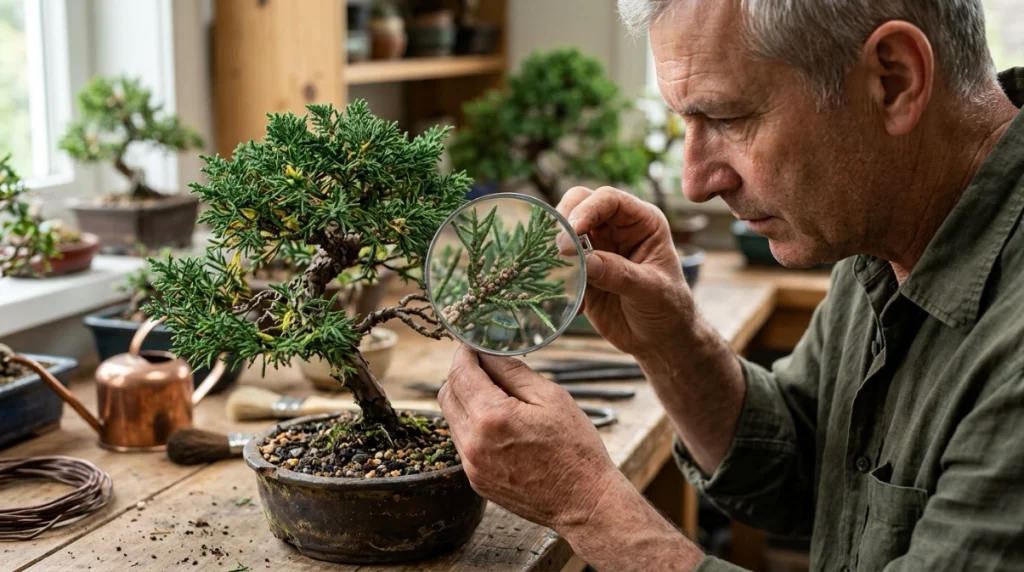
Look for small fixed bumps on stems, branches, leaf veins, and leaf undersides. Then check whether those bumps can be gently lifted and whether living insect tissue is present beneath them.
Don’t identify scale from one brown spot. Rough bark, lenticels, buds, scars, dried sap, mineral deposits, and normal branch texture can all create suspicious-looking marks.
Signs that strongly suggest scale
- Firm attached bumps: Brown, tan, gray, white, black, or waxy structures remain attached to the plant.
- Honeydew: Leaves, branches, pots, or surfaces beneath the tree become shiny and sticky.
- Sooty mold: Dark fungal growth develops over honeydew deposits.
- Ant activity: Ants may visit honeydew-producing scale colonies.
- Yellow leaves: Persistent feeding can contribute to discoloration and leaf loss.
- Weak shoots: New growth may slow when populations become heavy.
- Crawlers: Tiny mobile insects may appear around established adults.
Where should you inspect?
Use bright light and a 10× hand lens if you have one. Work methodically instead of examining only the obvious infestation.
- Inspect both sides of every suspicious leaf.
- Follow the main leaf veins toward the petiole.
- Check new shoots and branch junctions.
- Inspect twigs and rough bark crevices.
- Examine pruning scars and protected branch crotches.
- Check the trunk and surface roots.
- Look around the pot rim and nearby plant debris.
I like to inspect from the outer shoots toward the trunk. That simple pattern reduces the chance of overlooking a hidden colony in an interior branch junction.
Scale insects vs. other bonsai problems
| What You See | Likely Problem | Best Clue |
|---|---|---|
| Firm brown, gray, or white bumps | Scale insects | Attached closely to stems, leaves, or veins |
| White cotton-like clusters | Mealybugs | Fluffy wax around joints and protected areas |
| Soft pear-shaped insects | Aphids | Colonies concentrated on tender shoots |
| Fine pale stippling and webbing | Spider mites | Tiny moving specks beneath leaves |
| Chalky spots that wipe away | Mineral or spray residue | No insect body underneath |
Honeydew is useful evidence, but it isn’t a diagnosis by itself. Aphids, mealybugs, whiteflies, and soft scale can all leave sticky deposits.
Section takeaway: Confirm scale by combining several clues, especially fixed bumps, feeding symptoms, honeydew, and crawler activity. Never spray a bonsai simply because one mark resembles an insect.
Why Does a Bonsai Get Scale Insects?
A bonsai gets scale when insects or mobile crawlers reach a suitable host and establish themselves. New plants, nearby infested vegetation, touching foliage, containers, and plant-handling activities can all contribute to pest movement.
An infestation doesn’t automatically mean the bonsai was poorly cared for. Healthy trees can still acquire scale.
The scale insect life cycle explains why infestations return
The exact life cycle varies by scale species and climate. The most important stage for a bonsai grower to understand is the crawler stage.
- Egg or reproductive stage: A mature female produces offspring according to the biology of that scale species.
- Crawler stage: Young insects move across the host before selecting a feeding location.
- Settling stage: Crawlers attach to suitable tissue and begin feeding.
- Protective-cover stage: Many species develop increasingly protective wax or armor.
- Mature stage: Established insects continue feeding and eventually reproduce.
Crawlers matter because they have little protective covering. Contact treatments can therefore reach them more easily than heavily protected mature scale.
Where did the scale come from?
- A newly purchased tree: Small colonies can hide beneath leaves or along branches.
- Nearby plants: Crawlers can move between suitable hosts, especially when foliage touches.
- Outdoor exposure: Bonsai kept outdoors naturally interact with insects and surrounding vegetation.
- Hidden infestations: A few surviving scales can become noticeable only after population growth.
- Protected growing areas: Indoor rooms and greenhouses may allow pest populations to persist when conditions suit them.
Stress can make the effects of scale more noticeable, but stress isn’t the same thing as the cause. Correct light, watering, soil drainage, temperature, and nutrition still matter because a vigorous tree generally handles damage better.
Can scale spread to other bonsai?
Yes. Adult scale may appear stationary, but the young crawler stage is mobile.
Moving an infested bonsai away from the collection is therefore a sensible first response. Clean tools and work surfaces after handling it as well.
As of 2026, routine quarantine remains one of the simplest ways to protect a collection after bringing home a new or suspicious plant. Keep the species’ normal light and temperature needs in mind while isolating it.
Section takeaway: Scale doesn’t appear because a bonsai is automatically unhealthy. The crawler stage enables spread, which is why quarantine and repeated inspection are central parts of control.
How Do You Get Rid of Scale on a Bonsai?
Start by isolating the bonsai, confirming the pest, and physically reducing the population where practical. Then choose a treatment appropriate for the scale stage, tree species, season, and product label.
Trying to eliminate every scale insect with one aggressive spray often creates more risk than a controlled treatment program. Bonsai foliage can respond differently to oils, soaps, heat, sunlight, and pesticides.
Step 1: Isolate the bonsai
Move the affected tree away from healthy bonsai and other susceptible plants. Give the quarantine area suitable light, temperature, airflow, and watering conditions for that species.
Don’t put a tropical bonsai into damaging cold or move an outdoor temperate tree into unsuitable indoor conditions simply for convenience.
Step 2: Photograph and inspect the infestation
Take close photographs before treating the tree. A photo record helps you judge whether the population is declining during later inspections.
- Photograph several insects closely.
- Photograph the damaged foliage.
- Record the worst affected branches.
- Inspect the rest of the tree.
- Check nearby plants for similar signs.
Step 3: Physically remove manageable scale
Small infestations can often be reduced by gently removing individual scale insects. Use a soft tool that won’t cut the bark or damage delicate buds.
A soft toothbrush, cotton swab, or similar controlled tool can help on suitable bark and branches. Be gentler around tender foliage and young shoots.
Don’t scrape aggressively into living bark. Removing the insect is useful; injuring the cambium underneath is not.
Step 4: Wash honeydew and residue
Remove sticky honeydew and loose surface contamination where the species tolerates washing. Cleaner foliage also makes fresh honeydew easier to detect later.
Sooty mold grows on sugary deposits rather than feeding directly on bonsai sap. Controlling the honeydew-producing pest addresses the underlying problem.
Step 5: Choose a labeled scale treatment
Horticultural oils and insecticidal soaps are common lower-impact options for exposed scale stages. Their effectiveness depends heavily on coverage, timing, pest species, and label directions.
The University of Minnesota Extension’s indoor plant insect guidance lists physical removal, oils, and other labeled options for managing scale on plants.
- Confirm the product is labeled for the plant and intended use.
- Follow mixing and application directions exactly.
- Test sensitive foliage before treating the whole bonsai.
- Cover the pest thoroughly when using a contact treatment.
- Avoid applying sprays to moisture-stressed trees.
- Observe temperature and sunlight restrictions on the label.
Step 6: Reinspect for crawlers
One treatment may miss eggs or protected scale stages. Reinspect frequently so you can detect new crawlers before they become heavily protected adults.
You can place transparent or double-sided tape near established colonies when appropriate and examine it for tiny crawlers. A hand lens makes these insects much easier to see.
Step 7: Repeat only as the label allows
Repeat applications are sometimes necessary because scale populations contain different life stages. Don’t create your own pesticide interval or exceed label directions.
Keep records of the treatment date, product used, weather or indoor conditions, and what you observed afterward.
Pro tip: If controlling scale would require removing important live branches, major defoliation, or other irreversible work, consult an experienced grower or local bonsai club before making those cuts.
Section takeaway: Successful scale control is usually a process rather than one spray. Reduce the population, target vulnerable stages, monitor for new crawlers, and protect the bonsai from treatment stress.
Which Scale Treatment Works Best?
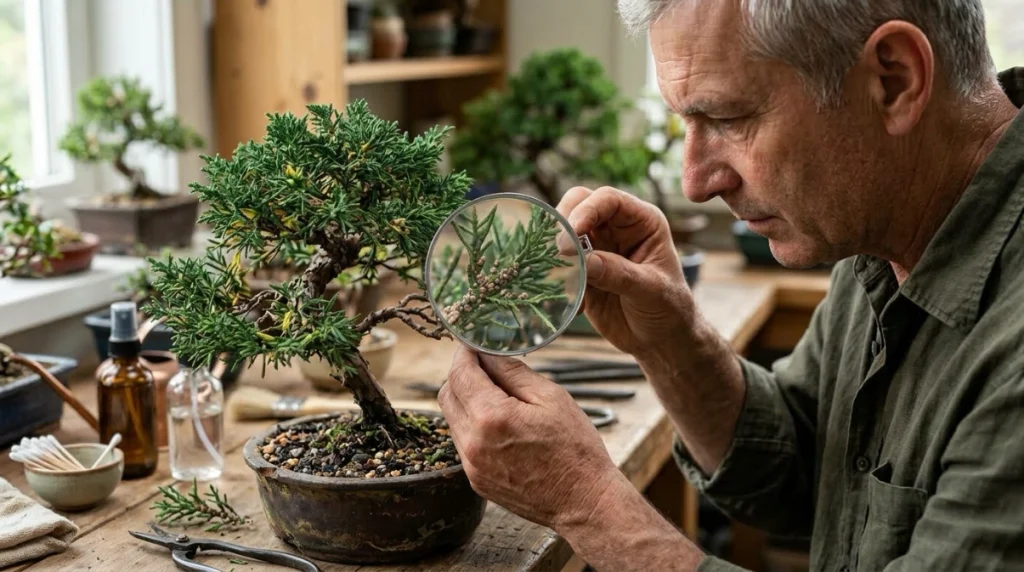
There isn’t one treatment that is best for every scale infestation. The right choice depends on population size, scale type, crawler activity, bonsai species, season, and where the insects are hiding.
For a small accessible colony, physical removal may do most of the work. A larger or persistent infestation often needs removal plus carefully timed treatment and repeated monitoring.
| Method | Best Use | Main Limitation | Monitoring Needed |
|---|---|---|---|
| Physical removal | Small, visible, accessible colonies | Easy to miss hidden insects | High |
| Water washing | Cleaning honeydew and loose pests | Doesn’t reliably eliminate established scale | High |
| Insecticidal soap | Exposed susceptible stages when labeled | Requires direct contact and careful coverage | High |
| Horticultural oil | Crawlers and suitable exposed or overwintering stages | Species, season, temperature, and coverage matter | High |
| Labeled systemic insecticide | Selected difficult infestations where the label supports use | Not appropriate for every scale species, host, or pollinator situation | Moderate to high |
| Selective pruning | Heavily infested expendable shoots | Can alter bonsai structure and styling | Moderate |
Why crawler timing matters
The mobile crawler stage is often the easiest stage to contact with sprays because its protective covering hasn’t fully developed. Mature armored scales can be much harder for contact products to reach.
University extension guidance recommends monitoring for crawler activity and timing appropriate treatments accordingly. This is more precise than repeatedly spraying the tree without knowing which life stage is present.
Should you use horticultural oil?
Horticultural oil can be useful against many scale insects when applied correctly. It works through direct coverage, so incomplete application can leave surviving pests behind.
Don’t assume every bonsai species will tolerate every oil application under every condition. Follow label precautions concerning heat, drought stress, sensitive plants, and application timing.
What about systemic insecticides?
Systemic insecticides may be available for some scale situations, but they aren’t a universal answer. Effectiveness varies among scale groups, products, plant species, and application methods.
Pollinator safety also matters when a treated bonsai flowers outdoors. Read environmental precautions on the label rather than treating systemic products as a routine first step.
Should you prune off infested branches?
Removing a disposable shoot covered in scale can quickly reduce pest numbers. Removing a primary branch, trunk feature, or carefully developed ramification is a different decision.
Ramification means the increasingly fine branching that creates a mature bonsai canopy. Years of structural work shouldn’t be sacrificed if less destructive control remains practical.
Pro tip: Before removing an important live branch solely because of scale, get a second opinion from an experienced bonsai grower or local club.
Section takeaway: The most effective program matches the treatment to the pest’s life stage. For many infestations, physical removal plus crawler-focused monitoring and properly labeled treatment is more sensible than indiscriminate spraying.
How Do You Stop Scale From Coming Back?
Continue monitoring after visible scale disappears. Hidden insects, eggs, or new crawlers can make an apparently successful treatment look like it failed weeks later.
Prevention depends more on inspection and quarantine than on routine pesticide use.
Inspect your bonsai regularly
Make pest inspection part of normal watering and maintenance. I prefer checking new growth first because subtle pest activity is easier to notice before the canopy becomes crowded.
- Look beneath leaves.
- Check along leaf veins.
- Inspect branch junctions.
- Watch fresh shoots.
- Check rough bark and protected crevices.
- Look for fresh honeydew.
- Watch for ants and sooty mold.
Quarantine new plants
Keep newly acquired or suspicious plants separated from established bonsai long enough to perform repeated inspections. Don’t rely on a single clean-looking inspection the day you bring the tree home.
Maintain the correct growing environment during quarantine. An isolation area that weakens the tree can create an entirely new care problem.
Keep tools and work areas clean
Remove plant debris after working on an infested tree. Clean reusable tools and surfaces before moving to healthy bonsai.
Work on healthy trees first when practical. Handle quarantined or actively infested material afterward.
Control ants when they are protecting honeydew producers
Ant activity can interfere with natural enemies that attack some soft scales. If ants are repeatedly visiting an infested outdoor bonsai, find the reason rather than focusing only on the ants you see.
Preserving beneficial predators and parasitoids can be valuable outdoors. Avoid unnecessary broad-spectrum pesticide use that may kill beneficial insects along with pests.
Help the bonsai recover without overcorrecting
A scale-damaged tree needs stable care rather than a sudden burst of fertilizer, severe pruning, and repotting all at once. Correct the pest problem first, then assess the tree’s actual strength.
- Maintain species-appropriate light.
- Water according to soil moisture and species needs.
- Keep the root zone draining properly.
- Avoid unnecessary environmental changes.
- Resume normal fertilizing based on growth and season.
- Delay major styling if the tree remains weak.
The American Bonsai Society can also help growers connect with bonsai education and local clubs when hands-on advice is needed.
A bonsai recovering from heavy scale may not replace damaged foliage immediately. Look instead for stable moisture use, healthy buds, clean new growth, and the absence of fresh pest activity.
Section takeaway: Preventing scale from returning means inspecting new growth, quarantining incoming plants, keeping the growing area clean, and avoiding unnecessary stress. Continue monitoring well after the obvious insects disappear.
Frequently Asked Questions
Can scale insects kill a bonsai tree?
Yes, a severe or long-lasting scale infestation can seriously weaken a bonsai and may contribute to branch dieback or death. The risk increases when pest pressure occurs alongside root problems, poor watering, extreme temperatures, or another source of stress.
What do scale insects look like on bonsai?
Scale usually looks like small brown, tan, gray, white, black, or waxy bumps attached to branches, leaves, or leaf veins. Soft scales may be accompanied by sticky honeydew, while armored scales usually don’t produce that sugary residue.
Do scale insects live in bonsai soil?
Most scale problems noticed by bonsai growers occur on above-ground plant tissue, but scale insects are diverse and some related pests can occur around roots. Don’t automatically replace the soil merely because you found scale on the branches; identify the pest and its location first.
Can I scrape scale insects off my bonsai?
Yes, careful physical removal can be effective for a small, accessible infestation. Use a controlled, gentle method and avoid damaging bark, buds, or tender shoots, then continue inspecting because hidden insects and newly emerged crawlers may remain.
Does horticultural oil kill scale insects?
Horticultural oil can control many scale insects when the pest stage, coverage, plant species, temperature, and label directions are appropriate. Oils are particularly useful when properly timed against vulnerable stages, but one treatment may not reach every insect in a mixed-stage population.
Why does scale keep coming back after treatment?
Scale may appear to return because eggs or protected stages survived the first treatment and later produced crawlers. Poor spray coverage, hidden colonies, incorrect identification, or reinfestation from another plant can also explain repeated problems.
How long should I isolate a bonsai with scale?
There isn’t a universal number of days for every scale species. Keep the bonsai separated while active pests remain and through repeated inspections after treatment, because hidden stages may become visible later.
If you’re uncertain whether the bumps are scale, photograph the insects before treating anything. Correct identification saves time and reduces the chance of stressing a bonsai with the wrong treatment.
Once scale is confirmed, keep the process simple: isolate, reduce the colony, target vulnerable stages, and keep checking. Catching the next crawler is easier than rebuilding a heavily damaged branch.