
White Scale on Bonsai: Identification and Treatment

Quick Answer
White scale on bonsai usually appears as small white, cream, or gray waxy bumps attached firmly to needles, leaves, twigs, or bark. Isolate the tree, confirm that the marks are scale insects, remove manageable colonies, then target vulnerable crawlers with a plant-labeled horticultural oil or insecticidal soap, following UC IPM scale management guidance.
Signs to Check First
- Attached white bumps: Scale stays firmly attached instead of moving like most visible insects.
- Waxy covering: Armored scale often develops a white, cream, or gray protective shell.
- Yellow foliage: Heavy feeding can weaken needles or leaves and reduce growth.
- Tiny crawlers: Newly hatched scale can move before settling and developing protective coverings.
- Little honeydew: White armored scales generally do not produce the sticky honeydew associated with soft scale.
Before You Spray
- Inspect the entire bonsai under bright light and test any treatment on a small area first.
- Always follow the pesticide label for species restrictions, temperature limits, dilution, and repeat applications.
White scale on bonsai can be surprisingly difficult to notice because the insects often look like bark marks, dried residue, or tiny pieces of wax. White scale insects are especially easy to miss on junipers and other conifers with dense foliage.
I approach these infestations as an identification problem first. Once you know what is attached to the tree, treatment becomes much more focused.
In This Guide
What Is White Scale on Bonsai?
White scale on bonsai describes scale insects with pale, waxy, or shell-like coverings. It is a description of appearance rather than one guaranteed insect species.
Many white scale problems belong to the armored scale group. These insects settle onto plant tissue and develop protective coverings that make mature stages difficult to reach with contact sprays.
Definition: A scale insect is a small piercing-sucking plant pest whose settled stages often remain attached to leaves, needles, stems, or bark beneath a waxy or shell-like covering.
Why does white scale appear on bonsai?
A bonsai does not develop scale because it is miniature. Scale insects also attack full-sized trees, shrubs, nursery plants, and houseplants that provide a suitable host.
The compact structure of bonsai can make infestations easier to overlook. Dense pads, interior branches, rough bark, and closely spaced plants create protected areas where small colonies can establish.
- New plants: Scale can enter a collection on recently purchased bonsai, nursery stock, or companion plants.
- Nearby hosts: Mobile crawlers may spread between plants, especially when foliage touches.
- Hidden colonies: Interior foliage and branch junctions may escape routine inspections.
- Plant stress: Drought, root problems, poor light, or other stress can make pest damage harder for a bonsai to tolerate.
Are all white scales the same species?
No. Host species provides an important clue, but color alone cannot identify a scale species accurately.
For example, junipers and related conifers can host juniper scale, Carulaspis juniperi. Penn State Extension describes mature females as approximately 1/16 inch, or 1.5 mm, across with a circular white covering and yellow center.
You can review Penn State’s juniper scale identification guidance when white scale appears on juniper, cypress, cedar, or related bonsai.
Section Takeaway: White scale is an appearance, not a complete diagnosis. Identify the host, insect shape, location, and life stage before deciding how to treat it.
How Do You Identify White Scale on a Bonsai?
Look for repeated white or cream structures attached firmly to foliage, twigs, or bark. Then inspect several areas of the bonsai instead of diagnosing the problem from one suspicious mark.
I find white scale easiest to spot when I rotate the tree slowly beneath strong light. A simple 10× hand lens makes tiny crawlers and wax coverings much easier to examine.
Where should you look?
- Leaf undersides: Follow major veins and inspect near petioles.
- Conifer needles: Check both exposed and shaded interior foliage.
- Young twigs: Look closely where new growth joins older branches.
- Branch forks: Protected junctions can conceal small colonies.
- Rough bark: Compare suspicious white marks with normal bark features.
- Nearby plants: Inspect anything touching or recently positioned beside the bonsai.
What does white armored scale look like?
Armored scales often appear flat, circular, oval, or elongated. The waxy cover may be white even when the insect beneath it is another color.
Some conifer scales are tiny enough to resemble dried paint droplets. A large colony can make needles or twigs look dusted with pale specks.
- Female covers: Often rounder or oval depending on the species.
- Male covers: Frequently smaller and more elongated in several armored scale species.
- Crawlers: Tiny mobile young that have not developed strong protective covers.
- Established scales: Usually stationary and tightly attached to the host.
What damage should you look for?
Scale insects feed on plant tissue through specialized mouthparts. Heavy populations can reduce vigor and damage foliage or branches.
- Yellow or chlorotic foliage
- Premature leaf or needle drop
- Weak new shoots
- Loss of normal foliage color
- Localized twig decline
- Branch dieback during severe infestations
Yellow leaves alone never prove scale. Watering problems, root damage, heat, nutrient issues, and other pests can produce similar symptoms.
The general Bonsai Empire pest and disease guide also stresses identifying the pest before selecting treatment.
Section Takeaway: Repeated attached bumps plus crawler activity or feeding damage create a stronger diagnosis than color alone. Always inspect several parts of the tree.
Is It White Scale, Mealybugs, or Something Else?
White scale is commonly confused with mealybugs, mineral deposits, spider mite damage, and natural bark features. The best clue is what happens when you examine the suspicious material closely.
| What You See | Likely Cause | Best Identification Clue |
|---|---|---|
| White or cream fixed shells | Armored scale | Repeated coverings attached tightly to foliage or bark |
| Fluffy cotton-like clusters | Mealybugs | Loose wax around visible soft-bodied insects |
| Fine pale stippling | Spider mites | Tiny moving specks, often with delicate webbing |
| Chalky white marks | Mineral or spray residue | Residue wipes away without an insect beneath it |
| Regular bumps matching the branch | Normal bark or lenticels | Pattern continues naturally on healthy tissue |
Does sticky honeydew mean white scale?
Not necessarily. Soft scale, aphids, mealybugs, and whiteflies can produce sugary honeydew.
Armored scale generally does not produce honeydew. A bonsai can therefore have a serious white armored scale infestation without sticky foliage.
The distinction between soft and armored scale matters because their protective structures and feeding habits differ. The University of Maryland’s scale insect guide provides detailed comparisons of these groups.
How Do You Treat White Scale on Bonsai?
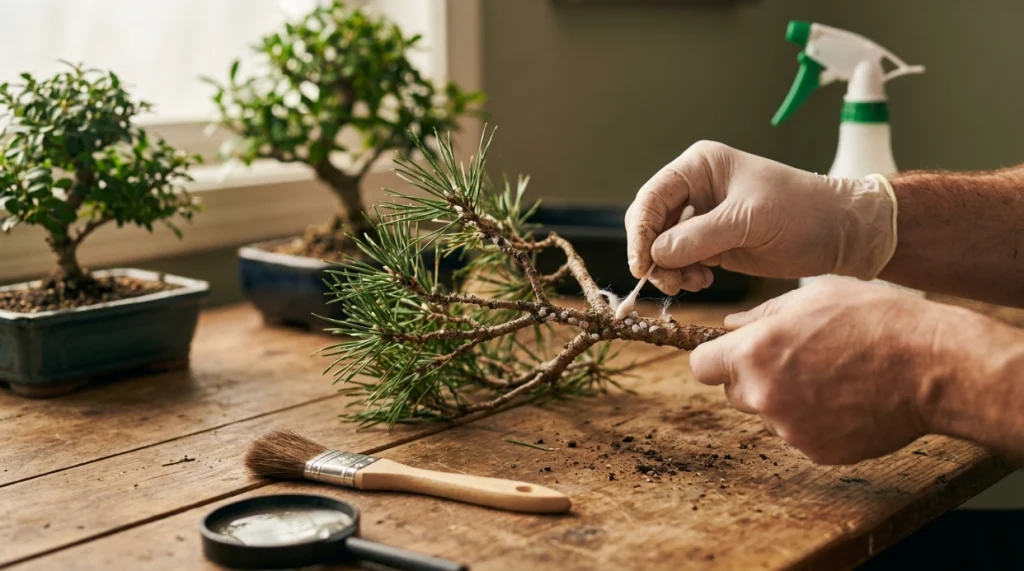
Treat white scale with a combination of isolation, manual reduction, monitoring, and targeted spraying when necessary. Avoid reaching immediately for the strongest pesticide available.
The protective shell on mature armored scale makes timing important. Young crawlers are usually much easier to contact with treatment.
Step 1: Isolate the bonsai
Move the affected tree away from healthy bonsai and houseplants. Keep branches from touching nearby plants while you inspect and treat it.
Step 2: Inspect the entire tree
Check the foliage, twigs, branch forks, trunk, and protected interior growth. Use magnification when the scale is too small to examine clearly.
Step 3: Remove reachable scale manually
For a small infestation, gently remove visible scales with a damp cotton swab or soft-bristled brush. Work carefully so you do not scrape tender bark or damage needles.
- Support thin branches while cleaning them.
- Work from the outer foliage toward the trunk.
- Dispose of removed insects and heavily infested debris.
- Clean tools before using them on another plant.
Step 4: Look for crawler activity
Crawlers are the mobile young stage of scale insects. They move before settling and producing the protective structures that make older scales harder to control.
You can inspect suspicious growth with a hand lens. Another simple method is placing light-colored material beneath a branch while examining or gently tapping the foliage.
Step 5: Apply a suitable treatment when needed
For infestations that cannot be controlled manually, use horticultural oil or insecticidal soap specifically labeled for the plant and pest. Thorough coverage matters because these products work mainly through direct contact.
Follow the label exactly for dilution, temperature, frequency, and species restrictions. Test a small part of the bonsai before treating the entire canopy.
Step 6: Recheck instead of assuming the problem is gone
Dead armored scale may remain attached after treatment. Do not judge treatment success only by whether the white shells disappear.
- Look for new crawlers.
- Watch for fresh white coverings.
- Check new foliage for discoloration.
- Inspect nearby plants for emerging colonies.
- Repeat treatment only as the product label permits.
Section Takeaway: Reduce the established population first, then focus treatment on vulnerable young scale. Monitoring after treatment is just as important as the first application.
When Should You Use Horticultural Oil or Insecticidal Soap?
Horticultural oil and insecticidal soap are most useful when they can contact vulnerable scale stages directly. Timing and complete coverage often matter more than applying a stronger product.
University extension guidance commonly recommends targeting crawler activity. Dormant-season oil may also help against overwintering stages on appropriate plants when the product label permits it.
Horticultural oil
Horticultural oil coats exposed insects and can control many scale species when applied correctly. It needs to reach the affected foliage, twigs, and other surfaces where scale is feeding.
- Best target: Crawlers and young nymphs without strong protective coverings.
- Coverage: Treat affected surfaces thoroughly according to the label.
- Plant condition: Avoid spraying a drought-stressed or otherwise severely weakened tree unless the label and expert guidance support treatment.
- Weather: Follow label restrictions for heat, freezing temperatures, rain, and humidity.
- Species sensitivity: Some conifers can react poorly or lose desirable waxy coloration after oil treatment.
Insecticidal soap
Insecticidal soap also depends on direct contact. It is generally more useful against exposed young stages than against mature armored scale protected beneath a waxy shell.
Do not substitute household dishwashing liquid for a labeled insecticidal soap. Household detergents vary in formulation and can injure plant tissue.
Be careful with blue or waxy conifers
Extra caution is appropriate with blue-foliaged junipers, spruces, cypresses, and similar plants. Oil can alter the natural surface wax responsible for their blue or glaucous appearance.
If the tree is valuable or you cannot identify the scale, get species-specific advice before spraying. The same treatment is not equally suitable for every bonsai.
What about stronger systemic insecticides?
I would not make a systemic pesticide the automatic first response to white scale. Some systemic products work poorly against certain armored scales, and pesticide choice also depends on host species and local regulations.
The University of Minnesota’s scale insect management guidance shows how treatment recommendations vary by scale species and life cycle.
If manual removal and carefully timed low-impact treatments fail, contact a local extension service or qualified pest-management professional. That is especially sensible for rare or high-value bonsai.
Section Takeaway: Horticultural oil and insecticidal soap work best with correct timing and direct coverage. Never assume a treatment is safe for every bonsai species.
How Do You Keep White Scale From Returning?
Preventing another infestation starts with inspection rather than routine pesticide use. Catching a few insects early is easier than treating a colony spread throughout a developed canopy.
Quarantine new plants
Keep new bonsai, nursery stock, and companion plants separated from your established collection while you inspect them. Check again over time because small scale colonies can initially be difficult to see.
Inspect your bonsai regularly
I prefer a repeatable inspection pattern instead of random checking. Start with outer foliage, move into branch junctions, then examine the trunk and shaded interior growth.
- Check both sides of leaves.
- Inspect conifer needles closely.
- Look around buds and branch forks.
- Watch for pale or declining growth.
- Use magnification on suspicious white marks.
Keep the tree appropriately vigorous
Healthy care does not make a bonsai immune to scale. It can, however, help the tree tolerate limited feeding damage while you address the infestation.
- Water according to the species and substrate rather than a fixed calendar.
- Give the bonsai suitable light for its species.
- Maintain airflow around the canopy.
- Avoid unnecessary crowding between trees.
- Correct root, watering, or heat stress instead of treating every symptom as a pest problem.
Protect beneficial insects outdoors
Lady beetles, lacewings, parasitoid wasps, and other natural enemies can suppress some scale populations. Broad-spectrum pesticide use may remove these beneficial insects along with the target pest.
As of 2026, an integrated pest management approach remains the practical choice: identify the pest, monitor it, use the least disruptive effective control, and evaluate the result.
Section Takeaway: Quarantine, close inspection, appropriate care, and early action are your best defenses against recurring white scale.
Frequently Asked Questions
Can white scale kill a bonsai tree?
Yes, a severe or persistent infestation can contribute to foliage loss, weak growth, twig decline, and branch dieback. The risk increases when a bonsai is already stressed by drought, damaged roots, poor light, or another health problem.
What are the tiny white dots on my juniper bonsai?
They may be armored scale, including juniper scale or another conifer scale, but white dots alone are not enough for identification. Inspect whether they form attached waxy coverings and look for yellowing foliage, crawlers, or living insects beneath the covers.
Does white scale produce sticky leaves?
Armored scales generally do not produce honeydew. Sticky foliage points more strongly toward soft scale, aphids, mealybugs, or whiteflies, although you should still inspect the actual insects before diagnosing the problem.
Can I scrape scale off a bonsai?
You can gently remove accessible scale from sturdy foliage or bark with a damp cotton swab or soft brush. Avoid aggressive scraping because thin bark, tender shoots, needles, and buds can be damaged easily.
Why is white scale still attached after treatment?
Dead armored scale can remain attached beneath its protective covering. Check for new crawlers and fresh scale development instead of assuming every remaining shell contains a living insect.
How often should I spray a bonsai for scale?
There is no universal spray interval because products, host species, scale species, and crawler periods differ. Follow the pesticide label exactly and monitor the bonsai between permitted applications rather than spraying on an arbitrary schedule.
Should I repot a bonsai because it has scale?
Usually not. Scale primarily attacks above-ground plant tissue, so unnecessary repotting can add root stress without solving the infestation.
Pro tip: If pest damage has already weakened the bonsai, avoid combining treatment with major pruning, root work, or other irreversible procedures unless necessary. Ask an experienced grower or local bonsai club for help when the tree is valuable or severely stressed.
White scale on bonsai is manageable when you catch it early and identify it correctly. Focus on careful inspection, controlled removal, crawler monitoring, and label-directed treatment instead of repeatedly spraying an unidentified problem.
Keep watching the tree after the visible infestation declines. A few minutes of regular inspection can stop the next generation before it becomes another established colony.