
How to Prevent Scale on Bonsai Trees

Quick Answer
To prevent scale on bonsai trees, inspect foliage and branches regularly, quarantine new plants, keep trees healthy, and avoid moving pests between trees. Pay special attention to young scale insects called crawlers, because they are easier to detect and manage before protective coverings develop. The University of California scale insect guide explains why monitoring and good plant care are central to prevention.
Scale Prevention Checklist
- Inspect weekly: Check leaves, needles, twigs, branch joints, and sheltered bark areas during active growth.
- Quarantine newcomers: Keep newly purchased or recently returned plants separate before placing them beside established bonsai.
- Check undersides: Scale and other pests often hide beneath leaves and in protected crevices.
- Reduce tree stress: Give each species suitable light, watering, drainage, and nutrition.
- Control spread: Clean tools and avoid brushing infested foliage against healthy trees.
- Watch for crawlers: Tiny mobile young scale insects are an important early-warning sign.
Best Habit to Start Today
- Use watering time as inspection time, so pest checks become part of your normal bonsai routine.
Scale prevention is much easier than removing a mature infestation from a finely branched bonsai. I’ve found that a short inspection routine catches more problems than waiting for yellow leaves or sticky foliage.
This guide focuses on stopping scale insects before populations build. It also explains quarantine, crawler monitoring, tree health, and the first steps to take when scale appears.
In This Guide
Why Do Scale Problems Start on Bonsai Trees?
Scale problems usually begin when insects arrive on new plant material or spread from another infested plant. A bonsai can look clean while tiny crawlers or hidden settled insects remain beneath leaves and inside branch junctions.
Definition: Scale insects are sap-feeding insects whose settled stages often develop waxy, leathery, or shell-like coverings while attached to plant tissue.
Two broad groups matter to bonsai growers:
- Soft scales: These often produce sticky honeydew while feeding.
- Armored scales: These develop protective coverings and normally do not produce honeydew.
- Crawlers: These are newly hatched, mobile young scale insects that move before settling.
The crawler stage matters most for prevention. Mature scale can remain difficult to notice because it resembles bark texture, buds, or small scars.
The Bonsai Empire pest and disease guide lists scale among pests growers may encounter on bonsai. Correct identification is important because not every brown or white bump is an insect.
Where does scale usually hide?
Don’t limit an inspection to the top of the canopy. Scale often occupies sheltered places that receive little disturbance.
- Leaf undersides
- Main leaf veins
- Needle bases
- Young twigs
- Branch crotches
- Rough bark crevices
- Protected trunk areas
- Interior branches within dense foliage
Soft scale may also reveal itself through honeydew. That sugary material can leave leaves, pots, shelves, or benches sticky.
Black sooty mold may then grow on the honeydew. Armored scale usually lacks this clue, so absence of sticky residue does not prove the tree is clean.
Section Takeaway: Prevention starts with understanding where scale comes from and where it hides. Catching crawlers or small colonies early is much easier than dealing with protected adults.
How Do You Inspect a Bonsai for Scale?
A consistent inspection routine is one of the strongest ways to prevent serious scale infestations. Check the entire bonsai rather than examining only damaged leaves.
I like to inspect from the outer shoots toward the trunk. That pattern makes it harder to overlook sheltered interior branches.
Use a simple inspection sequence
- Start with new growth. Look for distorted, pale, or unusually weak shoots.
- Check both leaf surfaces. Pay close attention to veins and petioles.
- Follow each twig inward. Look for fixed brown, gray, tan, cream, or white bumps.
- Inspect branch junctions. These protected spaces can hide small colonies.
- Check the trunk and bark. Compare suspicious bumps with normal bark texture.
- Look beneath the canopy. Sticky surfaces may indicate honeydew-producing pests.
A 10× hand lens can make this job easier. Clemson Cooperative Extension recommends magnification when checking plants for small pests during isolation.
Their houseplant pest prevention guidance also recommends paying special attention to leaf undersides and inspecting isolated plants regularly.
How often should you check?
During active growth, a weekly check is a useful routine when scale is a concern. The University of Minnesota recommends checking for scale crawlers at least weekly when monitoring their emergence.
You can combine that inspection with watering. A few focused minutes per tree is more useful than an occasional rushed look across the whole collection.
| Prevention Task | Useful Timing | What You Are Looking For |
|---|---|---|
| Full foliage inspection | About weekly when risk is high | Fixed bumps, crawlers, yellowing, honeydew |
| New-tree inspection | Before joining the collection | Hidden insects, eggs, damaged foliage |
| Crawler monitoring | During suspected hatch periods | Tiny mobile yellowish or reddish insects |
| Branch and bark check | During routine care | Settled scale hidden in bark or branch junctions |
The University of Minnesota scale guide suggests shaking infested branches over white paper or using double-sided tape to detect crawlers. Those methods are especially useful when adults have already been found.
How Does Quarantine Prevent Scale?
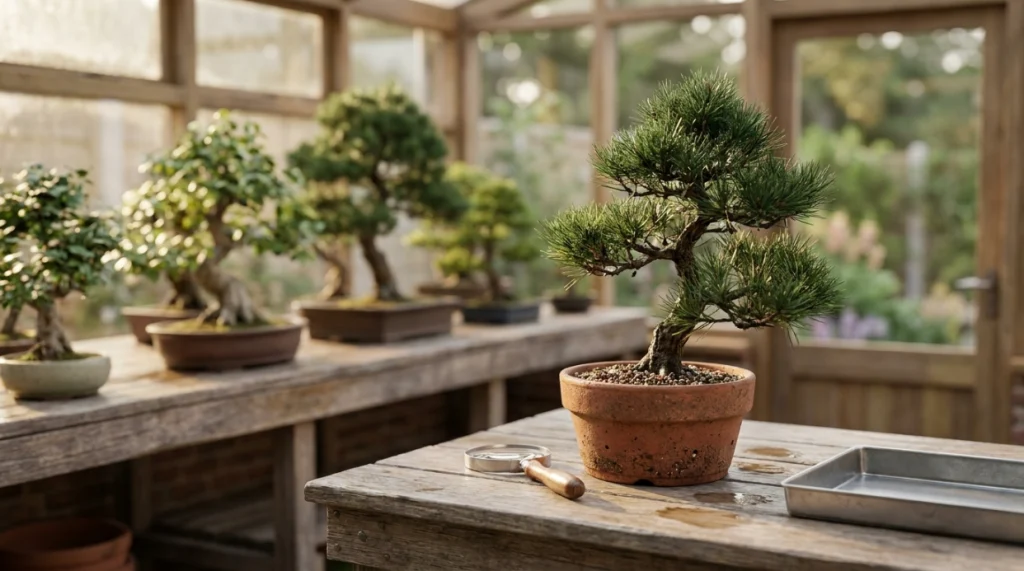
Quarantine prevents a hidden pest on one tree from immediately reaching the rest of your collection. This is especially important with newly purchased bonsai, nursery stock, houseplants, or trees that have spent time elsewhere.
Never assume a healthy-looking canopy means a plant is pest-free. Tiny scale stages can remain difficult to see until their numbers increase.
Quarantine new plants before mixing them
Clemson Cooperative Extension recommends isolating new houseplants for six weeks. That is a conservative approach that can also be useful for tropical bonsai kept indoors with other plants.
During isolation, inspect the tree regularly rather than simply leaving it alone.
- Keep it physically separated from established trees.
- Inspect leaves, twigs, trunk, and pot edges.
- Use bright light and magnification where needed.
- Look for crawlers as well as mature insects.
- Watch for sticky honeydew or black sooty mold.
- Check neighboring surfaces for signs of pests.
Outdoor bonsai deserve the same caution. A nursery tree can carry scale even if it has been grown outside its entire life.
Inspect trees before moving them indoors
Tropical bonsai often spend warm months outside before returning indoors. Inspecting them before that move reduces the chance of bringing scale into a protected indoor growing area.
Check the pot as well as the tree. Leaves and insects from neighboring plants can collect around rims, feet, and drainage areas.
Section Takeaway: A separate observation period creates time to find hidden scale before it reaches valuable trees. Inspect throughout quarantine instead of relying on a single first-day check.
Does Good Bonsai Care Help Prevent Scale?
Good bonsai care cannot guarantee that scale will never arrive. It can, however, reduce stress and help the tree tolerate small pest populations while you detect them.
The University of California recommends appropriate irrigation and good growing conditions as part of scale management. Bonsai growers should adapt that principle to each species.
Match care to the species
A juniper, ficus, Japanese maple, pine, and Chinese elm do not need identical growing conditions. Light, watering, dormancy, and temperature requirements differ.
Focus on these basics:
- Light: Give the species the amount and type of light it needs.
- Water: Water according to soil moisture and species needs rather than a fixed calendar.
- Drainage: Use a bonsai substrate that allows water and air to move through the root zone.
- Fertilizer: Feed according to the species, season, and stage of development.
- Air movement: Avoid overcrowding trees so badly that inspection and airflow become difficult.
- Seasonal care: Respect dormancy requirements for temperate species.
Overfertilizing is not a pest-prevention strategy. The goal is balanced growth, not forcing soft growth with excessive feeding.
I prefer to leave enough space between trees that I can see into each canopy. That small habit improves both airflow and pest inspection.
Avoid unnecessary broad-spectrum spraying
Preventive pesticide spraying without identifying a pest can create new problems. Broad-spectrum products may also harm predators and parasites that naturally suppress scale outdoors.
University of California guidance emphasizes protecting beneficial insects and using less disruptive controls when treatment becomes necessary. That approach fits bonsai well because each tree can usually be inspected closely.
How Do You Stop Scale From Spreading?
Once scale reaches one bonsai, prevention shifts from keeping it out to containing it. Separation and careful handling become the priorities.
Move a suspicious tree away from healthy bonsai as soon as you confirm or strongly suspect an infestation.
Keep infested foliage away from healthy trees
Crawlers can move before settling. Avoid pushing branches from an affected tree through the canopy of neighboring bonsai.
Use separate work space where practical. Clean up removed insects and infested plant debris instead of leaving them around your benches.
Clean tools between problem trees
Scale is not mainly spread by pruning tools, but clean tools are still sound bonsai hygiene. Remove plant debris and clean tools before moving from an infested tree to a healthy one.
If pruning infested branches is necessary, avoid removing important live structure simply to make treatment easier.
Pro tip: Pruning live bonsai branches is irreversible. If removing an infested branch would alter the design or health of the tree, ask an experienced grower or local bonsai club before cutting.
Watch ant activity around soft scale
Ants often feed on the honeydew produced by soft scales. Some ants also interfere with natural predators and parasites that would otherwise attack honeydew-producing insects.
University of California scale guidance recommends managing scale-tending ants where they interfere with natural enemies. On outdoor bonsai benches, repeated ant activity is worth investigating rather than ignoring.
- Check for honeydew-producing pests.
- Inspect branches visited repeatedly by ants.
- Remove food and debris around benches.
- Avoid harming beneficial insects unnecessarily.
Section Takeaway: Isolate affected trees, handle them separately, and investigate ant activity. Simple containment can keep a small problem from becoming a collection-wide infestation.
What Should You Do When Scale First Appears?
Finding a few scale insects does not mean prevention has failed completely. Catching a colony while it is small is exactly what regular monitoring is meant to accomplish.
Start by confirming the insect before reaching for a spray.
- Isolate the bonsai. Move it away from healthy plants.
- Confirm scale. Look for attached insects and crawler activity.
- Inspect the whole tree. The visible colony may not be the only one.
- Remove accessible scale carefully. Small infestations can often be reduced manually.
- Monitor for crawlers. Young moving stages are usually more vulnerable than protected adults.
- Choose treatment only if needed. Use a product labeled for the plant and pest.
- Recheck repeatedly. One cleanup does not prove the infestation is gone.
Why are crawlers important?
Mature scale insects gain protection from waxy or armored coverings. Newly hatched crawlers have not yet developed the same protection.
That makes crawler timing important when a treatment is required. University extension guidance commonly recommends targeting this exposed stage.
Can horticultural oil or insecticidal soap help?
Horticultural oils and insecticidal soaps can help manage many scale crawlers when the product is labeled for the plant and applied correctly. Coverage and timing matter because these treatments depend heavily on contact.
Never assume every bonsai species will tolerate every spray under every condition. Read the complete product label and test cautiously when plant sensitivity is uncertain.
Oil treatments can also have species and seasonal limitations. Avoid copying a treatment schedule from another bonsai without confirming that it suits your tree and the scale involved.
Repeated monitoring remains essential after treatment. Dead scale covers may stay attached, while overlooked insects can continue the infestation.
Frequently Asked Questions
What is the best way to prevent scale on bonsai?
The best prevention is a combination of regular inspection, quarantine, correct bonsai care, and fast isolation of suspicious trees. Check leaf undersides, twigs, branch junctions, and bark rather than waiting for obvious leaf damage.
How often should I inspect my bonsai for scale?
A weekly inspection is sensible during active growth or when scale risk is high. Increase attention after introducing new plants or when crawlers have been detected on a nearby tree.
Can scale spread from one bonsai to another?
Yes. Newly hatched scale insects, called crawlers, are mobile and can move before settling. Keeping infested trees separated from healthy bonsai reduces opportunities for the pest to spread through a collection.
Does sticky foliage always mean scale?
No. Soft scale can produce sticky honeydew, but aphids, mealybugs, and whiteflies can produce it too. Armored scale generally does not produce honeydew, so identification should include the insects themselves.
Should I spray bonsai preventively for scale?
Routine pesticide spraying without finding a pest is usually unnecessary. Regular monitoring, correct identification, good plant care, and preservation of beneficial insects are better foundations for scale prevention.
Can scale survive on a bonsai after I remove visible insects?
Yes. Small crawlers or hidden scale can remain in leaf axils, branch joints, bark crevices, and interior foliage. Continue inspecting the isolated tree after visible adults have been removed.
Which bonsai trees can get scale?
Many woody and tropical plants can host one or more scale species, so both indoor and outdoor bonsai can be affected. Host preference varies by scale species, making accurate identification useful when infestations persist.
Final takeaway: The easiest scale infestation to manage is the one you catch before it becomes obvious. Build inspection into watering, quarantine incoming trees, maintain species-appropriate care, and act quickly when you find crawlers or suspicious colonies.
If you care for several bonsai, make that routine consistent across the whole collection. Five careful minutes now can save much more work later.