
White Cottony Bugs on Bonsai: What Are They?

Quick Answer
White cottony bugs on bonsai are most often mealybugs, small sap-feeding insects covered in white wax. They usually collect around leaf joints, branch crotches, tender shoots, and hidden bark crevices. Isolate the tree first, then compare what you see with UC IPM’s mealybug identification guidance before treating it.
Signs that point to mealybugs
- Cotton-like coating: White wax covers the oval insects and their egg masses.
- Hidden clusters: Look inside branch forks, leaf axils, bark cracks, and around the trunk base.
- Sticky leaves: Mealybugs produce honeydew, which can coat foliage and attract ants.
- Black residue: Sooty mold may grow on accumulated honeydew.
- Weak growth: Heavy feeding can cause yellowing, distorted shoots, leaf drop, and slower growth.
What to do first
- Move the bonsai away from other plants and inspect it closely before reaching for a pesticide.
White fluff on a bonsai looks alarming, especially when it appears almost overnight. When I troubleshoot this symptom, I first determine whether the material is an insect, an egg mass, or something harmless.
That distinction matters. Mealybugs are the leading suspect, but scale insects, woolly aphids, and non-insect residues can look similar from a distance.
In This Guide
- What are the white cottony bugs on my bonsai?
- How can I tell mealybugs from scale, aphids, or mold?
- Where should I check a bonsai for mealybugs?
- How do I get rid of white cottony bugs on bonsai?
- Why did mealybugs appear on my bonsai?
- When is a mealybug infestation serious?
- FAQ about white cottony bugs on bonsai
What are the white cottony bugs on my bonsai?
In most cases, white cottony bugs on bonsai are mealybugs. These small insects feed by inserting their mouthparts into plant tissue and taking sap.
Their white appearance comes from a waxy protective coating. Colonies can resemble tiny pieces of cotton stuck to leaves or bark.
- Adults: Usually oval, soft-bodied, and covered with white or grayish wax.
- Young mealybugs: Smaller and more mobile before developing a heavy wax coating.
- Egg masses: Often appear as fluffy white material in protected areas.
- Honeydew: A sticky sugary waste product that may coat leaves and branches.
Mealybug infestation means a population of these sap-feeding insects has established itself on the tree. A few visible insects can indicate more are hiding elsewhere.
Bonsai Empire’s pest and disease overview includes mealybugs among the common insects found on bonsai. Scale, aphids, spider mites, and whiteflies can also occur.
Grower note: Don’t diagnose the problem from color alone. I look for body shape, stickiness, location, and whether the white material hides a living insect.
A light infestation won’t always produce obvious leaf damage. As numbers rise, you may see weak shoots, yellow foliage, distorted growth, or premature leaf drop.
Ants are another useful clue. They often visit plants where honeydew-producing insects are feeding.
How can I tell mealybugs from scale, aphids, or mold?
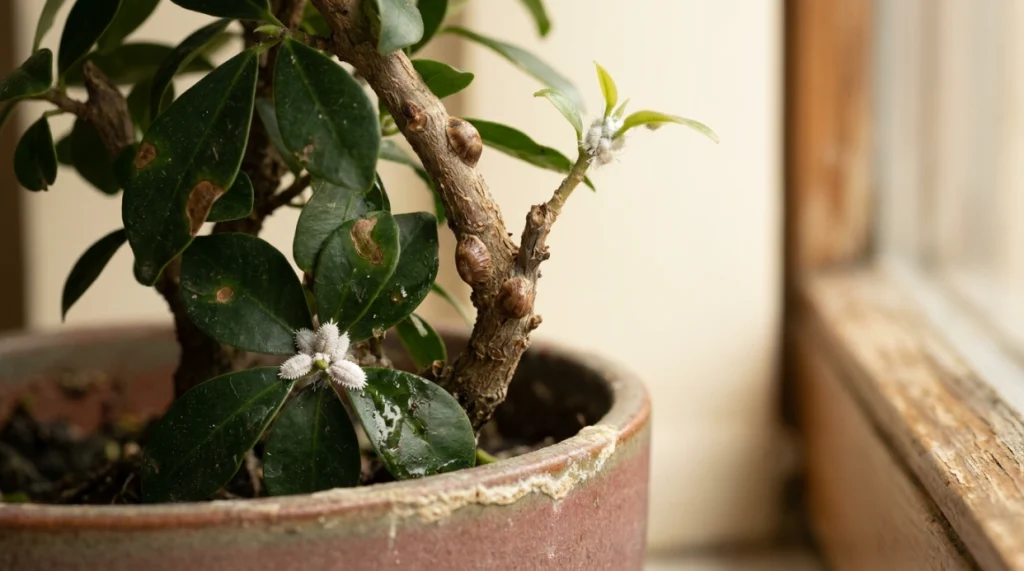
Mealybugs look soft and fuzzy, while many scale insects look like firm bumps attached to the plant. A hand lens can make the difference much easier to see.
The table below covers the most common look-alikes I would check before treatment.
| Possible cause | Typical appearance | Where you may find it | Useful clue |
|---|---|---|---|
| Mealybugs | White, fuzzy, oval insects or cottony masses | Leaf axils, shoots, branch forks, bark crevices | Sticky honeydew may be present |
| Cottony or soft scale | Attached bumps, sometimes with white wax or egg material | Woody stems, branches, leaf veins | Adults often remain firmly attached |
| Woolly aphids | Small insects covered with waxy filaments | Tender stems and growing points | Clusters may reveal aphid-shaped bodies |
| Fungal or mineral residue | Powder, crust, or irregular surface coating | Leaves, soil surface, pot, or trunk | No insect body or movement underneath |
Iowa State University’s pest diagnostic guide describes mealybug colonies as cottony masses, particularly around protected plant tissue.
Spider mites usually produce fine webbing and leaf stippling instead. Their damage can look dusty, but the insects themselves don’t resemble cotton tufts.
Where should I check a bonsai for mealybugs?
Start with protected areas rather than the most visible leaves. Mealybugs often settle where sprays, rain, and fingers rarely reach.
- Leaf axils: Inspect where each leaf or petiole joins the stem.
- Branch crotches: Check tight forks and congested branch junctions.
- New shoots: Examine tender growing tips and small unfolding leaves.
- Bark crevices: Look around rough bark, scars, and protected trunk areas.
- Trunk base: Check where the trunk meets the soil surface.
- Pot edges: Inspect rims, drainage areas, benches, and nearby plant containers.
Turn leaves over as you work. Bright indirect light and a small magnifying lens make young insects easier to spot.
Important: Inspect nearby plants too. Isolating one visibly affected bonsai won’t help if another plant already carries a hidden colony.
Some mealybugs can also infest roots. Suspect this when white waxy material repeatedly appears around the soil line or drainage holes despite cleaning the canopy.
Don’t immediately bare-root a healthy bonsai just to investigate. Root disturbance at the wrong time can create a second problem.
Pro tip: If root mealybugs are suspected, get species-specific advice before repotting or cutting roots. A local bonsai club or experienced grower can help you choose the safest timing.
How do I get rid of white cottony bugs on bonsai?
Successful mealybug control usually takes repeated inspection rather than one heavy treatment. Start with the least disruptive method that matches the infestation.
As of 2026, extension guidance still emphasizes isolation, physical removal, careful monitoring, and properly labeled products. That’s a sensible approach for bonsai too.
1. Isolate the bonsai
Move the affected tree away from your other plants. Avoid letting foliage or branches touch neighboring pots during treatment.
Wash your hands and clean tools after handling the infestation. Also inspect the bench or windowsill for insects.
2. Remove visible colonies
For a small infestation, physically remove as many insects as possible. This immediately lowers the population and makes follow-up treatment easier.
- Use a gentle stream of water when the species and soil setup allow it.
- Wipe reachable insects away with a cotton swab.
- Remove badly infested dead leaves or debris.
- Inspect again after cleaning for insects hidden beneath foliage.
UC IPM notes that small houseplant infestations may be treated by applying 70% or weaker isopropyl alcohol directly to individual mealybugs. Test a small plant area first and wait one or two days for damage.
I prefer spot treatment over soaking an entire bonsai with alcohol. Delicate foliage and tender bark can react badly to careless applications.
3. Use insecticidal soap or horticultural oil when appropriate
Larger infestations may need a pesticide labeled for the plant and pest. Insecticidal soaps and horticultural oils are common options for exposed mealybugs.
University of Maryland Extension’s mealybug guidance also stresses isolation, direct removal, labeled treatments, and repeat monitoring.
- Read the label: Confirm the product is suitable for your plant and intended growing location.
- Test first: Treat a small area before spraying the entire tree.
- Reach hiding places: Contact treatments only work where the spray reaches the pest.
- Follow intervals: Repeat treatment only at the label’s recommended timing.
- Avoid heat stress: Follow label warnings concerning sun, temperature, and sensitive foliage.
4. Keep checking after the tree looks clean
Adult insects aren’t the whole problem. Eggs and young crawlers can survive in protected areas and appear later.
Inspect the bonsai whenever you water it during the control period. Pay special attention to spots where you previously found colonies.
Avoid the kitchen-cabinet approach: Homemade mixtures can burn bonsai foliage. A product with clear plant and pest directions is easier to use safely.
Section Takeaway: Remove visible mealybugs, treat only with plant-appropriate methods, and keep monitoring. One spray rarely substitutes for careful follow-up.
Why did mealybugs appear on my bonsai?
Mealybugs don’t appear because you failed at bonsai care. They often arrive unnoticed on a new plant, cutting, container, or nearby ornamental.
Indoor trees can support populations for long periods because temperatures remain mild. Hidden branch joints also give insects protected feeding sites.
- New plants: A recently purchased tree can carry insects or egg masses.
- Nearby infestations: Crawlers can spread among closely grouped plants.
- Protected growth: Dense foliage creates more places to remain unnoticed.
- Excess nitrogen: Heavy fertilization encourages tender growth that can favor some sap-feeding pests.
- Missed inspections: A tiny colony can grow before visible damage develops.
Tree stress doesn’t magically create mealybugs. However, a stressed bonsai has fewer resources for recovering from persistent sap loss.
Prevention habit: I inspect new plants separately before placing them beside established bonsai. That small quarantine step can save an entire collection from a difficult cleanup.
Keep the tree in the light, watering, soil, and temperature conditions its species needs. Good culture supports recovery but doesn’t replace pest treatment.
When is a mealybug infestation serious?
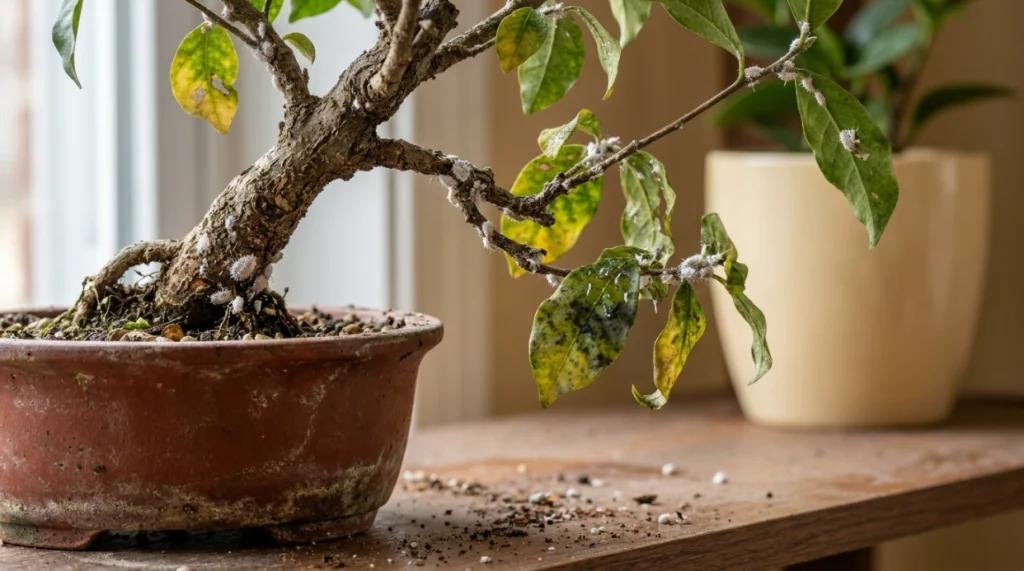
A few accessible insects are different from colonies covering several branches. The more widespread the infestation becomes, the harder complete control gets.
Look at both pest numbers and the tree’s condition. A weak bonsai deserves a more cautious treatment plan than a vigorous tree.
- Repeated colonies: White masses return soon after careful removal.
- Multiple plant areas: Bugs appear on leaves, branches, trunk, and soil-level tissue.
- Leaf decline: Foliage yellows, distorts, wilts, or drops.
- Sticky coverage: Honeydew coats a large part of the canopy.
- Sooty mold: Dark fungal growth develops on honeydew-covered surfaces.
- Nearby spread: Other plants begin showing similar insects.
Root involvement also deserves attention. Persistent populations below the soil surface can escape treatments aimed only at foliage.
A valuable or old bonsai is worth getting expert help with before using stronger insecticides or changing the root system. Species sensitivity and seasonal timing matter.
Decision point: If several careful treatment cycles fail, confirm the identification again. Treating the wrong pest repeatedly only adds stress to the tree.
FAQ about white cottony bugs on bonsai
Are white fuzzy bugs on bonsai always mealybugs?
No. Mealybugs are a common cause, but cottony scale and woolly aphids can look similar. Mineral deposits or fungal growth may also appear white, so confirm that you can see an insect body before choosing a treatment.
Will mealybugs kill a bonsai tree?
A small infestation usually doesn’t kill a healthy tree immediately. Heavy or persistent populations can weaken growth, cause yellowing and leaf loss, and increase stress, which matters more in a bonsai’s limited root environment.
Can I use rubbing alcohol on bonsai mealybugs?
Small infestations may sometimes be spot-treated with 70% or weaker isopropyl alcohol on a cotton swab. Test a small area first and wait for damage before continuing, because plant species differ in sensitivity.
Does neem oil kill mealybugs on bonsai?
Neem-based pesticide products may suppress exposed mealybugs when the product is labeled for the plant and pest. Coverage matters, and repeated treatment may be necessary. Never assume an oil is harmless to every bonsai species or under every temperature condition.
Should I repot a bonsai with mealybugs?
Don’t repot solely because you found mealybugs on the foliage. Repotting may become relevant when root mealybugs are confirmed, but root work should match the species, season, tree condition, and severity of the problem.
Why do mealybugs keep coming back after treatment?
Hidden insects, protected egg masses, or untreated neighboring plants can restart the infestation. Contact treatments may also miss pests inside branch crotches or other crevices, which is why inspection and repeat treatment according to the product label are important.
Should I isolate a bonsai with white cottony bugs?
Yes. Move a suspected infested bonsai away from other plants while you identify and treat the problem. Then inspect nearby plants, containers, shelves, and benches so an unnoticed second colony doesn’t reinfest the tree.
White cottony bugs on bonsai usually point to mealybugs, but identification comes first. Check the protected parts of the tree, isolate it, remove visible pests, and use only treatments appropriate for the species.
Keep inspecting after the white material disappears. Catching the next few insects early is far easier than dealing with another established colony.