
Brown Scale on Bonsai: Identification and Treatment

Quick Answer
Brown scale on bonsai usually appears as small brown, tan, or yellowish bumps attached to leaves or twigs. True brown soft scale, Coccus hesperidum, produces sticky honeydew, but other scale insects can also look brown, so confirm the type before treatment using reliable scale identification guidance.
Signs to check first
- Fixed brown bumps: Mature scale insects often stay attached to leaves, twigs, or bark.
- Sticky leaves: Soft scale produces honeydew that can coat foliage and nearby surfaces.
- Sooty mold: Black fungal growth may develop on sugary honeydew.
- Weak growth: Heavy infestations can contribute to yellowing, leaf drop, or declining shoots.
- Tiny crawlers: Newly hatched scale can move before settling and becoming difficult to see.
What to do
- Isolate the bonsai, remove reachable scale carefully, inspect nearby plants, and use a plant-labeled horticultural oil or insecticidal soap when appropriate.
Brown scale on bonsai is easy to overlook because the insects often resemble bark texture, scars, or tiny dried buds. The related problem, scale insects on bonsai, becomes easier to manage once you know whether you’re seeing soft scale, armored scale, or something else.
I use one rule with suspicious bumps: identify first and spray second. That approach protects the tree from unnecessary treatments and makes follow-up much more effective.
In This Guide
What Is Brown Scale on Bonsai?
Brown scale on bonsai describes scale insects that appear brown or tan while feeding on the tree. In some cases, the pest is specifically brown soft scale, scientifically known as Coccus hesperidum.
Definition: Scale insects are sap-feeding insects whose settled stages often remain attached to plant tissue beneath a waxy, shell-like, or body-derived covering.
Adults may look more like bumps than insects. You may not see obvious legs, antennae, or a recognizable head.
What does true brown soft scale look like?
Mature female brown soft scale is oval and slightly convex. Color can range from yellowish brown to light or dark brown.
Adults are roughly 1/10 to 1/6 inch long. You can find them on leaves and twigs, particularly on broadleaved plants.
- Shape: Oval rather than sharply pointed.
- Profile: Slightly raised or dome-like.
- Color: Yellow-brown, tan, or darker brown.
- Feeding site: Leaves, leaf stems, and young twigs.
- Residue: Sticky honeydew is an important clue.
As of 2026, UC IPM identifies brown soft scale as Coccus hesperidum and notes that several different-sized life stages can occur together. That mixed size pattern can help distinguish an active colony from uniform bark markings.
Section Takeaway: Brown color alone doesn’t identify the species. Honeydew, shape, attachment, location, and life stages provide stronger clues.
How Can You Identify Brown Scale on a Bonsai?
Start by inspecting the entire bonsai under bright light. Rotate the tree because scale can hide behind branches, leaf petioles, and tight junctions.
A 10× hand lens is useful on small-leaved species. It also helps when natural bark texture makes the insects difficult to separate from the tree.
Look for repeated attached bumps
Natural bark marks usually vary in shape and placement. Scale colonies often contain multiple similar bumps clustered along feeding areas.
- Check both sides of leaves.
- Inspect branch forks and leaf stems.
- Look along young shoots.
- Compare affected areas with clean branches.
- Examine nearby bonsai and houseplants.
Check for sticky honeydew
Soft scale feeds on phloem sap and releases sugary honeydew. Leaves may feel sticky before you notice the insects themselves.
Honeydew may also attract ants. Black sooty mold can then grow on the sugary coating.
Look for crawlers
The crawler is the young mobile stage of a scale insect. Crawlers have legs and move before settling on plant tissue.
They are much smaller than mature females. Their vulnerable stage is also important because contact treatments generally work better before a heavy protective covering develops.
Don’t confuse brown scale with armored scale
Armored scale can also appear brown, gray, or tan. However, armored scales normally do not produce honeydew.
The protective cover of an armored scale may separate from the insect underneath. Soft scale has a body covering that does not separate in the same way.
For broader bonsai-specific pest identification, the Bonsai Empire pests and diseases guide shows scale alongside other common bonsai pests.
Section Takeaway: A brown bump becomes more suspicious when you see repeated colonies, honeydew, sooty mold, or tiny crawlers nearby.
What Damage Does Brown Scale Cause?
Scale insects feed by drawing plant fluids from leaves or stems. The effect depends on the scale species, population, host tree, and overall condition of the bonsai.
A healthy tree may tolerate a small population. A stressed bonsai has less room for another problem.
Common signs of a heavier infestation
- Yellow foliage: Feeding and general stress can reduce normal leaf color.
- Weak shoots: New growth may appear less vigorous.
- Premature leaf drop: Severe or prolonged pest pressure can contribute to foliage loss.
- Sticky surfaces: Honeydew can coat leaves, pots, shelves, and benches.
- Sooty mold: Black fungal growth may cover honeydew-coated surfaces.
- Twig decline: Certain damaging scale infestations can contribute to dieback.
True brown soft scale is often more troublesome because of its honeydew than because of severe direct plant damage. Other scale species can be more damaging, which is another reason accurate identification matters.
Don’t assume every yellow leaf comes from scale. Watering problems, insufficient light, root stress, and seasonal changes can produce similar symptoms.
Section Takeaway: Judge the insects and the tree together. Visible scale plus honeydew or declining growth provides stronger evidence than yellow leaves alone.
How Do You Treat Brown Scale on Bonsai?
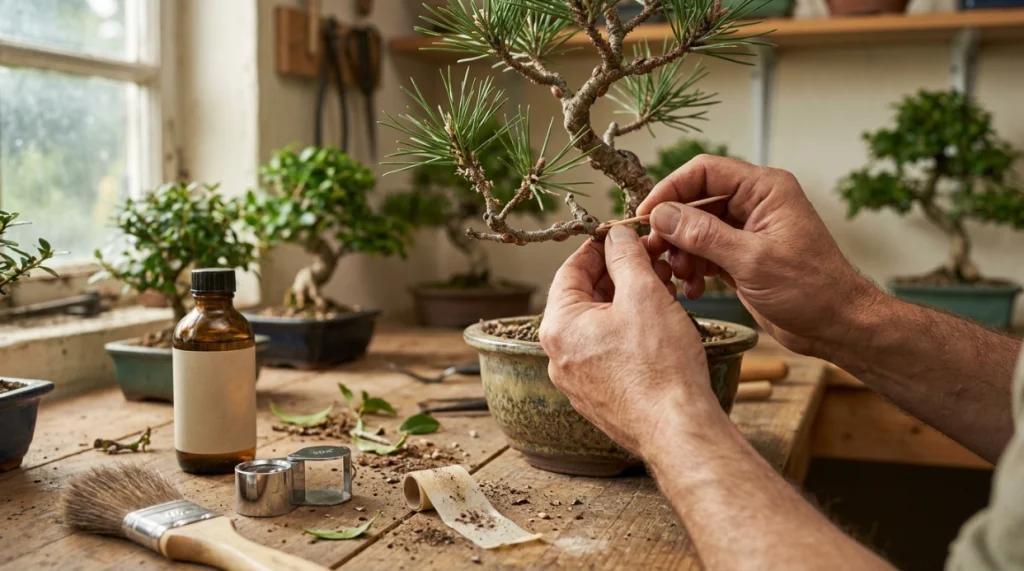
For a small bonsai, treatment should begin with isolation and physical removal. Then target insects you missed, especially young crawlers.
I prefer this staged approach because bonsai give you unusually good access to the canopy. You can inspect nearly every twig instead of immediately relying on a blanket spray.
Step 1: Isolate the bonsai
Move the affected tree away from your other bonsai and susceptible houseplants. Crawlers are mobile and can establish elsewhere.
Keep the tree in suitable light and growing conditions. Isolation should not mean placing an outdoor species indoors for weeks.
Step 2: Remove visible scale
For a light infestation, carefully dislodge reachable scale with a soft brush, wooden toothpick, or similar gentle tool. Work slowly around tender bark and buds.
You can also rinse loose crawlers from sturdy foliage with water. Avoid strong pressure that could damage fine branches or wash soil from the pot.
Step 3: Choose a plant-labeled treatment when needed
Horticultural oil can control many scale insects when it thoroughly contacts susceptible stages. Insecticidal soap may also help with exposed immature stages on plants listed on the product label.
- Read the label: Confirm your plant and intended use are allowed.
- Cover feeding areas: Pay attention to twigs and leaf undersides.
- Avoid stressed trees: Don’t treat a badly dehydrated bonsai.
- Protect from extremes: Follow label restrictions concerning heat and direct sun.
- Apply safely: Use pesticides outdoors when the label and conditions allow.
The University of Minnesota Extension scale guide emphasizes correct identification and treatment timing. That timing matters because crawlers are generally easier to contact than protected adults.
Step 4: Time treatment around crawlers
Scale management often improves when treatment reaches the crawler or young nymph stage. Mature insects can be harder to control because of their protective covering.
You can wrap a small piece of double-sided tape around an infested twig to watch for tiny moving crawlers. Check it regularly with a hand lens.
Step 5: Reinspect instead of assuming one treatment worked
Check the bonsai repeatedly after treatment. Look for new sticky residue, fresh scale, moving crawlers, and insects hidden at branch junctions.
Do not automatically repeat a pesticide on a calendar schedule. Follow the specific product label and base further treatment on continued pest activity.
Should you use systemic insecticides?
Systemic products are not a universal answer for scale. Some active ingredients can control certain soft scales while performing poorly against armored scale.
They may also harm beneficial insects or have restrictions that vary by location and plant use. For a small bonsai, correct identification and less disruptive methods often deserve attention first.
Section Takeaway: Remove what you can, target vulnerable stages, follow the product label, and keep monitoring. The protective adult stage makes repeated inspection especially important.
Brown Scale vs. Other Bonsai Pests: What’s the Difference?
The fastest way to avoid the wrong treatment is to compare several visible clues. Honeydew and body covering are especially useful when separating soft scale from armored scale.
| Feature | Brown Soft Scale | Armored Scale | Mealybugs | Aphids |
|---|---|---|---|---|
| Typical look | Oval, slightly convex, yellow-brown to dark brown | Flat or shell-like protective cover | White or cottony clusters | Recognizable soft-bodied insects |
| Size clue | Mature females about 1/10–1/6 inch | Many are under about 1/8 inch | Varies by species and life stage | Varies by species and life stage |
| Honeydew | Yes | Usually no | Often yes | Often yes |
| Movement | Adults mostly stationary; crawlers move | Settled stages stationary; crawlers move | Can move slowly | Adults and nymphs can move |
| Useful clue | Sticky foliage plus brown oval bumps | Hard cover without honeydew | Cottony wax in crevices | Clusters on tender new growth |
If identification is still uncertain, photograph the affected twig under strong light and magnification. Comparing several characteristics is more reliable than identifying a pest by color alone.
Section Takeaway: Sticky honeydew strongly points toward soft scale rather than armored scale, but always use several clues before choosing treatment.
How Do You Keep Brown Scale From Coming Back?
Prevention depends on catching small populations before they become established. Regular inspection takes only a few minutes on a compact bonsai.
- Inspect new trees: Check leaves, twigs, branch junctions, and the underside of foliage.
- Quarantine additions: Keep new or infested plants away from the main collection while monitoring them.
- Check weekly during problems: Look for fresh honeydew and new crawlers.
- Maintain proper watering: Healthy trees cope with pest pressure better than stressed ones.
- Provide suitable light: Match placement to the bonsai species rather than treating every tree as a houseplant.
- Watch ants: Ant activity around honeydew can interfere with natural enemies of soft scale.
- Avoid unnecessary broad-spectrum sprays: They can disrupt predators and parasitoids that naturally suppress scale.
The American Bonsai Society also provides educational resources and connections to bonsai clubs. A local club can be valuable when pest identification is uncertain on a rare or sensitive specimen.
I also like to inspect trees when watering rather than creating a separate chore. A quick look at several leaf undersides and branch forks can reveal a new colony early.
Section Takeaway: Frequent inspection is the strongest prevention habit. Catching a few insects is easier than treating an established colony.
Frequently Asked Questions
Can brown scale kill a bonsai tree?
A severe scale infestation can weaken a bonsai, especially when the tree is already stressed by poor watering, damaged roots, heat, or inadequate light. True brown soft scale often causes more honeydew and sooty mold than serious direct injury, but other scale species can be more damaging.
What is the sticky substance on my bonsai leaves?
Sticky foliage may be honeydew produced by soft scale, aphids, mealybugs, or whiteflies. If you also see fixed brown oval bumps on leaves or twigs, soft scale becomes a strong possibility, but inspect the tree closely before deciding.
Does neem oil kill scale on bonsai?
Some neem-based horticultural products are labeled for scale insects, particularly exposed immature stages. Effectiveness depends on coverage, timing, product formulation, and the scale species, so use only a product labeled for the plant and situation and follow its directions exactly.
Can I scrape scale insects off my bonsai?
Yes. Physical removal can work well for a small infestation because a bonsai’s branches are accessible. Use a soft brush, wooden toothpick, or another gentle tool and avoid damaging thin bark, buds, or tender shoots while removing attached insects.
Why does brown scale keep coming back?
Hidden adults, newly emerging crawlers, nearby infested plants, and incomplete treatment coverage can all produce another visible population. Reinspect branch junctions and leaf undersides, monitor for crawlers, and keep affected trees separated until you no longer find active insects.
Should I use horticultural oil on every bonsai with scale?
No. Plant sensitivity, season, temperature, species, and product formulation all matter. Horticultural oil is useful against many scale insects, but the label must permit use on the plant, and the tree should not be severely moisture-stressed when treated.
How can I tell if the scale insects are dead?
Dead scale may remain attached after treatment, so appearance alone can mislead you. Remove or lift a few specimens carefully and look for living tissue beneath them, then monitor the tree for fresh crawlers, new honeydew, or newly established bumps.
Final takeaway: Brown scale on bonsai is manageable when you identify it early, distinguish soft scale from armored scale, and target vulnerable stages instead of spraying blindly.
Inspect the tree closely over the next several weeks after treatment. Consistent monitoring is what turns a temporary cleanup into lasting control.