
Can Scale Insects Kill a Bonsai? Signs, Treatment, and Recovery

Quick Answer
Yes, scale insects can kill a bonsai when a heavy infestation continues long enough to weaken leaves, shoots, and branches. A few scales on a healthy tree are usually manageable, but yellowing, leaf drop, weak growth, or twig dieback means you should act quickly and follow reliable scale insect management guidance.
Signs the infestation may be serious
- Yellowing foliage: Persistent feeding may cause leaves or needles to lose healthy color.
- Weak new growth: New shoots may extend slowly or fail to develop normally.
- Leaf drop: Heavy feeding can contribute to premature foliage loss.
- Branch decline: Severe infestations may cause twig or branch dieback.
- Sticky residue: Soft scales often produce honeydew that coats leaves and branches.
- Black coating: Sooty mold may develop on honeydew from soft scale.
What to do first
- Isolate the bonsai, confirm that the bumps are scale insects, remove manageable colonies, and monitor for the vulnerable crawler stage.
Scale insects can look harmless because mature insects often resemble tiny bumps instead of moving pests. That disguise lets an infestation build before the bonsai shows obvious stress.
I treat scale as an identification problem first and a pesticide problem second. This guide explains when scale becomes dangerous, how to judge the damage, how to treat it, and how to help the tree recover.
In This Guide
- Can Scale Insects Really Kill a Bonsai?
- How Can You Tell if Scale Is Seriously Damaging Your Bonsai?
- How Do You Get Rid of Scale Insects on a Bonsai?
- How Do You Help a Bonsai Recover and Prevent Scale From Returning?
- Frequently Asked Questions About Scale Insects
- Final Takeaway: Act Before the Tree Becomes Weak
Can Scale Insects Really Kill a Bonsai?
Yes. A severe or persistent scale infestation can weaken a bonsai enough to cause foliage loss, branch dieback, and eventual death.
A small infestation is different. Healthy trees can often tolerate low pest numbers while you identify and control the problem.
Definition: A scale insect is a sap-feeding plant pest whose settled stages often stay attached to leaves, stems, twigs, or bark beneath a waxy, leathery, or shell-like covering.
Why scale feeding weakens a bonsai
Scale insects feed by inserting piercing-sucking mouthparts into plant tissue. Large populations continuously draw resources from the tree.
The resulting damage depends on the type of scale, the number of insects, and the bonsai’s existing health.
- Reduced vigor: The tree may produce shorter or weaker shoots.
- Yellow foliage: Leaves or needles may lose color as feeding pressure increases.
- Premature leaf drop: Stressed foliage may fall before it normally would.
- Twig dieback: Heavily infested branches can weaken and die.
- Canopy decline: Severe cases may affect entire sections of the tree.
The confined container doesn’t cause scale. However, a bonsai has less foliage and root volume than a full-sized landscape tree.
That means damage to several important branches can quickly affect both the tree’s health and its design.
Soft scale and armored scale are not identical
Growers commonly encounter two broad groups: soft scales and armored scales. Knowing the difference helps you interpret the symptoms.
- Soft scale: Often has a rounded or waxy body and commonly produces sugary honeydew.
- Armored scale: Develops a protective covering and usually doesn’t produce honeydew.
- Crawlers: Newly hatched scales are mobile before settling into a feeding position.
Sticky foliage isn’t therefore required for a scale diagnosis. An armored-scale infestation may cause substantial damage without producing the sticky residue associated with soft scale.
Bonsai-specific pest guidance also recognizes scale among the common insects growers should watch for. The Bonsai Empire pest and disease guide shows scale alongside aphids, mites, mealybugs, and other familiar bonsai pests.
When scale becomes dangerous
The most dangerous situation is prolonged feeding on an already stressed tree. Root problems, dehydration, recent major work, or inappropriate growing conditions can reduce the bonsai’s ability to recover.
- A vigorous established tree with several visible scales is usually lower risk.
- A weak bonsai with several infested branches deserves faster attention.
- A recently stressed tree with leaf loss and branch decline deserves especially careful treatment.
As of 2026, I still prefer an integrated approach rather than automatically using the strongest available pesticide. Correct identification, physical removal, crawler monitoring, and targeted products usually make more sense.
Section Takeaway: Scale insects can kill a bonsai, but risk depends on infestation size, duration, and tree health. A few insects are manageable; widespread feeding plus visible decline is a warning to act promptly.
How Can You Tell if Scale Is Seriously Damaging Your Bonsai?
Look at the whole tree instead of counting only the insects you can see. The strongest warning signs combine visible scale with declining foliage or branches.
What does scale look like?
Mature scales may appear as brown, gray, tan, cream, white, or waxy bumps. They often sit tightly against leaf veins, twigs, branches, or bark.
Use bright light and a 10× hand lens if available. Don’t assume every bump is a pest, because buds, bark texture, scars, dried sap, and mineral deposits can look similar.
- Inspect both sides of leaves.
- Follow leaf veins toward the petiole.
- Check branch junctions and protected crevices.
- Look along young twigs and older bark.
- Inspect the trunk and exposed surface roots.
- Search for tiny moving crawlers near adults.
Light infestation vs. dangerous infestation
| Infestation Level | What You May See | Risk to the Bonsai | Best Response |
|---|---|---|---|
| Light | Several scales on one small area | Usually low on a vigorous tree | Remove, inspect, and monitor |
| Moderate | Multiple branches affected, honeydew, yellowing | Increasing | Isolate and begin targeted control |
| Heavy | Dense colonies, leaf drop, weak shoots | High | Treat promptly and monitor closely |
| Severe decline | Twig dieback, major canopy loss, weak tree | Potentially critical | Control pests while minimizing additional stress |
Sticky leaves and black mold are important clues
Many soft scales produce honeydew, a sugary waste product. Leaves, pots, benches, or surfaces below the bonsai may become shiny and sticky.
Sooty mold can then grow on that honeydew. The dark coating is secondary, so controlling the scale addresses the underlying cause.
Ants repeatedly climbing the bonsai can provide another clue. Ants often visit honeydew-producing insects for the sugary material.
Yellow leaves alone do not confirm scale
Yellow foliage can also result from watering trouble, root problems, nutrient issues, seasonal change, or other pests. Find the insects or another strong diagnostic clue before treating.
This matters on bonsai because unnecessary pesticide use can add stress. Diagnosis should come first.
How Do You Get Rid of Scale Insects on a Bonsai?
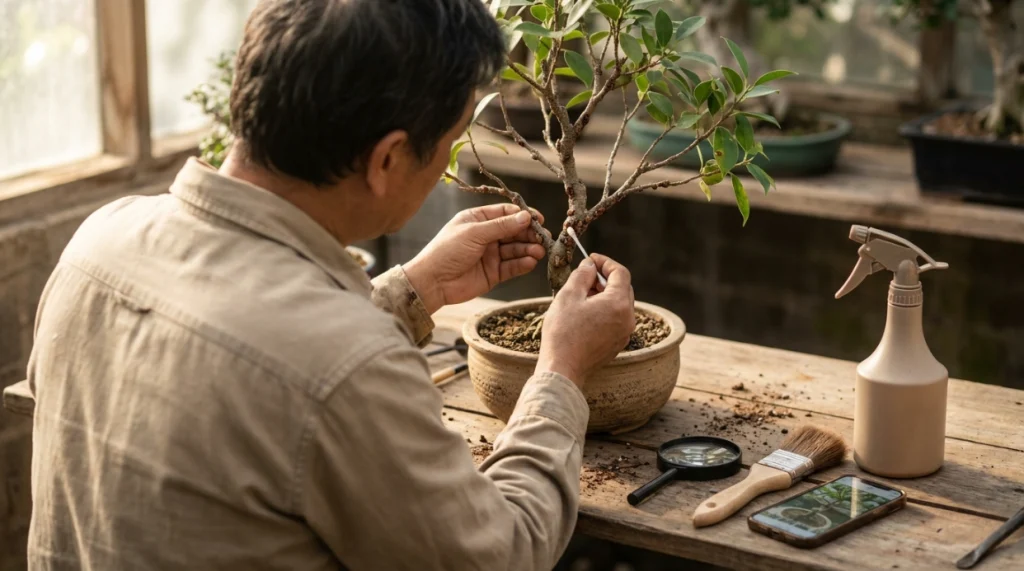
Start by isolating the tree, confirming the insect, and reducing the population manually. Then target remaining scale with an appropriate treatment while continuing to monitor for crawlers.
Step 1: Isolate the affected tree
Move the bonsai away from healthy plants while you investigate. Young scale crawlers can move before settling, so separation reduces opportunities for spread.
Keep the isolation area suitable for the species. Don’t move an outdoor temperate bonsai indoors or expose a tropical tree to damaging cold just to quarantine it.
Step 2: Photograph and inspect the infestation
Take close photographs before disturbing the insects. Comparing images later can help you judge whether your treatment is working.
- Photograph the worst affected branches.
- Inspect the entire canopy.
- Check the trunk and protected branch junctions.
- Look for scale on nearby plants.
- Record yellowing, leaf drop, or weak shoots.
Step 3: Remove visible scale where practical
Small colonies can often be reduced by carefully removing individual insects. A cotton swab or soft brush can work on suitable branches.
Use a gentle touch around buds, soft bark, and tender foliage. Removing the insect isn’t worth damaging living tissue underneath.
Pro tip: Avoid aggressive scraping or cutting into bark while removing scale. If valuable branches are heavily affected, ask an experienced grower or local bonsai club before doing anything irreversible.
Step 4: Watch for the crawler stage
Crawlers are newly hatched scale insects that haven’t yet developed the stronger protection of settled adults. That makes them an important treatment target.
The University of Minnesota Extension scale guide emphasizes correct identification and treatment timing because scale is especially vulnerable during the crawler stage.
- Check affected branches regularly.
- Use magnification when possible.
- Watch for tiny moving insects near established scales.
- Follow any treatment interval stated on the product label.
Step 5: Use an appropriate labeled treatment
Horticultural oils and insecticidal soaps are common lower-impact options for exposed scale stages. Their success depends on coverage, timing, scale type, plant sensitivity, and label directions.
- Read the label: Confirm the product is suitable for the plant and intended use.
- Test first: Treat a small area when plant sensitivity is uncertain.
- Cover carefully: Contact products must reach the target insects.
- Avoid heat stress: Follow temperature and sunlight restrictions on the label.
- Reinspect: One treatment may not reach every protected stage.
Don’t improvise stronger concentrations because the tree is small. Bonsai foliage can be sensitive, and more product doesn’t automatically mean better control.
I also avoid stacking several treatments at once. When a tree is already weak, changing everything together makes it harder to know whether the pest or the treatment caused new damage.
Section Takeaway: Effective scale control is usually a process, not a one-time spray. Isolate, identify, reduce the population, target vulnerable crawlers, and keep checking the tree.
How Do You Help a Bonsai Recover and Prevent Scale From Returning?
Once scale numbers fall, focus on stable bonsai care rather than forcing rapid growth. Proper light, watering, drainage, and species-appropriate feeding help the tree rebuild vigor.
Don’t overcorrect after an infestation
A weak tree doesn’t need several major changes at the same time. Keep its environment as stable as possible while monitoring new foliage and branches.
- Water according to the tree’s actual needs.
- Maintain suitable light for the species.
- Keep the substrate draining properly.
- Avoid excessive fertilizer on a struggling tree.
- Delay unnecessary major styling while recovery is underway.
Scale damage doesn’t disappear immediately after the insects die. Existing yellow leaves or damaged twigs may remain visible while healthy growth develops elsewhere.
Inspect new growth regularly
Check shoot tips, leaf undersides, branch joints, bark crevices, and previously affected areas. A few surviving insects can rebuild the population.
Regular observation is one of the simplest bonsai habits. I find a short inspection during watering easier than waiting for a separate pest-checking session.
Quarantine new plants
New bonsai and companion plants can carry hidden pests. Keeping new arrivals separate at first gives you time to find suspicious bumps, crawlers, honeydew, or other insects.
Clean tools and work surfaces after handling an infested plant. Also check nearby trees before returning the treated bonsai to the collection.
Protect the tree without eliminating every insect outdoors
Outdoor bonsai are part of a living ecosystem. Predatory insects and tiny parasitoid wasps can help suppress some scale populations.
Avoid unnecessary broad-spectrum pesticide use when lower-impact control is suitable. The American Bonsai Society can also help growers connect with bonsai education and local clubs when a valuable tree needs hands-on advice.
Frequently Asked Questions About Scale Insects
Can one or two scale insects kill a bonsai?
A few scale insects usually won’t kill a vigorous bonsai. Remove them, inspect the rest of the tree, and keep monitoring because visible adults may represent only part of the infestation.
How fast can scale insects kill a bonsai?
There is no reliable universal timeline. Damage depends on the scale species, population size, tree species, season, and existing stress, so focus on visible decline rather than expecting a fixed number of days or weeks.
Should I remove scale insects by hand?
Yes, manual removal can be useful for a light, accessible infestation. Use a controlled method and avoid scraping living bark, delicate buds, or tender shoots while removing the insects.
Does horticultural oil kill scale on bonsai?
Horticultural oils can control many scales when correctly timed and applied according to the product label. Results depend on scale type, life stage, coverage, tree sensitivity, temperature, and application conditions.
Why do scale insects come back after treatment?
Protected insects, eggs, or overlooked colonies may survive the first treatment. New crawlers can then appear, which is why repeated inspection is important even after the visible adult scale seems gone.
Can scale spread from one bonsai to another?
Yes. Settled adults may barely move, but crawler stages are mobile and can establish on nearby suitable plants, so isolating an infested bonsai is a sensible precaution.
Should I repot a bonsai because it has scale?
Not automatically. Scale commonly feeds above the soil line, and unnecessary repotting can add root stress to an already weakened tree unless there is a separate root or substrate problem requiring attention.
Final Takeaway: Act Before the Tree Becomes Weak
Scale insects can kill a bonsai, but that outcome is far from inevitable. Most problems become much easier when you catch the infestation before widespread foliage and branch decline begins.
Confirm the pest, isolate the tree, remove manageable scale, target vulnerable stages appropriately, and keep inspecting afterward. Stable bonsai care then gives the tree the best chance to rebuild healthy growth.
The key is consistency. Catching a few crawlers today is much easier than trying to rescue a heavily weakened branch months later.