
How to Identify Mealybugs on Bonsai

Quick Answer
To identify mealybugs on bonsai, look for small, soft-bodied insects coated with white powdery or cotton-like wax. Check leaf joints, branch forks, undersides of leaves, new shoots, bark crevices, and the soil line, following established mealybug identification guidance from UC IPM.
Signs that point to mealybugs
- White wax: Adults often look as though they were dusted with flour or wrapped in tiny cotton fibers.
- Segmented bodies: Look beneath the wax for an oval, visibly segmented insect rather than a hard shell.
- Hidden colonies: Mealybugs favor protected places such as leaf axils, branch crotches, dense foliage, and bark gaps.
- Sticky honeydew: Sap-feeding mealybugs can leave shiny, sticky residue on leaves and branches.
- Sooty mold: A black surface coating may develop where honeydew has collected.
- Slow movement: Many female mealybugs retain their legs and can crawl when disturbed.
Best confirmation check
- Use a hand lens and inspect the insect itself. Cottony material alone is not enough because scale insects, woolly aphids, and harmless residues can look similar.
If you’re trying to work out whether the white fuzz on your tree is a pest, learning how to identify mealybugs on bonsai is much safer than treating first and asking questions later.
I start with the insect’s shape, movement, and hiding place. Those clues usually tell me more than the color white by itself.
In This Guide
What Do Mealybugs Look Like on a Bonsai?
Mealybugs are soft-bodied, sap-feeding insects in the family Pseudococcidae. Most visible females have oval or elongated segmented bodies covered partly or completely in whitish wax.
Definition: A mealybug is a small, soft-bodied scale relative that protects itself with a powdery or cotton-like wax coating while feeding on plant sap.
According to horticultural identification guidance available in 2026, adult females can range from roughly 1/20 to 1/5 inch long. That makes a hand lens useful when the colony is still small.
The wax is usually the first thing growers notice. It may appear as powder, short white filaments, fluffy clumps, or an egg mass resembling a tiny piece of cotton.
Don’t stop at the wax. The Wisconsin Horticulture description of mealybugs notes that visual inspection of the insects and their waxy egg masses is one of the best ways to detect an infestation.
Look for a segmented insect beneath the wax
If you can see through the white coating, look for a clearly segmented body. Many females remain mobile and can crawl slowly across a leaf or branch.
Some species also develop wax filaments around the body. These can be especially noticeable near the rear of the insect.
Look for colonies rather than one isolated white speck
Mealybugs commonly collect in protected feeding sites. Several insects, egg masses, and patches of wax may sit close together.
- White insects mixed with cotton-like material
- Tiny crawlers near larger adults
- Sticky residue below the colony
- Yellowing or weakened growth nearby
Section takeaway: White wax gets your attention, but a soft, segmented insect beneath that wax is the stronger identification clue.
Where Should You Look for Mealybugs on a Bonsai?
Start in the tightest, most protected parts of the tree. Mealybugs often feed where leaves, stems, branches, or other plant surfaces meet.
I check branch forks before scanning open leaf surfaces. A small colony can stay hidden there while the rest of the canopy still looks normal.
Inspect these areas in order
- Leaf axils: Check the point where each leaf or petiole joins a shoot.
- Branch crotches: Inspect tight forks and crowded branch junctions.
- Leaf undersides: Follow the veins and inspect curled or distorted foliage.
- New growth: Look around tender tips, buds, and closely packed young leaves.
- Bark crevices: Check rough bark, pruning scars, and protected trunk areas.
- Pot and soil line: Inspect the trunk base, pot rim, drainage area, and exposed surface roots.
The University of Minnesota Extension’s indoor plant pest guidance recommends inspecting leaf tops, undersides, stems, containers, rims, and crevices. A 10-power hand lens can make small pests easier to recognize.
Use sticky residue as a trail
Honeydew is a clear, sugary waste produced by several sap-feeding pests. On a bonsai, it can leave leaves, branches, the pot, or the surface below the tree unexpectedly sticky.
Follow that residue upward. The pest colony may be directly above the sticky area, especially in dense foliage.
Section takeaway: Search protected junctions first, then use honeydew and damaged foliage to narrow your inspection.
How Can You Tell Mealybugs From Other Bonsai Pests?
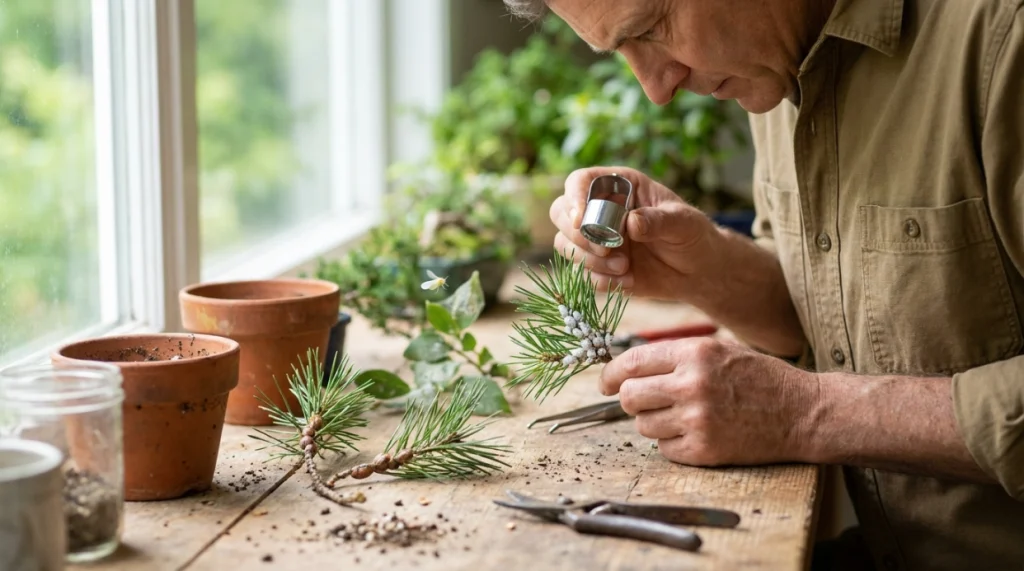
White material does not automatically mean mealybugs. Scale insects, woolly aphids, whiteflies, mites, mineral deposits, and fungal growth can all create confusing symptoms.
The easiest approach is to compare several clues at once. Look at body shape, movement, wax, webbing, honeydew, and where the organism sits.
| Possible pest | Typical appearance | Movement | Honeydew? | Best distinguishing clue |
|---|---|---|---|---|
| Mealybugs | Soft, segmented insects with white powdery or cottony wax; adult females about 1/20–1/5 inch | Usually slow crawling | Yes | Visible segmented body beneath wax |
| Scale insects | Brown, tan, white, or waxy bumps | Settled stages usually stay fixed | Soft scale often does | Looks more like a fixed shell or bump |
| Woolly aphids | Aphid-shaped insects hidden under fluffy wax | Can crawl | Often | Pear-shaped aphid body and longer legs |
| Whiteflies | Tiny white, gnat-like adults around 1/16 inch | Adults fly when disturbed | Yes | Small white adults rise from foliage when disturbed |
| Spider mites | Extremely small mites with stippling or fine webbing | Tiny crawling movement | No | Fine webbing and pale stippled foliage |
Iowa State University Extension’s pest diagnosis guide describes mealybugs as white, cottony insects commonly clustered in leaf axils and beneath leaves.
Mealybugs vs. scale
This is the mix-up I see most often. Scale tends to resemble a fixed bump, while a female mealybug usually looks visibly segmented and more insect-like beneath its wax.
Mealybugs vs. woolly aphids
Both can produce fluffy white wax. If you expose the insect, an aphid has a more pear-shaped form and relatively obvious legs.
Mealybugs vs. whiteflies
Gently disturb the foliage. Adult whiteflies commonly take flight, while female mealybugs stay on the plant and crawl slowly.
Mealybugs vs. spider mites
Spider mites produce stippling, bronzing, and sometimes fine webbing. They do not normally produce the sticky honeydew associated with mealybugs.
Section takeaway: Don’t diagnose from whiteness alone. A segmented, wax-covered crawling insect plus honeydew strongly favors mealybugs.
What Damage Do Mealybugs Cause on Bonsai?
Mealybugs pierce plant tissue and feed on sap. A small colony may cause little obvious damage at first, which is why visual inspection matters.
As numbers increase, the tree may lose vigor. The symptoms are not unique to mealybugs, so always find the pest before blaming it.
- Yellow leaves: Heavy feeding can interfere with healthy foliage and contribute to chlorosis.
- Weak new growth: Shoots may develop slowly or appear stunted.
- Leaf drop: Heavily affected plants may shed weakened foliage.
- Sticky surfaces: Honeydew may coat leaves, branches, pots, benches, or windowsills.
- Black coating: Sooty mold can grow on accumulated honeydew.
Sooty mold is a secondary clue rather than the pest itself. It grows on sugary deposits left by honeydew-producing insects.
Ant activity can also draw your attention to honeydew. However, ants do not prove that mealybugs are present because aphids and soft scale can produce the same food source.
Don’t confuse pest damage with bonsai stress
Yellow leaves, weak growth, and leaf drop also occur after watering problems, root stress, poor light, or seasonal changes. Visible insects, wax, honeydew, or egg masses make the diagnosis much stronger.
Section takeaway: Plant symptoms support the diagnosis, but seeing the insect itself is the most reliable confirmation.
Can Mealybugs Hide in Bonsai Soil and Roots?
Yes. Some mealybugs feed below the soil surface, which makes them much easier to miss during a normal canopy inspection.
Suspect a hidden infestation when the top of the tree declines without many visible pests above ground. White wax around exposed roots, drainage holes, or the lower trunk deserves closer inspection.
Signs worth checking near the root zone
- White waxy deposits near the trunk base
- Cotton-like material around visible roots
- Pests moving around drainage holes or beneath the pot
- Unexplained yellowing, wilting, or weak growth
- Repeated above-ground infestations after apparent removal
Be careful with white material in bonsai substrate. Perlite, fertilizer residue, mineral salts, fungal growth, and broken soil particles can all resemble pest wax from a distance.
Use a hand lens before disturbing the root ball. If you find an actual soft-bodied insect among the roots, identification becomes much more convincing.
Pro tip: Root work is irreversible. If confirming the infestation would require major repotting, root pruning, or disturbing a weak tree out of season, ask an experienced grower or local bonsai club for species-specific advice first.
Section takeaway: A clean canopy does not completely rule out mealybugs because some species can live around roots and below the soil surface.
What Should You Do After Identifying Mealybugs?
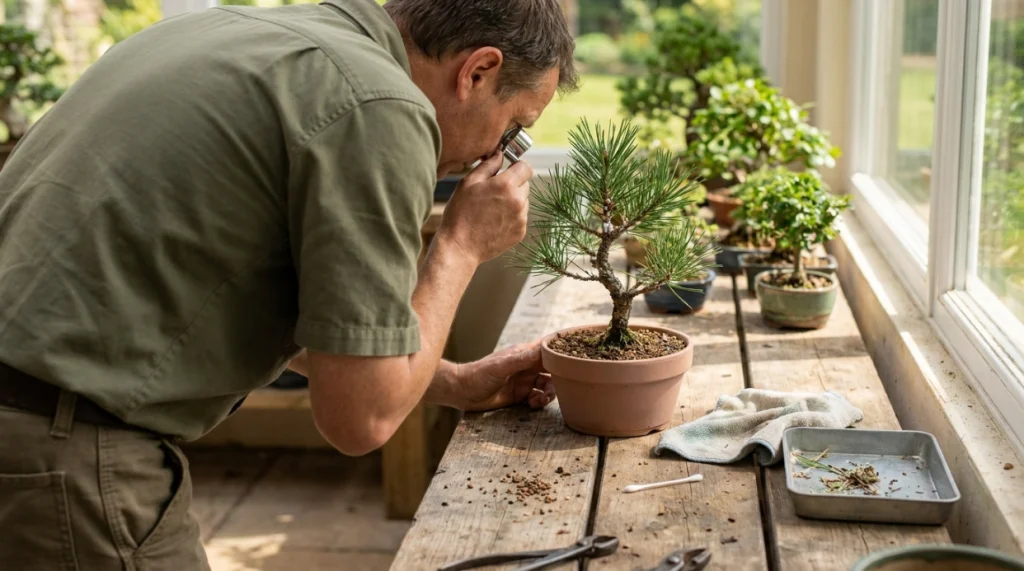
Once you’ve confirmed mealybugs, separate the affected bonsai from nearby plants. Crawlers and contaminated plant material can help an infestation spread through a collection.
The immediate goal is containment, not aggressive treatment. A stressed bonsai can suffer when several control methods are applied at once.
- Isolate the tree: Move it away from other bonsai and susceptible houseplants.
- Inspect nearby plants: Check foliage, branch joints, pots, and surfaces for similar wax or honeydew.
- Remove small colonies: Physical removal may be practical when only a few insects are present.
- Clean the area: Remove fallen material and inspect benches, saucers, tools, and pot rims.
- Choose a labeled treatment if needed: Follow the product label and make sure the treatment is appropriate for both the plant and the pest.
- Reinspect regularly: Eggs and hidden insects can make one treatment or cleaning session insufficient.
Bonsai Empire’s pest and disease overview also emphasizes identifying the pest before selecting a control method.
For bonsai, that matters. Compact foliage, textured bark, and tight branch structure create hiding places that are easy to miss during a quick spray.
I prefer to reinspect the exact branch forks and leaf axils where the first colony appeared. Those protected areas often reveal whether the problem is returning.
Section takeaway: Confirm, isolate, remove what you can, and keep checking. Identification should guide treatment rather than the other way around.
Frequently Asked Questions About Mealybugs on Bonsai
What is the easiest way to identify mealybugs on bonsai?
Look for a small, soft, segmented insect beneath white powdery or cotton-like wax. Mealybugs often gather in leaf axils, branch forks, new growth, and other protected places, where sticky honeydew may provide another clue.
Are white cottony patches always mealybugs?
No. Woolly aphids, some scale insects, fungal material, mineral deposits, and debris can also appear white. Confirm the diagnosis by finding the actual insect and examining its shape, segmentation, movement, and position on the tree.
Do mealybugs move?
Many female mealybugs retain their legs and can crawl slowly. Their young nymphs, often called crawlers, are also mobile and can move to new feeding sites before becoming easier to notice.
Do mealybugs make bonsai leaves sticky?
Yes. Mealybugs can produce sugary honeydew while feeding, leaving foliage and nearby surfaces sticky. Aphids, whiteflies, and soft scale also produce honeydew, so sticky leaves alone do not prove that the pest is a mealybug.
Can mealybugs live in bonsai soil?
Some mealybugs can feed around roots or below the soil surface. Check exposed roots, the lower trunk, drainage holes, and the underside of the pot when a tree declines without an obvious above-ground infestation.
How do I tell mealybugs from scale insects?
Mealybugs usually have visible segmented bodies covered in loose white wax and can crawl. Settled scale insects are more likely to resemble fixed brown, tan, gray, or white bumps attached firmly to leaves or branches.
Can one mealybug mean there are more?
Yes. A single visible insect is a reason to inspect the whole tree carefully because mealybugs hide in protected areas and may have eggs or smaller crawlers nearby. Check neighboring plants as well before assuming the problem is isolated.
The Bottom Line
The best way to identify mealybugs on bonsai is to combine several clues: white wax, a soft segmented body, protected hiding places, slow crawling movement, honeydew, and nearby plant damage.
Don’t treat a tree based on white fuzz alone. Find the insect first, compare it with common look-alikes, and inspect both the canopy and root zone before deciding what comes next.
Make pest inspection part of your normal watering routine. Catching one small colony early is far easier than finding the same pest throughout an entire bonsai collection.