
Mealybugs on Bonsai Leaves: How to Treat Them

Quick Answer
Mealybugs on bonsai leaves are small sap-feeding insects covered with white, cottony wax. Isolate the tree, remove visible insects, inspect hidden leaf joints, and use a plant-safe contact treatment when needed, following UC IPM mealybug guidance.
What to do first
- Isolate the tree: Keep the affected bonsai away from healthy bonsai and houseplants.
- Confirm the pest: Look for white waxy insects, cotton-like deposits, honeydew, and weakened growth.
- Remove visible bugs: Use tweezers, a cotton swab, or a controlled water rinse where the foliage tolerates it.
- Check hidden areas: Inspect leaf axils, branch forks, buds, bark cracks, and the soil line.
- Treat carefully: Use alcohol spot treatment, insecticidal soap, or horticultural oil only when appropriate.
- Keep monitoring: Hidden insects can survive the first treatment and reappear later.
Before spraying
- Test unfamiliar treatments on a small area first and always follow the product label.
Finding white cottony patches on bonsai leaves can make a small pest problem look dramatic. Fortunately, mealybugs are manageable when you catch them early and treat the whole infestation rather than one visible cluster.
I prefer a progressive approach that starts with identification and physical removal. That protects delicate bonsai foliage while giving you a clearer picture of how serious the infestation is.
In This Guide
What Are Mealybugs on Bonsai Leaves?
Mealybugs are soft-bodied insects that feed by inserting piercing mouthparts into plant tissue and taking sap. Their bodies are usually covered by white powdery or cotton-like wax.
Definition: A mealybug is a sap-feeding insect protected by a waxy coating that can make it resemble a tiny piece of cotton on a leaf or stem.
The wax makes established insects harder to reach with contact treatments. Young immature mealybugs, commonly called crawlers, are smaller and more mobile.
On bonsai, the compact canopy creates many protected hiding places. That is why a casual look at the top of the tree often misses the real population.
- Leaf axils: Check where leaves or leaf stalks meet shoots.
- Leaf undersides: Inspect veins and folded areas.
- Branch forks: Look inside tight branch junctions.
- New growth: Examine buds and tender shoots closely.
- Bark crevices: Rough trunks can hide small colonies.
- Soil line: Check the trunk base and pot rim for waxy deposits.
Mealybugs may also produce sticky honeydew. That sugary material can collect on leaves, branches, pots, benches, or windowsills.
A bonsai pest and disease reference can help when white residue does not clearly look like an insect. Scale insects, mineral deposits, and other problems can be mistaken for mealybugs.
How Can You Confirm Mealybugs on Bonsai Leaves?
Confirm mealybugs by combining several clues rather than relying on white material alone. Look for an actual segmented insect beneath the wax.
A 10× hand lens makes small crawlers and hidden adults much easier to recognize. Good lighting matters just as much.
What signs should you look for?
- White cottony clusters: These often appear around leaf joints and branch forks.
- Oval insects: Adult females usually have a soft, segmented appearance beneath the wax.
- Sticky honeydew: Leaves or surfaces below the tree may feel shiny and tacky.
- Sooty mold: Black surface growth can develop where honeydew accumulates.
- Yellowing leaves: Heavy feeding can reduce vigor and contribute to discoloration.
- Weak growth: New shoots may become stunted or distorted during a serious infestation.
- Ant activity: Ants may visit plants to collect honeydew.
Could white material be something else?
Yes. Water deposits, fertilizer residue, fungal growth, scale insects, woolly aphids, and harmless debris can all create confusing white patches.
| Clue | Mealybugs | Possible Look-Alike |
|---|---|---|
| Texture | Soft, waxy, cotton-like | Mineral deposits often feel crusty |
| Movement | Adults or crawlers may move slowly | Residue does not move |
| Honeydew | Often present | Mineral residue does not produce it |
| Favorite location | Protected joints, veins, shoots | Water spots may occur across exposed surfaces |
My rule is simple: I do not treat a tree aggressively until I can identify a living pest. Correct identification prevents a pest problem from becoming a chemical-damage problem.
How Do You Treat Mealybugs on Bonsai Leaves?
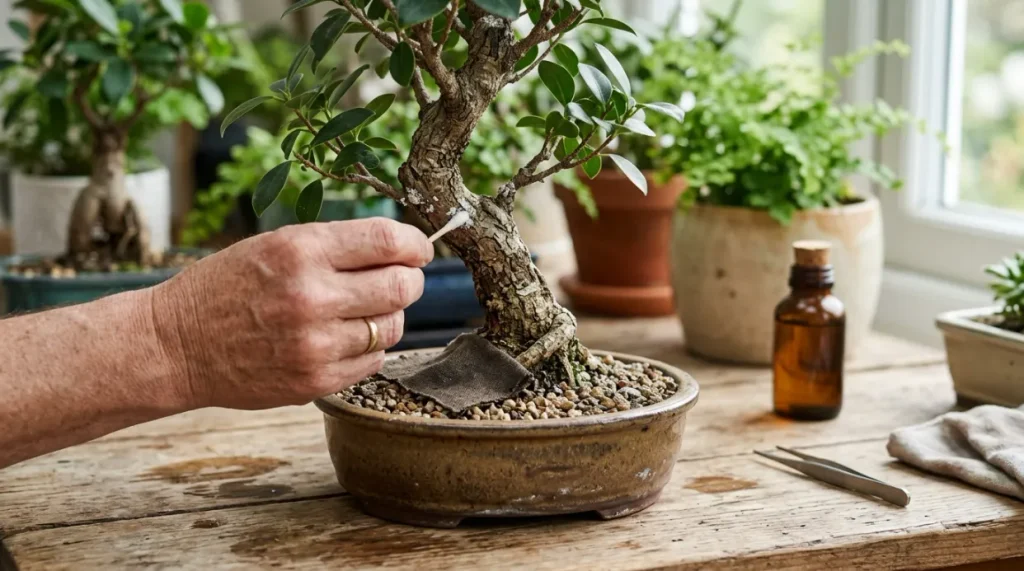
Start with containment and physical removal, then escalate only when insects remain. One heavy spray is usually less useful than repeated, careful inspection.
1. Isolate the affected bonsai
Move the tree away from healthy bonsai, houseplants, and propagation material. Check nearby pots because mobile crawlers can spread beyond the original tree.
- Clean the bench, tray, or windowsill.
- Inspect neighboring plants carefully.
- Clean tools before using them elsewhere.
- Wash your hands after handling the infested tree.
2. Remove visible mealybugs
For a small infestation, pick exposed insects off with tweezers or wipe them away with a cotton swab. A controlled stream of water can also dislodge pests from sturdy foliage.
Protect loose bonsai substrate before rinsing. A forceful stream that removes insects can also wash valuable soil from a shallow pot.
3. Spot-treat stubborn insects
For small colonies, isopropyl alcohol can be applied directly to individual mealybugs with a cotton swab. The University of Maryland Extension recommends keeping alcohol away from foliage where possible because leaves can be damaged.
- Use 70% or less: Stronger alcohol is unnecessary for routine spot treatment.
- Test first: Treat a small hidden area before broader use.
- Wait 1–2 days: Watch the test area for discoloration or leaf burn.
- Target the insect: Avoid soaking the entire canopy.
4. Use insecticidal soap when needed
A commercial insecticidal soap can suppress exposed mealybugs when physical removal is not enough. It works by contact, so hidden insects that stay dry can survive.
The Colorado State University Extension insecticidal soap guide warns against substituting household dishwashing liquids. Household products vary widely and may damage leaves.
5. Consider horticultural oil
A horticultural oil labeled for your plant can suppress exposed mealybugs and younger stages. Oils must contact pests effectively, and sensitive foliage can suffer injury under unsuitable conditions.
Follow the label for dilution, temperature limits, repeat applications, and species restrictions. Never assume a treatment tolerated by a ficus will be equally safe on every bonsai species.
Section Takeaway: Begin with isolation and physical removal. Add a labeled contact treatment only when monitoring shows that insects remain.
Which Mealybug Treatment Works Best?
The best treatment depends on the size and location of the infestation. Small visible colonies often need less intervention than insects scattered through a dense canopy.
| Treatment | Best Use | Repeat Approach | Main Caution |
|---|---|---|---|
| Tweezers or wiping | A few visible insects | Repeat whenever new insects appear | Hidden pests remain untreated |
| Water rinse | Exposed colonies on sturdy foliage | Reinspect within several days | Can disturb bonsai soil |
| Isopropyl alcohol swab | Small localized colonies | UC IPM notes weekly retreatment may be needed | Test for leaf burn first |
| Insecticidal soap | Wider exposed populations | Repeat only as the label directs | Must directly wet the pest |
| Horticultural oil | Exposed insects and younger stages | Follow label timing | Heat or sensitive foliage can increase injury risk |
As of 2026, extension guidance still supports starting with nonchemical removal when an infestation is manageable. Contact products become more useful when physical removal cannot reach enough insects.
Spray coverage matters more than drenching the tree. A contact treatment does little to an insect protected inside a tight leaf joint that the spray never reaches.
Avoid mixing several treatments at once. Oils, soaps, alcohol, heat, and strong light can place additional stress on already weakened foliage.
Section Takeaway: There is no single best product for every bonsai. Match the treatment to the infestation and the sensitivity of the tree.
Why Do Mealybugs Keep Coming Back?
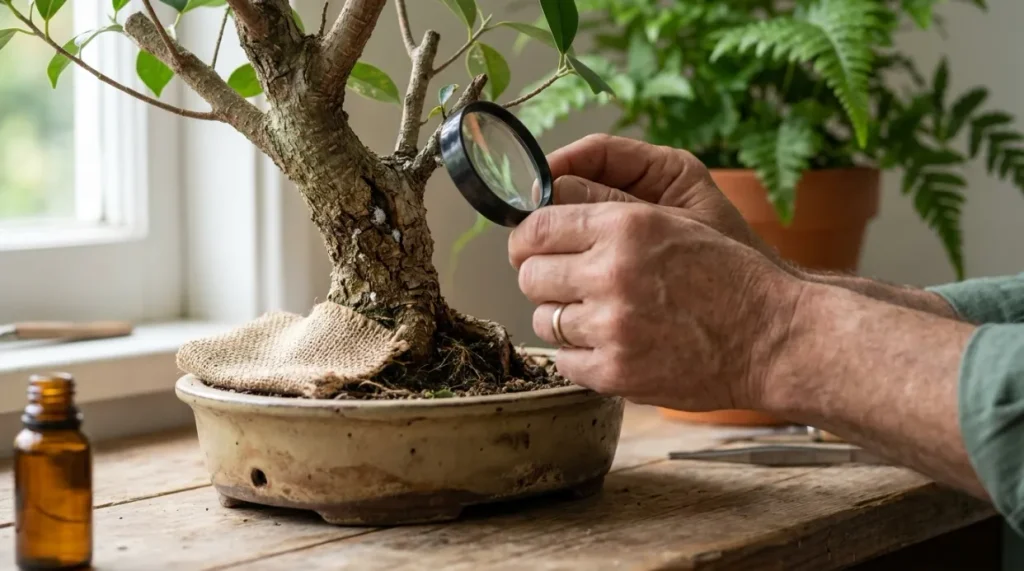
Mealybugs often return because eggs, crawlers, or hidden adults survived the first treatment. Their protected hiding places make one-time treatment unreliable.
Inspect your bonsai whenever you water it. Fresh white wax or new honeydew usually tells you that the life cycle has not been interrupted yet.
Check more than the leaves
- Look beneath foliage and along major veins.
- Inspect branch crotches and buds.
- Check the trunk base and pot rim.
- Examine drainage holes and nearby surfaces.
- Inspect plants that were sitting beside the bonsai.
The University of Minnesota Extension recommends examining containers as well as plant tissue. It also suggests isolating newly acquired indoor plants for one to two weeks.
What if you see white material in the soil?
Some mealybugs can feed around roots, so persistent decline with white wax near the soil deserves closer inspection. Do not assume every white deposit in bonsai soil is a root pest.
Mineral buildup, fertilizer residue, and fungal growth can look similar. Confirm moving insects before disturbing the root system.
Pro tip: Root work is irreversible. If confirmed root mealybugs require major repotting or root cutting outside the normal season, consult an experienced grower or local bonsai club first.
Prevent another outbreak
- Quarantine new plants: Inspect bonsai and companion plants before adding them to your collection.
- Keep tools clean: Remove pest residue before moving between trees.
- Inspect regularly: Use watering time as a quick pest check.
- Maintain airflow: Avoid crowding trees unnecessarily.
- Match care to the species: Correct light, watering, drainage, and feeding support stronger growth.
- Watch nearby houseplants: They can act as unnoticed pest reservoirs.
Do not respond to every yellow leaf by watering more. Pest damage and watering stress can look similar, and unnecessary watering can create a second problem.
Frequently Asked Questions
Can mealybugs kill a bonsai tree?
A severe, persistent infestation can weaken a bonsai enough to contribute to major decline. Small or early infestations are usually manageable, but stressed, recently repotted, or already weakened trees have fewer reserves and deserve especially careful monitoring.
Can I use rubbing alcohol on bonsai mealybugs?
Yes, for small infestations you can dab individual mealybugs with 70% or less isopropyl alcohol. Test a hidden area first and wait one to two days for signs of leaf injury before treating more insects.
Should I spray dish soap on my bonsai?
Commercial insecticidal soap is preferable to homemade dish-soap mixtures. Household detergents contain varying ingredients and concentrations, so they can injure bonsai foliage and were not formulated or tested as plant pesticides.
Does neem oil kill mealybugs on bonsai?
Neem-based horticultural products can suppress exposed mealybugs when the product is labeled for the plant and pest. Coverage matters because contact treatments cannot control insects they do not reach, and sensitive foliage may react badly to oils.
How often should I treat mealybugs?
There is no universal schedule for every treatment. Alcohol spot treatments may need weekly repetition, while soaps and horticultural oils should be repeated only according to their current product labels and after checking the tree for new pests.
Should I remove leaves covered with mealybugs?
Removing a badly infested leaf can reduce pest numbers, but avoid unnecessary defoliation of a weak bonsai. Physical removal of the insects may preserve useful foliage when the infestation is still localized and the leaf remains healthy.
How do I know when the infestation is gone?
Do not rely on one clean inspection. Continue checking protected leaf joints, new growth, bark crevices, the pot, and neighboring plants until repeated inspections show no live insects, new wax, crawlers, or fresh honeydew.
Final Takeaway
Mealybugs on bonsai leaves are easier to control when you act early and stay methodical. Isolate the tree, confirm the insect, physically remove what you can, and use the mildest effective treatment.
Keep inspecting after the tree looks clean. Persistence matters more than one aggressive treatment, especially when mealybugs are hiding inside a compact bonsai canopy.