
Mealybugs on Bonsai Trees: Complete Guide

Quick Answer
Mealybugs on bonsai trees are small sap-feeding insects covered in white, waxy material that often looks like cotton. Isolate the affected bonsai, confirm the pest, physically remove visible insects, and use a plant-safe treatment when needed; this bonsai pest and disease overview can also help with identification.
Signs to Check First
- White cottony clusters: Look around leaf joints, branch forks, buds, bark crevices, and the trunk base.
- Sticky honeydew: Leaves or surfaces beneath the bonsai may become shiny and sticky.
- Weak new growth: Heavy feeding can cause yellowing, stunting, wilting, or premature leaf drop.
- Ant activity: Ants may visit the tree to feed on the honeydew produced by mealybugs.
- Hidden root pests: Some mealybugs live around roots and may leave white wax in the soil or root ball.
What to Do First
- Move the bonsai away from other plants, inspect it closely, remove visible pests, and monitor repeatedly before escalating treatment.
Finding white, cotton-like insects on a bonsai can be alarming, especially when they seem to appear overnight. Mealybugs are persistent, but an infestation is usually manageable when you find it early.
I prefer to confirm live pests before spraying anything. White residue, mineral deposits, scale insects, and harmless debris can sometimes cause unnecessary treatment.
This guide covers identification, damage, treatment, root mealybugs, repeat infestations, and prevention. It also explains when a struggling tree needs more than a quick spray.
In This Guide
What Are Mealybugs on Bonsai Trees?
Mealybugs are soft-bodied, sap-feeding insects protected by a powdery or cotton-like wax. They belong to the same broad group of insects as scale insects.
Definition: A mealybug is a small plant-feeding insect that inserts piercing mouthparts into plant tissue and consumes sap while producing a protective waxy coating.
Adult females are usually oval and wingless. Many common forms appear white because wax covers much of their segmented bodies.
Young mealybugs are called crawlers. These immature insects are more mobile and can spread across the tree or onto neighboring plants.
Where do mealybugs hide on a bonsai?
Mealybugs favor protected areas where sprays, rain, and predators have trouble reaching them. A compact bonsai canopy provides plenty of hiding places.
- Leaf axils: Check where a leaf or petiole joins a shoot.
- Branch forks: Inspect tight junctions between branches.
- Young shoots: Tender growth provides accessible feeding sites.
- Bark crevices: Rough-barked trees can conceal small colonies.
- Under leaves: Look along veins and protected leaf surfaces.
- Trunk base: Check where the trunk meets the growing medium.
- Pot edges: Inspect drainage holes, pot lips, wire holes, and crevices.
- Root zone: Root-feeding species can live inside the growing medium.
Indoor and greenhouse-grown trees deserve close attention. Stable temperatures can allow some pest populations to remain active for long periods.
Which bonsai species can get mealybugs?
Mealybugs attack many ornamental plants, so no bonsai should be considered completely immune. Ficus, jade-type plants, tropical species, and several woody ornamentals can host them.
Juniper and other conifers can also host certain mealybug species. The important factor is identifying the pest rather than assuming a species cannot be attacked.
A newly purchased tree is a common introduction route. Pests may also arrive on nearby houseplants, nursery stock, pots, tools, or plant material.
Section Takeaway: Mealybugs are sap-feeding insects that hide in protected areas and spread most easily while young. Inspect the entire tree, pot, and nearby plants rather than checking only visible leaves.
How Can You Identify Mealybugs on a Bonsai?
Mealybugs usually look like small white or grayish insects covered in powder, wax, or cottony filaments. Their appearance is distinctive once you inspect them closely.
A 10× hand lens is useful for separating mealybugs from scale, mites, and ordinary debris. The University of Minnesota Extension’s indoor plant pest guidance also recommends close inspection of leaf undersides, containers, and hidden plant areas.
What are the first signs of an infestation?
- White wax: Powdery or cotton-like material appears around stems and leaves.
- Visible insects: Oval, slow-moving insects may crawl beneath the wax.
- Honeydew: Leaves, branches, pots, or nearby surfaces feel sticky.
- Sooty mold: Dark fungal growth may develop on accumulated honeydew.
- Ants: Ant traffic may increase around a honeydew-producing colony.
- Yellow foliage: Sustained feeding can weaken leaves and shoots.
- Distorted growth: Tender leaves or shoots may develop abnormally.
Mealybugs vs. scale, aphids, and spider mites
Several bonsai pests create overlapping symptoms. Sticky leaves, for example, can come from mealybugs, aphids, or soft scale.
| Pest | Typical Visible Size | Main Identification Clue | Honeydew | Movement |
|---|---|---|---|---|
| Mealybugs | Often around 3/16 in (5 mm), depending on species | White powdery or cotton-like wax | Common | Slow-moving; crawlers are more mobile |
| Scale insects | Often 1–6 mm, depending on species | Firm, waxy, shell-like, or dome-shaped bumps | Soft scale often does; armored scale usually does not | Adults often remain fixed in place |
| Aphids | Commonly about 1.5–3 mm | Pear-shaped insects clustered on tender growth | Common | Usually visibly mobile |
| Spider mites | Often around 0.4 mm or smaller | Fine stippling, tiny moving specks, and webbing | No | Tiny moving dots visible with magnification |
How can you confirm that the white material is alive?
Use a hand lens and gently disturb the suspected colony with a wooden toothpick or cotton swab. Look for an oval insect beneath the wax or for slow movement.
Check several locations before deciding. Mineral residue from hard water will not crawl, produce honeydew, or gather predictably in protected plant joints.
Bonsai Empire also lists mealybugs among common bonsai pests, alongside aphids, spider mites, scale insects, and other insects. Correct identification matters because those pests require different approaches.
What Damage Do Mealybugs Cause to Bonsai?
Mealybugs damage bonsai by removing sap from leaves, shoots, stems, and sometimes roots. A small population may cause little visible damage, while a large colony can reduce vigor substantially.
Early damage
The first symptom may be sticky honeydew rather than yellow leaves. New growth can also look weaker or slightly distorted.
- Reduced shoot vigor
- Minor yellowing
- Sticky foliage
- Scattered white wax
- Small colonies at branch joints
Moderate to heavy infestations
Continued feeding removes resources that the bonsai needs for healthy foliage and new growth. This matters more when the tree is already stressed by heat, poor light, root trouble, or improper watering.
- Stunted growth
- Yellowing foliage
- Wilting
- Premature leaf drop
- Shoot distortion
- Weak branches or twig decline
- Large amounts of honeydew
- Sooty mold developing on sticky surfaces
Sooty mold is usually a secondary problem. The dark fungus grows on sugary honeydew rather than directly feeding on the bonsai.
Can mealybugs kill a bonsai?
Yes, a severe and prolonged infestation can contribute to major decline and may kill a vulnerable bonsai. Young, weak, recently repotted, or badly stressed trees have less reserve for recovery.
Do not assume every yellow leaf means the infestation is severe. Watering problems, root damage, seasonal leaf changes, and poor light can produce similar symptoms.
Section Takeaway: The insect itself is only part of the problem. Watch the tree’s overall vigor, because severe pest feeding combined with existing stress creates the greatest risk.
How Do You Get Rid of Mealybugs on Bonsai?
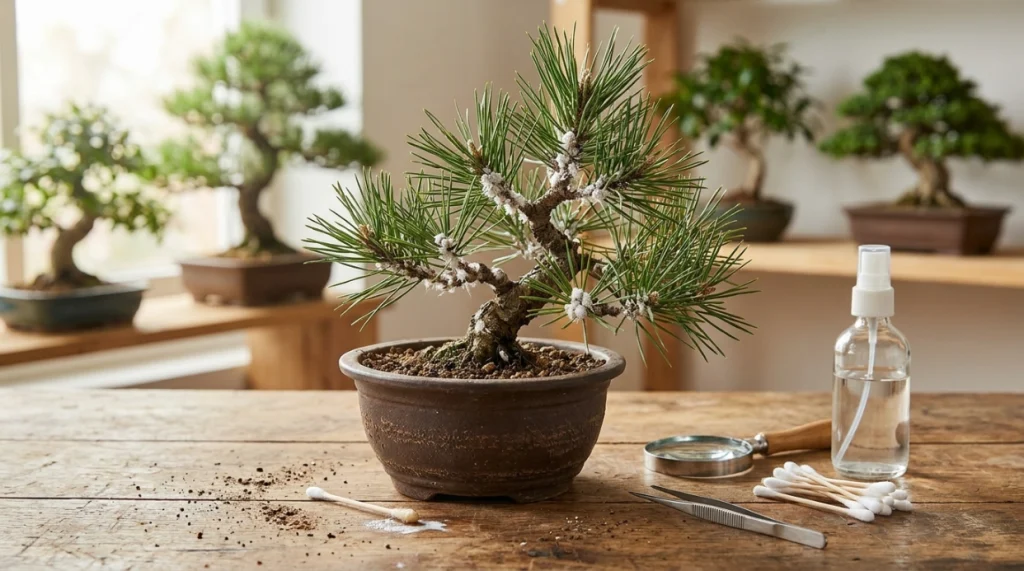
The safest approach is progressive: isolate the bonsai, remove what you can, monitor it, and escalate only when necessary. One aggressive spray is rarely as useful as careful repeat inspection.
Step 1: Isolate the bonsai
Move the affected tree away from other bonsai and houseplants immediately. Keep branches from touching healthy plants.
Also inspect the surface where the tree was sitting. Mealybugs and crawlers can hide around pots, saucers, shelves, and nearby plant material.
Step 2: Inspect the entire plant
Use bright light and a hand lens if available. Do not stop after finding the first visible colony.
- Inspect the tops and undersides of leaves.
- Check leaf axils and petioles.
- Follow each branch toward the trunk.
- Inspect cracks and rough bark.
- Look around the trunk base.
- Examine the pot rim and drainage holes.
- Check the soil surface for white wax.
Step 3: Physically remove visible mealybugs
Small infestations are often easiest to reduce by hand. Use tweezers, a soft brush, or a cotton swab to remove visible insects.
A controlled stream of water can dislodge exposed pests on suitable species. Protect the soil surface so you do not wash growing medium from a shallow bonsai pot.
Step 4: Consider spot treatment with isopropyl alcohol
For small aboveground infestations, rubbing alcohol can be useful as a targeted treatment. The UC Integrated Pest Management mealybug guide advises using 70% or less for spot treatment and testing a small area first for plant injury.
Lightly dampen a cotton swab rather than soaking the entire bonsai. Touch visible insects directly and avoid flooding leaves, bark, or soil with alcohol.
Wait one or two days after testing an inconspicuous area before treating more extensively. Some species and tender new leaves are more sensitive than others.
Step 5: Use insecticidal soap or horticultural oil when appropriate
Persistent exposed populations may respond to a commercially formulated insecticidal soap or horticultural oil labeled for the plant and pest. Coverage matters because contact treatments must reach the insect.
Avoid assuming homemade dish detergent is equivalent to insecticidal soap. Household detergents can damage plant tissue because they are not formulated or labeled as plant pesticides.
Do not apply horticultural oils during inappropriate heat or environmental conditions. Check the product’s temperature restrictions and species precautions.
Step 6: Follow pesticide labels exactly
As of 2026, product formulations and permitted uses can change. Always follow the current label rather than relying on an old online dosage.
The U.S. Environmental Protection Agency’s pesticide-label guidance emphasizes reading the label for safe application, storage, precautions, and permitted uses.
- Confirm that the product is labeled for the pest.
- Confirm that it can be used on the plant type.
- Check whether indoor application is permitted.
- Follow the stated concentration.
- Observe temperature restrictions.
- Keep children and pets away as instructed.
- Follow the stated repeat-treatment interval.
What about neem oil?
Some pesticide products containing neem-derived ingredients are labeled for mealybugs and other soft-bodied pests. Effectiveness depends on the formulation, coverage, pest stage, and correct use.
Use only a labeled product and follow its directions. Do not assume that a stronger homemade mixture will work better.
What if mealybugs are living in the bonsai soil or roots?
Root mealybugs are more difficult because the colony may remain hidden inside the root ball. Possible clues include white wax near the soil surface, drainage holes, roots, or inside the pot.
A declining bonsai with no obvious aboveground cause deserves a careful root-zone assessment. However, weak growth alone does not prove root mealybugs.
If repotting is seasonally appropriate and genuinely necessary, removing contaminated growing medium may help expose the problem. Do not automatically perform aggressive root pruning on an already weak tree.
Pro tip: Root work is irreversible. If a valuable or severely weakened bonsai may have root mealybugs, ask an experienced grower or local bonsai club for species-specific guidance before cutting roots or performing an emergency repot.
Should you use a systemic insecticide?
Some systemic pesticides are labeled for mealybugs on certain ornamental plants. They should not be treated as an automatic first choice.
Confirm the exact label, growing location, species, and environmental restrictions first. Systemic insecticides can also create concerns for pollinating insects when treated plants flower or move outdoors.
Section Takeaway: Start with isolation, identification, and physical removal. Escalate to labeled treatments only when the remaining infestation justifies them, and never increase a pesticide concentration beyond its label.
Why Do Mealybugs Keep Coming Back?
Mealybugs often seem to return because one treatment does not reach every life stage. Hidden insects, eggs, and newly emerging crawlers can rebuild a colony after the visible adults disappear.
The mealybug life cycle matters
Depending on the species, females may produce eggs inside waxy masses or produce live young. The young crawler stage is small, mobile, and easy to overlook.
Crawlers move into protected feeding sites as they develop. Their increasing wax coverage can make mature mealybugs harder for contact treatments to reach.
This creates a simple problem: killing the visible insects today does not guarantee that the tree is pest-free tomorrow.
How often should you check after treatment?
Inspect the bonsai every few days during an active infestation. Pay particular attention to the exact locations where colonies were previously found.
Repeat pesticide applications only at the interval stated on the product label. Physical removal and visual inspection can continue between applications.
Hidden colonies may survive
Dense foliage and complex branch structures make bonsai especially easy to inspect incompletely. A few insects around a rear branch or trunk crevice can restart the infestation.
Check these easily missed areas:
- Behind crossing branches
- Under branch collars
- Inside dense foliage pads
- Under old leaf sheaths
- Around pruning scars and bark crevices
- Under the pot rim
- Around drainage mesh
- Near exposed surface roots
Nearby plants can reinfest the bonsai
A clean bonsai can become infested again when a neighboring plant still carries mealybugs. Crawlers can move across touching foliage or contaminated surfaces.
Inspect every plant in the immediate growing area. Treating one bonsai while ignoring an infested houseplant beside it rarely solves the larger problem.
Ants can complicate control
Mealybugs produce honeydew that attracts ants. In outdoor growing areas, ants may interfere with predators and parasitoids that naturally attack honeydew-producing pests.
If ant traffic remains heavy after you reduce the visible colony, inspect the bonsai and nearby plants again. Ants may be revealing hidden sap-feeding insects.
Section Takeaway: A recurring infestation usually means something survived or returned. Keep inspecting beyond the first treatment and include nearby plants, pots, benches, and hidden tree surfaces in your checks.
How Can You Prevent Mealybugs on Bonsai?
Prevention starts with exclusion and routine inspection. It is much easier to remove three mealybugs than hundreds hidden inside a mature canopy.
Quarantine new bonsai and houseplants
Do not place a newly acquired plant directly inside an established collection. Keep it separate while you inspect it repeatedly for pests and suspicious symptoms.
Look at the pot as carefully as the foliage. Mealybugs can hide along rims, drainage holes, stakes, tags, and other sheltered surfaces.
Inspect while you water
Watering gives you a regular opportunity to check the tree. Turn the pot and look at the foliage from several angles.
- Check new shoots.
- Look beneath several leaves.
- Inspect branch junctions.
- Watch for sticky surfaces.
- Notice unusual ant traffic.
- Check the trunk base.
A thorough inspection once a week is a useful baseline during active growth. Increase the frequency after bringing home a new tree or after discovering pests nearby.
Avoid excessive nitrogen feeding
Overfeeding can produce large amounts of soft, tender growth. Sap-feeding insects often establish readily on this new tissue.
Follow a fertilizer program appropriate for the bonsai species, season, and stage of development. More fertilizer does not automatically create a healthier or more pest-resistant tree.
Keep the tree healthy without overcorrecting
Correct light, watering, drainage, temperature, and airflow help a bonsai maintain vigor. These practices do not create a magical pest barrier, but they improve the tree’s ability to tolerate and recover from damage.
Avoid making several stressful changes at once. Heavy pruning, emergency repotting, wiring, major relocation, and pesticide treatment can overwhelm a weak tree when combined unnecessarily.
Clean tools and growing areas
Good sanitation helps prevent accidental transfer between plants. Remove fallen foliage and clean work surfaces after handling an infested tree.
- Clean reusable tools before moving to another tree.
- Remove discarded infested plant material promptly.
- Check shelves and benches for crawlers.
- Clean pots before reusing them.
- Avoid letting foliage from quarantined trees touch healthy plants.
Encourage natural pest control outdoors
Outdoor bonsai may benefit from predators and parasitoids that feed on mealybugs. Broad-spectrum insecticides can disrupt these natural enemies.
Use targeted pest management whenever practical. Identifying the pest before spraying helps you avoid killing beneficial insects unnecessarily.
Section Takeaway: Quarantine, inspection, appropriate feeding, sanitation, and healthy growing conditions are the foundation of prevention. Catching the first few insects is far easier than treating a mature colony.
Frequently Asked Questions
Can mealybugs kill a bonsai tree?
Yes. A large, untreated population can weaken a bonsai through continuous sap feeding, contributing to yellowing, stunted growth, leaf loss, and decline. The danger increases when the tree is already stressed by poor roots, dehydration, unsuitable light, or recent major work.
Do mealybugs live in bonsai soil?
Some mealybug species feed below the soil surface and around roots. White wax around the root ball, drainage holes, or soil can justify closer inspection, but weak growth alone is not enough to diagnose root mealybugs.
Can I use rubbing alcohol on mealybugs?
Targeted use of 70% or weaker isopropyl alcohol can help remove mealybugs from some ornamental plants. Test a small area first and apply it directly with a cotton swab because sensitive leaves and species can suffer phytotoxic damage.
Does neem oil kill mealybugs on bonsai?
A properly labeled neem-based pesticide may suppress exposed mealybugs, especially younger stages. Use the commercial product according to its label and ensure your bonsai species and growing location are suitable for the application.
How often should I treat mealybugs?
Inspect the bonsai every few days while the infestation is active. If you use a pesticide, follow the exact repeat interval on its current label rather than creating your own schedule, because products and formulations differ.
Why are ants crawling on my infested bonsai?
Mealybugs excrete sugary honeydew, which attracts ants. Persistent ant activity can therefore be a useful clue that mealybugs, aphids, soft scale, or another honeydew-producing pest remains somewhere on the tree.
Should I repot a bonsai because it has mealybugs?
Not automatically. Aboveground mealybugs usually do not require repotting, while confirmed root mealybugs may justify root-zone treatment or repotting depending on species, season, vigor, and severity. Avoid unnecessary root disturbance on an already stressed tree.
Final takeaway: Mealybugs on bonsai trees are persistent but manageable when you identify them early, isolate the tree, remove visible colonies, and continue monitoring for hidden insects and crawlers.
Choose the least aggressive effective treatment and protect the tree from unnecessary stress. For difficult cases or valuable specimens, the American Bonsai Society can help you find bonsai education and local grower resources.