How to Remove Scale From Bonsai by Hand

Quick Answer
To remove scale from bonsai by hand, isolate the tree, confirm the bumps are scale insects, then gently lift or rub them away with a fingernail, wooden toothpick, cotton swab, or soft toothbrush. Work slowly around thin bark and buds, because physical removal should dislodge the pest without scraping living tissue; UC IPM’s scale guidance also recommends an integrated approach based on correct identification and monitoring.
Quick removal steps
- Isolate the tree: Keep the affected bonsai away from other plants while you inspect it.
- Confirm the pest: Look for attached shell-like bumps rather than scraping every natural mark on the bark.
- Support the branch: Hold delicate twigs from underneath before applying sideways pressure.
- Lift gently: Push from the edge of each scale instead of digging downward into the bark.
- Clean tight areas: Use a cotton swab or soft toothbrush around leaf veins, petioles, and branch junctions.
- Check again: Reinspect the tree regularly because newly emerged crawlers may settle after your first cleanup.
Most important rule
- Stop scraping if a suspicious spot will not release with gentle pressure. It may be bark, a bud, a lenticel, or another normal part of the tree.
Finding scale on a bonsai can be frustrating because these pests often look like part of the bark. Hand removal is one of my first choices when the infestation is small enough to inspect insect by insect.
This guide explains how to remove scale from bonsai by hand, which tools work best, and how to avoid damaging delicate foliage or branches.
In This Guide
How Can You Tell If the Bumps Are Scale?
Scale insects are sap-feeding pests that often look like stationary brown, tan, gray, white, or waxy bumps. Adults may look more like tiny shells than recognizable insects.
Definition: A scale insect is a sap-feeding insect whose settled stages often develop a waxy, leathery, or shield-like covering while attached to plant tissue.
Correct identification matters before you start scraping. Natural bonsai bark can contain buds, corky patches, lenticels, scars, and other raised features.
- Attached bumps: Scale commonly settles on leaves, twigs, branch junctions, stems, and leaf veins.
- Sticky residue: Soft scales can produce sugary honeydew on leaves and nearby surfaces.
- Black coating: Sooty mold may develop on honeydew produced by some scale species.
- Yellow leaves: Heavy feeding can weaken foliage and reduce plant vigor.
- Tiny moving insects: Newly hatched scale are called crawlers and can move before settling.
Armored scale and soft scale also behave differently. Soft scale commonly produces honeydew, while armored scale generally does not.
As of 2026, current horticultural guidance still supports physical removal when scale populations are limited. The University of Maryland Extension specifically lists fingernails, toothpicks, cotton swabs, and soft-bristled toothbrushes for removing scale.
Test one obvious bump before cleaning the entire tree. Apply gentle sideways pressure instead of digging into the bark.
If the object flakes or lifts away, scale becomes more likely. If removing it starts damaging green tissue or bark, stop.
What Do You Need to Remove Scale by Hand?
You don’t need specialized bonsai tools for a small infestation. Simple tools give you better control than aggressive scraping.
- Your fingernail: Useful for isolated scales on firm, accessible bark.
- Wooden toothpick: Helpful around branch junctions and other narrow spaces.
- Cotton swabs: Good for leaves, petioles, smooth stems, and delicate areas.
- Soft toothbrush: Useful when several scales occupy a stronger branch.
- Damp cloth: Helps wipe honeydew from larger leaves.
- Hand lens: A 10× lens makes tiny crawlers and hidden scales easier to spot.
- White paper: Placed beneath the canopy, it makes removed insects easier to see.
I prefer to start with the gentlest tool that will work. A cotton swab gives me more control on thin twigs than a brush.
A toothbrush becomes useful on stronger woody sections with several attached scales. The bristles should bend easily rather than scratch the bark.
Alcohol is sometimes suggested for houseplant pests, but I don’t make it my default method. Colorado State University Extension warns that alcohol can injure plant tissue and cause leaf burn.
If you choose to dab alcohol on individual pests, first test a tiny area. Keep it confined to the insect and away from the soil whenever possible.
How Do You Remove Scale From a Bonsai by Hand?
Work systematically rather than removing only the scales that catch your eye. A bonsai canopy has many sheltered locations where a few missed insects can remain.
- Move the bonsai away from other plants. Isolation makes inspection easier and reduces the chance of spreading crawlers.
- Inspect the entire tree under bright light. Check leaf undersides, midribs, petioles, twig crotches, buds, and bark crevices.
- Choose one clearly identifiable scale. Test how easily it releases before applying the same technique elsewhere.
- Support thin branches with one hand. Don’t let your scraping force bend a fine twig or tear a leaf.
- Push gently from the scale’s edge. Use your fingernail, toothpick, or cotton swab rather than stabbing downward.
- Brush clustered scales carefully. Use short strokes with a soft toothbrush on sturdy woody areas.
- Wipe away loose debris and honeydew. Use a damp swab or cloth where the foliage can tolerate wiping.
- Inspect the same area again. Removed adults can reveal smaller scales or crawlers that were hidden underneath.
My working rule is simple: I should see the pest moving away from the tree, not bark coming away with it. That distinction matters most around young branches.
Scale killed by disturbance can sometimes stay attached and still look alive. Removing the shell also makes later monitoring easier because new bumps stand out against the cleaned branch.
This matches broader bonsai pest advice from Bonsai Empire, which includes physical removal with a soft brush or cotton swab as a treatment approach for visible scale.
Which Manual Scale-Removal Method Is Best?
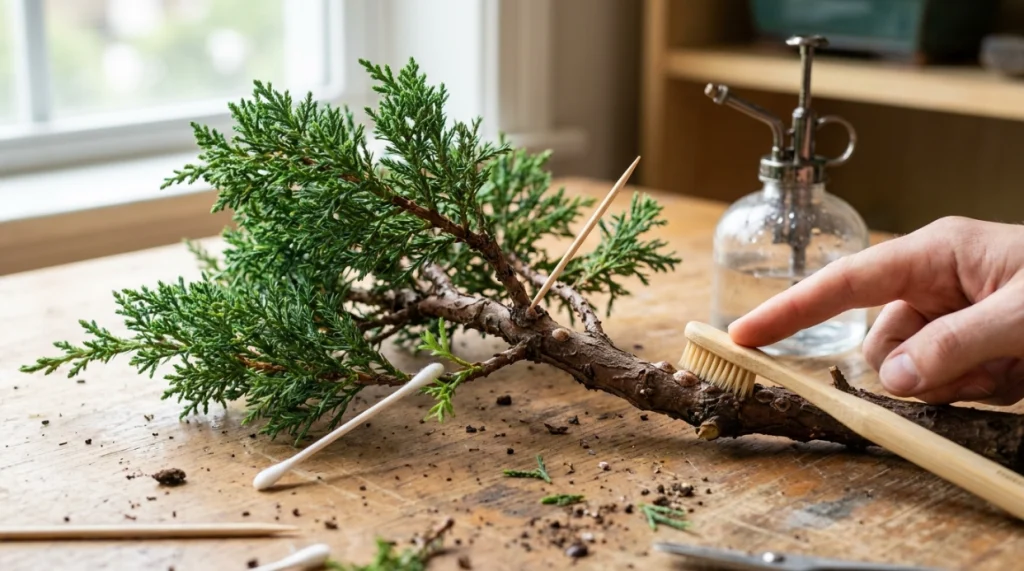
No single tool is best everywhere on a bonsai. Match the method to the strength and shape of the plant tissue beneath the scale.
| Method | Best Use | Main Advantage | Main Risk |
|---|---|---|---|
| Fingernail | Individual scales on firm bark | Excellent pressure control | Can scratch thin bark |
| Wooden toothpick | Branch joints and tight crevices | Precise reach | Point can gouge tissue |
| Cotton swab | Leaves, petioles, young stems | Gentle contact | Slow on large colonies |
| Soft toothbrush | Clusters on sturdy branches | Covers more surface quickly | Too much pressure can abrade bark |
| Controlled water rinse | Loose debris and exposed crawlers | No scraping | Strong water can break fine growth |
I use a fingernail or swab when only a few insects are present. Once scales form clusters on firm wood, a soft toothbrush usually makes the work more practical.
Hand removal becomes less practical when nearly every twig carries scale. At that point, removing visible adults can still reduce the population, but you’ll need closer monitoring and possibly another control method.
How Do You Remove Scale Without Damaging the Bonsai?
The goal is to disturb the insect, not the tree. Scale can often be loosened with surprisingly little pressure.
Use extra care on young bark, freshly extended shoots, buds, and thin leaves. These areas can suffer more damage from scraping than older woody branches.
- Ficus bonsai: Check leaf midribs, petioles, stems, and branch junctions before working on the bark.
- Chinese elm: Examine bark crevices carefully because natural bark texture can make identification harder.
- Juniper and pine: Inspect twigs and foliage bases, but avoid vigorous brushing through delicate foliage.
- Broadleaf tropical bonsai: Support each leaf while removing scale from its underside or central vein.
Don’t scrape a questionable bump simply because it has the right color. Shape, location, surrounding symptoms, and whether it separates from the plant all provide better evidence.
The Royal Horticultural Society notes that adult scales and egg masses can be physically removed, although manual removal alone may not control large populations.
That limitation is important. Hand removal works best when you can realistically inspect almost every affected area.
Pro tip: If removing a suspected scale risks damaging an important bud, fine twig, or live bark, leave that spot alone and ask an experienced grower or local bonsai club to help confirm the pest.
What Should You Do After Removing Scale?
Your job isn’t finished when the visible adults disappear. Young crawler stages may still be present or emerge later.
I like a simple follow-up routine: inspect the tree about once a week at first, focusing on the same branches where scale was removed. New bumps are much easier to spot on a branch you already cleaned.
- Recheck hidden areas: Inspect branch crotches, leaf undersides, petioles, and bark crevices.
- Look for crawlers: Use a hand lens to search for tiny moving yellowish or orange insects.
- Watch for honeydew: Fresh sticky residue may mean sap-feeding pests remain.
- Inspect neighboring plants: Check anything that previously touched or sat beside the affected bonsai.
- Keep the tree healthy: Maintain species-appropriate light, watering, airflow, and feeding.
A cleaned tree should stay isolated until repeated inspections show no obvious new scale. Don’t assume one thorough session has eliminated every life stage.
For a light infestation, persistence often matters more than force. Five careful inspection sessions are safer than one aggressive scraping session that scars your bonsai.
Frequently Asked Questions
Can I pick scale off a bonsai with my fingers?
Yes. Individual scales on sturdy bark can often be rubbed or lifted away with a fingernail, but use gentle sideways pressure and support thin branches while you work.
Does removing scale by hand kill it?
Physical disturbance can kill settled scale by damaging its feeding connection to the plant. However, removing visible adults doesn’t guarantee that eggs, crawlers, or hidden scales are gone.
Can I use a toothbrush to remove scale from bonsai?
Yes, but choose a soft toothbrush and reserve it for sturdy branches or clusters of scale. Use lighter tools around young bark, leaves, buds, and fine twigs.
Should I use rubbing alcohol while removing scale?
Alcohol can help with some plant pests, but it may also burn sensitive foliage. If you use it, apply only a small dab to an individual pest, test the plant first, and avoid soaking leaves or soil.
How often should I check my bonsai after removing scale?
Check it about weekly during the early follow-up period. Pay special attention to previously infested branches because crawler-stage scale can settle and become less noticeable as it matures.
Why are scales still stuck to the branch after treatment?
Dead scale insects can remain attached to plant tissue. That’s one reason I prefer removing old shells manually when practical, because a clean surface makes new infestations easier to detect.
When is hand removal not enough?
Manual removal becomes impractical when scale covers much of the canopy or repeatedly returns despite careful cleaning. A larger infestation may require an integrated treatment plan based on the scale type, crawler timing, plant species, and product labels.
The main takeaway: Remove scale patiently and use the least force necessary. Correct identification, gentle tools, and repeated inspection protect your bonsai better than aggressive scraping.
Start with the most visibly affected branch, clean it carefully, then work methodically through the rest of the tree. A few minutes of close inspection each week can also help you catch the next infestation while it is still manageable.