
Scale on Bonsai Branches and Trunks: Identification and Treatment

Quick Answer
Scale on bonsai branches and trunks usually appears as small brown, tan, gray, white, or waxy bumps attached firmly to bark and twigs. Confirm that the bumps are insects, remove manageable colonies gently, then target exposed crawlers with a labeled horticultural oil or insecticidal soap when appropriate, following UC IPM scale-management guidance.
Signs to Check
- Fixed bumps: Scale often stays attached to branches, twigs, bark crevices, and trunk surfaces.
- Sticky residue: Soft scale may produce honeydew on branches, leaves, pots, and benches.
- Black coating: Sooty mold can grow on honeydew from a heavy soft-scale infestation.
- Weak growth: Large populations may contribute to yellow foliage, poor vigor, or twig dieback.
- Moving crawlers: Newly hatched scale insects are mobile before settling and developing stronger protection.
Best First Move
- Isolate the bonsai, inspect the entire tree under bright light, and identify the pest before spraying anything.
Scale on bonsai branches and trunks is easy to miss because mature insects rarely look like normal bugs. On rough bark, they can resemble lenticels, old scars, dried sap, or part of the tree’s natural texture.
I approach suspicious bumps as an identification problem first. That prevents unnecessary spraying and makes the eventual treatment much more precise.
In This Guide
What Does Scale Look Like on Bonsai Branches and Trunks?
Scale insects usually look like small stationary bumps attached closely to bark, twigs, branches, or foliage. Mature stages may lack the obvious legs and body shape that growers expect from an insect.
Common scale coverings can be only a few millimeters across. UC IPM notes that many scale coverings range from roughly 1/25 to 1/4 inch long.
Definition: Scale insects are sap- or plant-tissue-feeding insects whose settled stages often remain attached to the plant beneath waxy, leathery, or shield-like protection.
Where should you inspect first?
Start where branches meet the trunk, then work outward toward smaller twigs. Bark cracks and protected branch crotches can hide colonies that are invisible from the front of the tree.
- Branch junctions: Inspect tight crotches and shaded interior growth.
- Rough bark: Look between flakes, ridges, and natural fissures.
- Young twigs: Check smooth shoots where new scale is easier to see.
- Pruning areas: Examine the bark around old cuts and scars.
- Surface roots: Inspect exposed woody roots near the trunk base.
- Leaves or needles: Check both surfaces because colonies may extend beyond the woody parts.
How do you know the bump is alive?
Compare the suspicious area with healthy bark elsewhere on the tree. Scale often appears as repeated bumps with similar size, shape, or color rather than normal irregular bark texture.
A hand lens around 10× makes this much easier. I also rotate the bonsai under side lighting because low-angle light makes raised insects stand out.
- Look for tiny crawlers near established scale.
- Check for sticky honeydew or nearby ants.
- Watch for yellow foliage or weakening shoots.
- Look for tiny parasitoid exit holes in old scale covers.
- Avoid aggressively scraping valuable or thin bark just to test a suspicious spot.
How Can You Tell Soft Scale From Armored Scale?
The most useful first distinction is whether you are dealing with soft scale or armored scale. Both can occur on woody plant parts, but their coverings and secondary symptoms differ.
Soft scale often produces sugary honeydew. Armored scale generally does not, so the absence of sticky residue does not rule out scale.
| Feature | Soft Scale | Armored Scale |
|---|---|---|
| Typical shape | Often rounded, convex, or dome-shaped | Often flatter, crust-like, circular, oval, or elongated |
| Protective covering | Covering is generally part of the insect’s body | Separate protective cover forms over the insect |
| Honeydew | Common with many species | Usually absent |
| Secondary clue | Ant activity and sooty mold may appear | Twig decline can occur without sticky foliage |
| Vulnerable stage | Young crawler stage | Young crawler stage |
Honeydew is useful evidence, but it is not a complete diagnosis. Aphids, mealybugs, and whiteflies can also produce sticky deposits.
For bonsai-specific pest identification, the Bonsai Empire pest and disease guide also includes scale among common bonsai pests.
How Do You Get Rid of Scale on Bonsai Branches and Trunks?
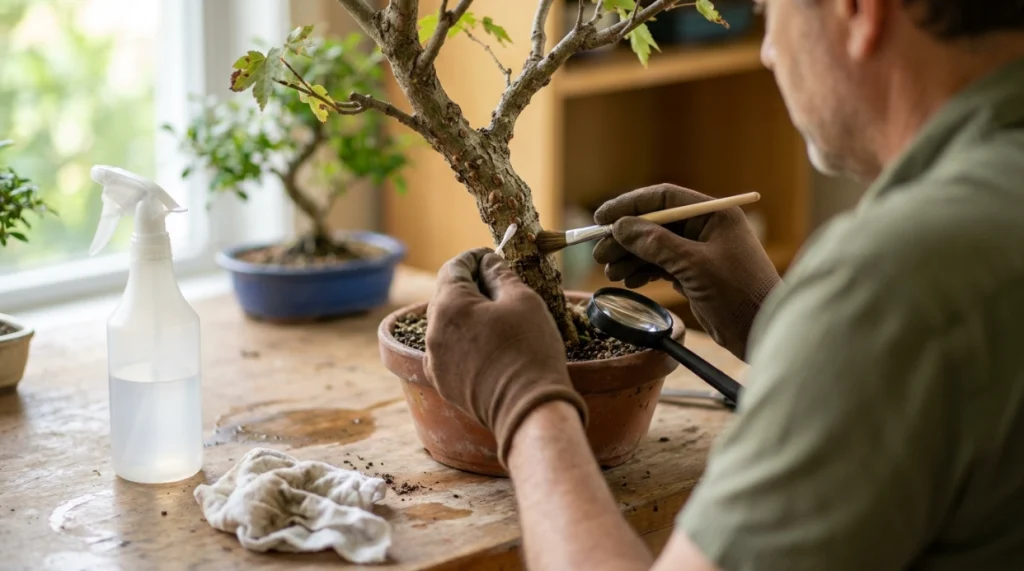
Start with the least disruptive method that can realistically control the infestation. A few reachable insects call for a different response than hundreds of scales covering every major branch.
I prefer to separate removal, treatment, and monitoring into distinct steps. That makes it easier to judge whether the infestation is shrinking.
- Isolate the bonsai. Move it away from other bonsai and houseplants while you inspect and treat it.
- Confirm live scale. Check multiple branches instead of assuming every bark bump is a pest.
- Remove accessible insects. Use a soft brush, cotton swab, or another gentle tool that will not scar the bark.
- Clean heavy honeydew. Removing sticky deposits makes later inspection easier.
- Monitor for crawlers. Young mobile scale is easier to target than protected mature insects.
- Apply a labeled treatment if needed. Horticultural oil or insecticidal soap may help when the product label includes the target pest and plant.
- Inspect again. Old scale covers may remain attached even after insects die, so judge success by new crawler activity and fresh symptoms.
Should you physically remove scale?
Yes, physical removal is useful for a light infestation on an accessible bonsai. The University of Maryland Extension describes brushing or mechanically removing scale as an environmentally friendly management option.
Use gentle pressure on smooth bark. Avoid digging underneath insects with a blade because a small scar can become far more noticeable on a bonsai trunk.
University of Maryland Extension scale guidance also recommends removing badly declined or dead infested branches when appropriate.
Should you prune infested branches?
Pruning makes sense when a branch is dead, severely declining, or so heavily infested that keeping it offers little value. Do not cut an important live branch merely because several insects are visible.
Pro tip: Major pruning is irreversible. On valuable material, discuss structural cuts with an experienced grower or local bonsai club before removing a live branch.
Do horticultural oil and insecticidal soap work?
They can, especially when coverage and timing are correct. These contact treatments are generally more effective against exposed crawlers than mature scale protected beneath established coverings.
- Read the label: Confirm the product is labeled for your plant and scale insects.
- Test first: Treat a small area before covering a valuable bonsai.
- Cover thoroughly: Branch undersides, crotches, and bark crevices are easy to miss.
- Respect conditions: Follow label restrictions involving temperature, sunlight, drought stress, and application frequency.
- Avoid random mixtures: Household detergents and homemade chemical combinations can injure foliage or bark.
I do not treat a bonsai by simply scaling down a landscape-tree pesticide routine. Concentration, host sensitivity, coverage, and label instructions still matter on a miniature tree.
Section Takeaway: Confirm the pest, physically remove manageable colonies, and use a labeled contact treatment when scale numbers justify it. The crawler stage gives you the best opportunity to reach insects before their protection becomes stronger.
When Is the Best Time to Treat Scale?
The crawler stage is usually the most vulnerable treatment window. Crawlers are newly hatched scale insects that still have legs and move before settling onto the plant.
The exact timing depends on the scale species, host tree, climate, and season. That is why monitoring works better than choosing one calendar date for every bonsai.
How do you monitor scale crawlers?
The University of Minnesota Extension recommends watching infested branches closely and using double-sided tape when monitoring for crawlers.
- Wrap a small piece of double-sided tape near an infested section.
- Check the tape at least weekly during likely hatch periods.
- Use magnification to look for tiny yellowish or orangish moving insects.
- Replace dirty tape so new activity remains easy to see.
Dormant-season horticultural oil can also be useful for some scale species and host plants. Apply it only when the product label supports that use on your particular tree.
As of 2026, integrated pest management remains the sensible approach: identify the insect, monitor its vulnerable stage, protect beneficial organisms, and treat only when necessary.
How Do You Keep Scale From Coming Back?
Successful treatment is not finished when the visible bumps disappear. A few missed insects or newly hatched crawlers can rebuild a colony.
Inspect the tree repeatedly for several weeks after treatment. Pay special attention to the same branch crotches and bark crevices where the first infestation appeared.
- Quarantine new trees: Inspect new bonsai before placing them beside an established collection.
- Check neighboring plants: Nearby hosts may maintain the infestation.
- Watch ants: Ant activity can point toward honeydew-producing soft scale.
- Avoid plant stress: Keep watering, light, drainage, and feeding appropriate for the species.
- Avoid excessive nitrogen: Do not push unnecessary soft growth on a tree already dealing with pests.
- Preserve natural enemies: Avoid unnecessary broad-spectrum insecticides that also kill predators and parasitoids.
- Inspect regularly: Look closely at woody branches instead of checking foliage alone.
The American Bonsai Society can also help growers locate bonsai education resources and clubs when a valuable tree needs hands-on advice.
My inspection habit is simple: I start at the trunk base, follow each primary branch outward, then check foliage last. That pattern keeps rough bark and hidden interior branches from becoming blind spots.
Frequently Asked Questions
Can scale insects live directly on a bonsai trunk?
Yes. Many scale insects can settle on trunks, branches, twigs, leaves, or needles depending on the species and host plant. Rough bark can make them harder to notice, so inspect crevices and branch junctions carefully.
Does sticky bark always mean soft scale?
No. Sticky honeydew strongly suggests a sap-feeding pest, but aphids, mealybugs, and whiteflies can also produce it. Confirm the actual insects before choosing a treatment.
Why are scale insects still attached after treatment?
Dead scale coverings may remain stuck to bark after successful treatment. Look for new crawlers, fresh honeydew, increasing numbers, or living tissue beneath the covers instead of judging success only by whether every shell disappears.
Can I scrape scale off my bonsai trunk?
Gentle mechanical removal can work on a light infestation, but avoid hard scraping. Thin bark and carefully developed trunk surfaces scar easily, so a soft brush or cotton swab is safer than a knife or sharp tool.
Will horticultural oil kill scale on bonsai?
Horticultural oil can control many scale insects when properly timed and thoroughly applied. Use only a product labeled for the target pest and host, and follow all directions concerning concentration, temperature, plant stress, and repeat applications.
How often should I check a bonsai after treating scale?
Check it frequently during the weeks following treatment, especially while crawlers may still hatch. Weekly inspection is a practical minimum during suspected crawler activity, while severe infestations deserve closer observation.
Can scale kill a bonsai tree?
A severe or persistent infestation can weaken growth and contribute to yellowing, leaf drop, twig dieback, or broader decline. Risk increases when the bonsai is already stressed by poor watering, damaged roots, heat, or another problem.
Final Takeaway
Scale on bonsai branches and trunks is manageable when you catch it early and identify it correctly. Look for attached bumps, determine whether honeydew is present, inspect for crawlers, and avoid treating normal bark features as pests.
Start with gentle removal and careful monitoring, then use a properly labeled horticultural oil or insecticidal soap when treatment is justified. Keep checking the bonsai afterward, because good follow-up is what prevents a small surviving population from becoming the next infestation.