
Spider Mites on Indoor Bonsai: Causes and Treatment

Quick Answer
Spider mites on indoor bonsai are tiny plant-feeding arachnids that cause pale stippling, dull or bronzed leaves, fine webbing, and sometimes leaf drop. Warm, dry conditions and plant stress can favor outbreaks, so confirm active mites first, isolate the tree, rinse the foliage, correct care problems, and use a labeled soap or horticultural oil when necessary; UC IPM’s spider mite guidance provides a useful identification and treatment reference.
Signs and causes to check
- Pale stippling: Tiny white or yellow dots appear where mites have damaged leaf cells.
- Fine webbing: Thin silk may develop beneath leaves or between shoots as populations increase.
- Moving specks: A 10× hand lens or white-paper test can reveal mites that are difficult to see unaided.
- Warm, dry air: Common web-spinning mites often multiply quickly in heated, dry indoor conditions.
- Water stress: A bonsai that repeatedly dries too far can suffer more severe mite damage.
What to do first
- Move the affected bonsai away from other plants, confirm live mites, rinse both sides of the foliage, and monitor closely before escalating treatment.
Spider mites on indoor bonsai can be frustrating because the damage often appears before the pest becomes obvious. I’ve seen growers change watering, fertilizer, and light several times before discovering tiny mites beneath the leaves.
The good news is that an early infestation is usually manageable. This guide explains why mites appear, how to confirm them, which treatments make sense, and how to reduce the chance of another outbreak.
In This Guide
- What Are Spider Mites on Indoor Bonsai?
- How Can You Tell If an Indoor Bonsai Has Spider Mites?
- What Causes Spider Mites on Indoor Bonsai?
- How Do You Treat Spider Mites on an Indoor Bonsai?
- Which Spider Mite Treatment Works Best?
- How Can You Keep Spider Mites From Coming Back?
- Spider Mites on Indoor Bonsai FAQ
What Are Spider Mites on Indoor Bonsai?
Spider mites are tiny plant-feeding arachnids related to spiders and ticks. They are mites, not true insects, which matters when you choose a treatment.
Definition: A spider mite is a small mite that pierces plant cells and removes their contents, leaving pale stippling, discoloration, bronzing, weakened foliage, and sometimes fine silk webbing.
Common web-spinning spider mites can be less than 1/20 inch long. A magnifying lens is therefore much more useful than relying on your eyes alone.
Why indoor bonsai can develop noticeable damage quickly
A bonsai is a full-sized plant species grown in a restricted root volume. Its compact canopy means a relatively small damaged area can affect a noticeable percentage of the foliage.
Indoor environments also remove some of the natural checks found outside. Warm rooms, dry air, limited rainfall, and fewer natural predators can create favorable conditions for mites.
- Tropical bonsai: Ficus and other warm-growing trees may remain indoors for long periods, giving mites a year-round host.
- Shallow containers: Bonsai soil can dry faster than the soil in a large houseplant pot.
- Dense foliage: Interior leaves and branch junctions provide sheltered feeding areas.
- Close plant spacing: Mites can move to neighboring susceptible plants when foliage touches.
Bonsai Empire’s pest and disease overview also identifies spider mites among common bonsai pests and emphasizes correct identification before treatment.
How Can You Tell If an Indoor Bonsai Has Spider Mites?
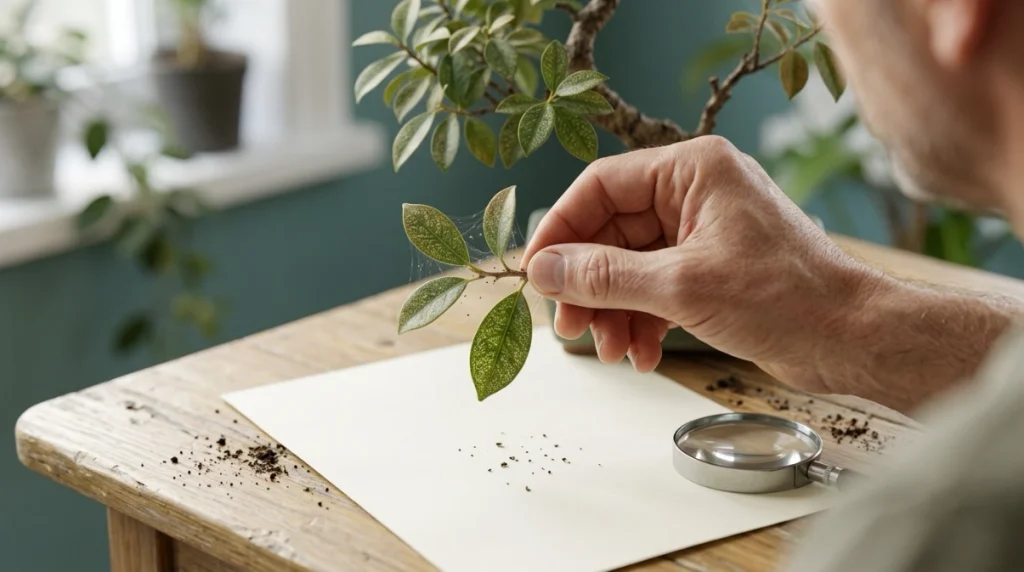
Look for a combination of fine stippling, dull foliage, tiny moving mites, and delicate webbing. Do not diagnose spider mites from yellow leaves or webbing alone.
Check for the characteristic feeding pattern
Spider mite feeding often creates many tiny pale dots instead of one large yellow patch. As damage becomes heavier, leaves may look gray-green, bronze, scorched, or unusually dull.
- Early damage: Fine white or yellow speckling across individual leaves.
- Moderate damage: Larger areas become faded, mottled, or bronze.
- Advanced damage: Leaves dry, curl, weaken, or fall prematurely.
- Heavy infestation: Fine silk may cover leaf undersides, petioles, shoot tips, or small twigs.
Use the white-paper test
This is the test I reach for first when a bonsai develops unexplained fine speckling. It takes less than a minute and helps separate mites from watering or nutrient problems.
- Hold a clean sheet of white paper beneath a suspicious branch.
- Tap or shake the foliage gently but sharply.
- Wait several seconds and watch the fallen particles.
- Use a 10× hand lens if available.
- Look for tiny specks that begin crawling across the paper.
Dust does not crawl. Moving dots combined with stippled foliage strongly support a spider mite diagnosis.
Inspect the underside of leaves
Check beneath affected leaves along the veins and around protected junctions. You may find moving oval mites, small eggs, pale shed skins, or fine silk.
The University of Maryland Extension’s mite guidance notes that mites can remain active year-round on indoor plants, making regular inspection especially useful.
What Causes Spider Mites on Indoor Bonsai?
Spider mites do not appear because a bonsai is dirty or poorly cared for. They must reach the plant, but environmental stress can help an existing population multiply or cause greater damage.
Warm, dry indoor conditions
Many common web-spinning spider mites become troublesome in warm, dry conditions. Heated homes during winter can therefore create an environment where mites remain active.
Dry air alone does not create spider mites. It simply favors some mite species once they are present.
Repeated drought stress
A shallow bonsai container may dry faster than a conventional houseplant pot. Trees allowed to become severely dry can suffer greater mite injury.
Do not solve this by keeping the soil permanently wet. Water according to the species, substrate, temperature, light, and actual moisture level.
New plants and nearby infestations
New bonsai, houseplants, cuttings, and nursery material can carry mites or eggs before obvious webbing develops. Nearby plants can also maintain a low population that later spreads.
- Inspect new plants before placing them beside your collection.
- Keep suspicious plants separated while you monitor them.
- Check neighboring houseplants after confirming mites on one bonsai.
- Avoid letting infested and healthy foliage touch.
Dust and broad-spectrum pesticides
Dusty foliage and dry conditions can favor outbreaks and make inspection harder. Periodic gentle rinsing can help where the bonsai species tolerates wet foliage.
Some broad-spectrum insecticides can also worsen mite problems by killing natural predators. This is one reason I avoid spraying an unidentified pest “just in case.”
Section Takeaway: Spider mites need to reach the tree first, but warm rooms, dry foliage, drought stress, dusty conditions, and disrupted natural predators can turn a small population into a serious problem.
How Do You Treat Spider Mites on an Indoor Bonsai?
Start with isolation and physical removal, then escalate only when monitoring shows that mites remain active. The goal is to control the pest without adding unnecessary stress to an already weakened bonsai.
1. Isolate the bonsai
Move the affected tree away from your other bonsai and houseplants. Give yourself enough room to inspect and spray the foliage from every direction.
Keep the tree in light and temperatures appropriate for its species. Do not suddenly place a shade-acclimated tropical bonsai in harsh outdoor sun because it has mites.
2. Rinse the foliage thoroughly
Use a controlled stream of water to dislodge mites from both sides of the leaves. Give extra attention to leaf undersides and sheltered interior growth.
- Protect loose bonsai substrate from being washed from the pot.
- Support delicate shoots while rinsing.
- Work from several angles.
- Allow foliage to drain with suitable airflow afterward.
For indoor plant pests, UC IPM’s houseplant guidance also recommends isolation, correct identification, washing foliage, and labeled treatments when physical controls are insufficient.
3. Use insecticidal soap or horticultural oil when needed
If rinsing does not control the infestation, a product labeled for spider mites and your plant can be appropriate. Insecticidal soaps and horticultural oils work mainly through direct contact, so coverage matters.
Spray the leaf undersides and protected foliage rather than misting only the visible canopy. Follow the product label for dilution, application interval, protective equipment, indoor-use restrictions, and temperature limits.
Test an unfamiliar product on a small part of the plant first when the label permits. Tender foliage and some species can react badly to soaps, oils, or combinations of treatments.
4. Inspect again after treatment
One application may not end an established infestation. Eggs or mites hidden from a contact spray can survive, so repeat inspection is essential.
Use the same white-paper test every few days while the problem is active. Repeat any pesticide treatment only at the interval allowed on its label.
Which Spider Mite Treatment Works Best?
No single method is best for every indoor bonsai. A light infestation may respond to rinsing, while an established colony can require a labeled contact treatment and repeated monitoring.
| Treatment | Best Use | Main Advantage | Main Limitation |
|---|---|---|---|
| Water rinse | Early or light infestations | Physically removes mites without pesticide residue | May require repeated, thorough rinsing |
| Insecticidal soap | Active mites on accessible foliage | Useful contact treatment when properly labeled | Must contact pests and may injure sensitive foliage |
| Horticultural oil | Persistent infestations where the label permits | Smothers mites when coverage is thorough | Heat, plant stress, and species sensitivity can limit use |
| Predatory mites | Suitable controlled indoor collections | Biological control without routine contact sprays | Requires correct predator selection and suitable conditions |
I normally begin with isolation, rinsing, and confirmation before reaching for a pesticide. That approach has saved me from treating yellowing caused by root stress as though it were a mite infestation.
If you choose a pesticide, start with a product specifically labeled for your pest and plant. UC IPM’s less-toxic pesticide guidance explains why soaps and insecticidal oils are commonly considered before broader-spectrum products.
Never mix treatments because the combination sounds stronger. Oil, soap, sulfur, and other products can have important label restrictions and may damage foliage when misused.
How Can You Keep Spider Mites From Coming Back?
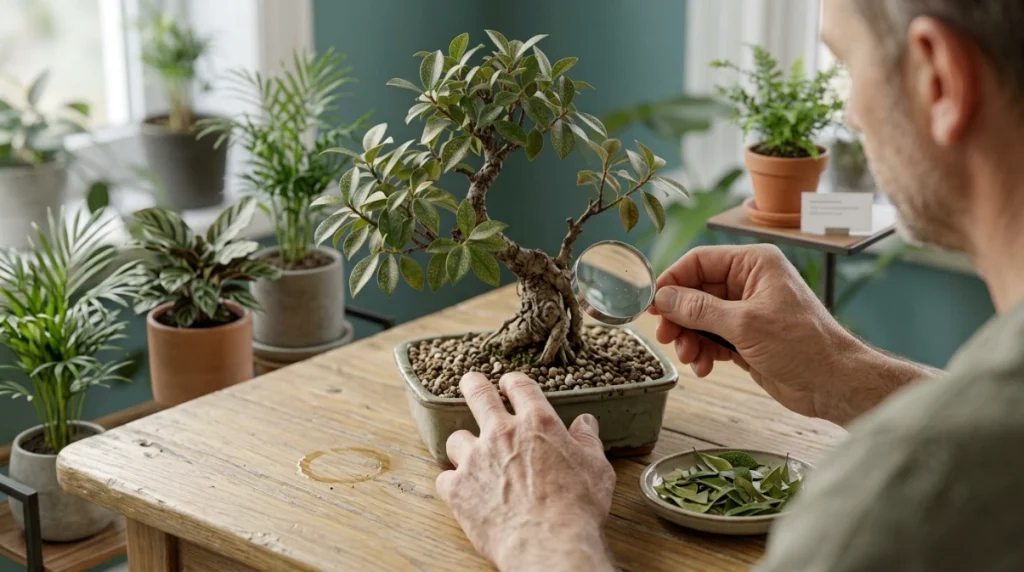
Prevention depends more on inspection and healthy growing conditions than on routine spraying. I would rather find five mites during a weekly check than discover a webbed canopy a month later.
Inspect your indoor bonsai weekly
Use a hand lens to check the underside of several leaves, especially where you previously found damage. Include interior foliage instead of inspecting only the outside of the canopy.
- Look for fresh stippling.
- Check for moving mites or eggs.
- Inspect fine branch junctions for silk.
- Repeat the white-paper test on suspicious branches.
- Check neighboring indoor plants.
Keep watering consistent
Prevent severe drought stress without turning the soil into a permanently saturated mass. Indoor bonsai still need the watering rhythm that suits their species and substrate.
Check the soil rather than watering by a fixed calendar. Light, temperature, pot size, root mass, and season can all change how fast a bonsai dries.
Quarantine new plants
Keep newly purchased plants away from an established collection while you inspect them for mites and other pests. A clean-looking plant can still carry eggs or a small hidden population.
Clean fallen leaves from the growing area and avoid sharing contaminated tools or plant debris between trees. Wash your hands after handling a heavily infested plant before working through the rest of the collection.
Do not rely on humidity alone
Raising humidity is not a complete spider mite treatment. The tree still needs proper root watering, light, airflow, and direct pest management when mites are already established.
As of 2026, integrated pest management remains the approach I favor: identify first, reduce stress, use physical controls, monitor results, and apply a labeled pesticide only when it is justified.
Section Takeaway: Weekly inspection, correct watering, clean foliage, plant spacing, and temporary quarantine are more useful for long-term prevention than routine pesticide spraying.
Spider Mites on Indoor Bonsai FAQ
Can spider mites kill an indoor bonsai?
Yes. A severe, untreated infestation can remove enough healthy leaf tissue to weaken a bonsai substantially, especially if the tree is already stressed. Early identification and treatment usually give the tree a much better chance to recover.
Do spider mites live in bonsai soil?
Common spider mites mainly feed and reproduce on plant foliage rather than living as a soil pest. Focus your inspection on leaf undersides, stems, protected branch junctions, and nearby plants instead of treating the soil without evidence.
Does misting an indoor bonsai get rid of spider mites?
Light misting alone is unreliable. A thorough water rinse can physically dislodge mites, but an established infestation may still require repeated washing, monitoring, or a labeled insecticidal soap or horticultural oil.
How often should I treat a bonsai for spider mites?
There is no universal spray interval. Inspect the bonsai frequently, then repeat any pesticide application only according to the specific product label because formulations, plant tolerances, and legal directions differ.
Why did spider mites return after spraying?
Contact treatments can miss eggs and mites hidden beneath leaves or inside dense growth. Reinfestation can also come from neighboring plants, so check the whole growing area and continue monitoring after visible webbing disappears.
Should I remove leaves damaged by spider mites?
Remove only badly damaged foliage when doing so will not weaken the tree further. A stressed bonsai may need its remaining functional leaves for recovery, so avoid stripping the canopy simply because older leaves still show cosmetic damage.
Pro tip: If removing foliage would involve major pruning or irreversible work on a weak bonsai, get advice from an experienced grower or local bonsai club before cutting heavily.
Can an indoor bonsai recover after spider mites?
Many bonsai recover once active mites are controlled and normal care resumes. Damaged leaves usually will not become green again, so judge recovery by stable watering, healthy remaining foliage, and clean new growth rather than old leaf appearance.
Spider mites are much easier to manage when you confirm them early. Keep a hand lens nearby, inspect suspicious foliage before changing your care routine, and treat the tree with the least disruptive method that solves the problem.
Once the mites are controlled, focus on healthy growth rather than forcing rapid recovery. Consistent light, species-appropriate watering, clean foliage, and regular inspections give your indoor bonsai the best chance to rebuild a healthy canopy.