
Spider Mites on Outdoor Bonsai: Prevention and Control

Quick Answer
Spider mites on outdoor bonsai are best controlled by confirming the pest early, reducing drought stress, washing mites from foliage, and protecting natural predators. If populations persist, use a product specifically labeled for spider mites and the plant species, following guidance such as the Colorado State University Extension spider mite guide.
What to do first
- Confirm the mites: Tap suspicious foliage over white paper and look for tiny moving specks.
- Check leaf undersides: Look for stippling, mites, eggs, shed skins, and fine silk webbing.
- Separate the tree: Move an infested bonsai away from tightly grouped trees while you assess the problem.
- Rinse the foliage: A firm but plant-safe spray of water can remove many mites and disrupt webbing.
- Correct dry stress: Water the root ball properly without keeping the bonsai constantly wet.
- Repeat inspections: Eggs and newly hatched mites can survive the first treatment, so one check is rarely enough.
Avoid this common mistake
- Do not automatically reach for a broad-spectrum insecticide. Spider mites are arachnids, and some insecticides can also kill predators that naturally suppress them.
Spider mites can turn a healthy outdoor bonsai into a dull, speckled tree surprisingly fast. The problem becomes especially noticeable during hot, dry weather when a small population can multiply before the damage catches your eye.
I treat spider-mite prevention as part of normal summer bonsai maintenance rather than an emergency job. A thirty-second leaf check while watering is much easier than recovering a badly bronzed tree later.
In This Guide
- Why Do Outdoor Bonsai Get Spider Mites?
- How Can You Tell If a Bonsai Has Spider Mites?
- How Do You Prevent Spider Mites on Outdoor Bonsai?
- How Do You Control Spider Mites Before They Spread?
- Which Spider Mite Treatments Work on Bonsai?
- How Long Should You Monitor a Bonsai After Treatment?
- Frequently Asked Questions
Why Do Outdoor Bonsai Get Spider Mites?
Outdoor bonsai get spider mites when susceptible foliage, favorable weather, and plant stress overlap. Hot, dry, dusty conditions are especially favorable for many important spider-mite species.
Definition: Spider mites are tiny plant-feeding arachnids in the family Tetranychidae. They pierce plant cells and remove their contents, producing pale stippling, bronzing, drying, and sometimes premature leaf drop.
Small bonsai pots can increase drought stress
A bonsai has far less soil volume than the same species growing in the ground. On a hot afternoon, a shallow pot can move from adequately moist to dry much faster than a garden bed.
Drought stress does not create mites, but it can make conditions more favorable for an outbreak. The tree is also less able to tolerate continuing leaf damage.
- Shallow containers: Small soil volumes heat and dry quickly.
- High leaf exposure: Bonsai foliage may receive strong sun and drying wind.
- Restricted roots: The root system cannot access moisture beyond the pot.
- Bench conditions: Hot walls, paving, gravel, and reflected sunlight can raise local temperatures.
- Dust: Dry, dusty foliage can favor spider-mite problems and interfere with some natural enemies.
Spider mites reproduce quickly in favorable weather
Some spider mites can move through their life cycle in roughly one to two weeks when conditions suit them. That is why an infestation can appear to explode between inspections.
The exact timing varies with mite species and temperature. Cool-season mites found on some conifers may behave differently from the common twospotted spider mite.
Outdoor bonsai can lose natural protection
Predatory mites, small lady beetles, predatory thrips, and other beneficial arthropods naturally feed on spider mites. Preserving these predators is an important part of outdoor pest management.
Broad-spectrum pesticide use can disrupt that balance. Colorado State University Extension notes that some insecticide use can contribute to spider-mite outbreaks by killing their natural enemies.
You can read more about this predator-pest relationship in the CSU Extension overview of spider mites.
Section Takeaway: Outdoor bonsai are most vulnerable when mites meet hot, dry conditions and a stressed tree. Good watering, clean foliage, regular inspection, and predator-friendly pest management provide the strongest foundation for prevention.
How Can You Tell If a Bonsai Has Spider Mites?
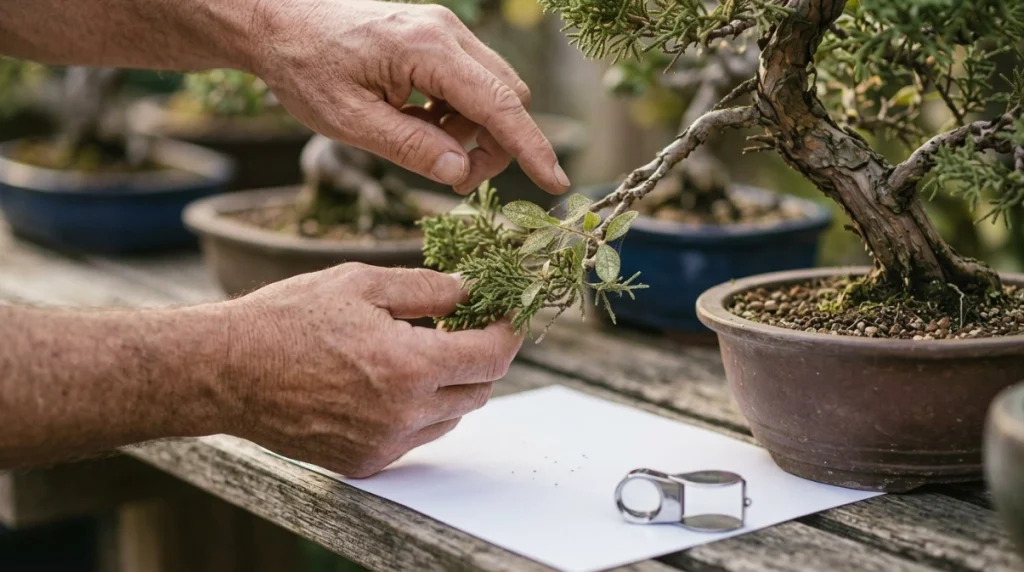
Look for fine stippling, dull or bronzed foliage, tiny mites on leaf undersides, and delicate webbing. Confirming living mites before spraying prevents unnecessary treatment.
Fine webbing alone is not enough. Ordinary spiders can also build silk around a bonsai, although their webbing usually looks different.
Check for characteristic feeding damage
Spider mites feed by damaging individual plant cells. Early injury often appears as many tiny pale dots rather than one large yellow patch.
- Pale stippling: Numerous pin-sized white or yellow dots across the leaf.
- Dull foliage: Leaves lose their normal glossy or rich green appearance.
- Bronzing: Heavier feeding can turn foliage gray-green, yellow, tan, or bronze.
- Drying edges: Damaged leaves may become brittle as injury progresses.
- Leaf drop: Severe infestations can cause premature loss of leaves or needles.
Inspect the underside of leaves
Turn affected leaves over before looking at the upper surface again. Mites, eggs, shed skins, and early feeding damage often concentrate underneath.
A 10× hand lens makes the inspection easier. Without magnification, active mites may look like slowly moving grains of dust.
Use the white-paper tap test
Hold clean white paper beneath a suspicious branch. Tap or shake the branch sharply several times.
Watch the paper for tiny specks that begin moving. Crushing a suspicious speck may also leave a colored smear, although movement is a more useful clue than color alone.
| What You See | Spider Mites? | What to Check Next |
|---|---|---|
| Fine pale stippling | Likely | Inspect leaf undersides with a hand lens. |
| Fine silk plus stippling | Strong warning sign | Use the white-paper tap test. |
| Large spider web only | Not necessarily | Look for feeding damage and moving mites. |
| Sticky leaves | Less typical | Check for aphids, scale, or mealybugs. |
| White powdery coating | Usually another problem | Consider powdery mildew or spray residue. |
Bonsai Empire also lists spider mites among common bonsai pests and recommends identifying the pest before choosing a treatment. Its broader bonsai pests and diseases guide is useful when several symptoms overlap.
How Do You Prevent Spider Mites on Outdoor Bonsai?
The most effective prevention strategy is to keep trees properly watered, inspect foliage frequently, reduce dusty stress, and avoid unnecessary pesticide use. Prevention works best as a routine rather than a one-time treatment.
Water the root ball correctly
Do not let a mite-prone bonsai repeatedly wilt from lack of water. Check moisture according to the species, soil mixture, pot depth, weather, and root condition.
At the same time, never fight spider mites by keeping the soil permanently wet. Root suffocation and root rot create a different problem without reliably controlling mites.
Rinse foliage during dry periods
A directed water spray can physically dislodge mites, remove dust, and break apart some webbing. This is especially useful before populations become heavy.
Support delicate branches while rinsing them. Avoid a jet strong enough to strip foliage, expose roots, or wash soil from the pot.
Inspect more often during high-risk weather
My summer routine is simple: when several hot, dry days arrive together, I inspect susceptible foliage during watering. I focus on the oldest damaged leaves first, then check nearby trees.
- Normal growing weather: Check foliage at least weekly.
- Hot, dry spells: Check every few days if mites have been a previous problem.
- After buying a tree: Keep it separated long enough to inspect for hidden pests.
- After an outbreak: Inspect neighboring bonsai even if they still look healthy.
Preserve beneficial predators
Outdoor bonsai benefit from a miniature ecosystem around them. Predatory mites, minute pirate bugs, predatory thrips, and specialized lady beetles can help keep plant-feeding mites under pressure.
Avoid spraying the entire collection simply because one tree has a few mites. Targeted management causes less disruption than routine broad-spectrum treatment.
Keep the growing area clean without sterilizing it
Remove badly damaged fallen leaves and control weeds touching your benches. Keep enough spacing between trees to make inspection and treatment practical.
You do not need a sterile garden. The goal is to reduce neglected hiding places and make developing pest problems easier to see.
Section Takeaway: Spider-mite prevention is mostly good bonsai culture. Proper watering, frequent inspection, occasional foliage washing, sensible spacing, and protection of beneficial predators make outbreaks less likely to gain momentum.
How Do You Control Spider Mites Before They Spread?
Start with isolation, confirmation, water-based removal, and repeated inspection. Escalate to a labeled treatment only when the mite population continues to grow.
Step 1: Move the affected bonsai
Place the tree away from closely grouped bonsai where practical. Spider mites can move between touching foliage and may also disperse to nearby plants.
Do not put a sun-loving outdoor species into a dark garage for weeks. Maintain suitable light, temperature, and watering while creating useful separation.
Step 2: Remove the worst foliage only when appropriate
Badly infested leaves can hold large numbers of mites, eggs, and webbing. Removing a small amount of severely damaged foliage may reduce the population.
Avoid stripping a weak bonsai simply to remove mites. The remaining healthy foliage is still needed for photosynthesis and recovery.
Pro tip: If pest removal would require heavy pruning or cutting important branches, ask an experienced grower or local bonsai club before making irreversible cuts.
Step 3: Wash the canopy thoroughly
Direct water toward leaf undersides, interior shoots, and branch junctions. These sheltered areas are easy to miss during a casual rinse.
Colorado State University Extension specifically recommends periodic hosing as a mechanical spider-mite control. The water can remove mites, reduce dust, and disrupt protective webbing.
Step 4: Inspect nearby bonsai
Check trees positioned beside the infested bonsai. Prioritize the same species and trees showing unexplained stippling or dull foliage.
- Check the underside of several leaves from different branches.
- Tap suspicious branches over white paper.
- Look around branch forks for fine silk.
- Record which trees show live moving mites.
Step 5: Repeat instead of assuming one rinse worked
Spider mites lay eggs, and not every life stage will be removed at once. Recheck the bonsai every few days while the outbreak is active.
If live mites continue increasing despite mechanical control, move to a labeled soap, horticultural oil, or miticide appropriate for the species.
Which Spider Mite Treatments Work on Bonsai?
No single treatment is ideal for every bonsai. The safest choice depends on the tree species, mite population, weather, foliage condition, and product label.
| Method | Best Use | Main Limitation |
|---|---|---|
| Water spray | Early or light infestations | Usually needs repetition |
| Insecticidal soap | Direct contact with exposed mites | Coverage is critical; some plants are sensitive |
| Horticultural oil | Contact management of mites and some eggs | Species, temperature, and label restrictions matter |
| Predatory mites | Biological-control programs | Success depends on predator species and conditions |
| Labeled miticide | Persistent or serious infestations | Resistance, plant safety, and label limits |
Insecticidal soap
Insecticidal soaps work mainly through direct contact, so thorough coverage matters. They should not be confused with homemade dish-detergent mixtures.
Some plants can suffer spray injury. CSU Extension recommends testing uncertain plants on a small area and following label directions carefully in its guide to insecticidal soap.
Apply only a product labeled for your intended plant and use. Avoid improvising stronger concentrations because the first spray did not eliminate every mite.
Horticultural oils
Horticultural oils can control spider mites by coating susceptible life stages. Good contact with the pest is essential.
Modern oil products vary, so check the label for plant restrictions, temperature limits, mixing warnings, and suitable application timing. Some bonsai species or tender foliage may be sensitive.
For background on appropriate uses, see CSU Extension’s horticultural oil guidance.
Predatory mites
Predatory mites are natural enemies of plant-feeding mites. Species used in biological control include members of the family Phytoseiidae.
They are not a simple “release once and forget” solution outdoors. Temperature, humidity, pesticide history, prey density, and the predator species all influence results.
Miticides and acaricides
A miticide or acaricide is a pesticide intended to control mites. A general insecticide should not be assumed to control spider mites.
Resistance is also a concern with repeated pesticide use. Rotate active ingredients only where the product label and local guidance permit it, rather than repeatedly spraying the same material.
What about neem oil?
Some commercially labeled neem-based horticultural products can have activity against mites. Their formulation, concentration, and approved plant uses matter more than the word “neem” on the bottle.
Do not substitute an unmeasured homemade oil mixture. Bonsai foliage can be damaged by excessive oil, strong sun, heat, incompatible products, or an unsuitable concentration.
When should you spray?
Follow the product label above any general online schedule. Labels provide the legal application rate, repeat interval, weather restrictions, and plant-safety information for that specific formulation.
- Avoid stressed trees: Correct severe dehydration before adding chemical stress where possible.
- Test first: Treat a small portion when species sensitivity is uncertain.
- Cover undersides: Spider mites commonly occupy protected leaf surfaces.
- Respect temperature limits: Oils and soaps can injure foliage under unsuitable conditions.
- Repeat only as labeled: More frequent spraying is not automatically more effective.
Section Takeaway: Start with the least disruptive control that can realistically work. If you need soap, oil, or a miticide, product labeling and complete coverage matter more than aggressive dosing.
How Long Should You Monitor a Bonsai After Treatment?
Keep checking until repeated inspections find no active mites and new foliage remains clean. A single mite-free inspection immediately after spraying is not enough.
Watch for new feeding, not old scars
Existing stippling and bronzing will not necessarily disappear after the mites die. Use new damage and live-mite checks to judge whether control is working.
Healthy new leaves or needles are more informative than damaged tissue that developed before treatment.
Recheck at short intervals during an active outbreak
Inspect every few days at first, especially during warm weather. The goal is to catch newly active mites before their numbers rebuild.
- Repeat the white-paper test.
- Inspect new and older foliage.
- Check adjacent bonsai.
- Look for fresh webbing.
- Record whether active mites are increasing or decreasing.
Continue normal bonsai care
Do not compensate for mite damage with excessive fertilizer. A stressed tree benefits more from stable watering, appropriate light, and time to rebuild foliage.
If the root ball dries unusually fast, correct the watering problem rather than repeatedly misting the leaves. Foliar moisture cannot replace proper root-zone hydration.
Investigate if the tree keeps declining
If no live spider mites remain but the bonsai continues deteriorating, reconsider the diagnosis. Root problems, heat injury, nutrient issues, fungal disease, scale insects, and other pests can produce overlapping symptoms.
That distinction matters. Treating a nonexistent mite problem repeatedly can damage foliage while the real cause remains untouched.
Frequently Asked Questions
Can spider mites kill an outdoor bonsai?
A heavy infestation can seriously weaken a bonsai and cause extensive leaf or needle loss. Severe damage is more dangerous when the tree is already stressed by drought, heat, root problems, recent repotting, or another health issue.
Do spider mites live in bonsai soil?
The plant-feeding spider mites responsible for stippling and webbing are primarily associated with foliage and other above-ground plant surfaces. Tiny organisms moving across damp soil may be different mites, springtails, or other arthropods, so identify them before treating.
Will rain get rid of spider mites?
Rain can wash some mites from foliage and make conditions less favorable, but one rainfall should not be treated as a complete cure. Inspect the bonsai afterward and confirm whether living mites remain.
Should I repot a bonsai because it has spider mites?
Usually not. Spider-mite treatment focuses on the foliage, plant health, and pest population, while unnecessary repotting can add root stress during an outbreak.
Repot only when the tree already needs repotting for legitimate root, soil, or drainage reasons.
Can I use dish soap on spider mites?
I prefer a commercially formulated insecticidal soap labeled for plants rather than household detergent. Dishwashing products vary in ingredients and concentration, so they can cause unpredictable foliage injury.
Does misting prevent spider mites?
Occasional misting alone is not a dependable prevention program. Proper root watering, washing foliage when useful, monitoring susceptible leaves, reducing drought stress, and protecting natural predators have greater practical value outdoors.
Why did spider mites return after spraying?
Eggs or mites may have escaped the first application, coverage may have missed leaf undersides, or nearby plants may still be infested. Pesticide resistance and using a product that does not effectively target mites are other possible explanations.
How Do You Keep Spider Mites From Coming Back?
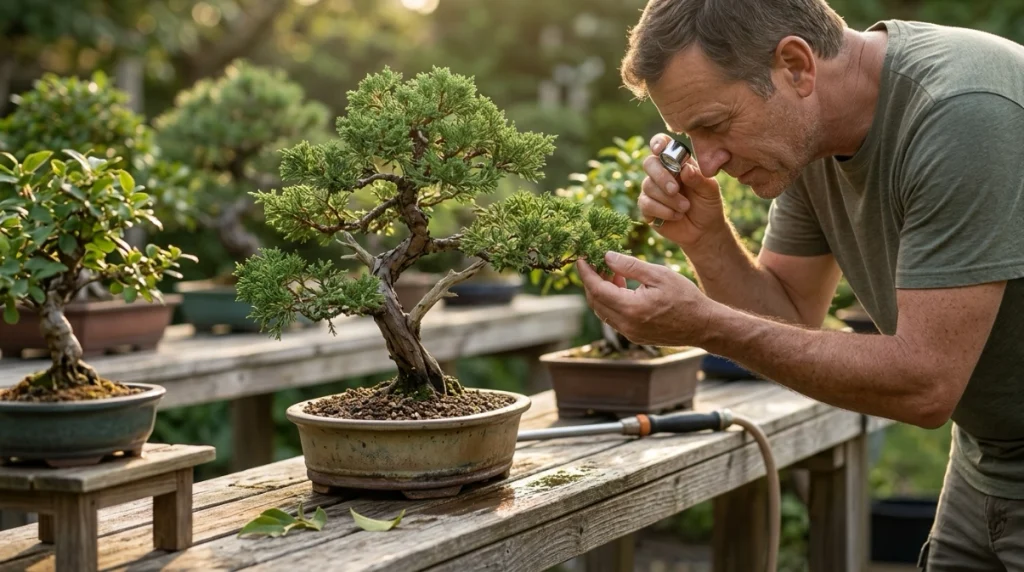
Make spider-mite inspection part of routine outdoor bonsai care. Catching five mites is easier than treating a canopy covered in webbing.
During hot, dry weather in 2026 and beyond, pay particular attention to water stress, dusty foliage, and trees with a previous history of mites. Use the white-paper test before damage becomes severe.
- Water according to the tree’s actual root-zone needs.
- Inspect leaf undersides during warm, dry periods.
- Wash mites and dust from foliage when appropriate.
- Separate newly acquired or infested trees from close neighbors.
- Avoid unnecessary broad-spectrum pesticide use.
- Use only labeled soaps, oils, or miticides when treatment is needed.
- Keep monitoring after the visible symptoms stop worsening.
The aim is not to create a pest-free sterile bench. It is to keep spider-mite populations low enough that healthy bonsai and their natural predators stay ahead of them.
If your tree is already showing heavy bronzing, widespread webbing, or rapid leaf loss, confirm the pest today and start with the least disruptive effective control. Early action gives the bonsai the best chance to recover without unnecessary stress.