How to Treat Bonsai After a Scale Infestation
Quick Answer
After a scale infestation, keep your bonsai isolated, remove remaining scale and honeydew, and give the tree stable care while it rebuilds strength. Avoid heavy fertilizer, unnecessary repotting, or aggressive pruning, and continue monitoring for crawlers using guidance such as the UC IPM scale management guide.
What to do after the infestation
- Keep it isolated: Don’t immediately return the bonsai to your collection because hidden scale or newly hatched crawlers may remain.
- Clean the tree: Remove dead scale coverings, honeydew, sooty residue, and fallen plant debris without damaging bark or buds.
- Water normally: Check the soil and water according to the species instead of keeping the root ball constantly wet.
- Delay stressful work: Avoid major pruning, wiring, or repotting unless another serious problem makes it necessary.
- Watch new growth: Healthy buds, firm foliage, and normal shoot development are stronger recovery signs than old damaged leaves.
- Inspect repeatedly: Check branches, leaf undersides, and branch unions for new crawlers or scale at least weekly during recovery.
Most important rule
- Help the tree regain steady growth rather than trying to force fast recovery with extra fertilizer or repeated treatments.
Getting rid of visible scale is only the first half of the job. I treat the following weeks as a recovery period because the bonsai may still be weakened by sap loss, leaf damage, treatment stress, or hidden crawlers.
How you care for the tree now matters. This guide explains how I stabilize watering, light, feeding, pruning, monitoring, and general bonsai care after a scale infestation.
In This Guide
- What Should You Do Immediately After a Scale Infestation?
- How Should You Water a Bonsai After Scale?
- Should You Fertilize a Bonsai After Scale Treatment?
- Should You Prune or Repot After a Scale Infestation?
- How Do You Know Your Bonsai Is Recovering?
- How Can You Keep Scale From Coming Back?
- Frequently Asked Questions
What Should You Do Immediately After a Scale Infestation?
Keep the bonsai separated from other plants and inspect it again before changing anything else. An apparently clean tree can still contain tiny crawlers, eggs beneath coverings, or scale hidden around branch junctions.
Post-infestation recovery is the period when you protect a treated bonsai from reinfestation and unnecessary stress while healthy growth resumes.
Remove residue without damaging the tree
Old scale coverings may remain attached after insects die. Soft scale can also leave sticky honeydew that supports dark sooty mold on plant surfaces.
- Inspect bark: Look along branches, trunk crevices, and branch unions.
- Check foliage: Examine leaf undersides, petioles, needles, and tender shoots.
- Remove loose debris: Clean fallen leaves and material around the pot.
- Clean honeydew: Gently wash sticky residue where the species tolerates it.
- Use magnification: A simple 10× hand lens helps distinguish tiny crawlers from dirt.
Don’t scrape aggressively at mature bark. Bonsai trunks often contain natural cork, lenticels, scars, and texture that can resemble scale.
Continue monitoring after treatment
I never assume one clean inspection means the problem has ended. Scale life stages can overlap, and protected adults are harder to control than exposed crawlers.
The University of Minnesota Extension scale guide recommends monitoring for crawlers and notes that this exposed stage is often the best time for treatment.
- Inspect the tree at least once each week.
- Look for yellowish or reddish moving specks.
- Check for fresh sticky honeydew.
- Watch for newly appearing attached bumps.
- Inspect nearby plants that were previously close to the bonsai.
For a valuable tree, I prefer several clean inspections over rushing it back beside the rest of the collection.
How Should You Water a Bonsai After Scale?
Water according to the root ball’s condition, not because the tree looks stressed. Giving extra water to a weakened bonsai can create a second problem if the soil remains saturated.
Scale feeds above the soil on plant tissue. A foliage infestation does not automatically mean the roots need more water.
Check moisture before watering
During active growth, I check a recovering bonsai frequently because foliage loss can change how quickly the pot dries. A tree with fewer leaves may use water more slowly than it did before the infestation.
- Check the surface: Look for the normal drying pattern of your soil mix.
- Check below it: Don’t judge moisture from a dry-looking surface alone.
- Water thoroughly: When watering is needed, wet the root ball evenly.
- Allow drainage: Never leave the pot sitting continuously in drainage water.
- Recheck daily: Small bonsai pots can change moisture quickly during hot weather.
A fast-draining akadama, pumice, and lava-based mix behaves differently from dense organic potting soil. Species, pot depth, weather, root health, and foliage density also affect drying speed.
Keep the environment stable
Recovery isn’t the time for abrupt changes from shade to harsh sun or from protected conditions to extreme heat. Give the species its normal suitable light while considering any temporary sensitivity caused by treatment.
Horticultural oils deserve particular caution. Colorado State University Extension notes that plant sensitivity and drought stress can increase the risk of injury from oils.
- Follow the pesticide or horticultural-oil label.
- Respect temperature and sunlight restrictions.
- Don’t spray a drought-stressed tree.
- Avoid stacking several treatments without a clear reason.
The goal is boring, predictable care. That’s exactly what a weakened bonsai needs.
Should You Fertilize a Bonsai After Scale Treatment?
Don’t use heavy fertilizer to force a stressed bonsai to recover. Resume normal feeding when the tree is actively growing and its roots, moisture balance, and foliage appear stable.
Fertilizer supplies nutrients. It doesn’t repair damaged leaves or eliminate remaining scale.
Let the tree show you it is ready
I look for active buds, stable leaf color, firm foliage, and normal water use before returning a weakened tree to its regular feeding routine.
- Good sign: Buds expand normally.
- Good sign: New leaves remain firm and correctly colored.
- Good sign: Shoot growth continues without sudden collapse.
- Warning sign: Leaves keep yellowing rapidly.
- Warning sign: Branch tips continue dying.
- Warning sign: The root ball remains wet much longer than expected.
Once growth is stable, follow the normal fertilizer schedule for that species and season. Avoid applying stronger doses simply because the tree recently suffered pest damage.
Excess nitrogen can also encourage soft, tender growth. Balanced recovery is more useful than a sudden flush that the weakened root system and canopy may struggle to support.
Should You Prune or Repot After a Scale Infestation?
Avoid combining pest recovery with major pruning, root work, wiring, or repotting unless another urgent problem requires it. Each major operation asks the tree to spend additional energy adapting.
A scale infestation on foliage and branches does not, by itself, mean the bonsai needs fresh soil or root pruning.
When light pruning can make sense
Removing a dead leaf, dead twig, or badly infested expendable shoot can improve inspection and sanitation. Don’t turn that cleanup into a major styling session.
- Remove clearly dead material when appropriate.
- Remove heavily infested disposable foliage if necessary.
- Keep healthy foliage that helps power recovery.
- Delay structural pruning when possible.
- Delay major wiring until vigor returns.
Pro tip: Any cut involving valuable live branches or major structural work is irreversible. If you’re unsure, ask an experienced grower or find support through the American Bonsai Society or a local bonsai club before cutting.
When repotting may be justified
Repot because of a root or soil problem, not simply because scale appeared. Serious drainage failure, root disease, badly decomposed substrate, or an appropriate scheduled repot may justify separate consideration.
If the roots are functioning and the soil drains correctly, keeping them undisturbed usually removes one major source of additional stress.
How Do You Know Your Bonsai Is Recovering?
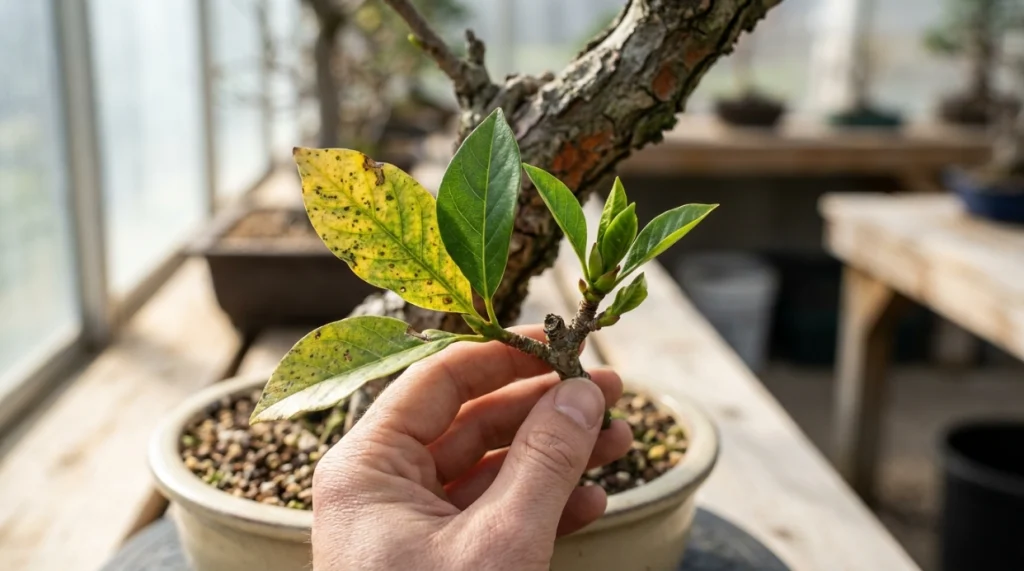
Healthy new growth is usually more useful than the appearance of old damaged foliage. Existing yellow spots, scars, or lost leaves may not reverse even after the pest is gone.
Focus on what happens next.
| What You See | What It May Mean | What to Do |
|---|---|---|
| Healthy buds opening | Recovery is progressing | Maintain stable normal care |
| No fresh honeydew | Soft-scale activity may have stopped | Continue inspections |
| No new attached bumps | Control may be working | Keep checking hidden areas |
| Fresh crawlers appear | The infestation is still active | Use an appropriate label-approved treatment |
| Increasing twig dieback | Severe stress or another problem may remain | Check pests, roots, watering, and disease |
| Burned or spotted foliage after spraying | Possible treatment injury | Stop unnecessary applications and review the label |
Old damage can remain visible
A leaf damaged by scale doesn’t need to become perfect again for the treatment to have worked. Deciduous trees may eventually replace damaged leaves, while evergreen foliage can show old injury much longer.
The Bonsai Empire pest and disease guide also emphasizes regular inspection because symptoms such as sticky residue, discoloration, or abnormal growth can help reveal pest problems early.
As of 2026, my practical recovery test remains simple: look for normal new growth and no evidence of a rebuilding scale population.
How Can You Keep Scale From Coming Back?
Preventing another infestation depends more on inspection and good plant care than repeated preventive spraying. Healthy growing conditions also make changes in a bonsai easier to notice.
Build a simple inspection routine
I rotate each tree while inspecting it instead of looking only at the display side. Scale commonly hides in places you won’t notice from the front.
- Check leaf undersides and needles.
- Inspect new shoots and petioles.
- Look closely at branch forks.
- Examine rough bark and crevices.
- Watch for honeydew and sooty mold.
- Use a 10× hand lens on suspicious areas.
Pay extra attention to recently treated trees and new plants entering your collection. A short inspection takes much less effort than controlling a large infestation.
Don’t ignore ants and honeydew
Soft scales can produce sugary honeydew that attracts ants. UC IPM notes that pest-tending ants can interfere with beneficial predators and parasitoids that help control some scale populations.
Avoid broad-spectrum insecticides unless they are genuinely needed and appropriate. They can harm beneficial organisms while failing to solve the underlying care problem.
- Keep benches and growing areas clean.
- Separate suspicious new plants.
- Provide suitable airflow.
- Give each species appropriate light.
- Water according to root-zone moisture.
- Avoid unnecessary pesticide applications.
One scale outbreak doesn’t mean your bonsai is doomed. It does mean that regular inspection should become part of your normal care routine.
Frequently Asked Questions
How long does a bonsai take to recover from scale?
There is no fixed recovery time. A lightly affected, vigorous bonsai may resume normal growth quickly, while a tree with heavy leaf loss, twig damage, root stress, or repeated treatments can need much longer.
Should I remove all old scale shells after treatment?
You can gently remove accessible old scale coverings when doing so won’t injure bark, buds, or foliage. Removing them can make future inspections easier because newly appearing scale becomes more obvious.
Can I fertilize immediately after killing scale?
Don’t fertilize heavily just because treatment has ended. If the bonsai is actively growing and otherwise healthy, return gradually to the normal feeding program recommended for its species and season.
Should I repot my bonsai after a scale infestation?
Usually not for a foliage infestation alone. Repot when root health, drainage, degraded soil, or the normal repotting cycle calls for it rather than using repotting as a general pest treatment.
Why are leaves still yellow after the scale is gone?
Previously damaged leaves may remain yellow or scarred after successful control. Watch new leaves, buds, shoots, and overall vigor to judge recovery rather than expecting every old leaf to return to its original appearance.
How do I know whether scale is still alive?
Look for new attached bumps, crawlers, fresh honeydew, or expanding colonies. A hand lens and repeated inspections are more reliable than judging the tree from a distance.
Can scale come back after treatment?
Yes. Hidden insects, protected eggs, newly emerged crawlers, or pests on nearby plants can restart an infestation, which is why repeated monitoring after treatment is important.
Final Takeaway
Treating bonsai after a scale infestation is mostly about restraint. Keep monitoring the tree, provide stable species-appropriate care, and avoid piling fertilizer, repotting, pruning, and repeated sprays onto an already stressed bonsai.
Watch the new growth instead of obsessing over every old damaged leaf. When fresh buds develop normally and repeated inspections reveal no living scale, your bonsai is moving in the right direction.