
Whiteflies on Bonsai Trees: Identification and Treatment

Quick Answer
Whiteflies on bonsai trees are tiny, sap-feeding insects that usually gather beneath leaves. Adults flutter away when disturbed, while eggs and flattened nymphs stay attached to the foliage. Effective treatment combines isolation, physical removal, careful monitoring, and repeated applications of a labeled insecticidal soap or horticultural oil when needed. The UC Integrated Pest Management whitefly guide also emphasizes thorough coverage of leaf undersides.
Signs to check first
- Flying white adults: Small white insects rise from the foliage when you tap or move the bonsai.
- Leaf undersides: Eggs and pale, flattened nymphs usually develop beneath the leaves.
- Sticky leaves: Feeding whiteflies produce sugary honeydew that can coat leaves and branches.
- Sooty mold: Black fungal growth may develop on honeydew-covered surfaces.
- Yellowing foliage: Heavy infestations can weaken leaves and cause premature drop.
Best first response
- Isolate the tree: Move it away from other bonsai before adults spread.
- Inspect closely: Use a 10× hand lens if necessary and examine every leaf underside.
- Remove heavily infested leaves: Prune only what the tree can safely afford to lose.
- Treat thoroughly: Contact sprays work only when they reach the insects.
Whiteflies can turn a healthy-looking bonsai into a sticky, yellowing mess surprisingly fast. The good news is that early infestations are usually manageable when you identify the pest correctly and stay consistent.
I approach whiteflies differently from a watering problem or nutrient issue. Instead of treating the whole tree blindly, I start beneath the leaves and work from evidence.
In This Guide
What Are Whiteflies on Bonsai Trees?
Whiteflies are small sap-feeding insects in the order Hemiptera. Despite their name, they aren’t true flies and are more closely related to aphids, scale insects, and mealybugs.
Definition: A whitefly is a plant-feeding insect whose adults have pale, wax-covered wings while its immature stages live mostly attached to leaf undersides and feed on plant sap.
Adults are the easiest stage to notice. Move a heavily infested bonsai and you may see a small cloud of white insects flutter upward.
The harder part is beneath the foliage. Whiteflies normally lay tiny eggs on leaf undersides, and the young pass through four nymphal stages before becoming winged adults.
- Eggs: Tiny and usually attached beneath leaves.
- Crawlers: The first nymphal stage moves briefly before settling.
- Later nymphs: Flattened, oval, mostly immobile, and easy to mistake for scale.
- Adults: Winged, pale insects that fly when disturbed.
All feeding stages use piercing mouthparts to take sap from leaves. The immobile nymphs are especially important because a large hidden population can keep damaging the tree after visible adults are reduced.
Warm, protected growing conditions can allow populations to rise quickly. Indoor bonsai, greenhouse trees, and sheltered outdoor collections therefore deserve regular inspection.
The exact whitefly species depends on the host and location. For example, citrus whitefly can occur on ficus, citrus, gardenia, pomegranate, and several other woody plants.
That doesn’t mean every pale insect on a ficus bonsai is a whitefly. Confirmation matters before treatment.
For broader bonsai pest identification, I also recommend reviewing the Bonsai Empire pest and disease overview.
Section Takeaway: Whiteflies spend much of their life hidden beneath leaves. Finding adults is useful, but finding eggs and nymphs confirms where the infestation is developing.
How Do You Identify Whiteflies on a Bonsai?
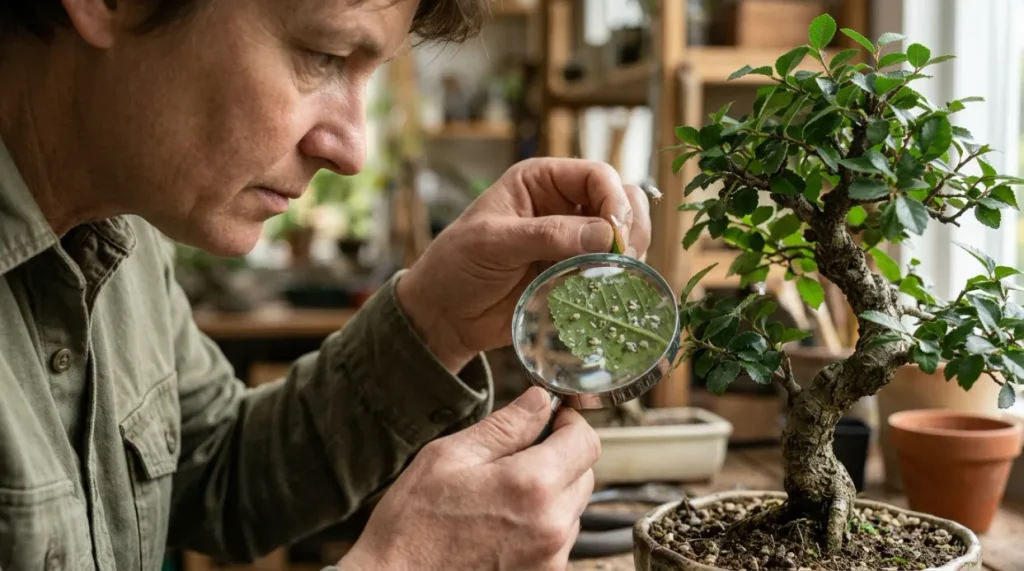
The simplest test is to gently tap a leafy branch. Whitefly adults usually flutter away briefly before returning to the foliage.
Don’t stop there. Turn several leaves over and examine them in bright light.
What should you look for under the leaves?
A developing colony may include eggs, translucent crawlers, flattened nymphs, and empty cases left after adults emerge. A 10× hand lens makes the smaller stages much easier to see.
- Pale or yellowish adult insects with powdery-looking wings
- Clusters of tiny eggs beneath foliage
- Oval, flattened immature insects attached to leaves
- Sticky honeydew on leaves or surfaces below the tree
- Black sooty mold growing over sticky deposits
- Yellowing or drying leaves around heavily infested areas
Whiteflies vs. other common bonsai pests
Several bonsai pests create similar symptoms. Use movement, location, webbing, and body shape to narrow the diagnosis.
| Pest | Typical clue | Where to check | What happens when disturbed? |
|---|---|---|---|
| Whiteflies | White adults, flattened nymphs, honeydew | Leaf undersides | Adults often flutter upward |
| Aphids | Soft-bodied insects, honeydew, distorted new growth | Shoot tips and tender leaves | Most remain on the plant |
| Spider mites | Fine stippling and sometimes webbing | Leaf undersides and branch junctions | No cloud of white flying adults |
| Scale insects | Firm or waxy bumps attached to tissue | Leaves, twigs, and branches | Attached stages remain stationary |
| Mealybugs | Cottony white wax and honeydew | Leaf joints and protected crevices | They crawl rather than fly away |
Whiteflies are also easy to confuse with harmless insects around damp bonsai soil. Springtails, for example, usually remain around moist substrate rather than colonizing leaf undersides.
If the insects are concentrated in the soil, reconsider the diagnosis. True whitefly colonies are primarily associated with foliage.
Section Takeaway: The strongest confirmation is a combination of flying white adults and attached immature stages beneath leaves. Sticky residue alone isn’t enough to diagnose whiteflies.
What Damage Do Whiteflies Cause?
Whiteflies weaken bonsai by repeatedly removing sap from foliage. Small populations may cause little visible damage, while larger colonies can lead to yellowing, drying, and premature leaf loss.
The damage isn’t limited to feeding. Whiteflies also produce honeydew, a sugary waste that coats foliage and creates secondary problems.
- Leaf yellowing: Heavy feeding interferes with normal leaf function.
- Leaf drop: Severely affected leaves may dry and fall.
- Sticky foliage: Honeydew collects on leaves, branches, pots, and benches.
- Sooty mold: Dark fungi can grow on honeydew-covered surfaces.
- Reduced vigor: Continued feeding can slow an already stressed bonsai.
- Ant activity: Ants may visit honeydew and interfere with beneficial insects outdoors.
Can whiteflies kill a bonsai tree?
A light infestation usually won’t kill an otherwise healthy bonsai. A severe, neglected infestation becomes more serious when combined with root stress, poor light, incorrect watering, or another health problem.
This distinction matters. If a tree is dropping many leaves, don’t automatically blame every symptom on whiteflies.
Check the soil moisture, drainage, light exposure, temperature, root condition, and recent fertilizer use. A bonsai can have pests and a separate care problem at the same time.
Why small bonsai need close monitoring
A bonsai carries much less foliage than a full-size landscape tree. Losing even a modest number of leaves can therefore have a noticeable visual and physiological impact.
I avoid aggressive defoliation on a weak tree for that reason. Removing a few badly infested leaves is different from stripping most of the canopy.
The U.S. National Arboretum’s National Bonsai & Penjing Museum describes bonsai as living trees requiring continual horticultural care alongside pruning and training. Pest treatment should support that horticultural health rather than add another major stress.
Section Takeaway: Whiteflies are most dangerous when populations become large or the bonsai is already stressed. Treat the insects, but also investigate the tree’s overall growing conditions.
How Do You Get Rid of Whiteflies on Bonsai Trees?
The best approach is integrated pest management rather than relying on one spray. As of 2026, the practical sequence remains isolation, inspection, physical reduction, targeted treatment, and repeated monitoring.
1. Isolate the affected bonsai
Move the tree away from nearby bonsai and houseplants as soon as you confirm adults. Whiteflies can move between suitable host plants.
Check neighboring plants at the same time. Catching a second infestation early saves work later.
2. Remove the worst-infested leaves
Pinch or prune isolated leaves carrying dense colonies when the tree has enough healthy foliage to tolerate the loss. Seal discarded material in a bag rather than leaving it beside the collection.
Pro tip: Avoid major pruning or defoliation on a weak bonsai. If removing infested foliage would substantially reduce the canopy, ask an experienced grower or local bonsai club before making irreversible cuts.
3. Wash off adults and immature stages
A controlled stream of water can knock adults from foliage and remove some eggs or young stages. Support delicate branches while spraying.
On a small bonsai, I protect the soil surface with mesh or a cloth so the water doesn’t blast particles from the pot. Concentrate on leaf undersides.
4. Add a yellow sticky trap
Place a yellow sticky card close to the foliage to monitor adult activity. The trap can reduce some flying adults, but it won’t kill eggs or attached nymphs.
Treat it as a monitoring tool rather than a complete cure. A declining trap count is useful evidence that your program is working.
5. Use insecticidal soap when needed
Commercial insecticidal soap containing potassium salts of fatty acids can control whiteflies it directly contacts. Complete coverage is critical because these products have little or no residual action.
- Use a product labeled for your plant and growing location.
- Follow the label concentration exactly.
- Spray upper and lower leaf surfaces.
- Test a small portion of the tree first.
- Repeat only as the product label directs.
Avoid homemade dish-soap mixtures. The University of Minnesota Extension guidance for indoor plant insects specifically warns that homemade soap products can burn plants.
6. Consider horticultural oil or neem oil
Horticultural oils and some neem-oil products can reduce whitefly populations by contacting and smothering exposed stages. Like soap, they depend on thorough application.
Don’t spray a drought-stressed bonsai or apply oil in intense heat. UC IPM advises using soaps and oils below 90°F, about 32°C, to reduce the risk of plant injury.
- Read the product label before every application.
- Confirm that the bonsai species is suitable for treatment.
- Don’t guess concentrations.
- Avoid spraying during strong direct sun.
- Watch treated foliage for phytotoxicity, meaning chemical injury to the plant.
7. Recheck the tree repeatedly
One treatment rarely reaches every life stage. Eggs and protected nymphs can remain after many adults disappear.
Inspect leaf undersides every few days during an active infestation. Follow the pesticide label for any repeat-treatment interval rather than inventing your own schedule.
Section Takeaway: Whitefly control succeeds through repeated inspection and direct contact with the insects. Adult traps alone won’t solve the infestation, and a single spray often misses hidden life stages.
How Do You Prevent Whiteflies From Coming Back?
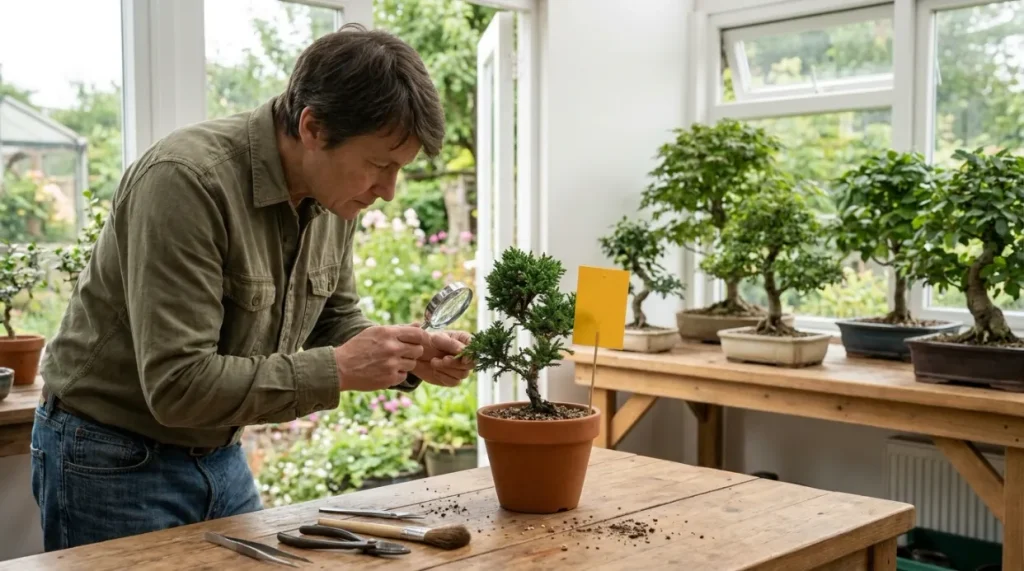
Prevention starts with inspection. Every new bonsai or companion plant should be checked before it joins the rest of your collection.
I pay particular attention to the lowest leaves and dense interior growth. Those areas are easy to overlook during casual watering.
Quarantine new plants
Keep new or recently purchased plants separated long enough to inspect them repeatedly. Look beneath leaves rather than judging the plant from above.
- Check for adults by gently disturbing foliage.
- Inspect eggs and nymphs with a hand lens.
- Watch for honeydew and sooty mold.
- Place a sticky card nearby when whiteflies are a recurring problem.
Maintain airflow without drying the tree
Crowded plants make pest inspection and treatment harder. Give foliage enough space for air movement and easy access to both sides of the canopy.
Airflow doesn’t replace proper watering. Bonsai roots still need species-appropriate moisture, drainage, and protection from extreme drying.
Keep the growing area clean
Remove fallen leaves and badly infested plant material promptly. Also inspect weeds and nearby ornamentals that may act as alternate hosts.
If you’re growing outdoors, preserve beneficial insects where possible. Lacewings, lady beetles, and tiny parasitoid wasps can help suppress whitefly populations.
Avoid unnecessary broad-spectrum pesticides
Broad-spectrum insecticides can kill the natural enemies that keep whiteflies in check. UC IPM notes that disrupted biological control is one reason whitefly outbreaks become severe.
Systemic products also require caution around pollinators and flowering plants. Use any pesticide only where its label allows and where the benefits justify the risks.
Help the bonsai recover after treatment
Once the infestation drops, return attention to normal bonsai care. Don’t respond to yellow leaves by suddenly flooding the soil or applying heavy fertilizer.
- Maintain normal species-appropriate watering.
- Provide appropriate light.
- Delay unnecessary styling on a weakened tree.
- Watch new leaves for renewed pest activity.
- Resume fertilizer according to the tree’s health and normal seasonal schedule.
A recovering tree may not replace damaged leaves immediately. Judge progress by stable hydration, healthy buds, new growth, and falling pest numbers.
Section Takeaway: The best prevention routine is simple: inspect new plants, keep the collection easy to examine, protect beneficial insects, and check leaf undersides before whiteflies become numerous.
Frequently Asked Questions
What kills whiteflies on bonsai trees?
Physical removal, water sprays, commercial insecticidal soap, and labeled horticultural or neem-oil products can reduce whiteflies. Contact treatments must reach the insects, especially beneath leaves, and repeat applications may be needed according to the product label.
Does neem oil get rid of whiteflies on bonsai?
Neem-oil products can reduce whitefly populations when they directly contact vulnerable stages. They aren’t an instant cure. Apply only according to the label, cover leaf undersides carefully, avoid stressed plants, and test a small area for sensitivity first.
Can I use dish soap for whiteflies?
It’s safer to use a commercial insecticidal soap labeled for plants. Household soaps and detergents aren’t formulated as pesticides and may damage foliage, especially on sensitive or stressed bonsai.
Why do whiteflies keep coming back?
Adults may disappear while eggs and nymphs remain beneath leaves. Nearby infested plants can also reintroduce adults. Continue inspecting the whole collection and follow the treatment label’s repeat-application instructions until no new stages appear.
Will yellow sticky traps eliminate whiteflies?
No. Sticky traps capture flying adults and help you monitor population changes, but they don’t control eggs or attached nymphs. Use them as one part of an integrated treatment plan.
Should I repot a bonsai because it has whiteflies?
Usually not. Whiteflies primarily live and feed on foliage, so repotting doesn’t address the main infestation. Repot only when the tree has a separate root or soil problem and the timing is appropriate for that species.
Can a bonsai recover after losing leaves to whiteflies?
Many otherwise healthy bonsai can recover once the infestation is controlled and normal care resumes. Avoid combining pest treatment with unnecessary repotting, heavy pruning, overfertilizing, or other major stresses while the tree rebuilds strength.
Final Takeaway: If tiny white insects fly from your bonsai, inspect the leaf undersides before doing anything else. Confirm the eggs or nymphs, isolate the tree, reduce the population physically, then use a labeled contact treatment only when necessary.
Stay consistent after the adults disappear. Whitefly control is less about one powerful spray and more about breaking the pest’s life cycle while keeping the bonsai healthy enough to recover.