
Why Do Bonsai Trees Get Pests and Diseases? Causes, Warning Signs, and Prevention
You water your bonsai, give it light, and try to keep it healthy—then suddenly you notice sticky leaves, tiny insects, brown spots, yellowing foliage, or branches that seem to be weakening.
So why do bonsai trees get pests and diseases?
Bonsai are not naturally more “sickly” than ordinary trees. However, they live in small containers with limited soil and roots, so mistakes involving water, drainage, light, temperature, or feeding can affect them quickly. Stress can weaken the tree, while certain growing conditions also make life easier for pests and disease-causing organisms.
Understanding why these problems develop is one of the best ways to prevent them. Below, we will look at the main causes, warning signs, prevention methods, and situations where professional help may be worthwhile.
Quick Answer
Bonsai trees get pests and diseases when insects or pathogens encounter a susceptible tree under favorable conditions. Poor drainage, overwatering, weak airflow, incorrect light, temperature stress, contaminated tools, and newly introduced plants can increase the risk. Healthy bonsai can still get pests, but good care makes serious problems less likely.
Why Bonsai Trees Can Be Vulnerable to Pests and Diseases
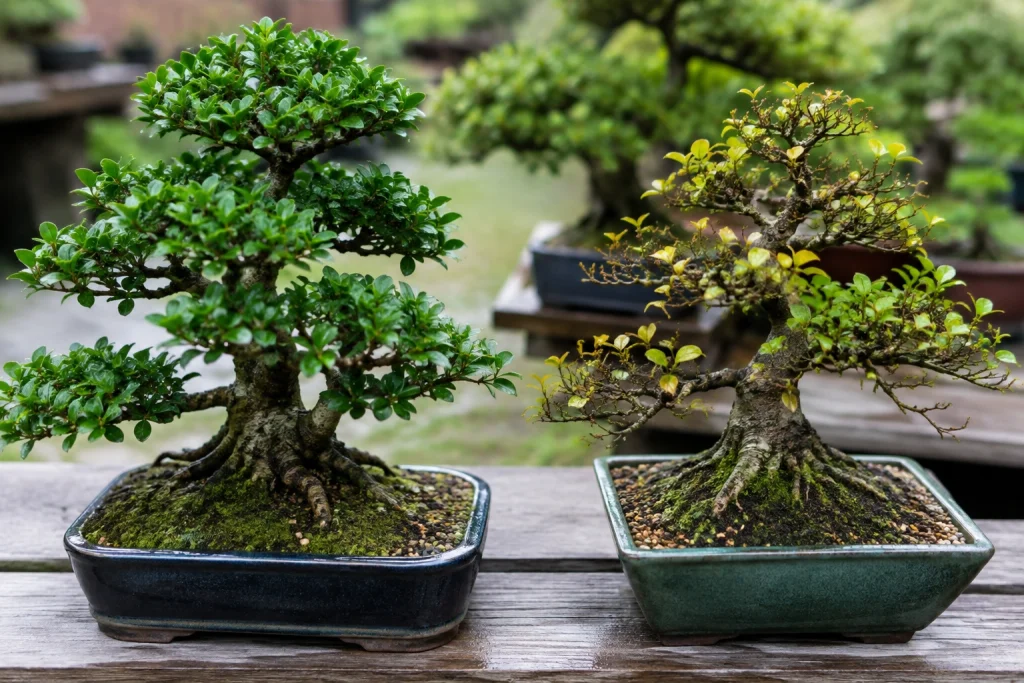
A bonsai is a normal woody plant trained to remain compact through root management, pruning, wiring, and container cultivation.
The U.S. National Arboretum’s National Bonsai & Penjing Museum describes bonsai as living plants that require continual care, including watering, fertilization, pruning, and training. Those ongoing care requirements help explain why growing conditions matter so much.
Unlike a landscape tree with roots extending through a large area of soil, a bonsai depends on a relatively small root zone.
That means:
- Water levels can change quickly.
- Fertilizer salts can become concentrated.
- Roots have less room to escape poorly drained soil.
- Hot weather can heat and dry a pot rapidly.
- Incorrect indoor conditions can weaken some species.
- Severe pruning or repotting can temporarily reduce vigor.
A healthy bonsai has natural defenses against many problems. A severely stressed tree usually has fewer resources available for producing new roots, sealing wounds, replacing damaged foliage, and recovering from pest feeding.
Important: Stress does not magically create insects, fungi, bacteria, or other pathogens. It can, however, create conditions in which existing pests or pathogens become more damaging.
The Main Reasons Bonsai Trees Get Pests and Diseases
1. Overwatering and Poor Drainage
Overwatering is one of the most important conditions to check when a bonsai begins declining.
Roots need both moisture and oxygen. If the soil remains saturated for too long, air spaces in the growing medium disappear and root health can deteriorate.
Poorly aerated roots may become weak, and prolonged wet conditions can favor some organisms associated with root disease.
The University of California Integrated Pest Management guidance on container plants notes that root rot is commonly associated with poor drainage and overwatering, while aging or compacted potting media can lose aeration. (UC IPM)
Possible warning signs include:
- Persistent wet soil
- Yellowing leaves
- Weak or stalled growth
- Wilting despite wet soil
- Dark, soft roots
- Unpleasant smells from the root zone
- Fungus gnats around the soil
Do not automatically water a bonsai every day. Check the soil and the needs of the species first.
2. Letting the Tree Become Too Dry
The opposite problem can also weaken a bonsai.
Because bonsai pots contain relatively little soil, they may dry much faster than garden beds. A tree that repeatedly becomes severely dehydrated can experience leaf loss, root damage, or branch dieback.
Water stress may also make it harder for the tree to recover from an existing pest infestation.
This is especially important during:
- Hot summer weather
- Windy conditions
- Periods of active growth
- Very small bonsai pots
- Recently repotted trees
The goal is not to keep the soil constantly wet. The goal is to provide appropriate moisture while maintaining good aeration.
3. The Wrong Soil for the Species or Climate
Good bonsai soil should balance drainage, moisture retention, and oxygen around the roots.
A dense soil that stays waterlogged may increase root problems. A mixture that drains extremely fast may be difficult to manage in a hot climate or with a moisture-loving species.
There is no single perfect soil recipe for every bonsai.
Consider:
- Tree species
- Pot depth
- Local temperature
- Humidity
- Rainfall
- How often you can water
- Stage of development
A beginner should generally prioritize a well-structured, free-draining bonsai mix that still retains enough moisture for the particular tree rather than choosing soil simply because it is inexpensive.
4. Poor Air Circulation
Crowded foliage, tightly packed plant shelves, and poorly ventilated indoor rooms can create stagnant conditions.
Some disease-causing organisms benefit when foliage remains wet for extended periods. Better air movement helps leaves dry more quickly and can make the environment less favorable for certain foliar diseases.
UC IPM recommends practices such as reducing excessive humidity, improving air circulation, and allowing plant surfaces to dry when managing several container-plant diseases. (UC IPM)
Do not interpret this as a reason to place your bonsai directly in front of a powerful fan. Gentle natural airflow is usually preferable.
5. Incorrect Light
Different bonsai species need different amounts of light.
Many temperate bonsai—including junipers, pines, maples, and elms—are primarily outdoor trees. Tropical species such as ficus can tolerate indoor cultivation more successfully when they receive sufficient light and appropriate temperatures.
Insufficient light can lead to:
- Weak, elongated shoots
- Reduced leaf density
- Slower growth
- Poor recovery after pruning
- General loss of vigor
At the other extreme, suddenly exposing shade-grown foliage to intense sun can cause scorching.
Match the growing location to the species rather than treating every bonsai as an indoor houseplant.
6. Temperature and Seasonal Stress
Extreme heat, freezing temperatures, sudden indoor-to-outdoor moves, and cold drafts can all stress a bonsai.
Species suitability matters here.
A tropical ficus and a temperate juniper have very different seasonal requirements. Protecting a tropical tree from freezing temperatures makes sense, while keeping a temperate species permanently inside a warm living room may interfere with its natural seasonal cycle.
Before diagnosing disease, ask whether the symptoms appeared shortly after:
- A heat wave
- A frost
- Moving the tree indoors
- Moving it into stronger sunlight
- Repotting
- Shipping
- Heavy pruning
Environmental damage can sometimes resemble pest or disease symptoms.
Pests Can Arrive on New Plants
One of the easiest ways pests enter a bonsai collection is on another plant.
A newly purchased bonsai may carry insects, eggs, mites, or disease symptoms that are difficult to notice immediately.
The University of Minnesota Extension guidance on indoor plant insects recommends inspecting plants carefully and maintaining proper watering and drainage because overly wet conditions can contribute to root problems and fungus gnat issues. (University of Minnesota Extension)
When bringing home a new bonsai:
- Inspect the tops and undersides of leaves.
- Look closely at branch forks and buds.
- Check the trunk and soil surface.
- Look for sticky residue, webbing, cottony material, bumps, or moving insects.
- Keep the new tree separated from valuable bonsai for a short observation period when practical.
- Reinspect it regularly before placing it among the rest of your collection.
Quarantine is especially useful if you own several bonsai, because one infested tree can expose nearby plants.
Common Bonsai Pests and Why They Appear
Different species attract different pests, but several groups regularly affect container-grown woody plants.
| Pest | Typical Signs | Conditions or Situations That Can Help Problems Develop |
|---|---|---|
| Aphids | Clusters of small insects, curled growth, sticky honeydew | Tender new shoots and nearby infested plants |
| Spider mites | Fine stippling, bronzed foliage, webbing | Often problematic in hot, dry or dusty conditions |
| Scale insects | Brown, tan, or whitish bumps on stems and leaves | Can arrive unnoticed on new plants |
| Mealybugs | White cotton-like material, sticky leaves | Protected branch joints and dense foliage |
| Fungus gnats | Tiny flies around the pot | Persistently moist, organic growing media |
| Thrips | Silvery damage, distorted foliage, tiny dark specks | Infested surrounding plants or new material |
A small pest population does not always mean the bonsai is dying. Early identification is far more useful than immediately applying the strongest pesticide available.
Why Bonsai Diseases Develop
Plant disease usually requires several things to come together: a susceptible plant, a disease-causing organism, and environmental conditions that allow infection or development.
For bonsai growers, that means changing the environment can sometimes be as important as treating the pathogen.
Common disease-promoting conditions include:
- Constantly wet roots
- Long periods of wet foliage
- Poor airflow
- Infected plant debris
- Contaminated cutting tools
- Damaged tissue
- Excessively weak growth
- Introducing infected plant material
Fungal leaf spots, root rots, bacterial problems, and other diseases can have different causes, so do not assume every brown spot is a fungus.
How to Tell Whether You Have Pests, Disease, or General Stress
Many bonsai symptoms overlap.
For example, yellow foliage might result from root trouble, low light, pests, seasonal changes, or watering problems.
Use the pattern of damage rather than relying on one symptom.
| Warning Sign | More Likely Possibilities | What to Check First |
|---|---|---|
| Fine webbing and speckled leaves | Spider mites | Undersides of foliage |
| Sticky leaves | Aphids, scale, mealybugs | Stems, leaf joints, new shoots |
| White cotton-like clusters | Mealybugs | Branch crotches and sheltered areas |
| Dark, soft roots | Root damage or root disease | Drainage and watering history |
| Brown circular leaf spots | Disease or environmental injury | Leaf wetness, airflow, recent weather |
| Wilting in wet soil | Root dysfunction | Roots, drainage holes, soil condition |
| Crispy leaf edges | Drought, heat, fertilizer salts | Watering and environmental conditions |
| Sudden widespread decline | Severe root or environmental problem | Recent care changes and root health |
How to Reduce the Risk of Bonsai Pests and Diseases
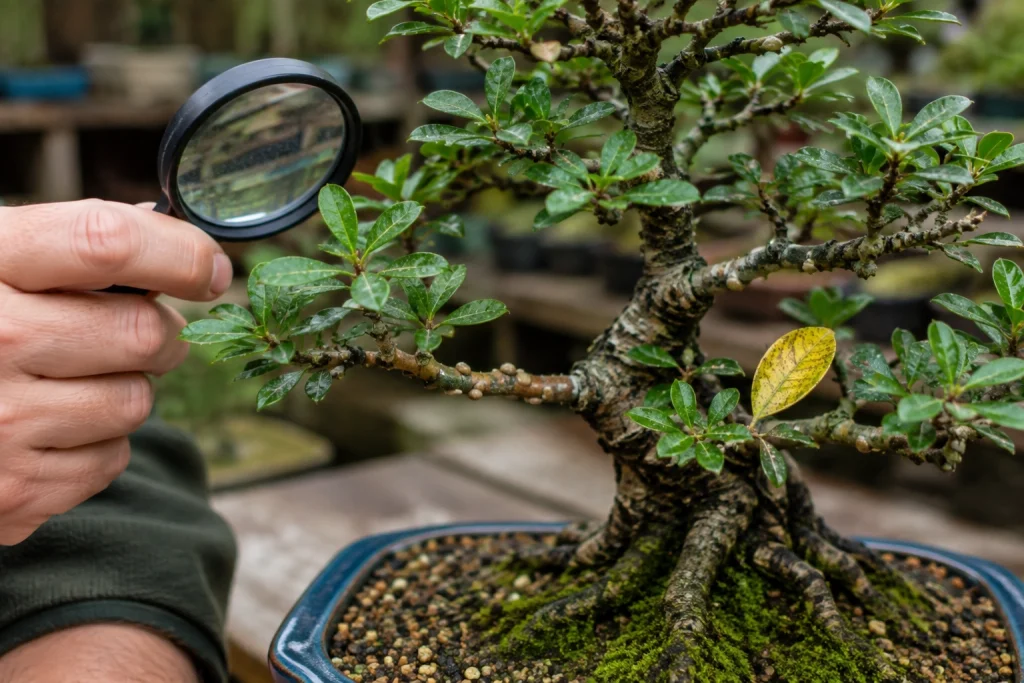
Prevention usually requires less effort than rescuing a badly weakened tree.
Follow This Simple Routine
- Check the tree regularly. Look under leaves, around buds, along branches, and near the soil.
- Water according to need. Check moisture rather than following a rigid calendar.
- Maintain drainage. Make sure water can pass freely through the pot.
- Give the species appropriate light. Learn whether your tree is tropical, deciduous, or evergreen and whether it belongs indoors or outdoors.
- Provide reasonable airflow. Avoid tightly crowding trees together.
- Remove dead material. Fallen leaves and dead twigs can provide hiding places or infected material.
- Keep tools clean. Clean pruning equipment, especially after working on a suspicious or diseased tree.
- Inspect new plants. Do not immediately place an unfamiliar tree in the middle of your collection.
- Avoid unnecessary stress. Do not combine severe pruning, aggressive root work, wiring, and other major operations on a weak tree without a good reason.
Expert Tip: Before treating a struggling bonsai, write down what changed during the previous two weeks—watering, location, temperature, repotting, fertilizer, pruning, or a new plant nearby. The timeline often reveals more than the damaged leaf itself.
Should You Immediately Use an Insecticide or Fungicide?
Usually, no.
First identify whether the problem is actually a pest, disease, or care issue. Spraying a fungicide will not correct sun scorch or waterlogged soil, and using an insecticide will not fix root rot.
For a small pest infestation, physical removal, washing, isolating the tree, or removing severely affected foliage may sometimes be enough.
If a pesticide becomes necessary, follow the EPA’s pesticide safety guidance, which emphasizes reading and following the product label, using only products intended for the target pest, and keeping children and pets away according to label directions. (US EPA)
Never assume that using more pesticide gives better control. Excessive or inappropriate treatment can damage foliage and create unnecessary risks.
Also confirm that the product is suitable for your particular plant. Some bonsai species may react badly to certain oils, soaps, chemicals, or concentrations.
Do You Need Expensive Pest-Control Equipment?
Not usually.
Beginners can perform much of the initial inspection with simple equipment.
| Item | Cost Level | Value for Beginners | Quality Consideration |
|---|---|---|---|
| Hand lens | Low | Very useful for mites and tiny insects | Clear optics matter more than fancy construction |
| Clean spray bottle | Low | Useful for washing some pests | Keep it dedicated to plant care |
| Pruning scissors | Low to moderate | Removes damaged or infested growth | Good steel stays sharp longer and makes cleaner cuts |
| Sticky monitoring cards | Low | Helps detect flying pests | Primarily for monitoring, not complete control |
| Specialized pesticide | Moderate | Useful only after correct diagnosis | Choose by pest, species suitability, and label instructions |
Durable bonsai tools are worthwhile when you prune frequently, but buying expensive tools will not compensate for incorrect watering, weak light, or poor drainage.
For pest and disease prevention, observation skills are usually more valuable than a large collection of chemicals.
Common Mistakes Bonsai Owners Should Avoid
- Watering on a rigid schedule. Soil moisture changes with temperature, season, pot size, and species.
- Keeping outdoor bonsai indoors permanently. Many temperate species need outdoor conditions and natural seasonal cycles.
- Treating before identifying the problem. Yellow leaves do not automatically mean insects or fungus.
- Using ordinary dense garden soil in a shallow bonsai pot. Poor structure can reduce drainage and aeration.
- Ignoring the undersides of leaves. Many pests remain hidden there.
- Placing a new bonsai directly beside established trees. Inspect it first.
- Overfertilizing a stressed tree. More fertilizer does not automatically restore damaged roots.
- Repotting a severely weakened tree without a clear reason. Major root work can add more stress.
- Using stronger pesticide concentrations than the label allows. This can injure the plant and increase safety risks.
- Performing aggressive styling while the tree is sick. Stabilize serious health problems before major pruning, wiring, or root reduction.
When to Ask an Experienced Bonsai Grower or Arborist
Many minor pest problems can be managed by a careful hobbyist, but some situations deserve experienced help.
Ask a knowledgeable bonsai grower, horticulturist, plant diagnostic clinic, or qualified arborist when:
- A valuable or old bonsai is declining rapidly.
- Large sections of the canopy are dying.
- You suspect significant root rot.
- The trunk has spreading cankers, unusual decay, or major bark damage.
- You cannot identify the pest despite close inspection.
- Treatment repeatedly fails.
- Multiple trees become sick at the same time.
- You are considering major root work on an already weakened tree.
- You suspect a regulated or unusual pest.
An arborist may be most useful for tree-health diagnosis, while an experienced bonsai grower can provide species-specific advice about repotting, seasonal care, styling stress, and container culture.
For unusual symptoms, a university extension plant diagnostic service may also be able to examine photographs or plant samples.
FAQs
Can a perfectly healthy bonsai still get pests?
Yes. Pests can arrive from outdoor plants, newly purchased bonsai, neighboring vegetation, or other houseplants. Good health does not make a tree immune, but a vigorous bonsai is generally better positioned to tolerate minor damage and recover.
Does overwatering cause bonsai pests?
Overwatering does not directly create most insects. However, continuously moist organic soil can favor fungus gnats, while poor drainage may weaken roots and contribute to conditions associated with root disease.
Why does my indoor bonsai keep getting pests?
Indoor conditions can favor certain pests, especially when airflow is limited or the tree is close to infested houseplants. Low humidity can also favor spider mite problems on susceptible plants. Inspect nearby plants and confirm that your bonsai species is actually suitable for indoor growing.
Should I repot a bonsai that has pests?
Not automatically. If pests are limited to foliage or branches, repotting may add unnecessary stress. Repot when the root system, soil condition, drainage, or species-specific seasonal timing provides a genuine reason for doing so.
Can bonsai soil prevent disease?
Good soil can lower the risk of problems related to poor drainage and root aeration, but no soil mix can guarantee a disease-free tree. Watering technique, climate, pot depth, species, sanitation, and overall tree health also matter.
Should I remove every leaf with a brown spot?
Not necessarily. A few damaged leaves may be caused by sun, drought, physical injury, old age, or minor disease. Identify the pattern first. When infectious disease is reasonably suspected, removing affected material may help, but avoid stripping large amounts of foliage from an already weak bonsai.
How often should I check my bonsai for pests?
A quick inspection whenever you water is an excellent habit. Pay extra attention during active growth, hot weather, after bringing plants indoors, and whenever you introduce a new bonsai to your collection.
Conclusion
So, why do bonsai trees get pests and diseases? Usually, it is not because bonsai are inherently unhealthy trees. Problems develop when a pest or pathogen reaches a suitable host and environmental conditions allow it to become established or damaging.
Poor drainage, incorrect watering, unsuitable light, weak airflow, environmental stress, contaminated tools, and newly introduced plants can all increase the risk.
The most useful habit is simple: inspect your bonsai regularly and respond to the cause instead of treating the symptom blindly.
Check the foliage, soil, roots, growing environment, and recent care history before reaching for a pesticide or repotting the tree. If the problem is severe or you cannot identify it confidently, get experienced help before performing major root work or aggressive treatment.
Start today by giving each bonsai a close inspection—especially the undersides of the leaves, branch joints, soil surface, and drainage—and correct small problems before they become serious.