How Soil Compaction Causes Bonsai Problems

Quick Answer
Soil compaction causes bonsai problems by squeezing out the pore spaces that roots need for air, water movement, and new root growth. As the substrate becomes dense, drainage slows, oxygen around the roots drops, and fine feeder roots can decline. A good bonsai substrate should stay open enough to drain freely while still holding useful moisture.
Common Signs of Compacted Bonsai Soil
- Slow drainage: Water pools on the surface or takes longer than usual to leave the pot.
- Hard surface: The substrate feels dense, crusted, or difficult to penetrate gently.
- Weak growth: New shoots may become shorter, thinner, or less vigorous.
- Root stress: Poor aeration can damage fine roots and increase problems in persistently wet soil.
- Uneven watering: Water may run around the root ball instead of soaking through it evenly.
How to Confirm It
- Compare drainage with the tree’s normal watering behavior, inspect the surface structure, and check the root ball at the proper repotting season if the symptoms persist.
Soil compaction in a bonsai pot can be easy to miss because the first symptoms often look like watering or fertilizer problems.
In this guide, I’ll explain what compacted bonsai soil does to roots, how to recognize it, what causes it, and how to correct it without making the tree’s stress worse.
In This Guide
What Is Soil Compaction in a Bonsai Pot?
Bonsai soil compaction is the loss of open pore space between substrate particles. The root zone becomes denser, less aerated, and harder for water and fresh roots to move through.
A healthy substrate is not simply loose dirt. It is a structured growing medium with spaces between particles.
Definition: Soil pore space is the open area between solid particles where air and water can move. Compaction reduces those spaces and changes the root environment.
That matters more in bonsai than in many garden plants. A bonsai root system lives inside a shallow, restricted container with little room to escape poor conditions.
General soil science also shows that compaction reduces pore space, water infiltration, drainage, and gas exchange. The University of Minnesota Extension explains these effects in its soil compaction guidance.
The problem isn’t that every particle touches another particle. Some settling is normal.
Trouble starts when enough fine material fills the gaps that air exchange and drainage become noticeably restricted.
Compaction is different from being root-bound
A root-bound bonsai has so many roots that they occupy much of the pot. Compacted soil, however, involves the physical structure of the substrate itself.
The two problems often appear together. Dense roots can reduce usable pore space while aging substrate breaks into smaller particles.
- Compacted substrate: Soil structure collapses and pore spaces shrink.
- Root-bound tree: Roots fill the available container volume.
- Both together: Water penetration and aeration can become especially uneven.
What Problems Does Compacted Soil Cause in Bonsai?
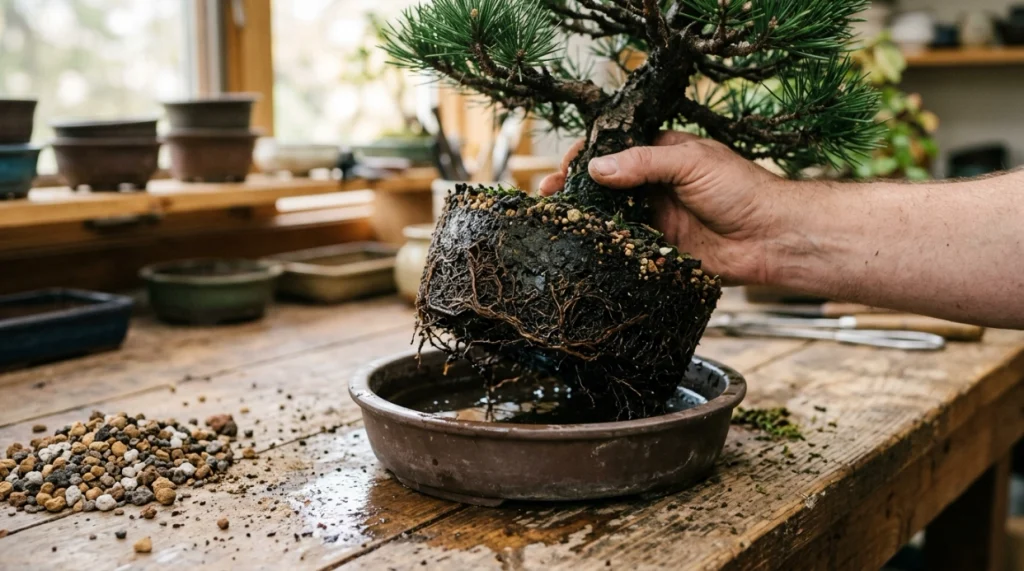
Compacted soil primarily harms bonsai by disrupting the balance between air, water, and roots.
A tree can sit in moist soil and still experience root stress if too little oxygen reaches the root zone.
1. Roots receive less oxygen
Roots need oxygen for normal respiration. When large pore spaces disappear, air moves through the substrate more slowly.
This gets worse when compacted soil remains saturated. Water fills the limited pore space that is left.
Penn State Extension notes that compaction reduces porosity and increases conditions that restrict normal root growth. Its overview of the effects of soil compaction helps explain the underlying root-zone process.
2. Drainage becomes slower or uneven
Healthy bonsai substrate should accept water and allow excess moisture to escape through the drainage holes.
Dense substrate may instead behave in several ways:
- Water sits on the surface before soaking in.
- One section remains wet while another stays relatively dry.
- Water follows cracks around the root ball.
- The center stays wetter than the visible surface suggests.
This makes watering decisions much harder. The top layer can look dry while the interior remains wet.
3. Fine root development can decline
Fine feeder roots are important because they absorb much of the tree’s available water and mineral nutrients.
When soil becomes physically dense, new roots have fewer open spaces to colonize. Low oxygen can add another source of stress.
4. Nutrient uptake may suffer indirectly
Fertilizer cannot compensate for a failing root environment. A weak root system may struggle even when nutrients are present.
Adding more fertilizer can sometimes make matters worse. Salts may accumulate if drainage is already poor.
5. Persistent wetness can favor root decline
Compaction doesn’t automatically mean a tree has root rot. However, poor aeration and prolonged saturation create unfavorable root conditions.
That distinction matters. Don’t diagnose root rot from yellow leaves alone.
| Root-Zone Feature | Open Granular Substrate | Compacted Substrate |
|---|---|---|
| Pore space | More open spaces between particles | Reduced by fines and collapsed structure |
| Drainage | Water moves through predictably | Often slower or uneven |
| Aeration | Fresh air can move through pore spaces | Gas exchange becomes restricted |
| New root growth | Roots have physical space to extend | Physical resistance can increase |
| Watering | Drying patterns are easier to judge | Wet and dry pockets may develop |
Section Takeaway: Compaction rarely creates just one symptom. It changes the entire root environment, which is why drainage, growth, and watering problems often appear together.
How Can You Tell If Bonsai Soil Is Compacted?
The best clue is a change in how the pot behaves. I pay more attention to watering response than to any single leaf symptom.
If a pot that once drained quickly begins accepting water slowly, I start checking the substrate structure.
Watch what happens during watering
Watering gives you a useful diagnostic test without disturbing the roots.
- Surface pooling: Water stands on top longer than it once did.
- Channeling: Water races down one edge instead of soaking evenly.
- Delayed drainage: The drainage holes release water unusually slowly.
- Uneven moisture: Some areas stay wet while other sections dry quickly.
Bonsai Empire also shows how a compacted or pot-bound root mass can interfere with water absorption in its bonsai watering guidance.
Inspect the surface carefully
A hard, fine-textured crust can indicate that small particles have accumulated near the surface.
Don’t judge the whole root ball from the top centimeter alone. Algae, moss, fertilizer residue, and fine top dressing can also change surface appearance.
Compare current growth with normal seasonal growth
A stressed root system can contribute to weak extension growth, small leaves, dieback, or poor vigor.
Those symptoms are not specific to compaction. Light, watering, temperature, pests, disease, and seasonal dormancy can create similar signs.
Check the root ball at the correct season
If symptoms remain unexplained, inspection during the normal repotting window gives the clearest answer.
Look for dense roots, degraded substrate, muddy fines, and areas where old soil has lost its granular structure.
Section Takeaway: Diagnose compaction from a pattern of evidence. Slow drainage plus degraded substrate and restricted roots is far more meaningful than yellow leaves by themselves.
Why Does Bonsai Soil Become Compacted?
Bonsai substrate usually compacts gradually. The most common cause is the breakdown and migration of smaller particles.
Organic materials decompose
Peat, compost, bark, and other organic components change as they age.
As larger pieces break down, finer material can fill the air spaces between more stable particles.
Some granular components also break down
Inorganic doesn’t mean indestructible. Certain fired clays can soften or fracture after repeated wetting, freezing, handling, or long-term use.
Particle quality therefore matters as much as the ingredient name.
Unsifted dust fills pore spaces
Fine dust is one reason many growers screen bonsai substrate before use.
A handful of fines may look harmless, but they can settle into spaces that would otherwise hold air.
Repeated watering moves particles
Every watering shifts fine material downward through the pot. Over time, those particles may accumulate in tighter layers.
This is one reason I don’t judge a mix only by how it looks on repotting day. Its ability to maintain structure matters more.
Roots gradually occupy the remaining space
Healthy root growth is desirable, but eventually the root system can fill much of a small container.
That crowded root mass can worsen uneven watering even when the original substrate was excellent.
How Do You Fix Compacted Bonsai Soil Safely?
Severe compaction is usually corrected during properly timed repotting, not by aggressively poking or digging into the pot whenever drainage slows.
Timing depends on the species, climate, tree health, and growth stage.
Step 1: Confirm that compaction is likely
First, rule out simpler causes such as blocked drainage holes or a dense surface layer.
If the whole root ball appears affected, plan a more complete correction.
Step 2: Choose the correct repotting window
For many temperate bonsai, repotting is commonly performed as spring growth begins, but species requirements vary.
Use species-specific guidance rather than treating every bonsai the same.
Step 3: Remove degraded substrate carefully
Work progressively around the root ball instead of tearing through roots.
The goal is to replace degraded material while preserving enough healthy roots for recovery.
Pro tip: Root pruning and major soil removal are irreversible. If you’re unsure how much root work your species can tolerate, get help from an experienced grower or local bonsai club.
Step 4: Replace it with a stable, well-draining substrate
A commonly cited reference mix is equal parts akadama, pumice, and lava rock, although climate and species can require adjustments.
Bonsai Empire’s repotting guide discusses this 1:1:1 starting point and explains why the mixture may need adjustment.
| Situation | Example Adjustment | Reason |
|---|---|---|
| General reference mix | 1 part akadama, 1 part pumice, 1 part lava | Balances moisture retention, structure, and drainage |
| Tree dries too quickly | Increase the more water-retentive component | Extends useful moisture between waterings |
| Humid or wet conditions | Increase durable drainage material | Helps excess water leave the root zone |
Step 5: Work substrate around the roots
Fresh substrate needs contact with the root system without being crushed into a dense mass.
Use a chopstick carefully to settle particles into larger gaps while preserving the mix’s granular structure.
Step 6: Adjust aftercare
A newly repotted tree may dry differently from the same tree in its old compacted soil.
Check moisture instead of automatically keeping the old watering schedule.
Section Takeaway: Repotting fixes the structure problem, but the safest correction respects species timing, root health, and the tree’s current condition.
How Can You Prevent Soil Compaction?
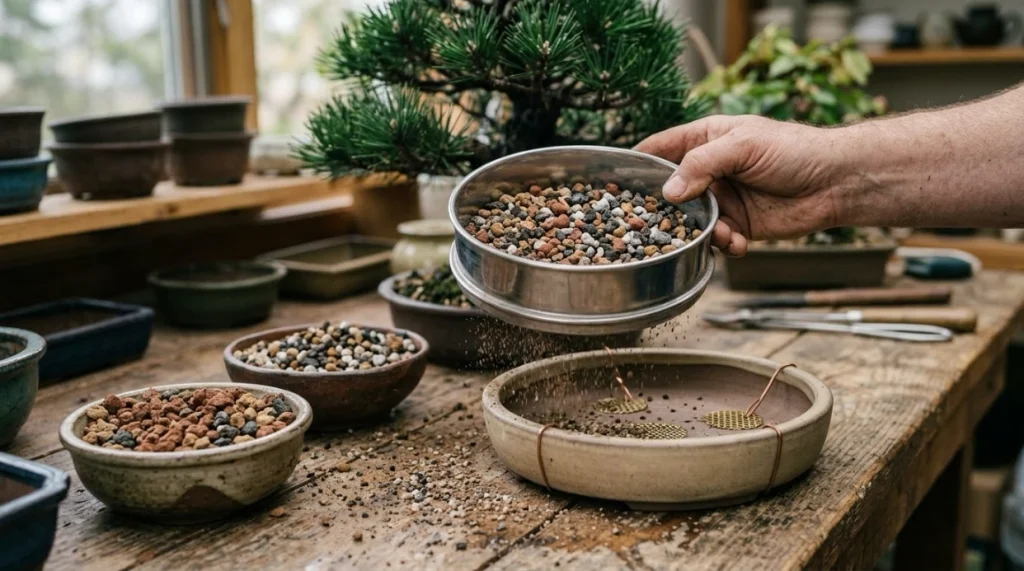
Prevention starts with a substrate that maintains useful pore space for an appropriate length of time.
As of 2026, the basic principle has not changed: bonsai roots need a balance of moisture, drainage, and aeration.
Use appropriately sized particles
Extremely fine material packs tightly. Consistent granular particles create more predictable spaces for air and water.
Screening dust before potting can help preserve that structure.
Match the mix to your climate
A mix that performs well in a hot, windy climate may dry too slowly somewhere cool and humid.
Likewise, an extremely fast-draining mix can demand more frequent watering in summer.
Don’t press soil firmly into the pot
The goal is to fill gaps around roots, not compress the substrate like planting soil in a landscape bed.
Settle particles gently and make sure the tree itself is secured with potting wire when necessary.
Repot according to root and substrate condition
There is no universal calendar that fits every tree.
Young, vigorous trees may fill containers quickly, while older refined specimens may require a different schedule.
- Check drainage behavior through the growing season.
- Watch for declining substrate structure.
- Inspect roots during appropriate repotting periods.
- Record the last repotting date for important trees.
- Adjust the next interval based on what you find.
The U.S. National Arboretum’s National Bonsai & Penjing Museum is also a useful reminder that bonsai are living woody plants requiring continuous horticultural care, not static decorations.
Frequently Asked Questions
Can compacted soil kill a bonsai?
Yes, severe long-term compaction can contribute to serious root decline. Reduced aeration, poor drainage, and restricted root growth can weaken the tree. Compaction is usually one part of the problem, so check watering, drainage, root condition, light, and seasonal factors before deciding on treatment.
Can I loosen compacted bonsai soil with a chopstick?
You can sometimes open a small surface area gently, but aggressive poking can damage fine roots. It also won’t restore a badly degraded root ball. If compaction affects the whole pot, properly timed repotting is usually a more complete solution.
Why does water run around my bonsai soil instead of soaking in?
Water can channel around a dense root ball, through cracks, or along the edge of the pot. Compacted substrate and a root-bound tree are common possibilities. Inspect the surface, drainage pattern, and root condition rather than assuming the tree simply needs more water.
Does akadama prevent soil compaction?
Akadama can provide useful structure and water retention, but it can break down over time. Its durability depends on product quality, climate, freeze-thaw exposure, and use. Mixing it with durable materials such as pumice or lava can help maintain an open substrate structure.
Is regular potting soil too compact for bonsai?
Many conventional potting soils contain fine organic materials designed to hold substantial moisture. In a shallow bonsai container, they may provide less aeration than a granular bonsai mix. The exact result depends on the product, species, climate, container depth, and watering habits.
Should I repot immediately if my bonsai soil drains slowly?
Not automatically. Emergency repotting at the wrong time can stress an already weak tree. First check for blocked drainage holes, surface crusting, and watering issues. If the entire root ball has deteriorated, plan corrective repotting at the safest time for that species.
The key lesson is simple: bonsai roots need structure around them, not a dense block of exhausted soil.
Watch how your pot accepts water, protect pore space with a stable substrate, and treat declining drainage as an early warning rather than waiting for the foliage to fail.
