How to Recover a Bonsai After Root Disease
Quick Answer
To recover a bonsai after root disease, first correct the wet, compacted, or poorly drained conditions that damaged the roots. Remove only clearly dead root tissue when necessary, restore an airy substrate, and follow careful bonsai watering practices while the remaining healthy roots rebuild.
Recovery priorities
- Confirm the problem: Dark, soft, deteriorating roots are more concerning than yellow leaves alone.
- Restore drainage: Make sure drainage holes are open and the pot never sits in collected water.
- Save healthy roots: Keep firm, living roots and remove only tissue that is clearly dead or rotten.
- Reduce stress: Delay heavy pruning, wiring, defoliation, and strong fertilizer during recovery.
- Watch moisture: Water from the condition of the substrate, not from a fixed daily schedule.
- Be patient: Root recovery may take several weeks or much of a growing season.
Before cutting roots
- If you cannot confidently separate healthy from damaged roots, get species-specific help before making irreversible cuts.
Recovering a bonsai after root disease is less about finding a miracle treatment and more about rebuilding a healthy root environment. The tree needs oxygen, controlled moisture, intact living roots, and time.
I approach a sick root system cautiously. One aggressive intervention after another often creates more stress than the original problem.
In This Guide
- How Can You Tell Whether Root Disease Is Still Active?
- What Should You Do First After Discovering Root Disease?
- Should You Repot a Bonsai After Root Disease?
- How Do You Rebuild a Healthy Root Zone?
- How Should You Care for a Recovering Bonsai?
- How Long Does Root Recovery Take?
- Frequently Asked Questions
How Can You Tell Whether Root Disease Is Still Active?
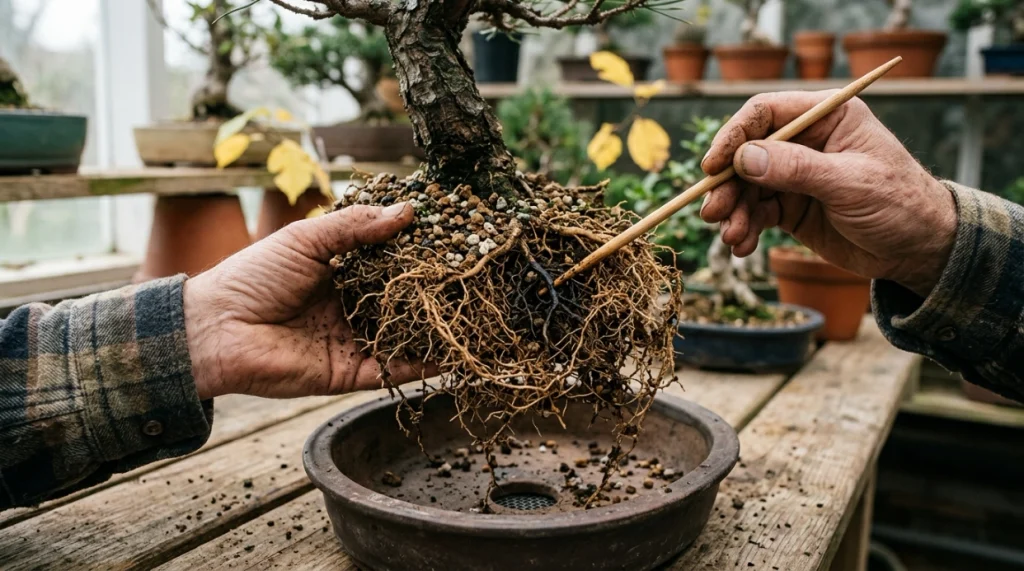
Root disease cannot be diagnosed reliably from leaf color alone. Yellowing, wilting, leaf drop, and weak growth can also result from drought, poor light, temperature stress, pests, or recent repotting.
Definition: Bonsai root disease is a damaging process affecting root tissue. It may involve infectious organisms, such as water molds, but roots can also die from prolonged saturation and oxygen loss without a confirmed pathogen.
Inspect the whole situation before disturbing the roots. Moisture level, drainage speed, recent watering, seasonal conditions, and root texture provide better clues together.
What do diseased bonsai roots look like?
Healthy root appearance varies between species, so color by itself is not enough. Texture and structural integrity matter more.
- Firm roots: Usually more reassuring than soft or collapsing tissue.
- Fine feeder roots: Their presence suggests some active root function remains.
- Soft or mushy roots: More concerning for advanced deterioration.
- Sloughing outer tissue: Can indicate severe root damage.
- Sour or rotten odor: Suggests unhealthy decomposition in the root zone.
- Persistently saturated substrate: Points toward a serious moisture and aeration problem.
Some infectious root diseases also require laboratory diagnosis for certainty. Illinois Extension notes that symptoms caused by Phytophthora root disease can resemble other root problems.
Penn State’s Pythium guidance also describes brown, dying root tips and wilting among possible symptoms. This is one reason I would not choose a fungicide solely from foliage symptoms.
| Clue | Root Disease / Rot | Underwatering | Temporary Stress |
|---|---|---|---|
| Substrate | Often stays wet too long | Dry through much of root mass | May appear normal |
| Roots | May be soft or deteriorating | May become dry or brittle | Often remain firm |
| Wilting | Can occur while soil is wet | Usually accompanies dryness | May follow heat or repotting |
| Drainage | Often slow or restricted | Can be fast through very dry soil | Usually unchanged |
Section Takeaway: Diagnose the root environment before treating the tree. Wet soil plus declining foliage raises concern, but root texture, drainage, and care history provide stronger evidence.
What Should You Do First After Discovering Root Disease?
Your first goal is to stop the conditions causing further root damage. Do not respond by repeatedly watering, fertilizing, pruning, spraying, and moving the tree.
Start with the least disruptive corrections. Escalate only when the root system clearly requires intervention.
- Stop calendar watering. Check the substrate before adding more water.
- Empty standing water. Never leave an ordinary bonsai pot soaking in a full saucer.
- Check drainage holes. Remove debris that prevents excess water from leaving.
- Protect the tree from extremes. Avoid severe heat, drying wind, or sudden environmental changes.
- Pause major styling. Do not combine root recovery with heavy wiring, defoliation, or structural pruning.
- Separate suspect plants when appropriate. Soil-borne pathogens can sometimes move through contaminated soil, tools, pots, or water.
Should you use a fungicide immediately?
Usually, diagnosis should come first. Different root pathogens respond to different products, and some declines result primarily from poor aeration rather than an infectious organism.
If an infectious disease is strongly suspected, use local horticultural or extension guidance. Follow the product label and confirm that both the plant and target pathogen are listed.
Should You Repot a Bonsai After Root Disease?
Repotting can help when damaged roots remain trapped in collapsed, contaminated, or severely waterlogged substrate. It is not automatically the right response to every yellowing or weak bonsai.
Root work creates stress of its own. A weak tree may have little reserve left for unnecessary disturbance.
Repot sooner when the root environment cannot recover in place
- The substrate has broken down and barely drains.
- Drainage remains poor after checking the holes.
- Large areas of roots are soft and decomposing.
- The root ball remains saturated far longer than expected.
- The tree continues declining despite correcting watering.
- Contaminated or decomposed growing media needs replacement.
Disturb the roots less when conditions are stable
- The substrate drains adequately.
- Roots remain mostly firm.
- The overwatering event was brief.
- The tree is extremely weak.
- Another cause better explains the symptoms.
Normal repotting timing also varies by species. For many temperate bonsai, early spring around bud swelling is a common window, as explained in this bonsai repotting guide.
An emergency repot may fall outside that ideal period. In that case, the question is whether leaving the damaged root environment untouched presents an even greater danger.
How much damaged root should you remove?
Remove only roots you can identify confidently as dead and deteriorating. Preserve as much functioning tissue as possible because the remaining root system must support recovery.
Pro tip: Root cutting is irreversible. If you cannot confidently identify living tissue or safe pruning limits for the species, ask an experienced grower or local bonsai club before cutting.
Use clean, sharp tools during root work. Clean tools again before using them on another tree when an infectious root problem is possible.
Section Takeaway: Repot because the damaged root environment requires correction, not simply because the foliage looks unhealthy. Preserve healthy roots and avoid unnecessary root reduction.
How Do You Rebuild a Healthy Root Zone?
A recovering bonsai needs a substrate that balances moisture with oxygen. The exact mix depends on species, climate, pot depth, and your watering habits.
Structure matters more than copying one universal recipe. A good mix should remain open enough for excess water to leave and fresh air to return.
What substrate works after root disease?
Granular materials such as akadama, pumice, and lava rock are widely used in bonsai. Their proportions should change with the tree and growing conditions.
Bonsai Empire’s guide to bonsai soil and substrates emphasizes drainage, aeration, and moisture retention as key characteristics. Those three qualities become especially important after root decline.
- Hot, dry climate: The mix may need greater moisture retention.
- Wet, humid climate: Stronger drainage may be helpful.
- Shallow pot: Moisture can change quickly, so monitor closely.
- Weak root system: Avoid a large mass of constantly wet unused substrate.
- Species-specific needs: Azaleas, conifers, tropical bonsai, and deciduous trees should not all receive an identical mix automatically.
Do rocks in the bottom solve poor drainage?
No drainage layer can rescue an unsuitable root-zone mix by itself. The substrate surrounding the roots must provide the required balance of water and air.
Keep drainage holes open and use mesh where appropriate. Secure the tree so new roots are not repeatedly disturbed by movement.
How Should You Care for a Recovering Bonsai?
Recovery care should be stable rather than aggressive. The tree needs enough resources to rebuild fine roots without facing several additional stresses at once.
Water according to the substrate
Do not allow a recovering tree to stay permanently waterlogged. Do not respond by withholding water until the root ball becomes dangerously dry either.
- Check moisture before watering.
- Water the root mass thoroughly when it needs water.
- Let excess water drain from the pot.
- Recheck more often during hot or windy weather.
- Expect drying to slow during cool, cloudy, or dormant periods.
Give the species appropriate light
A weak tree still needs light for photosynthesis, but sudden intense exposure can increase stress. Keep the environment appropriate for the species and its previous acclimation.
Outdoor species such as junipers and pines should remain outdoor trees. Do not move them indoors as a general recovery treatment.
Should you fertilize immediately?
I prefer not to push a severely root-damaged tree with strong fertilizer immediately after major root work. First look for stabilization and evidence that normal growth is restarting.
Once recovery is underway, return to an appropriate feeding program for the species and season. Avoid assuming that extra fertilizer can replace lost root function.
Pause styling work
- Delay major wiring.
- Avoid heavy branch pruning.
- Skip defoliation during early recovery.
- Avoid another unnecessary repot.
- Reduce avoidable movement of the tree in its pot.
Section Takeaway: Recovery works best when you remove stresses instead of adding treatments. Stable light, responsive watering, good aeration, and patience give the remaining roots the best chance to rebuild.
How Long Does Root Recovery Take?
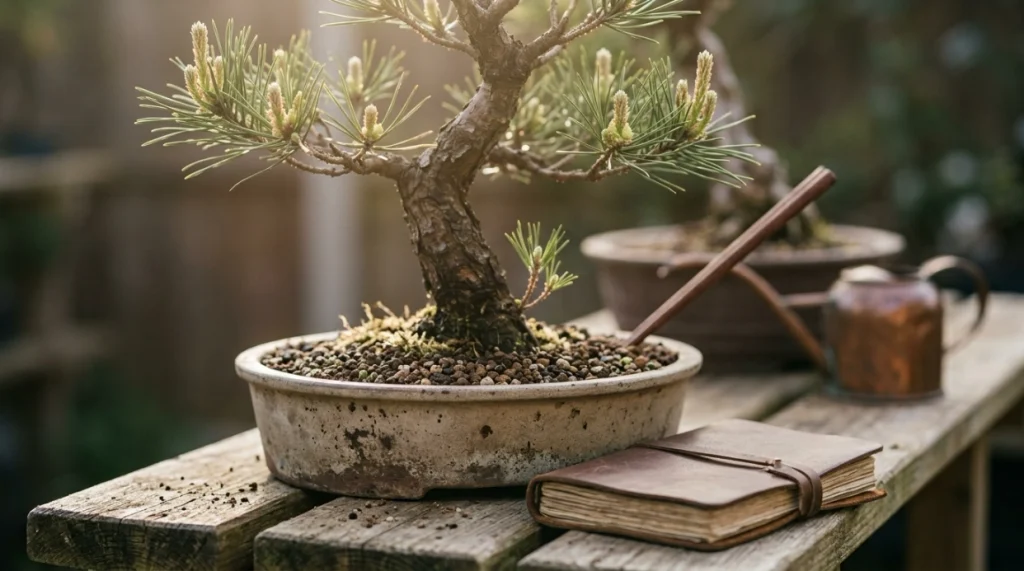
Root recovery usually cannot be judged in a few days. Depending on the species, season, root loss, and remaining vigor, improvement may take several weeks and full recovery may occupy much of a growing season.
As of 2026, I still consider sustained new growth more useful than any fixed recovery timetable. The tree itself should determine when normal styling and feeding resume.
Signs your bonsai may be stabilizing
- Moisture use becomes predictable: The substrate begins following a consistent wet-to-drier cycle.
- Decline slows: Progressive leaf loss or dieback stops.
- Buds remain healthy: Existing buds hold instead of collapsing.
- New growth appears: Fresh shoots or leaves develop during the appropriate season.
- Foliage stays firm: The tree maintains hydration between normal watering cycles.
Warning signs that need another diagnosis
- Continued branch dieback
- Persistent wilting in wet substrate
- New soft or decaying root tissue
- Darkening at the trunk base or crown
- Foul-smelling substrate
- No stabilization despite corrected drainage and care
Do not keep uprooting the bonsai every few days to check for new roots. Repeated disturbance can damage the fine roots you are trying to encourage.
A photo log is safer. Record foliage condition, watering dates, weather, drainage behavior, and visible new growth once or twice each week.
Frequently Asked Questions
Can a bonsai survive root disease?
Yes, recovery is possible when enough healthy root tissue remains and the underlying cause is corrected. The outlook depends on species, disease severity, season, remaining vigor, and how quickly drainage and root-zone conditions improve.
Should I cut off every brown bonsai root?
No. Root color varies between species and ages, so brown coloration alone does not prove a root is dead. Texture and condition matter more; remove only tissue that is clearly soft, decomposed, hollow, or otherwise dead.
Should I stop watering a bonsai with root rot?
No. The tree still needs water. Instead of stopping completely, water according to actual substrate moisture and prevent damaged roots from remaining continuously saturated.
Can I reuse soil from a bonsai with root disease?
I would avoid reusing suspect substrate when an infectious root disease may be involved. Old compacted material may also recreate the same drainage conditions that contributed to the original decline.
Can root disease spread between bonsai trees?
Some root pathogens can move with contaminated soil, water, pots, plant material, or tools. Clean equipment after working on a suspect tree and avoid moving questionable substrate into healthy bonsai containers.
How soon should I fertilize after treating root disease?
There is no universal number of days. After serious root damage or repotting, wait until the tree stabilizes and shows signs of active recovery, then resume an appropriate fertilizer program gradually for the species and season.
When should I get expert help?
Get experienced help when severe root cutting seems necessary, the species is valuable or difficult, symptoms keep progressing, or you suspect an infectious pathogen. A local bonsai club, horticulturist, or plant diagnostic service can reduce the risk of an incorrect treatment.
A bonsai recovering from root disease needs fewer mistakes, not more interventions. Correct the cause, protect every healthy root you can, and give the tree enough time to show whether recovery is working.
Watch the root environment as closely as the foliage. Once stable growth returns, you can gradually move from rescue care back to normal bonsai development.
