
Bacterial Leaf Spot on Bonsai: How to Identify, Treat, and Prevent It

Quick Answer
Bacterial leaf spot on bonsai often starts as small, water-soaked or greasy-looking lesions that become brown or black. The spots may look angular because leaf veins restrict their spread. Isolate the tree, keep foliage dry, remove badly affected leaves, improve airflow, and follow good sanitation practices recommended for bacterial diseases of ornamental plants.
Signs to Check First
- Water-soaked spots: Early lesions can look translucent, oily, or darker than healthy tissue.
- Angular lesions: Spots sometimes stop at leaf veins instead of remaining perfectly round.
- Darkening tissue: Older lesions can change from green or yellow to brown or nearly black.
- Yellow margins: Some infections develop a yellow halo around damaged tissue.
- Fast spread after wetness: Splashing water and prolonged wet foliage can help bacterial problems spread.
Before You Treat
- Do not assume every black or brown leaf spot is bacterial. Fungal disease, insects, sun scorch, watering stress, and physical damage can look similar.
Bacterial leaf spot on bonsai can look alarming because a clean canopy may develop dark lesions within a short period. The challenge is that several unrelated bonsai problems can create almost identical spots.
When I troubleshoot spotted foliage, I focus on the pattern, recent growing conditions, and how quickly the damage spreads. That approach is safer than choosing a spray based only on leaf color.
In This Guide
What Is Bacterial Leaf Spot on Bonsai?
Bacterial leaf spot describes leaf lesions caused by plant-pathogenic bacteria. Depending on the host, organisms from groups such as Pseudomonas or Xanthomonas may be involved.
It is not one universal bonsai disease. Different tree species can host different pathogens, while some bonsai may never develop a significant bacterial leaf problem.
A leaf lesion is simply an area of damaged or diseased leaf tissue. Early bacterial lesions often have a water-soaked appearance before becoming tan, brown, or black.
- Early stage: Tiny translucent, greasy, or dark green areas may appear.
- Developing stage: Lesions become more obvious and may be restricted by veins.
- Older stage: Damaged tissue becomes brown, black, dry, or papery.
- Severe stage: Multiple spots can join and kill a larger section of the leaf.
One or two damaged leaves do not prove a bacterial infection. Mechanical damage, sunburn, fungal leaf spots, insects, and watering problems must remain on your shortlist.
That distinction matters with bonsai. A small tree has limited foliage, so unnecessary defoliation or aggressive chemical treatment can create another source of stress.
Section Takeaway: Bacterial leaf spot is a disease category, not a diagnosis based on color alone. Look for a combination of symptoms and growing conditions.
How Can You Identify Bacterial Leaf Spot?
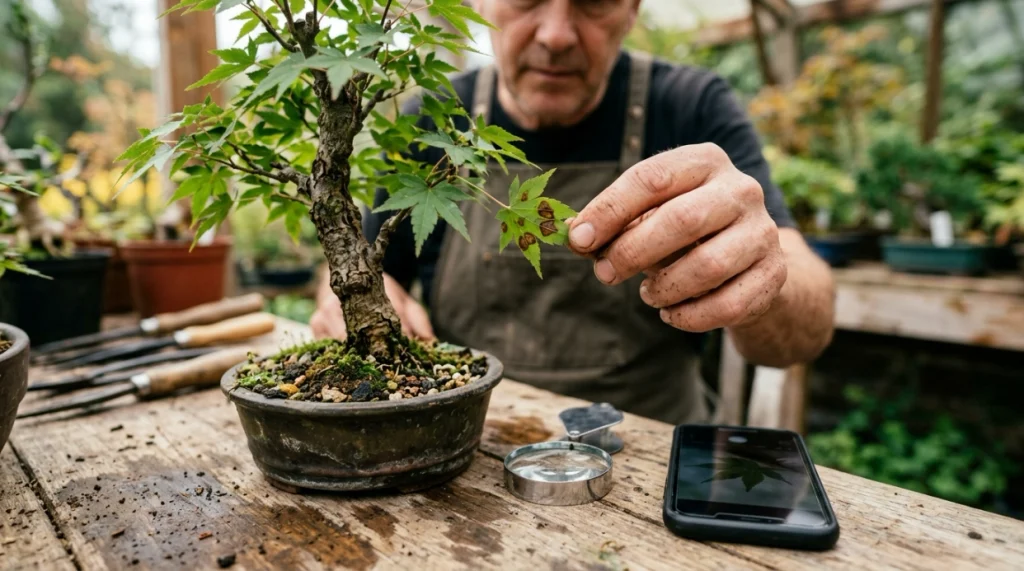
Suspect bacterial leaf spot when lesions begin water-soaked and become dark, especially when the pattern follows leaf veins. Recent rain, misting, or repeated wet foliage makes that suspicion stronger.
I would still avoid diagnosing from one symptom. The table below shows why.
| Problem | Typical Clues | Useful Distinction |
|---|---|---|
| Bacterial leaf spot | Water-soaked, greasy, angular, brown or black lesions; sometimes yellow margins | Often associated with splashing water and extended leaf wetness |
| Fungal leaf spot | Brown, tan, black, or patterned lesions that vary by fungus and host | Can resemble bacterial disease closely; laboratory diagnosis may be needed |
| Sun scorch | Dry tan or brown patches, often on the most exposed foliage | Usually follows sudden exposure to stronger sun or heat |
| Spider mites or insects | Stippling, webbing, distorted leaves, sticky residue, or visible pests | Inspect both leaf surfaces with a magnifier |
| Watering or root stress | General yellowing, wilting, weak growth, leaf drop, or dry edges | Symptoms often affect overall vigor rather than forming distinct lesions |
Check Both Sides of the Leaf
Turn affected leaves over and inspect them under bright light. Water-soaked areas can sometimes appear more clearly from underneath.
Also check petioles, young stems, neighboring leaves, and nearby bonsai. A spreading pattern deserves more attention than a single isolated blemish.
Watch the Lesion for Several Days
Photograph the affected leaf before removing it. Compare the size and number of lesions after 24 to 72 hours.
A spreading problem under consistently wet conditions deserves prompt isolation and sanitation. Old physical damage usually remains more static.
Section Takeaway: No visual sign proves a bacterial infection by itself. Pattern, moisture history, progression, and host species provide the strongest practical clues.
What Causes Bacterial Leaf Spot to Spread?
Water movement is one of the biggest practical risk factors. Bacteria associated with ornamental plant diseases can move through splashing irrigation, contaminated material, hands, and tools.
Penn State Extension’s guidance on bacterial diseases of ornamentals emphasizes sanitation and keeping foliage dry. Those principles translate well to a small bonsai collection.
Common Conditions That Increase Risk
- Overhead watering: Splashing droplets can move contaminated water between leaves and nearby trees.
- Long leaf-wetness periods: Foliage that stays damp provides more favorable conditions for many plant diseases.
- Poor airflow: Crowded foliage takes longer to dry after watering or rainfall.
- Contaminated tools: Shears and other equipment can transfer pathogens between plants.
- Handling wet trees: Working through damp foliage can move contaminated moisture around the collection.
- Infected plant material: A newly acquired tree can introduce a disease problem into a closely spaced bench.
Does Overwatering Cause Bacterial Leaf Spot?
Overwatering does not automatically create bacterial leaf spot. However, constantly wet conditions and poor drainage can weaken a bonsai and complicate disease management.
Separate root-zone moisture from leaf wetness. You can water a bonsai thoroughly while still keeping its canopy relatively dry.
Section Takeaway: Reduce splashing, prolonged foliage wetness, crowding, and cross-contamination. These changes often matter more than reaching immediately for a spray.
How Do You Treat Bacterial Leaf Spot on a Bonsai?
Start by containing the problem and correcting the conditions that help it spread. Do not begin with aggressive pruning, repotting, fertilizing, and spraying all at once.
1. Isolate the Affected Bonsai
Move the tree away from healthy bonsai while you observe it. Leave enough space for air to circulate around the canopy.
Avoid placing it where runoff or splashing water can reach other plants.
2. Remove Badly Infected Leaves
Remove leaves with extensive lesions when doing so will not excessively defoliate an already weak tree. Bag the affected material rather than leaving it on the bench or soil surface.
Pro tip: Removing a large amount of live foliage can stress a bonsai. If the tree is weak, rare, or heavily affected, consult an experienced grower or local bonsai club before major pruning.
3. Sanitize Your Tools
Disinfect cutting tools after working on suspect tissue. Seventy percent alcohol is commonly recommended for disinfecting pruning tools used around affected ornamental plants.
Clean visible dirt and organic material first. Sanitizers work better on a clean surface.
4. Keep the Foliage Dry
Direct water toward the soil rather than repeatedly showering the canopy. If leaves become wet, give the tree enough light and airflow to dry promptly.
Don’t interpret this as a reason to underwater the root ball. Bonsai still need species-appropriate watering.
5. Be Careful With Copper Products
Copper-based products can suppress some bacterial plant diseases, but they are not a guaranteed cure. Some ornamentals can also suffer copper-related leaf injury.
Use a product only when its label includes your type of plant and intended disease use. Follow the label’s rate, timing, temperature restrictions, and safety directions exactly.
6. Avoid Stress Treatments During Recovery
Don’t fertilize heavily in an attempt to force damaged foliage back. Let the tree stabilize before resuming a normal feeding program.
Likewise, avoid unnecessary repotting during an active foliar problem. General bonsai care practices should still be adjusted for the species, season, soil, pot size, and climate.
Section Takeaway: Isolation, sanitation, dry foliage, and stable bonsai care form the core response. Chemical treatment should be secondary and label-driven.
How Can You Prevent It From Returning?
Prevention is easier than managing an established outbreak. A few bench habits reduce the chance of moving pathogens around a collection.
- Water the root zone: Minimize unnecessary splashing from one canopy to another.
- Allow airflow: Do not pack bonsai tightly together during warm, wet periods.
- Inspect new trees: Check incoming bonsai before placing them among established specimens.
- Clean tools: Sanitize shears after working on suspicious or diseased material.
- Remove debris: Do not let diseased foliage accumulate beneath pots or benches.
- Match care to species: Correct light, watering, and seasonal care keep trees better able to tolerate stress.
Should You Mist Bonsai Leaves?
Misting is not a substitute for proper root watering. When bacterial leaf spot is suspected, repeatedly keeping foliage wet is especially unhelpful.
If a species needs higher ambient humidity, manage the surrounding environment without leaving its leaves continuously wet. Good airflow remains important.
What About Rain?
Outdoor bonsai naturally get wet, and rain alone does not mean disease will develop. Problems become more likely when susceptible foliage stays wet for extended periods and inoculum is present.
During a persistent outbreak, spacing trees and reducing avoidable splash can help. As of 2026, these cultural controls remain central recommendations for ornamental bacterial leaf diseases.
Section Takeaway: Aim for healthy roots, appropriate moisture, quick foliage drying, clean tools, and good spacing. Those habits reduce several disease problems at once.
When Does a Bonsai Need Professional Diagnosis?
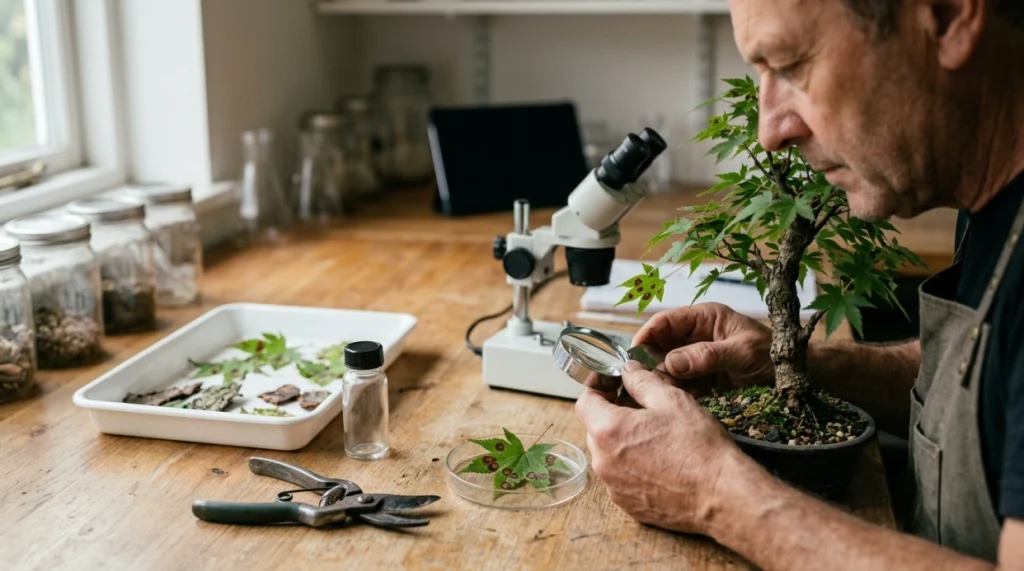
Seek a professional diagnosis when the disease spreads despite improved care or when symptoms move into stems and branches. You should also get help before applying repeated chemical treatments to a valuable tree.
The University of Georgia Extension notes that suspected bacterial diseases may require diagnostic confirmation. That is important because fungal and bacterial leaf spots can resemble one another.
Consider Diagnostic Help If You See:
- Rapid expansion of lesions across several branches
- Significant premature leaf drop
- Darkened or sunken stem tissue
- Dieback moving beyond individual leaves
- Several bonsai developing similar symptoms
- No improvement after moisture and sanitation problems are corrected
A plant diagnostic laboratory may use the host species, symptom pattern, microscopy, culturing, or other tests to narrow the cause. Testing can prevent weeks of treating the wrong problem.
This becomes especially useful with valuable Japanese maples, flowering bonsai, or trees already stressed by repotting. Avoid stacking treatments on a tree whose diagnosis remains uncertain.
Section Takeaway: If symptoms are severe, spreading, or unclear, confirm the cause before escalating treatment. Accurate diagnosis protects both the affected tree and the rest of your collection.
Frequently Asked Questions
Can bacterial leaf spot kill a bonsai?
Localized leaf spot does not automatically kill a bonsai. Severe disease can reduce foliage, weaken growth, and become more serious if infection progresses beyond isolated leaves or combines with other stress.
Should I remove every spotted leaf?
No. Remove heavily affected foliage selectively, especially when lesions appear to be spreading. Stripping a weak bonsai of most of its leaves can create additional stress, so balance sanitation against the tree’s remaining healthy foliage.
Can bacterial leaf spot spread to my other bonsai?
Potentially, yes. Some bacterial plant pathogens move through splashing water, contaminated tools, infected material, and handling, although susceptibility varies by plant species and pathogen.
Will neem oil cure bacterial leaf spot?
Do not assume neem oil will cure a bacterial disease. Correct diagnosis, sanitation, dry foliage, airflow, and species-appropriate care are more important first steps when bacterial leaf spot is suspected.
Is copper safe for every bonsai?
No. Copper products can injure sensitive foliage, and allowable uses differ between products and locations. Check the label for the plant and disease, then follow all application directions rather than using a general homemade concentration.
Are black spots on bonsai leaves always bacterial?
No. Black or brown spots can result from fungi, bacterial infections, insects, heat injury, watering stress, physical damage, or other causes. Look at the lesion pattern, recent conditions, pests, and how symptoms progress.
Should I repot a bonsai with bacterial leaf spot?
Not solely because of leaf spots. Repotting adds root stress and will not directly solve a foliar bacterial infection. Repot only when the roots or substrate independently justify it and the timing suits the species.
Final Takeaway: Treat bacterial leaf spot on bonsai as a diagnosis to investigate, not just a dark mark to spray. Isolate the tree, keep foliage dry, improve airflow, remove heavily infected material, sanitize tools, and watch how symptoms progress.
If the problem continues spreading, get a reliable diagnosis before escalating treatment. Careful observation protects the affected bonsai while reducing unnecessary stress on the rest of your collection.
