How to Inspect Bonsai Roots for Disease: A Step-by-Step Guide
A bonsai can look unhealthy above the soil even when the real problem is hidden inside the pot. Yellowing leaves, weak growth, branch dieback, or persistent wilting may all begin with damaged roots.
Knowing how to inspect bonsai roots for disease helps you separate genuine root problems from ordinary watering stress, seasonal changes, or harmless dark-colored older roots. The goal is not simply to find brown roots and start cutting. You need to examine their firmness, smell, location, surrounding soil, and the overall condition of the tree.
This guide explains when root inspection is justified, what healthy and unhealthy roots look like, how to examine them safely, and what to do if you discover rot or other suspicious damage.
Quick Answer
To inspect bonsai roots for disease, carefully remove the tree from its pot and check the roots for firmness, color, odor, and decay. Healthy roots are generally firm, while diseased roots may be soft, mushy, blackened, foul-smelling, or easily separated. Do not assume every dark root is diseased, because mature roots naturally vary in color.
Why Bonsai Root Health Matters
A bonsai depends on a relatively small root system confined inside a shallow container. Those roots must provide the entire tree with water, oxygen, and nutrients.
When roots become damaged, the canopy may begin showing symptoms even though the leaves and branches themselves are not infected.
Typical above-ground warning signs include:
- Unexpected yellowing
- Persistent wilting despite moist soil
- Reduced leaf size or weak new growth
- Premature leaf drop
- Twig or branch dieback
- Loss of vigor
- Needles turning dull or brown on conifers
- Soil remaining wet unusually long
These symptoms are not proof of root disease. Overwatering, underwatering, heat stress, poor light, fertilizer injury, and compacted soil can produce similar effects.
That is why inspection should be diagnostic rather than destructive.
University of Maryland Extension notes that overwatering and root rot can produce similar symptoms and that healthy roots are generally firm and light-colored. Its guidance for diagnosing indoor plant problems is a useful reminder that the condition of both the roots and growing environment should be considered together. (University of Maryland Extension)
When Should You Inspect Bonsai Roots?
You should not remove a bonsai from its pot every time one leaf turns yellow. Disturbing roots unnecessarily can create additional stress.
A complete inspection makes the most sense during normal repotting or when several warning signs strongly suggest a serious root problem.
Consider Inspecting the Roots When:
- The soil stays wet far longer than normal.
- The tree wilts even though the soil is moist.
- Water drains extremely slowly.
- The tree suddenly loses vigor without an obvious above-ground cause.
- A rotten or sour odor comes from the pot.
- Roots visible through drainage holes appear soft or decayed.
- The trunk base or root crown is becoming dark and soft.
- A recently purchased tree is declining in dense, waterlogged soil.
- The bonsai continues declining after watering, light, and temperature problems have been corrected.
According to the University of Maryland Extension’s root rot guidance, root and crown rots can cause yellowing, browning, dieback, poor growth, and wilting, while affected roots or crowns may become brown or black. (University of Maryland Extension)
Warning: If a weak bonsai is already severely stressed, removing all of its soil simply to “check the roots” may do more harm than good. Start with the least invasive observations possible.
What Do Healthy Bonsai Roots Look Like?
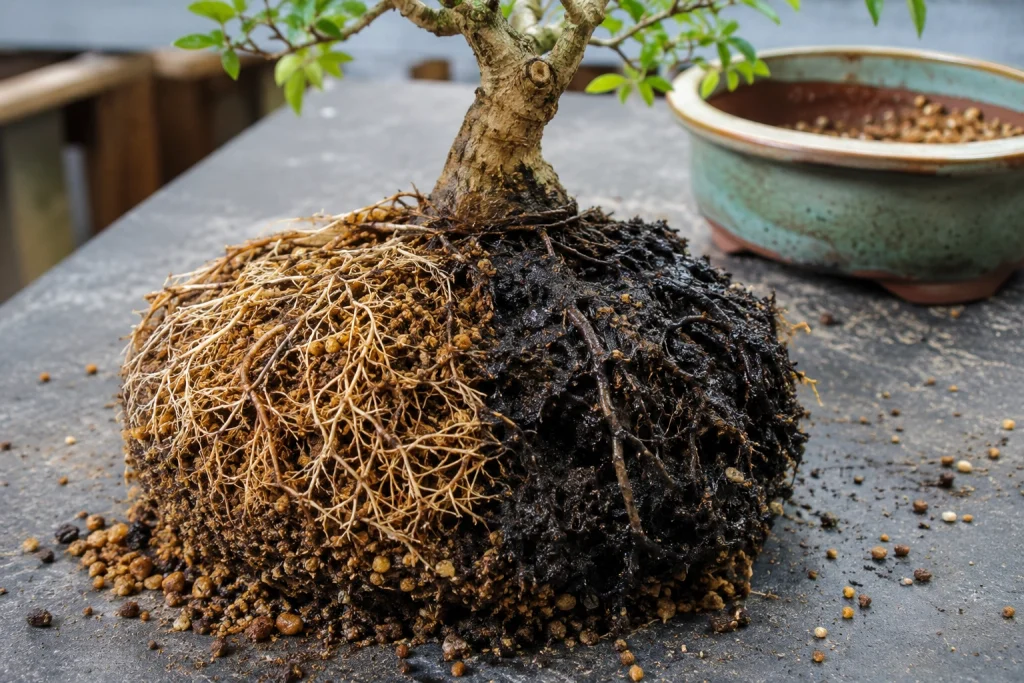
Healthy roots do not all look identical.
Young feeder roots—the fine roots responsible for much of the tree’s water and nutrient uptake—are commonly pale, cream, tan, or light brown when actively growing. Older structural roots naturally become darker and woodier.
Color by itself is therefore a poor diagnostic test.
Root color can vary with species, age, soil particles, organic matter, and growing conditions. University of Maryland Extension similarly notes that root color alone is not always a reliable indicator of health. (University of Maryland Extension)
A better inspection uses several characteristics together.
| Root Feature | Usually Healthy | Possible Disease or Decay |
|---|---|---|
| Texture | Firm and resilient | Soft, mushy, slimy, or collapsing |
| Fine roots | Numerous where conditions are suitable | Sparse, dead, or easily detached |
| Color | Cream, tan, light brown, or naturally woody brown | Suspicious blackening or dark lesions combined with decay |
| Smell | Mild earthy smell | Sour, rotten, or unpleasant odor |
| Outer tissue | Intact | Sloughs or pulls away easily |
| Root crown | Firm | Dark, soft, sunken, or decaying |
| Soil around roots | Moist but aerated | Permanently soggy, compacted, or foul-smelling |
The strongest warning is usually a combination of abnormal color, soft texture, bad odor, and declining tree vigor.
How to Inspect Bonsai Roots for Disease Step by Step
1. Examine the Tree Before Removing It
Start above the soil.
Record what the tree is doing before disturbing its root system. Look at leaf color, new growth, branch tips, soil moisture, drainage, and recent care.
Ask yourself:
- Has watering recently increased?
- Has the weather become cooler?
- Was the tree moved indoors?
- Has the soil started breaking down?
- Was fertilizer recently applied?
- Did the symptoms appear suddenly or gradually?
This information can prevent you from mistaking an environmental problem for an infectious disease.
Penn State Extension recommends looking at the whole pattern of symptoms when diagnosing poor plant health, because diseases, insects, environmental stress, and cultural problems can produce overlapping symptoms. (Penn State Extension)
2. Check the Soil Surface and Drainage Holes
Before unpotting the tree, inspect what you can see.
Look for:
- Constantly wet soil
- Collapsed or muddy substrate
- Poor water penetration
- Standing water
- Unusual fungal growth
- Dead roots around drainage holes
- A sour or stagnant smell
White fungal growth on organic material does not automatically mean the bonsai has root disease. Many fungi simply decompose dead organic matter.
3. Prepare Clean Tools
For a basic inspection, you may need:
- Root hook or bamboo chopstick
- Root shears
- Clean pruning scissors
- Disposable gloves
- Small brush
- Water spray bottle
- Magnifying lens
- Clean work surface
A simple chopstick and good pair of root shears are sufficient for many hobbyists.
Higher-quality bonsai tools tend to provide cleaner cuts and may last longer, but expensive tools do not improve diagnosis if you cannot recognize healthy and damaged tissue.
Beginners should prioritize clean, sharp, easy-to-control tools over a large specialist tool collection.
4. Remove the Bonsai Carefully
Release any tie-down wires beneath the pot first.
Run an appropriate tool around the inside edge only if necessary, supporting the trunk base rather than pulling aggressively on branches.
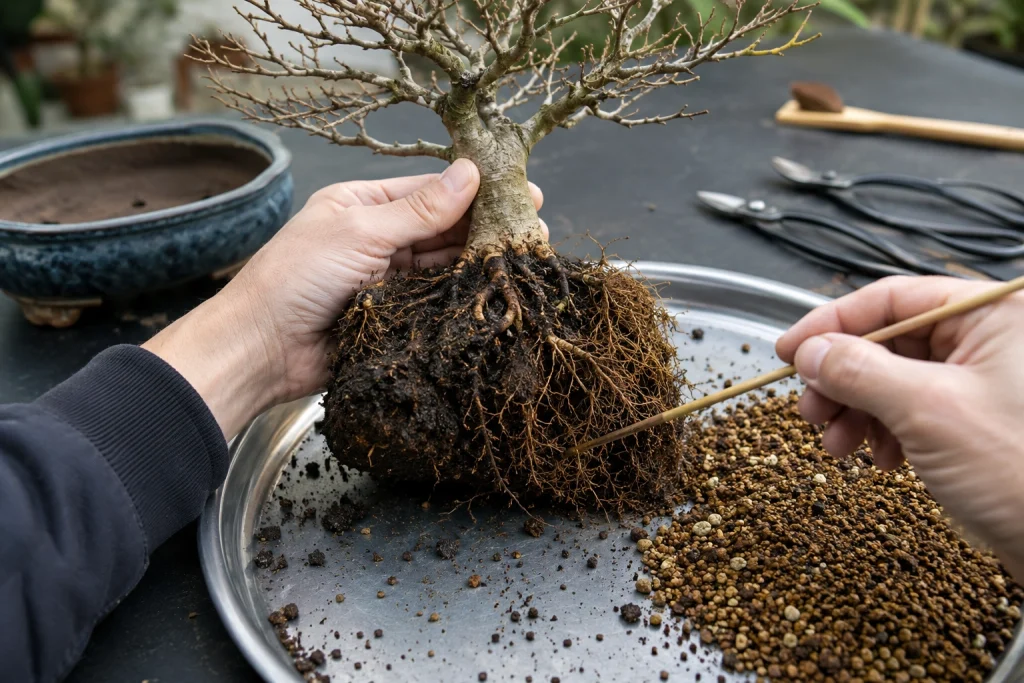
Slide the root mass from the pot as intact as possible.
Do not immediately rake all the soil away.
First examine the root ball in its existing condition. The pattern of wetness and decay may provide useful clues.
5. Inspect the Outer Roots First
Look at roots around the sides and bottom of the root mass.
Healthy feeder roots should generally feel firm. Questionable roots may appear:
- Soft
- Water-soaked
- Slimy
- Hollow
- Brittle and dead
- Darkened in irregular patches
- Easy to strip apart
Use your fingers gently. A healthy woody root should not collapse with light pressure.
6. Work Gradually Toward the Interior
Use a chopstick or root hook to loosen small areas of substrate.
Avoid combing out the entire root system unless repotting is appropriate for the species and season.
Pay particular attention to sections where the soil is unusually wet.
A root ball can sometimes have healthy roots near the outside while the central soil remains compacted and poorly aerated.
7. Check the Root Crown
The root crown is where the trunk transitions into the root system.
On bonsai, this area may also include the visible surface-root arrangement known as the nebari.
Healthy tissue should remain firm.
Look for:
- Soft areas
- Dark sunken tissue
- Bark separating unusually easily
- Decay spreading from the soil line
- Unpleasant odor
Rot at the crown is particularly concerning because damage in this area can affect a large portion of the tree’s vascular system.
8. Smell the Root Ball
Smell is surprisingly useful.
Healthy bonsai soil usually smells earthy. Waterlogged, oxygen-poor substrate may develop a stagnant or sour odor.
Severely decaying tissue can smell distinctly rotten.
Odor alone does not identify a pathogen, but when combined with soft roots and persistent wetness, it strengthens the case for root decay.
9. Compare Multiple Roots
Never diagnose the entire tree from one dark root.
Examine roots from several areas.
A few dead roots can occur naturally. What matters is whether decay is widespread, progressing, or associated with major loss of fine roots.
10. Photograph What You Find
Take close-up photographs before trimming anything.
Pictures allow you to:
- Compare root condition later
- Ask an experienced grower for help
- Show a plant diagnostic laboratory
- Track whether the condition is getting worse
- Avoid forgetting the original damage pattern
For valuable bonsai, documentation can be much more useful than immediately cutting away everything that looks suspicious.
Root Rot or Something Else?
Not every unhealthy-looking root system has an infectious disease.
Overwatering and Poor Aeration
Bonsai roots require both moisture and oxygen.
When fine particles break down and fill the air spaces inside the pot, roots can remain excessively wet. Root function declines, and conditions can become favorable for certain disease-causing organisms.
Persistent wet conditions therefore deserve attention even when you cannot identify a specific pathogen.
Fertilizer or Salt Damage
Excess fertilizer can damage fine roots.
Signs may include:
- Burned root tips
- Leaf-edge browning
- Sudden decline after feeding
- Salt deposits on the soil or pot
Simply applying fungicide will not correct this problem.
Drought-Damaged Roots
Roots that have dried severely may die and become brittle rather than mushy.
After watering resumes, damaged roots may then decay.
This can make the original problem difficult to identify unless you know the tree’s recent watering history.
Root-Bound Conditions
A dense root system is not necessarily diseased.
A vigorous bonsai can fill its container with roots between repottings. The main problem may simply be reduced room for fresh substrate and poor water movement.
Actual Root Rot
Root rot is a general description for decay involving roots. Different fungi, fungus-like organisms, and sometimes bacteria can be involved.
Common patterns include:
- Progressive loss of fine roots
- Soft or discolored root tissue
- Wet, poorly aerated substrate
- Weak canopy growth
- Wilting despite available moisture
- Root or crown lesions
You usually cannot identify the exact pathogen just by looking at the roots. Laboratory testing may be necessary when a precise diagnosis matters.
What Should You Do If You Find Diseased Roots?
Your response should depend on how much damage you find and how strong the bonsai is.
Remove Clearly Dead Tissue Conservatively
If repotting is appropriate, clearly rotten roots can generally be trimmed back to firm tissue with clean, sharp tools.
Do not remove healthy roots simply because they are brown.
Avoid aggressive root pruning on an already weak tree. A bonsai with few functioning roots may not tolerate major additional root loss.
Replace Degraded Soil When Necessary
If the substrate is compacted, broken down, or remaining saturated for excessive periods, fresh bonsai soil may be needed.
Choose a mixture appropriate for the species, climate, watering habits, and pot depth.
A good bonsai substrate should balance:
- Drainage
- Water retention
- Air space
- Structural stability
There is no single soil mixture that is ideal for every bonsai.
Clean the Pot and Tools
If infectious disease is suspected, avoid immediately using dirty root tools on another tree.
Clean soil and organic debris from tools and disinfect them according to the instructions for the product you use.
Keeping tools clean is especially important when working through several bonsai in one repotting session.
Expert Tip: Before cutting suspicious roots, compare several healthy-looking and unhealthy-looking roots from the same tree. This gives you a reference for that particular species and prevents unnecessary root pruning based only on color.
Should You Use a Fungicide?
Not automatically.
A fungicide will not fix poor drainage, compacted soil, excessive watering, fertilizer injury, or dead roots caused by drought.
Even when a pathogen is involved, the product must be labeled for the intended plant, disease, and application method.
The U.S. Environmental Protection Agency explains that pesticide labels contain legally enforceable directions for safe use. Never increase the concentration because you believe a stronger mixture will work faster. (US EPA)
For a valuable bonsai with severe or recurring root disease, getting a reliable diagnosis before applying chemicals is often smarter than repeatedly trying different products.
Root Inspection by Bonsai Type
Species suitability matters because bonsai do not all tolerate root disturbance equally.
| Bonsai Type | General Consideration |
|---|---|
| Deciduous bonsai | Often tolerate planned root work well when performed at the correct seasonal stage |
| Conifers | Usually benefit from more conservative root disturbance |
| Tropical bonsai | Root work is generally safer during warm, active growth |
| Weak or recently stressed trees | Require extra caution regardless of species |
| Newly purchased bonsai | Determine the soil condition and species needs before automatically repotting |
These are general principles, not fixed calendars.
A maple, juniper, ficus, pine, and azalea may require very different repotting strategies. Climate also changes timing.
Do not perform major root work simply because an online calendar says it is “repotting season.” Tree vigor and species biology matter just as much.
How to Reduce the Risk of Future Root Disease
Prevention is easier than trying to rescue a bonsai with extensive root loss.
Use Suitable Bonsai Soil
Avoid substrate that collapses quickly into dense mud.
Your mix should provide enough moisture for the species while still allowing air to reach the root system.
Water Based on the Soil, Not a Fixed Calendar
Checking every morning does not mean watering every morning.
Water when the tree actually needs it.
Hot summer weather may require frequent watering, while the same bonsai may dry much more slowly during cool weather.
Keep Drainage Holes Functional
Drainage mesh should keep substrate inside the pot without stopping water movement.
Make sure the tree is not sitting permanently in standing water.
Repot Before the Soil Completely Breaks Down
Over time, organic components and softer particles can decompose.
The interval varies considerably by species, substrate, tree age, root growth, and climate.
Watch Recently Repotted Trees Carefully
Freshly root-pruned bonsai cannot absorb water exactly as they did before root work.
Protect the tree from unnecessary environmental stress and follow species-appropriate aftercare.
Common Mistakes Bonsai Owners Should Avoid
- Diagnosing disease based only on brown roots. Older roots can naturally be dark.
- Pulling the tree from its pot repeatedly. Unnecessary root disturbance creates additional stress.
- Removing all the soil from a weak tree. Extensive bare-rooting may sacrifice functioning roots.
- Cutting every dark root. Texture, odor, and tissue integrity are more useful than color alone.
- Assuming wilting means the bonsai needs more water. A tree with damaged roots can wilt while sitting in wet soil.
- Treating every fungus as dangerous. Some fungi are decomposers rather than pathogens.
- Applying fungicide without correcting drainage. Chemical treatment cannot compensate for chronically waterlogged substrate.
- Using dirty tools from tree to tree. Clean tools when infectious disease is suspected.
- Performing emergency-style root pruning on a mildly stressed bonsai. Root work itself has consequences.
- Ignoring the species. Different bonsai respond differently to root disturbance.
When to Ask an Experienced Bonsai Grower or Arborist
Some root problems are reasonable for a beginner to manage. Others deserve experienced help.
Consider asking an experienced bonsai grower, horticulturist, plant diagnostic laboratory, or qualified arborist when:
- A valuable or old bonsai is declining rapidly.
- Most of the root system appears damaged.
- Decay has reached the trunk base.
- You cannot tell whether roots are naturally dark or diseased.
- The same problem returns after repotting.
- Several trees develop similar symptoms.
- You suspect a soil-borne infectious disease.
- You are considering removing a large percentage of the roots.
- A mature conifer is weak before repotting.
- You believe chemical treatment may be necessary.
For an inexpensive young tree, conservative DIY care may be reasonable.
For an established specimen representing years of training, paying for expert diagnosis can be a much better decision than experimenting with aggressive root pruning or multiple treatments.
FAQs
Can I inspect bonsai roots without removing the tree from the pot?
You can perform a limited inspection. Check drainage holes, soil moisture, odor, exposed surface roots, and tree vigor. A complete root assessment usually requires removing the tree, but this should only be done when justified.
Are black bonsai roots always root rot?
No. Some mature or naturally pigmented roots can be dark. Black color becomes more concerning when the roots are also soft, slimy, hollow, foul-smelling, or associated with declining growth.
What do healthy bonsai roots feel like?
Healthy roots should generally feel firm rather than mushy. Fine feeder roots may be flexible, while older structural roots become woody. Roots that collapse or lose their outer tissue with gentle handling deserve closer inspection.
Why is my bonsai wilting when the soil is wet?
Damaged roots may be unable to absorb and transport water effectively, even when plenty of moisture is present. Overwatering, poor aeration, and root rot are possible causes, so adding more water can sometimes make the problem worse.
Should I cut off all rotten bonsai roots?
Clearly dead or rotten roots may need removal during appropriate root work, but avoid cutting aggressively. If much of the root system is affected, get experienced advice before removing large amounts from an already weak tree.
Can I treat bonsai root rot without repotting?
It depends on the cause and severity. If poor drainage or badly degraded substrate is driving the problem, changing watering alone may not be enough. However, emergency repotting can also stress the tree, so the decision should consider species, season, and current vigor.
How often should I inspect bonsai roots?
A full inspection is normally unnecessary between appropriate repotting sessions unless the bonsai develops convincing signs of a root problem. Regularly monitor drainage, soil condition, watering behavior, and canopy health instead of repeatedly disturbing the roots.
Conclusion
Learning how to inspect bonsai roots for disease is less about memorizing what color a root should be and more about combining several clues.
Start with the tree’s overall behavior. Check watering and drainage. When root inspection is justified, look at firmness, smell, fine-root condition, crown health, soil structure, and the pattern of damage.
Most importantly, do not turn an inspection into unnecessary root pruning. Correct poor growing conditions first, remove clearly dead tissue conservatively when appropriate, and seek experienced help when major root loss or an uncertain disease threatens an important tree.
Make root inspection part of thoughtful bonsai care rather than an emergency reaction, and you will have a much better chance of catching problems while the tree still has enough healthy roots to recover.