Poor Drainage and Bonsai Root Problems: Causes, Signs, and Fixes

Quick Answer
Poor drainage causes bonsai root problems when excess water stays around the roots and pushes air out of the substrate. The result can be weak feeder roots, yellowing foliage, stalled growth, and eventually root rot. A properly structured bonsai soil mix should hold useful moisture while letting excess water escape and oxygen return to the root zone.
Signs Poor Drainage Is Affecting the Roots
- Slow runoff: Water pools on the soil surface or exits the drainage holes unusually slowly.
- Long wet periods: The root ball remains heavy and saturated much longer than expected.
- Weak foliage: Leaves may yellow, wilt, drop, or produce weak new growth despite moist soil.
- Soft roots: Damaged roots may feel limp, mushy, or lose their outer tissue instead of staying firm.
- Dense substrate: Old soil may break down into fine particles that reduce drainage and aeration.
First Thing to Check
- Watch how water moves through the pot before changing your watering routine or disturbing the roots.
Poor drainage and bonsai root problems often appear together, but wet soil alone does not prove that roots are rotting. The important question is whether the root zone stays saturated long enough to lose the air spaces healthy roots need.
I approach a slow-draining bonsai as a root-environment problem first. That helps avoid the common mistake of aggressively repotting an already stressed tree before identifying the real cause.
In This Guide
- What Does Poor Drainage Do to Bonsai Roots?
- How Can You Tell Drainage Is Causing Root Problems?
- What Causes Poor Drainage in Bonsai Pots?
- Poor Drainage vs. Overwatering vs. Root Rot: What Is the Difference?
- How Do You Fix Poor Bonsai Drainage Without Making Things Worse?
- How Can You Prevent Drainage-Related Root Problems?
- FAQ About Poor Drainage and Bonsai Root Problems
What Does Poor Drainage Do to Bonsai Roots?
Poor drainage keeps too much water inside the bonsai container for too long. As water fills the spaces between soil particles, less air remains available around the roots.
Definition: Poor bonsai drainage is a condition where excess irrigation or rainwater cannot move through and leave the root zone efficiently, causing prolonged saturation and reduced root aeration.
Roots are living tissues that need oxygen for normal respiration. A saturated container limits gas exchange and can gradually damage fine feeder roots.
The problem matters even more in shallow bonsai pots. There is little unused soil volume, so a drainage failure can affect a large portion of the active root system.
- Reduced oxygen: Water occupies pore spaces that would normally contain air.
- Weaker feeder roots: Fine absorbing roots may decline before larger roots show obvious damage.
- Poor nutrient uptake: Damaged roots become less effective at supporting foliage and new growth.
- Higher disease pressure: Persistently wet conditions can favor organisms associated with root diseases.
- Slower recovery: An already stressed tree has fewer healthy roots available to rebuild vigor.
The University of Illinois Extension notes that drainage holes allow water to leave containers while helping maintain air around roots. Its container drainage guidance also explains why persistently wet conditions increase root-rot risk.
As of 2026, I still consider drainage behavior more useful than a fixed rule about watering frequency. A tree should be judged by its substrate, weather, species, root density, and current growth.
Section Takeaway: Poor drainage is primarily an oxygen and root-environment problem, not simply a matter of the soil looking wet. Healthy bonsai roots need both moisture and air.
How Can You Tell Drainage Is Causing Root Problems?
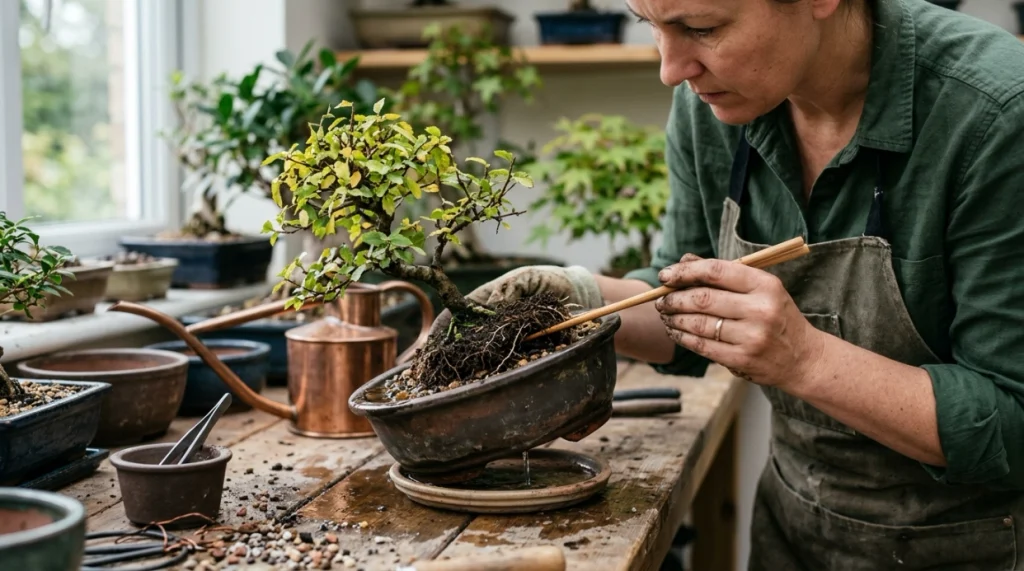
Look for several symptoms occurring together rather than diagnosing the tree from one yellow leaf. Slow drainage, persistent wetness, weak growth, and deteriorating roots create a much stronger case.
Watch what happens when you water
Water should enter the root ball and escape through the drainage holes without sitting on the surface for a prolonged period. A sudden change from fast drainage to sluggish drainage deserves attention.
- Water remains pooled on the soil surface.
- Only a small amount exits the bottom of the pot.
- One drainage hole works while another appears blocked.
- The pot stays unusually heavy for days after watering.
- The center of the root ball stays wet while the surface appears drier.
Check the foliage, but do not diagnose from leaves alone
Root stress often appears above ground. Yellowing, weak shoots, leaf drop, or wilting can develop because damaged roots cannot function normally.
The confusing part is that drought can produce similar symptoms. Adding more water to an already saturated tree may therefore make the original problem worse.
Inspect roots only when there is a good reason
Healthy root color varies with species and age, so brown roots are not automatically rotten. Texture and structure usually tell you more.
- More reassuring: Roots are firm and hold together when handled gently.
- Concerning: Fine roots are disappearing and the root mass smells stale or sour.
- More serious: Roots are limp, mushy, decomposing, or slough apart when touched.
The University of California IPM program explains that aging container media can settle, compact, and lose aeration. Its container root-health guidance also emphasizes good drainage and appropriate watering frequency for preventing root problems.
When I troubleshoot a slow-growing bonsai, I compare that pot with similar trees nearby. A pot that remains heavy and wet long after comparable trees begin drying often tells me where to investigate first.
Section Takeaway: Diagnose patterns, not single symptoms. Wet soil plus slow drainage plus soft roots is far more meaningful than yellow foliage by itself.
What Causes Poor Drainage in Bonsai Pots?
Poor drainage usually develops because of the substrate, drainage holes, root density, pot setup, or watering conditions. More than one cause often acts at the same time.
1. Fine or compacted soil
Dense garden soil and broken-down organic mixes contain fewer large air spaces than coarse bonsai substrates. Water then moves through the root ball more slowly.
Some substrate particles also become smaller as they age. That gradual breakdown can turn a once-open mix into a much denser root environment.
2. Blocked drainage holes
Roots, compacted particles, or misplaced mesh can obstruct a drainage hole. A pot sitting flat in trapped runoff can create a similar effect.
- Check every drainage opening.
- Remove obvious debris underneath the pot.
- Make sure drainage mesh is not packed with fine material.
- Do not leave an ordinary bonsai pot standing in collected runoff.
3. An overly dense root mass
A root-bound tree can become difficult to water correctly. Dense roots may leave little open substrate for water and air movement.
That does not mean every root-bound bonsai needs immediate emergency repotting. Species, season, health, and development stage should guide major root work.
4. A water-retentive mix that does not suit your climate
A substrate that performs well in a hot, dry location may stay wet too long during a cool, humid season. Bonsai soil therefore needs to match both the tree and the grower’s environment.
| Example Framework | Akadama | Pumice | Lava Rock | Practical Note |
|---|---|---|---|---|
| Deciduous starting mix | 50% | 25% | 25% | Balances moisture retention with open structure. |
| Conifer and pine starting mix | About 33% | About 33% | About 33% | Provides a highly granular starting framework. |
These ratios are examples rather than universal prescriptions. Species, rainfall, heat, humidity, pot depth, particle size, and your watering habits can justify changing the mix.
Section Takeaway: Fixing drainage starts with identifying why water is staying too long. Substrate structure, drainage openings, root density, and climate all matter.
Poor Drainage vs. Overwatering vs. Root Rot: What Is the Difference?
Poor drainage, overwatering, and root rot are related but not interchangeable terms. Keeping them separate makes diagnosis much easier.
| Problem | What It Means | Typical Clue | First Response |
|---|---|---|---|
| Poor drainage | Water cannot leave the root zone efficiently. | Slow runoff and prolonged wetness. | Check holes, substrate structure, and pot setup. |
| Overwatering | Water is added again before the root zone needs it. | Repeated watering while substrate is still sufficiently moist. | Water according to moisture and tree demand. |
| Root rot | Root tissue has deteriorated because of damaging conditions, pathogens, or both. | Soft or decomposing roots with declining growth. | Confirm root damage and correct the underlying environment. |
A bonsai can have poor drainage before root rot develops. Catching the problem at this earlier stage gives you more options and may avoid emergency root work.
Likewise, frequent watering does not automatically create disease if a highly aerated substrate drains and dries appropriately. The dangerous combination is repeated saturation plus insufficient aeration and susceptible roots.
Iowa State University Extension notes that organisms such as Pythium, Phytophthora, Rhizoctonia, and Fusarium can be associated with root rots. Their root rot guidance also warns that symptoms can be mistaken for water shortage.
Section Takeaway: Poor drainage describes the environment, overwatering describes a watering pattern, and root rot describes root deterioration. One can lead to another, but they are not the same diagnosis.
How Do You Fix Poor Bonsai Drainage Without Making Things Worse?
Start with the least invasive correction. A stressed bonsai does not benefit from unnecessary root disturbance simply because the soil drains slowly.
Step 1: Stop watering by the calendar
Check the substrate before adding more water. Weather, pot size, species, foliage mass, wind, and season can change water use dramatically.
Step 2: Check the drainage openings
Look beneath the pot and confirm that each drainage hole is open. Clear external debris without digging blindly through the root mass.
Step 3: Observe the soil structure
Fine, muddy, or badly broken-down substrate may no longer provide enough pore space. A dense nursery-style center core can also remain wet after the outer bonsai mix begins drying.
- Look for water pooling on top.
- Compare wetness near the surface and deeper in the pot.
- Check whether fine particles are accumulating near drainage holes.
- Note whether the pot remains heavy far longer than similar trees.
Step 4: Decide whether repotting is necessary
Repotting can solve a structural soil problem, but timing matters. Healthy seasonal repotting is different from emergency root work on a declining tree.
If severe root deterioration is confirmed, remove only clearly dead tissue and preserve functioning roots wherever possible. The correct amount of root pruning depends heavily on the species and condition.
Pro tip: Cutting live roots is irreversible. If the bonsai is valuable, badly weakened, or unfamiliar to you, ask an experienced grower or local bonsai club for species-specific help before major root pruning.
Step 5: Use an open substrate suited to the tree
The replacement mix should provide moisture retention without remaining airless. Akadama, pumice, lava rock, and other stable granular components are commonly used for this reason.
Do not assume adding a thick gravel layer beneath dense soil will solve the problem. Good drainage depends on the structure of the root-zone substrate and functional drainage openings.
Section Takeaway: Correct the simplest cause first. Major root work belongs later in the process, after you have confirmed that drainage or root deterioration cannot be corrected safely in place.
How Can You Prevent Drainage-Related Root Problems?
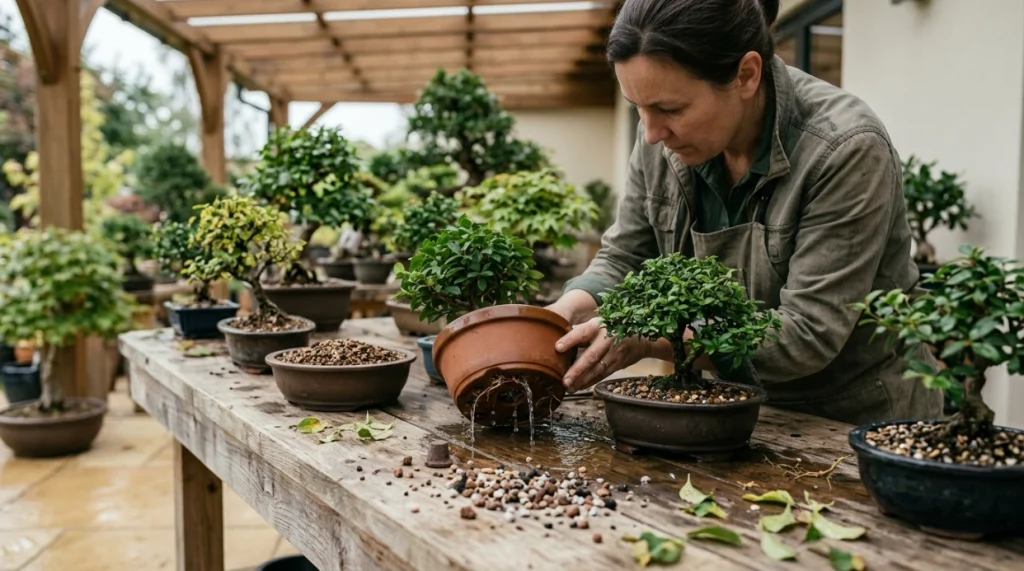
Prevention comes from matching watering, substrate, and container design to the tree. No single watering schedule works for every bonsai throughout the year.
Water according to need
Check trees individually instead of watering everything because it is a certain day. Bonsai Empire’s bonsai watering guidance likewise advises growers against relying on a fixed routine.
- Expect faster drying during hot, sunny, windy weather.
- Expect slower drying during cool, humid, cloudy periods.
- Watch recently repotted or weak trees carefully because water use may change.
- Remember that a small pot can behave differently from a deeper training container.
Protect soil structure
Sift out excessive dust when preparing granular substrate. Very fine particles can settle into gaps and reduce the open structure you were trying to create.
Watch older substrate for breakdown. A mix that performed well when new can drain differently after several seasons of watering, freezing, root growth, and particle decay.
Inspect the pot during routine care
Drainage holes should remain functional throughout the year. Pot feet or the pot’s design should also allow runoff to escape instead of collecting underneath.
- Check drainage after heavy rain.
- Watch for roots growing through the holes.
- Remove accumulated debris beneath pots.
- Do not allow runoff trays to remain filled around ordinary bonsai pots.
Respond to seasonal changes
A tree’s water use can fall sharply when growth slows. Continuing a midsummer watering routine into cooler conditions can keep the same substrate wet much longer.
This is one reason I watch each pot instead of memorizing a number of days between waterings. Drainage tells you how the container behaves, while drying speed tells you how the tree and environment are interacting.
Section Takeaway: Healthy roots come from a repeatable wet-to-aerated cycle, not from keeping the substrate permanently soaked. Good drainage gives you a wider margin for watering safely.
FAQ About Poor Drainage and Bonsai Root Problems
Can poor drainage kill a bonsai tree?
Yes. Persistent saturation can reduce oxygen around the roots, weaken fine roots, and contribute to serious root deterioration. The risk becomes greater when dense substrate, blocked drainage, frequent watering, and disease pressure occur together.
How do I know if my bonsai soil drains badly?
Watch the pot while watering. Water that pools for an unusually long time, exits slowly, or leaves the root ball saturated for extended periods can indicate a drainage problem, especially if the behavior has worsened over time.
Does wet bonsai soil always mean root rot?
No. Healthy bonsai soil becomes thoroughly wet when watered. Root rot becomes a concern when saturation persists and is accompanied by declining growth, poor aeration, and roots that are soft, decomposing, or losing healthy fine structure.
Should I repot a bonsai immediately if drainage is slow?
Not automatically. First check blocked holes, compacted surface material, watering habits, weather, and the tree’s health. Repotting adds stress, so emergency root work should be reserved for situations where leaving the root system unchanged presents the greater risk.
Can I improve drainage by putting gravel in the bottom of the pot?
A bottom layer of gravel does not compensate for dense, poorly draining substrate. Focus on an open root-zone mix, suitable particle sizes, and clear drainage holes throughout the container.
What should healthy bonsai roots feel like?
Healthy root appearance varies by species, but functioning roots should generally feel firm rather than mushy or decomposed. Fine active roots and a structurally sound root mass are more useful indicators than color alone.
Why does my bonsai wilt even though the soil is wet?
Damaged roots may struggle to absorb water even when plenty of moisture surrounds them. Check drainage, substrate condition, root health, light, temperature, and other stresses before assuming the tree simply needs another watering.
The main takeaway is simple: when a bonsai stays wet too long, investigate why before reaching for more water or pruning the roots. Check drainage, soil structure, moisture, and root firmness together, then choose the least stressful correction that solves the underlying problem.
A bonsai with a healthy root environment is easier to water, easier to diagnose, and better equipped to handle seasonal changes. Make drainage one of the first things you observe whenever a tree begins losing vigor.
