
Top 5 Best Bonsai Pruning Saw: Expert Picks For 2026

The Top 5 Best Bonsai Pruning Saw give clean cuts, control, and safety.
You love shaping living art, but ragged cuts and bulky tools slow you down. I’ve been there—trying to reach a tight crotch in a juniper or reduce a stubborn maple branch without tearing bark. The right saw makes the work smooth and calm. In this guide, I compare the Top 5 Best Bonsai Pruning Saw that I trust in 2026. I focus on cut quality, control, steel, and handling. I also add one essential accessory that protects your fresh cuts. If you want faster, cleaner, safer pruning, this review will help you choose with confidence.
KAKURI 3-1/8” Keyhole Bonsai Saw (Japan)

This compact KAKURI keyhole saw is built for delicate bonsai work. The 80 mm blade slides into tight branch crotches and narrow cuts where larger saws stall. It uses a Japanese pull stroke, so the blade stays straight and the kerf stays thin. I reach for it when I need to refine jin, open shari, or notch without bruising live tissue.
The carbon steel teeth feel eager on the pull. They bite cleanly, even in dense hardwoods like hornbeam or boxwood. The narrow spine helps you steer with the tip, which matters in complex deadwood. It is a specialist’s tool, and it shines when precision matters more than speed.
Pros
- Ultra-narrow profile reaches tight spots without damaging nearby bark
- Pull-cut action gives straight, low-effort strokes and control
- Thin kerf reduces fiber tear-out and speeds healing
- Great for detailed jin, shari, and small corrective cuts
- True Japanese build quality and consistent tooth geometry
- Lightweight, so your hand does not tire on long sessions
Cons
- Short blade limits cut depth on bigger branches
- Not ideal for fast reduction cuts or woody conifer trunks
- May not include a sheath; protect the teeth during storage
My Recommendation
If you work on compact trees, shohin, or fine detail, start here. The KAKURI keyhole saw is precise and calm. It lets you cut only what you intend to cut. Among the Top 5 Best Bonsai Pruning Saw, this one is the specialist that prevents costly slips when space is tight.
| Best for | Why |
|---|---|
| Tight crotches and confined spaces | Slender blade and pull stroke steer well in narrow gaps |
| Detail work on jin and shari | Clean, thin kerf protects live edges and bark |
| Shohin and small specimens | Short, light blade offers superior control on tiny trees |
KAKURI 4” Folding Bonsai Saw (Japan)

This 4-inch folding KAKURI hits the sweet spot for portability and control. The pull-saw blade tucks into a compact wooden handle, so it rides safely in a pocket or tool roll. I use it for quick branch reductions up to about 1 inch in diameter. It opens fast, locks tight, and the bite is smooth on both green and seasoned wood.
Compared to a multi-tool saw, this cuts cleaner and tracks better. The tooth geometry favors pull strokes that let you work with less pressure. That is kind to delicate cambium on maples and azaleas. It is a great everyday bonsai saw that you can take to workshops or club nights without fuss.
Pros
- Folds safely for travel and pocket carry
- Pull-cut blade delivers smooth, low-tear cuts
- Wood handle feels secure and warm in the hand
- Fast setup with a simple locking action
- Ideal for light to medium bonsai cuts in the 0.5–1.5 inch range
- Reliable Japanese steel maintains sharpness with basic care
Cons
- Short blade slows large reduction cuts
- Pivot needs cleaning if you work in resinous conifers
- Replacement blades may be harder to source than larger KAKURI sizes
My Recommendation
If you want one small saw to do most bonsai jobs, pick this. It is compact but serious, and it makes clean work of routine pruning. In the Top 5 Best Bonsai Pruning Saw, this is the best everyday carry for workshops, balcony growers, and travel kits.
| Best for | Why |
|---|---|
| Everyday bonsai pruning | Balanced blade length and easy control |
| Portable kits and classes | Folding design protects the blade and your bag |
| Delicate species like maple | Smooth pull cuts reduce bark tear and bruising |
Toolux 5” Folding Pruning Saw, SK5 Steel
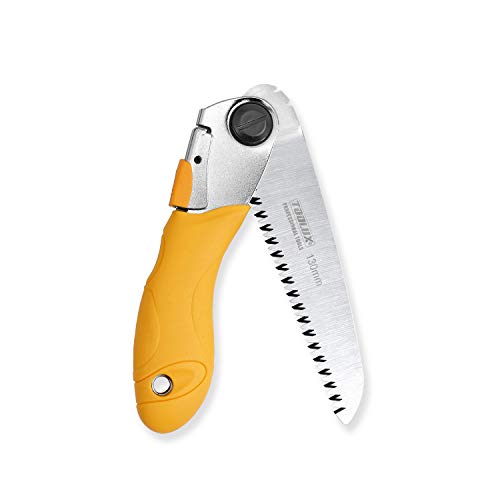
The Toolux 5-inch folding saw uses SK5 high-carbon steel. That steel holds an edge well and resists chipping if you cut dry twigs and mixed brush. The handle has a non-slip texture that feels secure with gloves or sweaty hands. It is a budget-friendly pick for new bonsai growers who also camp or garden.
It is not a true Japanese pull saw. The tooth set is more general-purpose, so it can leave a rougher surface on very soft bark. I work around that by undercutting first, then finishing with slow, light strokes. For the price, it brings a lot of utility to a starter kit.
Pros
- Affordable entry into dedicated pruning saws
- SK5 steel balances toughness and sharpness retention
- Folding design with grippy handle for safer use
- Cuts well across hobbies: bonsai, camping, yard work
- Good reach for 1–2 inch cuts without being bulky
- Low-maintenance and easy to clean after sap exposure
Cons
- Less refined finish than premium Japanese pull saws
- Can cause slight tear-out on thin-barked species if rushed
- Hinge play may develop if you force heavy cuts
My Recommendation
Choose the Toolux if you want value and versatility. It can prune bonsai, trim landscape shrubs, and ride in your camping bin. Inside the Top 5 Best Bonsai Pruning Saw, it is the budget hero that still makes safe, steady cuts when used with care.
| Best for | Why |
|---|---|
| Beginners on a budget | Low cost with solid SK5 blade performance |
| Mixed outdoor use | Folding, durable design works beyond bonsai |
| 1–2 inch branch work | Blade length and tooth set cut efficiently at this size |
Saboten 9.4” Japanese Pruning Saw, Wood Sheath
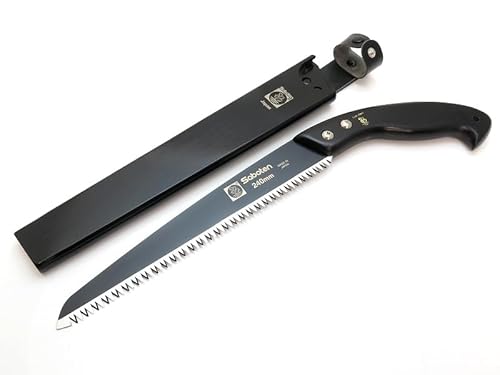
This Saboten is the heavy lifter in the set. The 240 mm blade with a 7.5 mm tooth pitch eats through larger limbs fast. It is still a pull saw, so it tracks straight without forcing. The fluorine coating sheds sap and reduces drag, which helps on pines and fruiting species.
I reach for it when I reduce nursery stock or restyle a big trident maple. The included wood sheath protects the edge between cuts and during travel. Paired with a branch cutter for the final nub, it leaves a smooth surface that heals well. It is a pro tool that rewards a steady hand and a slow first stroke.
Pros
- Long blade rips clean, fast cuts on thicker branches
- Fluorine coating reduces resin buildup and friction
- Wooden sheath is practical and protects the blade
- Pull stroke feels stable; less binding in dense wood
- Great for pre-bonsai reduction and structural work
- Durable high-carbon steel with consistent tooth set
Cons
- Too large for tight inner canopy work
- Bigger tooth pitch can mark very soft bark if rushed
- Requires space and two hands for best control
My Recommendation
Pick the Saboten if you often handle bigger trees or nursery stock. It reduces large branches with less sweat and keeps cuts straighter than push saws. Within the Top 5 Best Bonsai Pruning Saw, it is the power option for structural pruning and fast reduction work.
| Best for | Why |
|---|---|
| Large branch removal | Long blade and coarse pitch cut fast and true |
| Resinous species | Fluorine-coated blade resists sap stick and drag |
| Pre-bonsai reduction | Covers big cuts quickly to shape stock for styling |
Kiyonal Bonsai Pruning Sealer, 100g (Japan)

This is not a saw. It is a finishing essential. Kiyonal is a trusted pruning sealer used after you make clean cuts with the Top 5 Best Bonsai Pruning Saw. It spreads like a soft paste, dries to a flexible film, and shields fresh wounds from excess moisture and pathogens.
I apply it thinly on larger cuts and on species that bleed or die back. It helps maples, azaleas, and many conifers callus more evenly. Used right, it keeps edges tidy and color blends well as the tree heals. It is a small tube that makes a big difference in recovery.
Pros
- Protects fresh cuts from disease and drying
- Flexible film moves with the wood as it swells and shrinks
- Applies cleanly; easy to control thin layers
- Trusted by bonsai professionals for decades
- Improves callus appearance on many species
Cons
- Not needed on every species or tiny cuts
- Over-application can slow natural drying
- 100 g tube can run out fast during heavy work
My Recommendation
Use Kiyonal to finish the job your saw starts. It is not a cutter, but it is the best partner for the Top 5 Best Bonsai Pruning Saw when you care about healing and presentation. Apply it thinly on larger wounds, and your aftercare will match your cut quality.
| Best for | Why |
|---|---|
| Post-pruning wound care | Shields cuts from pathogens and helps neat callus |
| Bleeding-prone species | Controls moisture and reduces dieback risk |
| Display-ready finish | Thin, tidy coat blends visually as it cures |
FAQs Of Top 5 Best Bonsai Pruning Saw
How do Japanese pull saws help bonsai work?
They cut on the pull stroke. That keeps the blade straight and the kerf thin. You get cleaner cuts with less pressure and less bark tear.
What blade length should I choose first?
A 4–5 inch folding saw covers most bonsai cuts. Add a short keyhole saw for tight spots and a 9–10 inch saw for big reductions.
Do I need a sealer after every cut?
No. Use it on larger cuts or sensitive species. Thin coats help; heavy coats can trap moisture.
How do I prevent bark tear-out?
Score the cut line with a knife. Make a small undercut first. Finish with slow, light pull strokes.
How do I maintain these saws?
Brush off dust. Wipe with alcohol if sappy, then a light oil. Store dry, and protect teeth with a sheath or fold them in.
Final Verdict: Which Should You Buy?
If you want one do-it-all starter, choose the KAKURI 4” Folding Bonsai Saw. For tight, fussy work, the KAKURI keyhole saw is unmatched.
Handling big limbs? The Saboten 9.4” is the muscle in the Top 5 Best Bonsai Pruning Saw. On any large cut, finish with Kiyonal for clean healing.
Expert tips for getting the most from the Top 5 Best Bonsai Pruning Saw
Over years of shaping pines, junipers, and maples, I learned that clean, quiet strokes win. Japanese pull saws excel because wood fibers compress on the pull. That lowers the chance of a wandering blade and ragged edges. I start every cut with a light backstroke to set the teeth. Then I saw with steady, short motions until the kerf guides me. This rhythm preserves cambium and lowers fatigue.
Match the saw to the job. The KAKURI keyhole saw slips where other tools cannot go. It handles fine deadwood and tight angles near buds. The 4-inch folding KAKURI rides in my pocket when I walk benches. It handles half the day’s tasks with grace. When a big juniper branch must go, I take the Saboten. It bites deep and sheds resin thanks to its coating. This is real efficiency: the right edge at the right time.
Use body support to guide the blade. I brace my wrist or forearm on the pot rim or trunk when space is tight. That turns shaky freehand cuts into steady lines. With the Top 5 Best Bonsai Pruning Saw, your body can be a jig. Align, breathe, pull, and let the saw do the work. Your tree rewards you with smooth faces that callus like a zipper.
Prevention beats repair. If the branch is heavy, I make a relief cut further out. Then I remove weight so the final cut near the trunk does not tear. I also score the bark with a knife at the final cut line. It sounds slow, but it saves bark and time in the end. Clean work heals faster than quick, rough work.
Keep edges clean. After resinous cuts, sap will coat teeth and slow the next stroke. I wipe with isopropyl alcohol or a citrus cleaner, then add a whisper of camellia oil. It restores the glide. For the Saboten, the fluorine coat helps, but a wipe still matters. The saws in the Top 5 Best Bonsai Pruning Saw will last longer if you treat them like blades, not yard tools.
Know your species. Azaleas and maples bruise if rushed. Pines can pitch-glue a blade mid-cut. For soft bark, I use slower, finer strokes and support the branch. For sappy conifers, I keep a cloth handy and pause to wipe. Changing your pace to the wood makes your cuts feel like silk.
Finish well. Even a perfect cut can dry out or invite fungus. That is why I keep Kiyonal in my kit. I apply a thin coat to large or risky cuts. I avoid thick blobs. Thin coats flex and let gas exchange continue. Over the weeks, they blend as the callus rolls in. Good aftercare is the quiet partner to sharp tools.
Safety matters. Small saws still cut skin fast. I secure the tree or pot so it will not rock. I anchor my hands and avoid pulling toward my body. I fold or sheath every saw the second the cut is done. It is a habit that prevents bench-side surprises.
When you choose from the Top 5 Best Bonsai Pruning Saw, think in layers. A keyhole saw for detail, a compact folder for daily work, and a longer saw for structure. Add a tube of Kiyonal. With that set, you can handle any season, any species, and any styling task with calm, clean confidence.
Practical sizing guide. If the branch is pencil-thick, the keyhole saw excels. Thumb-thick to finger-thick, I grab the 4-inch folder. Wrist-thick or bigger, the Saboten wins. These quick rules help you choose without thinking. Over time, your hand will know the right tool before your mind names it.
Sharpening and replacement. Most modern Japanese saws use hardened teeth that resist wear. They are not easy to file at home. I rely on good technique and cleaning to stretch blade life. When a saw starts to skate on the first pull, I replace the blade if available or the tool if not. Fresh teeth are cheaper than torn bark.
Storage and climate. Humidity and sap can rust plain steel. Dry your saws after work, especially in rainy seasons. A drop of light oil on the blade and pivot keeps action smooth. Store folded or sheathed. These tiny steps keep the Top 5 Best Bonsai Pruning Saw ready for that perfect Sunday session.
In the end, bonsai rewards care and patience. Good saws protect your vision and your trees. They turn effort into ease and risk into rhythm. Choose the tools that match your trees and hands. Then practice slow, steady strokes. Your trees will tell the rest of the story in fresh buds, tight callus, and clean lines year after year.
