Spider Mite Damage on Bonsai: What It Looks Like

Quick Answer
Spider mite damage on bonsai usually starts as tiny pale, white, or yellow speckles across leaves or needles. As feeding increases, foliage can look dull, bronze, grayish, dry, or scorched, followed by premature leaf drop and fine webbing. The University of Minnesota Extension spider mite guide describes the same stippling, bronzing, webbing, and leaf-loss pattern.
Signs to look for
- Pale stippling: Hundreds of tiny light dots appear where mites have damaged leaf cells.
- Bronzed foliage: Heavier feeding can turn green leaves dull yellow, gray, bronze, or brown.
- Fine webbing: Thin silk may appear beneath leaves, between needles, or around twigs.
- Tiny moving dots: Mites may be visible with a 10× hand lens or on white paper.
- Early leaf drop: Severe feeding can weaken foliage enough to make leaves dry and fall.
Best confirmation test
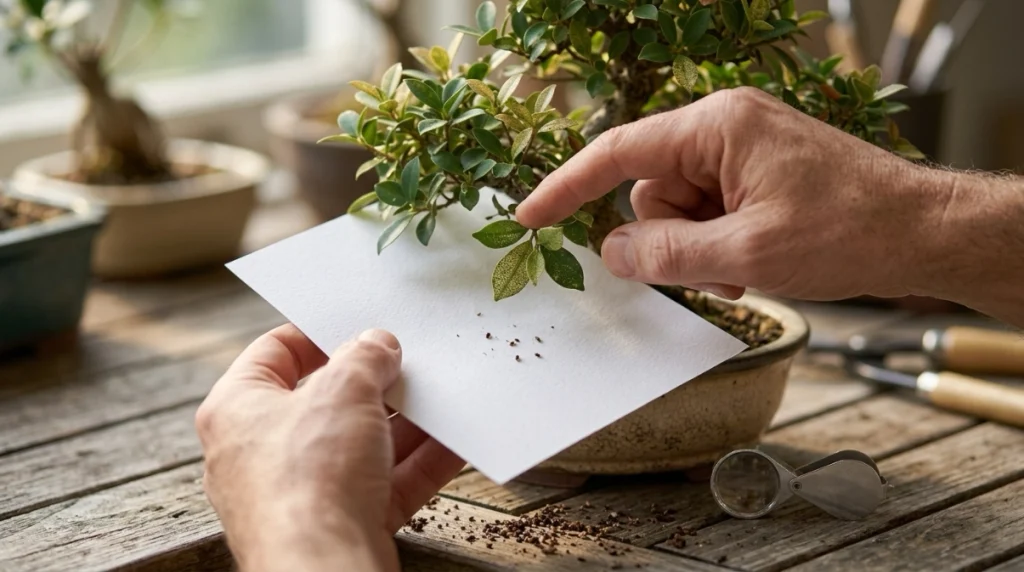
- Hold white paper beneath a suspicious branch, tap the foliage gently, and watch for tiny moving specks.
Spider mites are easy to overlook on bonsai because the first signs resemble watering stress or sun damage. By the time webbing becomes obvious, the population may already be well established.
When I troubleshoot suspicious foliage, I focus on the damage pattern before changing the tree’s care. That simple habit prevents a lot of unnecessary watering, fertilizing, and spraying.
In This Guide
- What does spider mite damage on bonsai look like?
- How can you confirm spider mites are causing the damage?
- How does spider mite damage progress?
- What conditions make spider mites worse?
- How do you stop spider mite damage?
- Can a bonsai recover from spider mite damage?
- Spider mite damage on bonsai FAQ
What Does Spider Mite Damage on Bonsai Look Like?
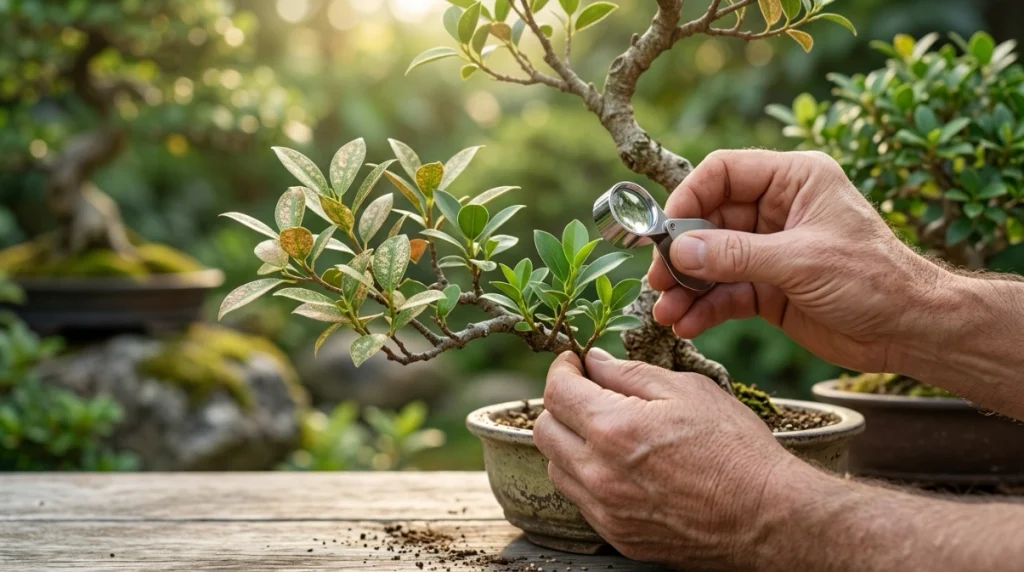
Spider mite damage usually appears as fine stippling rather than large spots. Individual leaf cells lose color after mites pierce the tissue and feed.
Definition: Spider mite damage is the visible leaf or needle injury caused by tiny arachnids feeding on plant cells. Early injury looks like pale speckling, while severe infestations can cause bronzing, drying, webbing, and leaf loss.
Early spider mite damage
The earliest sign may be dozens of pinprick-sized pale dots. The leaf can still look green from a distance.
- Broadleaf bonsai: Look for yellow-white stippling across the leaf surface.
- Fine foliage: Watch for an overall faded or dusty appearance.
- Conifers: Needles or scale foliage may lose their healthy green color and become dull or bronze.
- Leaf undersides: You may find mites, eggs, cast skins, or delicate silk.
More advanced damage
Continued feeding causes individual speckles to merge into larger faded areas. Leaves may then become yellow, bronze, grayish, or brown.
Fine webbing becomes more important at this stage. It may stretch between leaves, branch forks, petioles, or dense areas of foliage.
- Dry or papery-looking leaves
- Premature leaf or needle drop
- Reduced vigor
- Weak-looking new growth
- Dense webbing during a heavy infestation
Section Takeaway: Spider mite damage usually begins with fine stippling, not obvious webs. Bronzing, drying, and webbing generally indicate that feeding has progressed.
How Can You Confirm Spider Mites Are Causing the Damage?
Do not diagnose spider mites from yellow or brown foliage alone. Water stress, root trouble, fertilizer injury, sun scorch, and several diseases can create similar symptoms.
Use the white-paper test
This is one of my favorite checks because it takes less than a minute. It works especially well on dense or fine-leaved bonsai.
- Place a clean sheet of white paper beneath a suspicious branch.
- Tap or gently shake the foliage over the paper.
- Wait several seconds and watch the fallen particles.
- Look for extremely small dots moving across the paper.
- Confirm suspicious specks with a 10× hand lens when possible.
The UC Integrated Pest Management spider mite guidance also recommends checking leaf undersides and shaking mites onto white paper for closer inspection.
Inspect where mites hide
Spend more time beneath the foliage than above it. Spider mites commonly feed and reproduce on protected leaf surfaces.
- Undersides of leaves
- Interior foliage
- Leaf and stem junctions
- Dense needle clusters
- Fine twigs near damaged foliage
Spider mites versus other bonsai problems
Underwatering often causes more general wilting, dry edges, or rapidly crisp foliage. It does not normally produce moving mites or mite webbing.
Fungal leaf spots often create defined lesions rather than hundreds of tiny feeding speckles. Some spots develop darker centers or margins.
- Spider mites: Fine stippling, bronzing, tiny moving specks, possible webbing.
- Aphids: Visible insects around tender growth and often sticky honeydew.
- Scale: Attached shell-like bumps and sometimes sticky residue.
- Sun scorch: Larger bleached or burned areas, often concentrated on exposed foliage.
The Bonsai Empire pest and disease overview is useful when several bonsai pests could explain the symptoms.
Section Takeaway: A damage pattern suggests spider mites, but finding mites confirms them. Combine leaf inspection, magnification, and the white-paper test before treating.
How Does Spider Mite Damage Progress?
Spider mite damage tends to become progressively easier to recognize. Unfortunately, easier recognition usually means more feeding has already occurred.
| Damage stage | Foliage appearance | Webbing | What to do |
|---|---|---|---|
| Early | Scattered pale or yellow stippling | Often absent | Inspect undersides and confirm mites |
| Moderate | Faded, mottled, yellow, or bronze foliage | Fine strands may appear | Isolate and begin appropriate control |
| Heavy | Bronzed, dry, brown, or dropping foliage | Clearly visible | Treat promptly and inspect nearby plants |
| Severe | Extensive drying, defoliation, weak growth | May cover shoots and foliage | Control mites while minimizing added tree stress |
According to UC IPM, spider mite feeding initially creates pale stippling. Continued feeding can lead to yellowing, bronzing, drying, and premature leaf loss.
Do not judge infestation severity from webbing alone. Some populations can damage leaves before conspicuous silk appears.
What Conditions Make Spider Mite Damage Worse on Bonsai?
Spider mites often build rapidly during hot, dry conditions. A water-stressed bonsai may also tolerate feeding damage less effectively.
As of 2026, university extension and IPM guidance continues to emphasize heat, dry conditions, plant stress, and regular monitoring as key factors in spider mite management.
- Hot weather: Warm temperatures can accelerate mite development and population growth.
- Dry conditions: Spider mite outbreaks often become troublesome during dry periods.
- Water stress: Drought-stressed foliage can suffer greater damage.
- Dust: Dusty growing areas can favor mite problems and interfere with natural enemies.
- Crowded collections: Close foliage makes inspection harder and can help pests reach neighboring plants.
- New trees: An infested new bonsai can introduce mites into an established collection.
General bonsai health still matters. Appropriate light, watering, drainage, and species-specific care help the tree handle stress while you control the infestation.
The American Bonsai Society is also a useful starting point for bonsai education and finding experienced growers or local clubs.
How Do You Stop Spider Mite Damage Without Stressing the Bonsai?
Start by controlling the pest without making several major care changes at once. A stressed bonsai does not benefit from simultaneous spraying, repotting, heavy pruning, fertilizing, and relocation.
1. Isolate the affected bonsai
Move the tree away from other bonsai and suitable host plants. Check neighboring plants even when their foliage still looks healthy.
2. Wash the foliage when appropriate
A directed stream of water can physically remove mites from many plants. Pay particular attention to leaf undersides and dense foliage.
Protect the soil surface if needed so repeated washing does not disturb the bonsai substrate. Avoid blasting delicate shoots with excessive pressure.
3. Correct water stress
Water according to the tree’s actual needs rather than following a rigid calendar. Do not keep the substrate permanently wet just because mites favor dry conditions.
- Check moisture before watering.
- Water thoroughly when the tree needs it.
- Keep drainage holes functioning.
- Avoid allowing a susceptible tree to become repeatedly drought stressed.
4. Consider insecticidal soap or horticultural oil
Contact products such as suitable insecticidal soaps and horticultural oils can help manage spider mites when they are labeled for the plant and situation. Thorough coverage matters because mites often remain beneath leaves.
Test sensitive foliage first when appropriate. Never assume that every bonsai species will tolerate the same spray concentration or treatment schedule.
Important: Follow the pesticide label exactly. The U.S. EPA pesticide-label guidance explains that the label contains legally enforceable directions and safety precautions.
5. Avoid random broad-spectrum spraying
Some broad-spectrum insecticides can kill beneficial mite predators without providing good spider mite control. That can sometimes allow mite populations to rebound.
UC IPM recommends conserving natural enemies when possible. Predatory mites and several predatory insects can help suppress spider mite populations outdoors and in managed growing environments.
Pro tip: Avoid major pruning or root work simply because a bonsai has mites. If irreversible work seems necessary on a seriously weakened tree, consult an experienced grower or local bonsai club first.
Section Takeaway: Isolate first, confirm the pest, reduce plant stress, and choose the least disruptive effective treatment. Recheck the tree because one treatment may not eliminate every life stage.
Can a Bonsai Recover From Spider Mite Damage?
Yes. Many bonsai can recover well when mites are controlled before severe loss of vigor occurs.
Damaged leaves themselves usually will not turn perfectly green again. Recovery is better judged by healthy new growth and the absence of fresh stippling.
What recovery looks like
- No new webbing appears.
- White-paper checks stop revealing active mites.
- New foliage develops without pale stippling.
- Premature leaf drop slows or stops.
- The tree resumes species-appropriate growth.
Avoid trying to force recovery with heavy fertilizer. A weakened tree needs stable care more than aggressive feeding.
I also keep checking apparently clean foliage after the obvious symptoms disappear. That follow-up catches small surviving populations before another outbreak develops.
How often should you recheck?
During an active problem, inspect the tree every few days. Pay special attention to foliage that was previously damaged and to sheltered areas where mites could remain.
Once the infestation appears controlled, continue regular pest checks as part of routine watering and maintenance. The goal is to notice the next few pale dots before you see another web.
Section Takeaway: Old spider mite damage may remain visible, so judge recovery by new foliage. Healthy growth without fresh stippling or active mites is a better sign than the appearance of previously damaged leaves.
Spider Mite Damage on Bonsai FAQ
What is the first sign of spider mites on a bonsai?
The first visible sign is often fine pale or yellow stippling across leaves or needles. You may notice discoloration before seeing mites or webbing, so inspect leaf undersides and use a white-paper test when the pattern looks suspicious.
Does spider mite damage look like underwatering?
It can. Both problems may produce faded, dry, brown, or dropping foliage, but spider mites commonly create fine stippling and may leave webbing. Finding mites or eggs beneath the leaves provides much stronger evidence.
Do spider mites always make webs?
No. Light or early infestations may have little obvious webbing. Waiting for thick webs can delay diagnosis, which is why pale stippling and close inspection are important early warning signs.
Can spider mites kill a bonsai?
A severe, uncontrolled infestation can seriously weaken a bonsai and contribute to extensive leaf loss. Risk is greater when the tree is already stressed by heat, drought, root problems, or unsuitable growing conditions.
Should I remove all spider-mite-damaged leaves?
Not automatically. Removing large amounts of foliage can create additional stress, especially on a weakened bonsai. Remove material only when there is a clear reason, and avoid unnecessary heavy pruning during recovery.
Can I treat spider mites by increasing humidity?
Do not depend on humidity alone as a treatment. Hot and dry conditions often favor spider mites, but reliable control requires confirming the pest, reducing plant stress, physically removing mites when practical, and using an appropriate labeled treatment when needed.
How can I prevent spider mites from spreading to other bonsai?
Isolate affected trees, inspect nearby plants, clean tools, and avoid unnecessary plant-to-plant contact. Check new bonsai carefully before placing them with your established collection, particularly during warm weather when mite populations can build quickly.
Final Takeaway
Spider mite damage on bonsai is easiest to manage when you recognize the first pale speckles. Stippling, bronzing, dry foliage, fine webbing, and premature leaf drop form the classic progression.
Confirm mites before treating. Then isolate the tree, reduce stress, remove mites physically when appropriate, and use only treatments suitable for your tree and labeled use.
- Inspect leaf undersides regularly.
- Use a white-paper test when stippling appears.
- Watch vulnerable trees closely during hot, dry weather.
- Inspect nearby bonsai after finding an infestation.
- Judge recovery by healthy new growth rather than damaged old leaves.
Catching spider mites early changes the entire situation. A few minutes of careful inspection can prevent a small population from becoming a much harder bonsai problem.