
How to Prevent Spider Mites on Bonsai

Quick Answer
To prevent spider mites on bonsai, keep the tree properly watered, inspect foliage weekly, reduce dusty and excessively dry conditions, and quarantine new plants. Regularly checking leaf undersides is especially important because mites often establish there before damage becomes obvious. The UC Integrated Pest Management spider mite guide also recommends protecting natural predators and avoiding unnecessary broad-spectrum insecticides.
Spider Mite Prevention Checklist
- Inspect weekly: Check leaf undersides, branch junctions, needles, and tender growth.
- Avoid drought stress: Water according to the bonsai species and growing medium.
- Clean foliage: Rinse suitable trees periodically to remove dust and dislodge mites.
- Quarantine newcomers: Keep new bonsai away from your established collection while you inspect them.
- Skip random pesticides: Unnecessary broad-spectrum sprays can disrupt beneficial predators.
- Watch the season: Warm-weather mites and cool-season conifer mites can peak at different times.
Best Early-Warning Habit
- Tap suspicious foliage over white paper and inspect moving specks with a 10× hand lens.
Learning how to prevent spider mites on bonsai is much easier than trying to rescue a badly infested tree. These tiny pests can multiply quickly while remaining almost invisible among dense leaves or needles.
I prefer to make pest inspection part of normal bonsai care rather than a separate emergency task. Keeping spider mites off bonsai starts with noticing small changes before webbing and leaf loss appear.
In This Guide
- What Are Spider Mites and Why Do Bonsai Get Them?
- How Can You Prevent Spider Mites on Bonsai Day to Day?
- How Often Should You Inspect a Bonsai for Spider Mites?
- Do Watering, Humidity, and Airflow Prevent Spider Mites?
- Which Bonsai Are Most at Risk of Spider Mites?
- What Should You Do If You Find Spider Mites?
- Frequently Asked Questions
What Are Spider Mites and Why Do Bonsai Get Them?
Spider mites are tiny plant-feeding arachnids related to spiders and ticks. They pierce plant cells and remove their contents, producing pale stippling across leaves or needles.
Definition: Spider mites are microscopic or nearly microscopic mites that colonize plant foliage, commonly feeding on leaf undersides and sometimes producing fine silk webbing.
Early infestations are easy to overlook. Adults of common spider mite species can be less than 1/20 inch long, making magnification useful.
Typical warning signs include:
- Fine stippling: Tiny pale, yellow, or whitish dots appear across foliage.
- Dull foliage: Healthy green leaves begin looking gray, faded, or bronze.
- Fine webbing: Silk appears between leaves, needles, twigs, or branch junctions.
- Premature leaf drop: Heavily damaged foliage may yellow and fall.
- Moving specks: Tiny mites become visible when foliage is tapped over white paper.
The Bonsai Empire pest and disease guide includes spider mites among common bonsai pests. Healthy growing conditions reduce risk, although even well-cared-for trees can become infested.
Warm, dry conditions often favor common webspinning mites. Water-stressed plants can also suffer greater damage once mites begin feeding.
That doesn’t mean every bonsai should be kept wetter. Overwatering creates separate root problems, so prevention must match the species rather than follow a fixed watering schedule.
Why bonsai need close monitoring
A bonsai canopy can hide a surprising amount of pest activity. Dense foliage, compact branching, and close spacing between trees create many protected feeding sites.
Small pots also dry faster than garden soil during hot weather. A bonsai experiencing repeated drought stress may therefore become more vulnerable to mite damage.
How Can You Prevent Spider Mites on Bonsai Day to Day?

The best prevention program combines healthy culture with routine inspection. No single spray can replace those habits.
As of 2026, integrated pest management remains the safer approach: monitor first, reduce favorable conditions, protect beneficial organisms, and treat only when needed.
1. Keep the bonsai properly watered
Check moisture based on the tree’s needs rather than watering by calendar. The goal is to prevent severe drying without leaving roots constantly saturated.
During hot or windy weather, shallow bonsai containers may lose moisture quickly. Check them more often during these periods.
2. Keep leaves and needles clean
Dusty foliage can favor spider mite problems. Where the species tolerates it, gently rinsing the canopy can remove dust and physically dislodge some mites.
A small outdoor bonsai can often be rinsed with clean water. Indoor tropical bonsai can sometimes be washed in a sink or shower while protecting the soil from unnecessary flooding.
3. Give each tree enough space
Avoid pressing several dense canopies together. Space makes inspection easier and reduces direct contact between neighboring plants.
Good air movement also helps maintain a healthier growing environment. It should not become a strong, drying draft around indoor bonsai.
4. Quarantine new bonsai
New plants can carry mites before obvious symptoms develop. Keep newcomers separate while you repeatedly inspect leaves, needles, stems, and branch junctions.
Also inspect plants returning indoors after spending summer outside. Mites can travel with living plant material and spread to nearby hosts.
5. Avoid unnecessary broad-spectrum insecticides
Using an insecticide “just in case” can backfire. Some broad-spectrum products kill predators that naturally feed on pest mites.
That disruption can allow surviving mites to increase rapidly. Diagnose the pest before reaching for a pesticide.
Section Takeaway: Consistent watering, clean foliage, quarantine, spacing, and careful pesticide use form a stronger prevention system than routine spraying.
How Often Should You Inspect a Bonsai for Spider Mites?
For most collections, I like a quick pest check at least once each week. Increase that frequency when conditions strongly favor mites or a nearby plant has been infested.
A full inspection does not take long when you know where to look.
- Start underneath foliage: Examine lower leaf surfaces and the shaded interior of the canopy.
- Check new growth: Look for pale stippling, unusual fading, or distorted leaves.
- Inspect branch junctions: Search for extremely fine webbing.
- Use white paper: Hold paper beneath foliage and tap the branch firmly.
- Add magnification: Examine suspicious moving dots with a 10× hand lens.
The University of Maryland Extension indoor plant diagnostic guide identifies fine stippling and webbing as important spider mite clues. It also recommends regularly rinsing suitable indoor plants to help suppress mite problems.
Do not wait for heavy webbing
Webbing is useful evidence, but obvious webbing can indicate that the population is already substantial. Pale stippling often appears earlier.
Watch for changes in color rather than searching only for visible mites. A branch that looks dusty or bronze deserves closer inspection.
Check neighboring plants too
If one bonsai develops mites, inspect plants around it immediately. Treating one tree while ignoring nearby hosts can allow the cycle to continue.
Clean benches, trays, and nearby growing areas as part of your response. Avoid moving repeatedly between infested and clean trees without checking your hands and tools.
Do Watering, Humidity, and Airflow Prevent Spider Mites?
They can reduce risk, but balance matters. You shouldn’t turn spider mite prevention into overwatering, constant misting, or poor ventilation.
Watering prevents unnecessary plant stress
Water-stressed plants often suffer greater spider mite injury. Maintaining species-appropriate soil moisture is therefore one of the most useful cultural controls.
Check the growing medium rather than assuming every bonsai needs daily watering. Soil composition, pot depth, temperature, wind, roots, and species all change drying speed.
Humidity can matter indoors
Twospotted spider mites often become troublesome in warm, dry indoor environments. Avoiding excessively dry conditions can make the environment less favorable.
The Colorado State University Extension spider mite guide recommends washing small houseplants and notes the value of increasing humidity around affected indoor plants. Repeated washing can also physically remove mites and eggs.
Humidity is not a substitute for correct root watering. A humidity tray also cannot compensate for bone-dry bonsai soil.
Airflow still matters
Do not crowd trees into stagnant spaces merely to increase humidity. Moderate air movement helps foliage dry normally and makes the overall growing environment easier to manage.
The goal is balance: adequate root moisture, appropriate humidity, healthy airflow, and enough spacing to inspect each tree.
Which Bonsai Are Most at Risk of Spider Mites?
Spider mite risk varies with plant species, environment, and mite species. This distinction matters because not every spider mite peaks during hot summer weather.
| Bonsai Situation | Likely Risk Pattern | Prevention Priority |
|---|---|---|
| Indoor ficus and other tropical bonsai | Twospotted spider mites can persist indoors and favor warm, dry conditions. | Inspect leaf undersides, avoid drought stress, rinse suitable foliage, and quarantine new plants. |
| Outdoor deciduous bonsai | Webspinning mites can build during hot, dry, dusty periods. | Maintain watering, reduce dust, monitor regularly, and preserve predators. |
| Juniper and other susceptible conifers | Spruce spider mites can be most active during cooler spring and fall periods. | Monitor needles in cool weather instead of assuming summer is the only danger period. |
| Newly purchased or recently moved bonsai | Hidden mites can arrive with apparently healthy foliage. | Quarantine and inspect repeatedly before placing the tree beside your collection. |
Juniper owners should remember the cool-season exception
Junipers can host the spruce spider mite, Oligonychus ununguis. Unlike common warm-weather mites, this species is considered a cool-season pest.
Penn State Extension’s spruce spider mite guidance lists juniper, spruce, pine, hemlock, arborvitae, and Douglas-fir among susceptible conifers. Activity can become important in spring and again as temperatures cool.
This is why I would never stop checking a juniper simply because summer has ended. Seasonal monitoring should match the pest and tree, not one universal calendar.
What Should You Do If You Find Spider Mites?
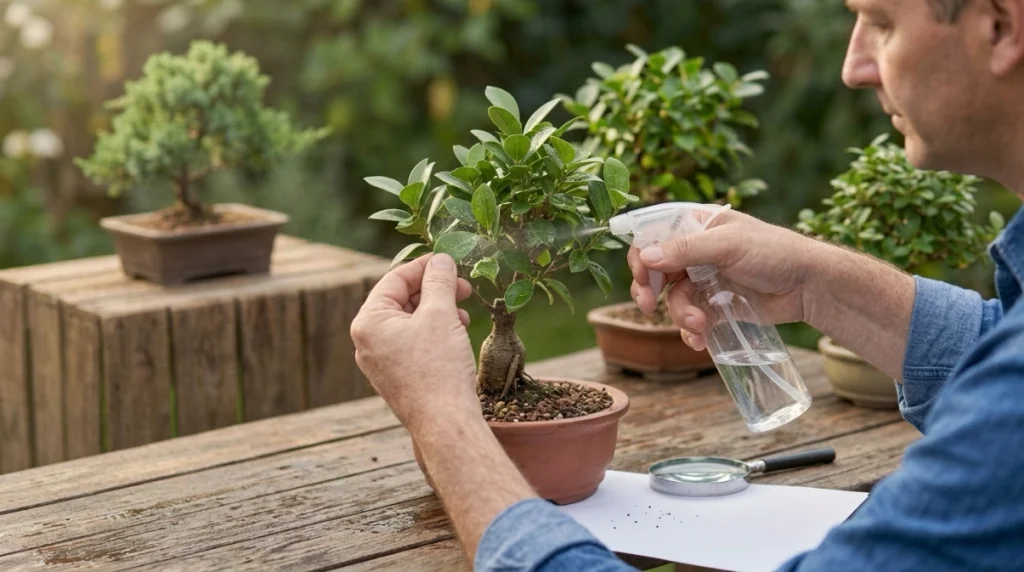
First, confirm that mites are present. Fine webbing, stippling, magnification, and the white-paper test provide stronger evidence than leaf yellowing alone.
Once confirmed, isolate the affected bonsai from other plants. Then decide how aggressive treatment needs to be based on infestation severity and tree health.
Start with physical control when practical
- Rinse suitable foliage thoroughly with water.
- Direct water toward leaf undersides where mites commonly feed.
- Remove badly damaged foliage when doing so is appropriate for the species.
- Keep the tree adequately watered while it recovers.
- Continue inspecting nearby bonsai for developing infestations.
Do not aggressively defoliate a weak tree just to remove mites. The remaining healthy foliage still supports photosynthesis and recovery.
Use sprays carefully
If physical controls are not enough, insecticidal soap or horticultural oil may help on suitable plants. Coverage matters because these products generally work through direct contact.
Always use a product labeled for the plant and pest. Follow its directions for concentration, temperature restrictions, intervals, and protective equipment.
Avoid homemade dish-detergent mixtures as your default treatment. Household detergents can damage foliage because they are not formulated or labeled as plant pesticides.
Do not assume ordinary insecticide will solve mites
Spider mites are arachnids, not insects. Some general insecticides provide poor mite control and may kill beneficial predators.
That can worsen the problem rather than solve it. When chemical control is justified, use a product specifically labeled for mite management on your type of plant.
Pro tip: If a stressed bonsai also needs major pruning, repotting, or root work, avoid stacking irreversible procedures without a clear reason. Ask an experienced grower or local bonsai club for help when the tree is already weak.
Section Takeaway: Confirm the pest first, isolate the tree, begin with low-impact controls, and use labeled mite treatments only when necessary.
Frequently Asked Questions
Can spider mites kill a bonsai?
Yes, a severe infestation can seriously weaken a bonsai and may contribute to extensive leaf loss or decline. Healthy woody plants often tolerate small mite populations, but heavy feeding becomes more dangerous when the tree is already stressed.
What is the first sign of spider mites on bonsai?
Fine pale stippling is often one of the earliest signs. Look closely at leaf undersides or needles before obvious webbing appears, especially when foliage starts looking dull, gray, yellow, or bronze.
Does misting prevent spider mites?
Misting alone is not a reliable prevention program. Proper watering, inspection, appropriate humidity, foliage washing where suitable, good airflow, quarantine, and sensible pest management are more important.
How often should I check my bonsai for spider mites?
A weekly inspection is a useful baseline for most collections. Check every few days during high-risk weather, after buying a new plant, or when mites have appeared on nearby bonsai or houseplants.
Can spider mites spread from one bonsai to another?
Yes. Mites can move between suitable plants, especially when foliage touches, and infestations can spread through a closely grouped collection. Isolate confirmed cases and inspect neighboring plants promptly.
Should I use neem oil to prevent spider mites?
Do not routinely coat a healthy bonsai with neem or another pesticide simply for prevention. If treatment becomes necessary, use a properly labeled horticultural oil or other appropriate product and follow its label exactly.
Are juniper bonsai more vulnerable in summer?
Not always. Junipers can host spruce spider mites, which are cool-season mites and may be active in spring and fall. Continue inspecting conifer needles when temperatures cool instead of focusing only on hot summer weather.
Preventing spider mites on bonsai comes down to consistency. Inspect often, water correctly, keep foliage clean, quarantine new trees, and respond to confirmed pests before populations explode.
Make the underside-of-the-leaf check part of your normal watering routine. That small habit can catch a problem weeks before heavy webbing makes the infestation obvious.
