
Tiny Black Bugs on Bonsai: Identification Guide

Quick Answer
Tiny black bugs on bonsai are often fungus gnats, dark aphids, thrips, springtails, or occasionally spider mites that look dark without magnification. Where the bugs are found, how they move, and the damage they leave are more useful than color alone. Before treating the tree, compare your symptoms with a reliable houseplant pest identification guide and inspect the bonsai closely.
Check These Clues First
- Flying near soil: Small, dark, mosquito-like flies strongly suggest fungus gnats.
- Clusters on shoots: Soft-bodied black insects around tender growth may be aphids.
- Silver leaf scars: Slender, fast-moving insects plus silvery damage can indicate thrips.
- Jumping from soil: Tiny bugs that spring away when disturbed are often springtails.
- Webbing and stippling: Tiny moving dots with fine webs can be spider mites.
- Fixed dark bumps: Immobile bumps on twigs or leaves may be scale insects rather than free-moving bugs.
What to Do Now
- Isolate the bonsai, inspect it under strong light with a 10× hand lens, and identify the pest before applying any treatment.
Finding tiny black bugs on a bonsai can be unsettling because several unrelated pests look nearly identical at first glance. I’ve found that the fastest way to avoid a bad treatment decision is to stop focusing on color and start watching behavior.
This guide shows you exactly where to look, what each likely pest does, and how I approach control without putting extra stress on a small container-grown tree.
In This Guide
What Are the Tiny Black Bugs on My Bonsai?
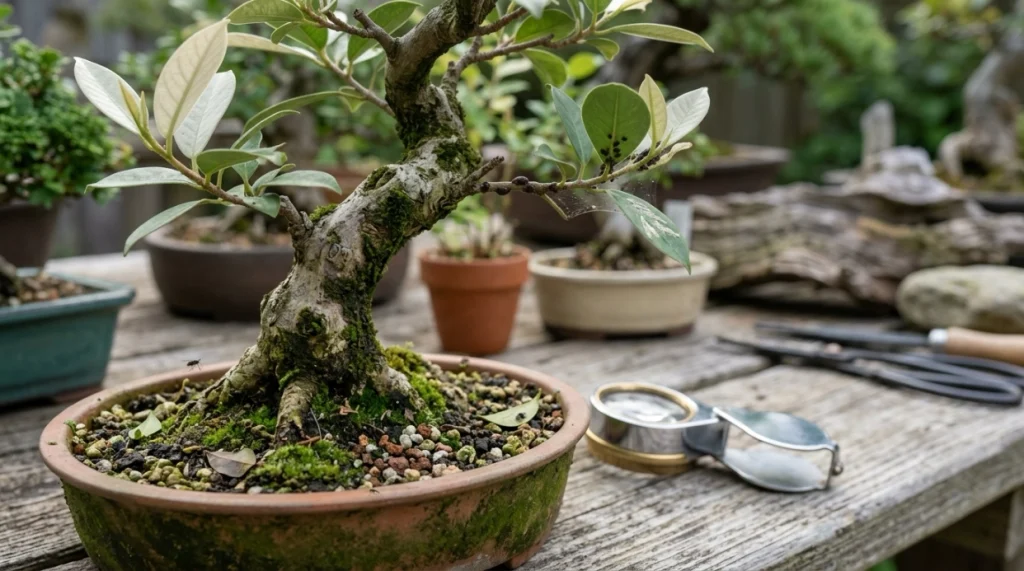
The most likely identity depends on whether the bugs fly, jump, crawl, or remain fixed in place. Their location on the tree provides another strong clue.
Definition: In this guide, “tiny black bugs on bonsai” means small dark insects or mites found on the foliage, branches, trunk, pot, or growing medium. It describes an appearance, not one specific pest species.
I start every inspection with a 10× hand lens. Many pests that look like identical black dots to the naked eye become surprisingly different once magnified.
| Possible Pest | Where You Usually Notice It | Key Identification Clue | Typical Concern |
|---|---|---|---|
| Fungus gnats | Soil surface and around the pot | Tiny dark flies, roughly 1/16–1/8 inch long | Usually signals consistently damp organic material |
| Black aphids | Young shoots, buds, soft leaves | Soft pear-shaped bodies, clusters, sticky honeydew | Distorted growth and sap loss |
| Thrips | Leaves, buds, flowers | Slender bodies, silvery scars, tiny dark specks | Leaf and flower damage |
| Springtails | Moist soil surface and beneath pots | Jump suddenly when disturbed | Usually more of a moisture indicator than a serious pest |
| Spider mites | Leaf undersides and fine foliage | Tiny moving dots, stippling, bronzing, fine webbing | Can cause substantial foliage damage |
| Scale insects | Stems, twigs, veins, leaves | Dark or brown bumps that stay attached | Sap feeding and gradual weakening |
How can I tell if the black bugs are fungus gnats?
Fungus gnats are small, dark flies associated with damp growing media. Adults often walk across the soil before making short flights around the pot.
The University of Minnesota describes adult fungus gnats as approximately 1/16 to 1/8 inch long. Their larvae live in moist media containing fungi and decaying organic matter.
If the bugs rise from the pot after watering, fungus gnats move high on my suspect list. Check whether the substrate is staying wet longer than expected for that species.
How can I identify black aphids?
Black aphids usually gather on tender new growth instead of hovering around the soil. Look at shoot tips, leaf undersides, buds, and young stems.
- Body shape: Aphids usually have soft, somewhat pear-shaped bodies.
- Feeding location: They favor young, actively growing tissue.
- Leaf symptoms: New foliage may curl, distort, or grow poorly.
- Sticky residue: Many aphids produce honeydew while feeding.
- Ant activity: Ants may visit plants carrying honeydew-producing pests.
Could the black dots be spider mites?
Yes, but spider mites are not insects. They are arachnids related to spiders and are easier to recognize by their damage than by body color.
The UC IPM spider mite guide recommends a 10× hand lens for seeing these tiny pests. Fine stippling, bronzed foliage, and delicate webbing are stronger clues.
You can also hold white paper beneath suspicious foliage and gently tap the branch. Moving specks on the paper deserve a closer look through magnification.
Section Takeaway: Don’t identify a bonsai pest by color alone. Location, movement, body shape, webbing, honeydew, leaf damage, and moisture conditions provide much stronger evidence.
Why Are Tiny Black Bugs Appearing on My Bonsai?
Tiny bugs do not appear simply because a bonsai is unhealthy. They usually arrive from another plant, outdoor exposure, purchased material, or an environment that favors their reproduction.
A healthy bonsai can still acquire pests. Good care simply gives the tree a better chance to tolerate damage and recover.
Is wet bonsai soil attracting them?
Persistently damp growing media strongly favors fungus gnats and can support springtails. This is especially noticeable in mixes containing a significant amount of decomposing organic material.
That does not mean you should deliberately dehydrate a bonsai. Watering must still match the species, temperature, pot depth, substrate, root mass, and season.
I treat recurring fungus gnats as a reason to review my watering pattern. If a mix remains wet much longer than expected, I also check drainage holes and the condition of the substrate.
Can a new bonsai bring pests into my collection?
Yes. Eggs, immature insects, mites, and scale crawlers can be difficult to notice during a quick nursery inspection.
The University of Minnesota Extension recommends inspecting new plants and keeping them isolated temporarily so hidden pest problems can become visible.
- Inspect the upper and lower surfaces of leaves.
- Check branch forks and bark crevices.
- Examine the pot rim and drainage openings.
- Look closely at new growth.
- Watch the soil surface immediately after watering.
Do dry conditions cause spider mites?
Warm, dry, dusty conditions can favor many spider mite problems. A water-stressed tree may also tolerate mite feeding poorly.
This does not make misting a reliable spider mite treatment. Correct identification and targeted management still matter.
Are Tiny Black Bugs Harmful to a Bonsai Tree?
Some are capable of serious damage, while others are mostly nuisance organisms. The difference is why identification should come before spraying.
Aphids, spider mites, thrips, and scale feed directly on plant tissue or sap. Heavy populations can weaken foliage and reduce healthy growth.
Which warning signs mean I should act quickly?
- Fine webbing: Check immediately for spider mites.
- Heavy stippling: Pale dots across foliage can indicate mite feeding.
- Sticky leaves: Inspect for aphids, soft scale, mealybugs, or whiteflies.
- Distorted shoots: Examine young growth for sap-feeding insects.
- Silver scars: Look closely for thrips.
- Rapid leaf drop: Inspect the whole tree, but also rule out watering and root problems.
- Branch decline: Treat this as a broader diagnostic problem rather than assuming insects are the only cause.
Penn State Extension notes that spider mite feeding can cause stippling, gray or bronze discoloration, leaf drop, and webbing. It also identifies honeydew as a clue for pests such as aphids, mealybugs, whiteflies, and scale.
Are fungus gnats dangerous to bonsai?
Adult fungus gnats are usually more annoying than damaging. The larvae live in growing media and primarily consume fungi and decaying material.
Heavy larval populations can sometimes affect roots, especially vulnerable young roots. More importantly, large numbers may tell you that the growing medium is staying consistently damp.
On a bonsai, that moisture clue deserves attention. A persistently saturated root zone can create problems beyond the insects themselves.
Are springtails harmful?
Springtails generally feed on fungi and decomposing organic material. Seeing them does not automatically mean your bonsai is under attack.
I usually treat them as an environmental clue first. If there are hundreds on the soil surface, I check whether the medium is remaining wetter than intended.
Section Takeaway: Sap-feeding insects and spider mites can directly damage bonsai, while fungus gnats and springtails may point toward a moisture issue. Judge urgency by both pest identity and tree symptoms.
How Do I Get Rid of Tiny Black Bugs on Bonsai?
The safest treatment starts with identification. Applying a random pesticide can fail, injure sensitive foliage, or disrupt useful predators without solving the original problem.
- Isolate the bonsai. Move it away from other susceptible plants while you investigate.
- Inspect under bright light. Check leaves, stems, bark, soil, pot rims, and drainage holes.
- Use magnification. A 10× hand lens can separate mites from insects and plant debris.
- Check nearby plants. Mobile pests may already have spread.
- Match treatment to the confirmed pest. Use cultural or pesticide controls appropriate for that organism.
- Reinspect repeatedly. Eggs or immature stages may remain after the first treatment.
What should I do about fungus gnats?
First, review why the growing medium remains attractive to them. Avoid watering by a fixed calendar if the tree does not need water yet.
- Remove fallen leaves and decaying debris from the soil surface.
- Make sure drainage holes are open.
- Let the surface dry appropriately between waterings when the bonsai species and substrate allow it.
- Use yellow sticky cards to monitor and catch some adults.
- For persistent larvae, use a labeled product containing Bacillus thuringiensis subsp. israelensis if appropriate and available.
Sticky traps help monitor adult numbers, but they do not eliminate larvae in the growing medium. I use them as a diagnostic tool rather than treating them as the whole solution.
How should I treat aphids, thrips, scale, or mites?
Small above-ground infestations may sometimes be reduced by carefully rinsing affected foliage when the species tolerates it. Afterward, inspect leaf undersides and protected branch joints again.
For confirmed pests, insecticidal soaps or horticultural oils labeled for the pest and plant type may be appropriate. Contact treatments require thorough coverage, so hidden leaf surfaces matter.
- Read the complete pesticide label before use.
- Never exceed the labeled concentration.
- Test sensitive foliage on a small area first.
- Avoid applying products to a badly drought-stressed tree.
- Do not spray during unsuitable heat or direct sun if the label warns against it.
- Repeat only at the interval permitted by the label.
Bonsai Empire’s pest and disease overview also emphasizes identifying the insect before choosing a treatment. Bonsai species can react differently, so treatment should never be more aggressive than necessary.
Should I use the strongest insecticide available?
No. Stronger is not automatically better, especially when you have not confirmed the pest.
Some broad-spectrum products can also kill beneficial organisms. I prefer the narrowest practical treatment that matches the identified pest and the pesticide label.
Section Takeaway: Isolate first, identify second, and treat third. Correcting the environment and using targeted controls is usually safer than repeatedly spraying an unidentified pest.
How Can I Prevent Tiny Black Bugs From Returning?
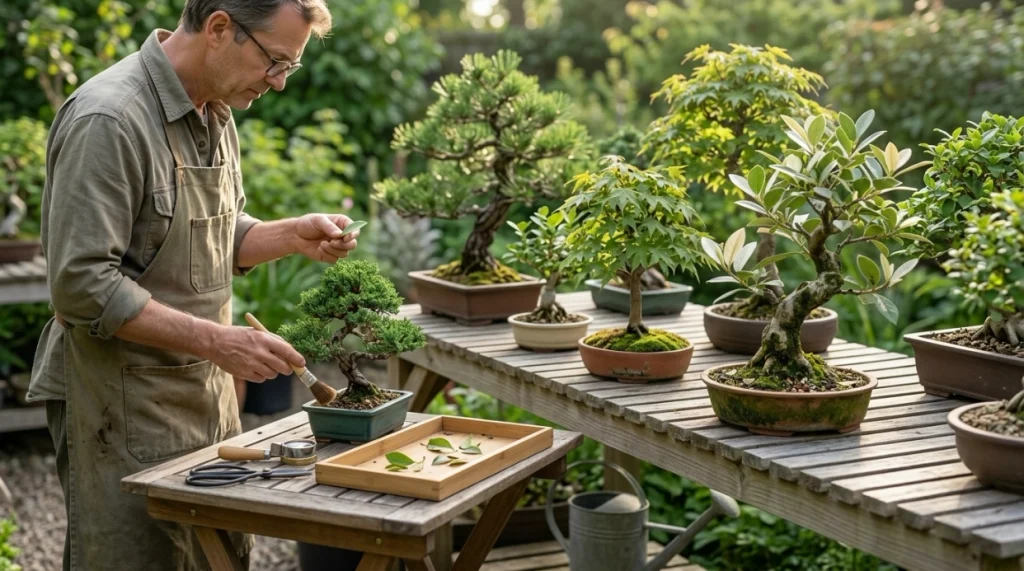
Regular inspection is the most useful preventive habit. I check vulnerable areas whenever I water, because that turns pest scouting into part of normal bonsai care.
- Inspect new trees: Look beneath leaves and around the soil before placing them with your collection.
- Quarantine arrivals: Keep new or previously infested plants separate until you are comfortable they are pest-free.
- Check while watering: Moisture often makes soil-dwelling insects move and become easier to see.
- Keep surfaces clean: Remove fallen leaves and accumulated organic debris.
- Maintain suitable airflow: Avoid crowding trees tightly together.
- Water by need: Check the substrate instead of following an inflexible calendar.
- Inspect tools and pots: Clean equipment before moving between an infested tree and healthy trees.
As of 2026, integrated pest management remains the approach I prefer: identify the problem, change favorable conditions where possible, then choose the least disruptive effective control.
The important part is consistency. Five minutes of close inspection can reveal a problem long before an entire canopy shows symptoms.
Frequently Asked Questions
Why are tiny black flies coming out of my bonsai soil?
Small dark flies emerging from the growing medium are often fungus gnats. Their larvae favor damp media containing fungi and decomposing organic matter, so check your watering pattern and drainage while confirming the insects with a close inspection.
What are the tiny black bugs clustered on my bonsai leaves?
Clusters on tender shoots or leaf undersides may be dark-colored aphids. Look for soft pear-shaped bodies, curled new growth, sticky honeydew, or ants visiting the tree before deciding on treatment.
Are tiny black bugs in bonsai soil always harmful?
No. Springtails and adult fungus gnats may be more of an environmental clue than a direct threat to a mature tree. Their presence can still justify checking moisture levels, decomposing material, drainage, and root-zone conditions.
Can I use insecticidal soap on a bonsai?
Insecticidal soap labeled for the plant and target pest may help control certain soft-bodied insects and mites. Follow the product label exactly and test a small area first because plant species, foliage condition, temperature, and concentration can affect sensitivity.
How do I know if my bonsai has spider mites?
Look for pale stippling, bronzed foliage, fine webbing, and tiny moving specks on leaf undersides. A 10× hand lens is useful, and tapping suspicious foliage over white paper can make moving mites easier to see.
Should I repot a bonsai because there are fungus gnats?
Not automatically. Repotting is stressful and should match the species, season, and root condition. Start by correcting excess moisture and managing the confirmed pest unless the substrate or roots have another serious problem requiring repotting.
Can tiny black pests spread to my other bonsai?
Yes. Aphids, thrips, spider mites, fungus gnats, and mobile scale stages can move between suitable plants. Isolate an affected bonsai and inspect nearby trees rather than assuming the problem is confined to one pot.
Final takeaway: If you find tiny black bugs on a bonsai, don’t spray first and identify later. Watch where they live, how they move, and what symptoms appear on the tree.
Once you know whether you’re dealing with fungus gnats, aphids, thrips, mites, scale, or harmless soil visitors, the next step becomes much clearer. Keep inspecting the tree after treatment, and make pest checks part of your regular watering routine.
