
Tiny Bugs on Bonsai Leaves: What Could They Be?

Quick Answer
Tiny bugs on bonsai leaves are commonly aphids, spider mites, mealybugs, scale crawlers, thrips, or whiteflies. The fastest way to identify them is to match the insect with its damage, location, movement, and residue, then confirm your diagnosis before treating; this bonsai pest and disease guide provides useful visual context.
Signs to Check First
- Sticky leaves: Aphids, mealybugs, soft scale, or whiteflies may be producing honeydew.
- Fine webbing: Spider mites become a strong suspect, especially with pale speckling.
- White cotton: Mealybugs often hide around leaf joints and branch forks.
- Silvery scars: Slender thrips can scrape leaves and leave streaked damage.
- Fluttering insects: Tiny white insects rising from the foliage often indicate whiteflies.
- Fixed bumps: Brown, tan, gray, or white bumps may be scale insects rather than moving bugs.
Best Confirmation Tip
- Inspect several affected leaves with a 10× hand lens before spraying anything.
Finding tiny bugs on bonsai leaves can be unsettling because several pests look almost identical at first glance. I always start with the damage pattern rather than reaching immediately for a pesticide.
This guide shows you what those tiny pests may be, how to tell them apart, and what to do without adding unnecessary stress to your tree.
In This Guide
What Tiny Bugs Are Most Likely on Bonsai Leaves?
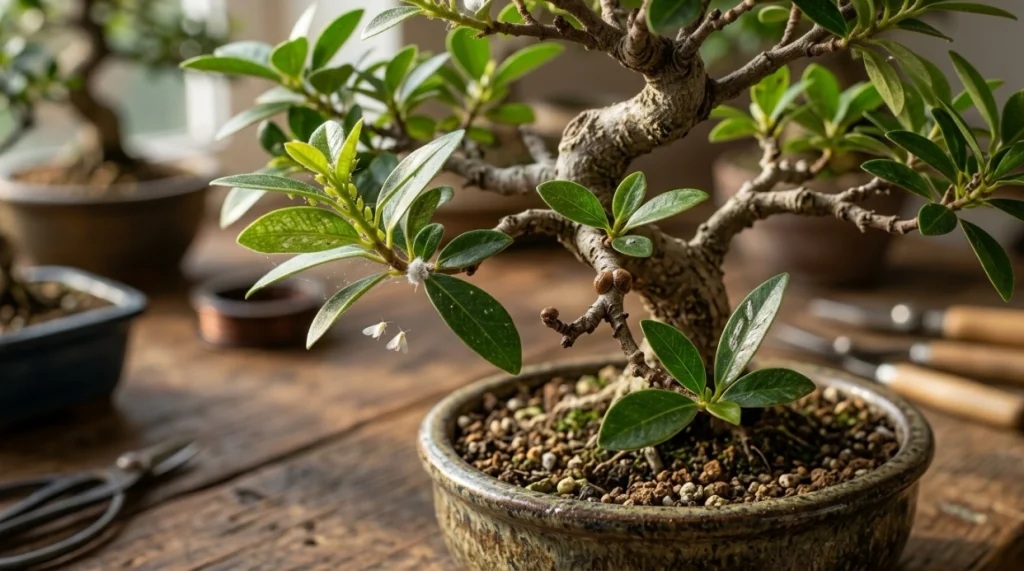
The most common suspects are aphids, spider mites, mealybugs, scale insects, whiteflies, and thrips. Each leaves a slightly different calling card.
Definition: A bonsai leaf pest is an insect or mite that feeds on foliage, shoots, stems, or plant sap and causes visible injury or reduced vigor. Some tiny organisms found around a bonsai are harmless, so correct identification matters.
| Pest | What It Looks Like | Typical Clue | Where to Look |
|---|---|---|---|
| Aphids | Soft, pear-shaped insects about 1/16–1/8 inch long | Sticky honeydew and curled growth | New shoots and leaf undersides |
| Spider mites | Tiny moving dots, often around 1/50 inch | Pale stippling and fine webbing | Leaf undersides and fine shoots |
| Mealybugs | White, waxy, cotton-like insects | White clumps plus honeydew | Leaf joints and protected crevices |
| Scale | Attached brown, gray, tan, or white bumps | Stationary bumps; soft scale may cause honeydew | Stems, veins, twigs, and leaves |
| Whiteflies | Tiny white, gnat-like adults near 1/16 inch | Adults flutter when foliage is disturbed | Mainly leaf undersides |
| Thrips | Slender tan, brown, or dark insects near 1/16 inch | Silvery scars and tiny dark droppings | Leaves, buds, and tender growth |
Aphids are among the easiest pests to see because they often gather in groups. Their white shed skins may also make a colony look larger than it is.
Spider mites are harder to spot. They are arachnids rather than insects, and their stippled feeding damage is often visible before the mites themselves.
Section Takeaway: Identification becomes much easier when you compare appearance, damage, residue, and location instead of relying on insect color alone.
How Can You Identify Tiny Bugs on a Bonsai?
Start with the symptom that stands out most. Sticky residue, webbing, cottony material, silvery scars, and moving white insects narrow the possibilities quickly.
Are the leaves sticky?
Sticky foliage is often honeydew, a sugary waste produced by several sap-feeding pests. Aphids, mealybugs, soft scale, and whiteflies should move near the top of your list.
- Aphids: Look for visible colonies around soft new shoots.
- Mealybugs: Search protected joints for white waxy material.
- Soft scale: Inspect stems and leaf veins for attached bumps.
- Whiteflies: Disturb the leaves and watch for tiny white adults taking flight.
Do you see pale dots and fine webbing?
Numerous pale pinpricks across a leaf are called stippling. Combined with delicate silk, stippling strongly suggests spider mites.
The UC Integrated Pest Management spider mite guide notes that these mites may look like moving dots without magnification. Heavy feeding can eventually leave foliage yellowed, bronzed, or dry.
- Hold a clean sheet of white paper beneath a suspicious branch.
- Tap the foliage several times.
- Wait a few seconds.
- Watch the fallen particles closely.
- Use a 10× hand lens to check whether tiny specks begin moving.
Do the leaves have silver streaks?
Silvery streaks or irregular pale scars point more toward thrips. Thrips scrape plant tissue before feeding, so their damage differs from the fine pinprick pattern caused by mites.
Tiny black or dark spots around damaged areas can be another useful clue. Those spots may be thrips waste.
Are there tiny brown or white bumps?
Scale insects can be mistaken for bark texture, scars, or dried residue. Settled adults often remain attached in one place, while young scale called crawlers are mobile.
Gently examine several bumps with magnification rather than scraping everything away. Bonsai bark can have natural features you do not want to damage.
Section Takeaway: Sticky residue suggests honeydew producers, fine webbing suggests mites, silver scars suggest thrips, and fixed bumps suggest scale.
Are All Tiny Bugs on a Bonsai Harmful?
No. Tiny organisms around a bonsai do not automatically mean the tree is under attack.
Springtails, for example, usually stay around damp organic material and soil rather than feeding seriously on healthy foliage. Ordinary spiders may also build webs around a bonsai while helping catch insects.
- Springtails: Tiny creatures that jump when disturbed and prefer moist organic material.
- Ordinary spiders: Produce larger, stronger webs and do not create leaf stippling.
- Predatory insects: Lady beetles, lacewing larvae, and other predators may be hunting plant pests.
- Fungus gnats: Adults may rest near foliage, but their larvae usually live in moist growing media.
The distinction matters because unnecessary spraying can kill beneficial organisms. It may also stress delicate foliage without solving the real problem.
Check whether the leaves show feeding injury before assuming the smallest creature you see is responsible. Yellowing alone can also result from watering, root, light, or nutrient problems.
What Should You Do First After Finding Bugs?
Isolate the bonsai before doing anything aggressive. Many common pests can spread to neighboring plants through direct contact, flying adults, tools, or handling.
- Separate the tree: Move it away from other bonsai and houseplants.
- Inspect both leaf surfaces: Pay special attention to veins and tender shoots.
- Check stems and branch joints: Scale and mealybugs often hide there.
- Use magnification: A 10× hand lens is enough for many common pests.
- Photograph the evidence: Close-up photos help you compare changes over several days.
- Inspect nearby plants: Do not assume the problem is limited to one pot.
The University of Minnesota Extension indoor plant pest guide also recommends examining leaf undersides, looking for webbing and honeydew, and isolating newly acquired plants.
If only a few soft-bodied insects are present, a controlled stream of water may remove many of them. Support delicate branches with your hand so the spray does not damage the tree’s structure.
Avoid changing watering, fertilizer, light, and pest treatment all at once. Too many changes make it difficult to tell what helped and can stress an already weakened tree.
How Should You Treat Tiny Bonsai Pests?
Treatment should match the pest you actually found. Start with the least disruptive method that can reasonably control the infestation.
Physical removal and washing
Aphids, some mites, whiteflies, and other exposed pests can often be reduced by washing the foliage. Repeat inspections matter because hidden individuals or newly hatched pests may remain.
- Rinse suitable foliage with a firm but gentle stream of water.
- Wipe sturdy broad leaves when the species tolerates handling.
- Remove small numbers of visible mealybugs manually.
- Remove isolated scale carefully without damaging bark.
Insecticidal soap and horticultural oils
Commercial insecticidal soaps and horticultural oils can help control several soft-bodied pests when the label specifically allows use on your plant. Contact products must reach the pest to work well.
Never assume homemade dish soap is equivalent to insecticidal soap. Household detergents can injure plant tissue because they were not formulated or tested as plant pesticides.
The Colorado State University Extension houseplant pest guide provides additional identification and management guidance for pests such as thrips and other indoor plant insects.
Be careful with valuable or stressed bonsai
Test any unfamiliar spray on a small area first when the label permits it. Avoid treating heat-stressed or severely dry foliage, and follow all temperature and sunlight restrictions on the product label.
If an infestation is limited to expendable shoots, selective pruning may sometimes reduce the population. Structural bonsai branches deserve more caution.
Pro tip: Before cutting live branches from a valuable or highly refined bonsai, consider asking an experienced grower or local bonsai club for guidance because that design change cannot simply be reversed.
Do not spray repeatedly on a guessed schedule. Recheck the tree and follow the exact retreatment interval printed on the product label.
How Can You Keep Tiny Bugs From Returning?
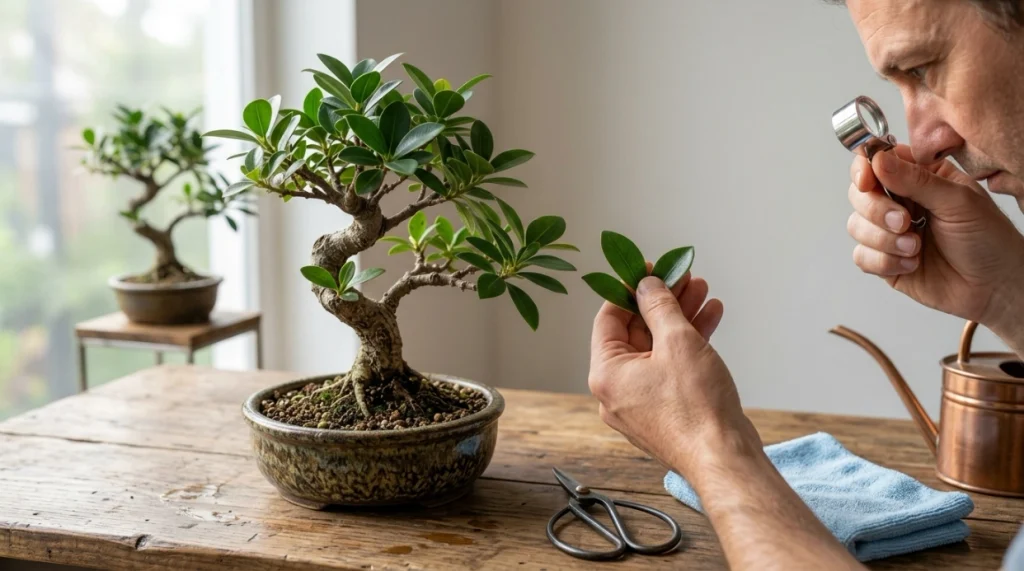
Prevention depends more on regular inspection and sound bonsai care than constant spraying. A healthy tree can still get pests, but early detection keeps a small problem from becoming a large one.
- Inspect weekly: Check leaf undersides, shoot tips, branch forks, and the soil surface.
- Quarantine newcomers: Keep newly acquired plants separate while watching for hidden pests.
- Manage water correctly: Avoid both prolonged drought stress and constantly saturated soil.
- Provide suitable light: Match placement to the species rather than treating every bonsai as an indoor plant.
- Keep foliage clean: Dusty leaves make small mites and feeding damage harder to detect.
- Clean tools: Wash tools and hands after handling an infested tree.
- Check nearby plants: Pests can move between bonsai, houseplants, and outdoor ornamentals.
As of 2026, I still consider identification-first integrated pest management the best approach. Observe, confirm, use physical controls where practical, and escalate treatment only when the infestation requires it.
Species also matters. A tropical ficus indoors faces different environmental pressures from a juniper growing outside, so avoid copying a pest routine without considering the tree’s normal growing conditions.
Section Takeaway: Frequent inspection catches pests sooner than emergency spraying. Good watering, suitable placement, quarantine, and clean growing practices reduce repeat problems.
Frequently Asked Questions
What are the tiny black bugs on my bonsai leaves?
Tiny black insects may be aphids, thrips, fungus gnats resting on the foliage, or another small insect. Look at their body shape and damage before treating. Slender insects with silvery leaf scars suggest thrips, while clustered pear-shaped insects around new growth suggest aphids.
What are the tiny white bugs on my bonsai?
White bugs may be mealybugs, whiteflies, scale, or shed aphid skins. Cottony wax points toward mealybugs, while tiny white adults that flutter upward when you disturb a leaf are more consistent with whiteflies.
Can spider mites look like tiny bugs?
Yes. Spider mites often look like moving specks rather than recognizable animals because they are extremely small. Look for pale stippling, bronzed foliage, tiny moving dots beneath leaves, and fine silk webbing before deciding mites are responsible.
Why are there bugs on the underside of my bonsai leaves?
The underside provides a protected feeding area for many pests, including aphids, mites, whiteflies, scale, and mealybugs. Wind, rain, and direct sunlight affect them less there, which is why inspecting only the top surface can miss an infestation.
Should I spray my bonsai as soon as I see insects?
Not automatically. Identify the pest first and determine whether it is damaging the tree. Physical removal or washing may handle a light infestation, while confirmed persistent pests may justify a labeled insecticidal soap, horticultural oil, or another appropriate treatment.
Can tiny bugs spread from one bonsai to another?
Yes. Aphids, mites, whiteflies, thrips, mealybugs, and scale crawlers can spread between susceptible plants in different ways. Separating the affected bonsai and checking neighboring plants is a sensible first response whenever you confirm an infestation.
Why do tiny bugs keep coming back after treatment?
Hidden pests, eggs, untreated leaf surfaces, nearby infested plants, or incomplete treatment can cause another outbreak. Keep inspecting after treatment and follow the product label rather than assuming one application eliminated every life stage.
Final takeaway: Tiny bugs on bonsai leaves are usually manageable once you know what you are looking at. Match the pest to its feeding damage, confirm it with close inspection, isolate the tree, and choose the least disruptive effective treatment.
Make pest inspection part of your normal watering routine. Those extra thirty seconds spent looking beneath leaves can save weeks of troubleshooting later.
