Boxwood Bonsai Winter Care: Cold Protection and Watering

This post contains affiliate links. As an Amazon Associate, OurBonsai earns from qualifying purchases at no extra cost to you. Read our disclosure.
In this guide
- Which boxwood do you have?
- Boxwood bonsai winter care checklist
- Overwintering hardy boxwood bonsai outdoors
- Why are my boxwood bonsai leaves turning bronze?
- Watering a boxwood bonsai in winter
- Harland boxwood winter care
- Pruning, wiring and repotting around winter
- Preparing your boxwood for winter in autumn
- Boxwood bonsai winter care in mild climates
- Common boxwood winter mistakes
- FAQ: boxwood bonsai winter care
- Final thoughts
Boxwood bonsai winter care depends a lot on which boxwood you have. The common European boxwood (Buxus sempervirens) and Japanese or Korean boxwood (Buxus microphylla) are tough, frost-hardy shrubs that need a cool winter outdoors. Harland boxwood (Buxus harlandii), the variety often sold as an indoor bonsai, is subtropical and cannot handle frost at all. Getting this right is the single most important step in keeping your tree healthy through winter.
This guide covers both types: how much cold they can take, why leaves turn bronze, where to keep the tree and how to water it until spring.
Which boxwood do you have?
| Type | Leaves | Cold hardiness | Winter location |
|---|---|---|---|
| Common boxwood (B. sempervirens) | Small, oval, glossy | Hardy to about zone 5 or 6 in the ground | Outdoors, roots protected |
| Japanese / Korean boxwood (B. microphylla) | Small, rounded | Hardy to about zone 5 or 6 | Outdoors, roots protected |
| Harland boxwood (B. harlandii) | Narrow, longer, notched tip | Not frost hardy | Indoors or frost-free greenhouse |
If your tree came from a garden center or nursery as an outdoor shrub, it is almost certainly one of the hardy types. If it was sold as an “indoor bonsai” with narrow, spoon-shaped leaves, it is probably Harland. Our review of Brussel’s Harland boxwood bonsai shows what that variety looks like.
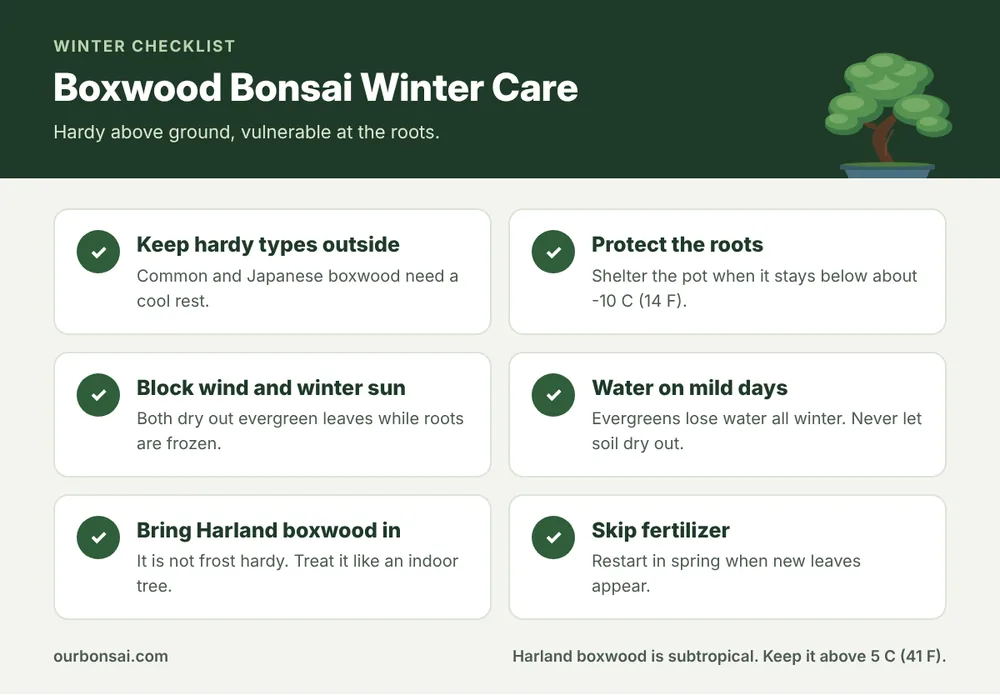
Boxwood bonsai winter care checklist
Overwintering hardy boxwood bonsai outdoors
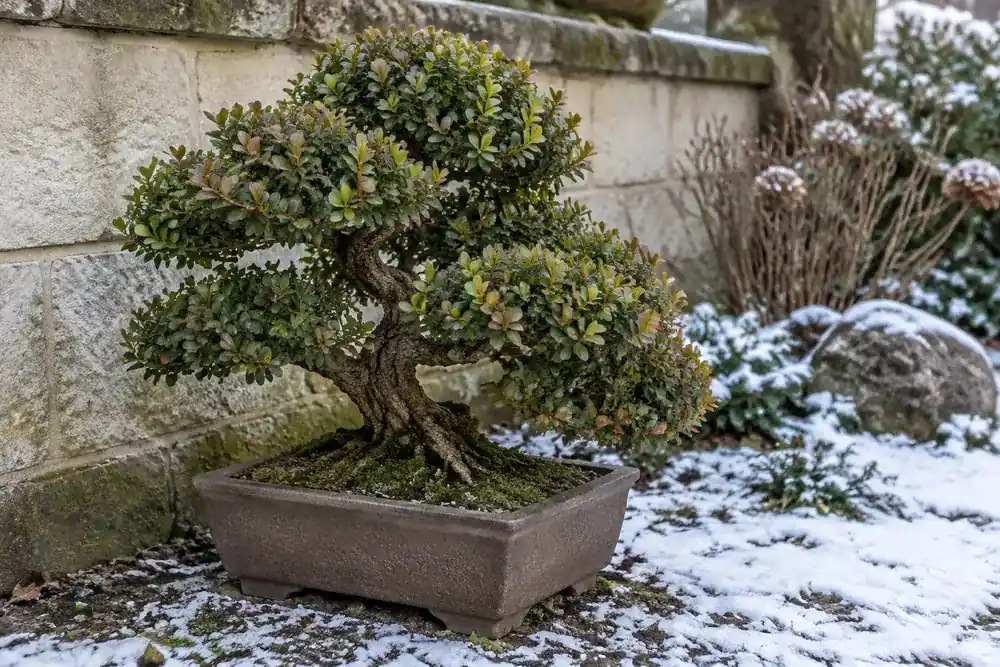
Hardy boxwoods need a cold rest. A tree kept indoors in a warm room all winter gets weak and often declines in spring. Keep it outdoors, but think about the roots. In a shallow pot, the roots can freeze much more deeply than they would in the ground.
- Down to about -5°C (23°F): Keep the tree outside in a spot sheltered from wind.
- -5 to -10°C (23 to 14°F): Set the pot on the ground and mulch around it with bark or straw.
- Long cold spells below -10°C (14°F): Move it into a cold frame, unheated greenhouse or unheated garage. Or bury the pot up to the rim in a garden bed.
Check your local winter lows on the USDA plant hardiness map to plan ahead.
Why are my boxwood bonsai leaves turning bronze?
Many boxwoods take on an orange, bronze or reddish tint in winter. This is a normal cold reaction, sometimes called winter bronzing, and the leaves usually turn green again in spring as growth starts. It is more common on trees in exposed, sunny, windy spots.
Bronzing becomes a problem when the leaves turn brown and crispy instead. That is usually winter burn, caused by wind and sun drying the leaves while the roots are frozen and cannot replace the water. The fix is to shelter the tree from wind and harsh winter sun and keep the soil moist. If leaves are browning outside winter, our guide to bonsai leaves turning yellow or brown covers the other causes.
Watering a boxwood bonsai in winter
Boxwood is evergreen, so its leaves keep losing water through winter, even though growth has stopped. That is why dry roots are a real risk.
- Check the soil every few days.
- Water on mild days when the soil is not frozen, ideally in the morning.
- Do not water a frozen pot; wait for it to thaw.
- If the tree is under cover in a shed or cold frame, it will not get rain, so check it more often.
Boxwood prefers soil that holds a little moisture but drains well. Our guide to bonsai soil mix ratios gives good starting points.
Harland boxwood winter care
Harland boxwood is native to southern China and needs to be treated like a tropical or subtropical tree:
- Keep it above about 5°C (41°F), ideally 10 to 20°C (50 to 68°F) in winter.
- Give it a bright spot near a south- or east-facing window, or under a grow light. Our guide to the best grow lights for bonsai helps you choose one.
- Water when the top layer of soil is dry. Indoor heating dries pots fast.
- Add humidity with a tray, and keep it away from radiators.
Harland boxwood can spend summer outside in a sheltered spot and come back in once nights fall below about 10°C (50°F).
Pruning, wiring and repotting around winter
- Pruning: Avoid heavy pruning in late autumn and winter, since new shoots will be damaged by frost. Light tidying is fine. Main pruning is best in spring and early summer.
- Wiring: Boxwood branches are stiff and can crack. Wire in spring when the tree is active, and bend slowly.
- Repotting: Early spring, just as growth begins, is ideal for hardy boxwood. Late spring for Harland.
- Fertilizer: Stop in early autumn. Restart in spring when new leaves appear.
For styling ideas once spring comes, see our guide to boxwood bonsai styles. Good tools make the job easier; you can browse bonsai concave cutters on Amazon.
Preparing your boxwood for winter in autumn
- Feed well through summer so the tree has reserves.
- Check for boxwood pests such as leaf miners, mites and psyllids. The boxwood (Buxus) article on Wikipedia describes the most common ones.
- Stop fertilizing in early autumn.
- Leave hardy trees outside as nights cool, so they harden off naturally.
- Plan the winter spot before the first hard frost.
Boxwood bonsai winter care in mild climates
In these conditions, the main risks are different:
- Wet roots. Long rainy spells can keep the soil soggy. Make sure the pot drains well and tilt it slightly during weeks of heavy rain.
- Fungal problems. Boxwood blight and leaf spot fungi spread in cool, wet weather. Good air flow and removing fallen leaves help.
- Early growth. A warm spell in late winter can push soft new shoots that a late frost then damages. Cover the tree with fleece on frosty nights in early spring.
In very hot climates, hardy boxwood sometimes struggles more in summer than in winter. Give it afternoon shade in summer and steady watering. Harland boxwood does well in warm climates and can stay outdoors all year where frost is rare.
Common boxwood winter mistakes
- Bringing a hardy boxwood into a warm house for winter.
- Leaving a Harland boxwood outside during frost.
- Letting the soil dry out in windy, cold weather.
- Placing the tree on a high, exposed bench during a deep freeze.
- Pruning hard in autumn, which triggers tender growth.
FAQ: boxwood bonsai winter care
Can boxwood bonsai stay outside in winter?
Hardy common and Japanese boxwood can, with root protection in hard freezes. Harland boxwood cannot and must come inside before frost.
Is it normal for boxwood bonsai leaves to turn orange in winter?
Yes. A bronze or orange tint is a common cold reaction. The leaves usually green up in spring.
How often should I water a boxwood bonsai in winter?
There is no fixed schedule. Check every few days and water when the surface starts to dry, on days when the soil is not frozen.
When can I start pruning my boxwood again?
In spring, once new growth starts. Trim new shoots back to keep the shape compact.
Final thoughts
Boxwood bonsai winter care starts with knowing your species. Hardy boxwoods belong outside, with their roots protected from deep frost and their leaves shielded from drying wind. Harland boxwood belongs indoors, in bright light and steady warmth. Get that right, keep the soil moist, and your tree will come into spring ready for a fresh flush of glossy green leaves. For more on outdoor species, see our guide to outdoor bonsai tree types.