
How to Prevent Thrips on Bonsai: A Practical Prevention Guide

Quick Answer
To prevent thrips on bonsai, quarantine new plants, inspect tender growth regularly, remove plant debris, avoid excessive fertilizer, and monitor for adults with sticky cards. The most reliable approach is an integrated routine based on thrips prevention and monitoring guidance rather than relying on preventive pesticide spraying.
Your Best Thrips-Prevention Routine
- Quarantine arrivals: Keep new bonsai and companion plants apart while checking repeatedly for pests.
- Inspect new growth: Check young leaves, buds, flowers, and protected shoot tips where thrips often hide.
- Tap over paper: Shake suspicious foliage over white paper and watch for tiny, slender insects moving across it.
- Keep areas clean: Remove fallen leaves, weeds, and plant debris around pots and bonsai benches.
- Avoid overfeeding: Follow a species-appropriate fertilizer schedule instead of pushing constant soft growth.
- Monitor adults: Use yellow or blue sticky cards as an early-warning tool, not as your only control.
The Most Important Habit
- Make pest inspection part of normal watering and maintenance so you notice damage before a population becomes established.
Preventing thrips on bonsai is easier than trying to eliminate a large population hidden inside buds and new leaves. These insects are tiny, mobile, and easy to bring home unnoticed on another plant.
I treat prevention as part of normal bonsai maintenance rather than a separate pest-control job. A few minutes of inspection each week can reveal trouble long before a tree develops widespread silver scarring.
In This Guide
- Why Are Thrips Difficult to Prevent on Bonsai?
- How Do You Inspect Bonsai Before Thrips Become Established?
- How Should You Quarantine New Bonsai to Prevent Thrips?
- Which Growing Conditions Help Reduce Thrips Problems?
- Do Sticky Traps, Rinsing, and Beneficial Insects Prevent Thrips?
- What Should You Do at the First Sign of Thrips?
- Frequently Asked Questions
Why Are Thrips Difficult to Prevent on Bonsai?
Thrips are difficult to prevent because they are tiny, hide inside protected plant tissue, and can arrive on newly purchased plants. Adults can also move between nearby hosts.
Definition: Thrips prevention is a combination of exclusion, inspection, sanitation, plant health, monitoring, and rapid early action designed to stop damaging populations from becoming established.
Most pest thrips are only around 2 mm long or less. Depending on the species, adults may be yellow, tan, brown, or almost black.
Their feeding can leave silver or bronze scars, dark fecal specks, distorted leaves, or damaged flowers. You may notice those symptoms before seeing a live insect.
Why does the thrips life cycle matter?
Prevention becomes easier when you understand where each life stage can hide. According to the University of Georgia’s thrips biology guidance, some thrips can complete a generation in about two weeks under favorable conditions.
| Life Stage | Where It May Be | Prevention Focus |
|---|---|---|
| Egg | Often inserted into plant tissue | Quarantine and repeated inspection |
| Larvae | Leaves, flowers, buds, tender shoots | Inspect protected growth closely |
| Prepupa and pupa | Plant, soil, or leaf litter depending on species | Sanitation and debris removal |
| Adult | Canopy and nearby plants | Sticky-card monitoring and plant separation |
This explains why simply looking at the upper leaf surface is not enough. A clean-looking tree may still contain eggs or insects hidden inside expanding foliage.
Section Takeaway: Thrips prevention works best when you manage the whole life cycle. Quarantine, inspection, sanitation, and monitoring each cover a different weak point.
How Do You Inspect Bonsai Before Thrips Become Established?
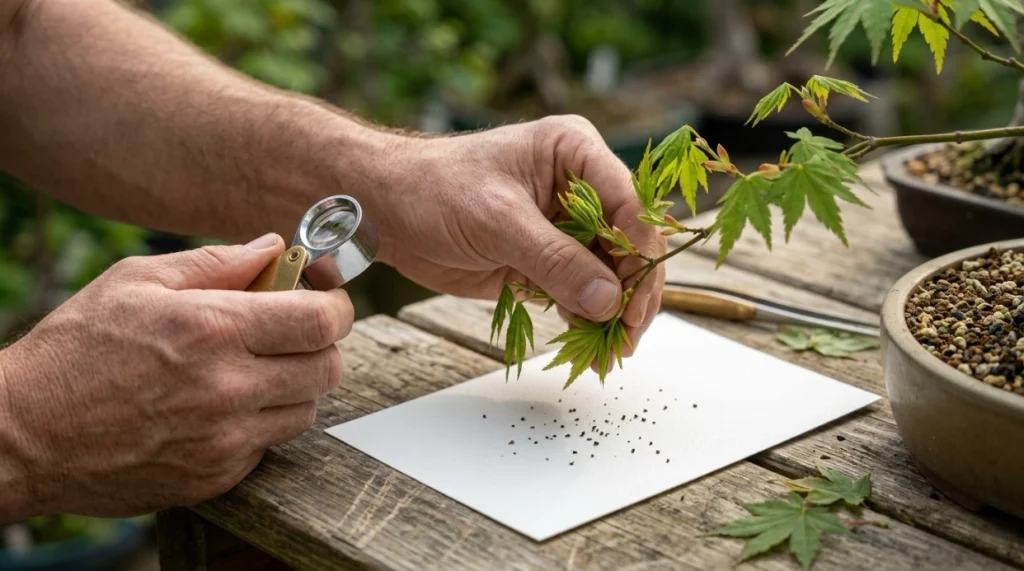
Inspect the places where thrips are most likely to hide before checking older, fully expanded foliage. Tender growth usually deserves the closest attention.
I like to make this inspection part of watering. During active growth, I check vulnerable trees about twice each week rather than waiting for obvious leaf damage.
Check these areas first
- New leaves: Look for silver streaks, pale scars, puckering, or distorted expansion.
- Leaf undersides: Examine veins and protected areas with bright side lighting.
- Shoot tips: Inspect folded or emerging leaves where insects can remain hidden.
- Buds and flowers: Thrips often feed where petals or leaves are tightly enclosed.
- Branch junctions: Check sheltered areas around dense foliage.
- Pot and bench: Look for fallen foliage or plant debris that should be removed.
Use the white-paper test
Place a sheet of plain white paper beneath a suspicious branch. Tap the foliage several times and examine anything that falls onto the surface.
Thrips often appear as tiny, narrow moving dashes. A 10× hand lens makes it much easier to separate them from dust, mites, or harmless debris.
Do not diagnose thrips from silver leaves alone. Spider mites, environmental injury, spray damage, and other problems can create symptoms that look similar.
Section Takeaway: Regular inspection is your strongest early-warning system. Focus on new growth and confirm suspicious damage with a white-paper test whenever possible.
How Should You Quarantine New Bonsai to Prevent Thrips?
New bonsai, nursery stock, accent plants, and houseplants are common pathways for introducing pests. Keep new arrivals physically separated before placing them beside an established collection.
The goal is not to leave a tree in unsuitable conditions. A quarantined bonsai still needs the correct light, temperature, airflow, and watering for its species.
Use a simple arrival routine
- Inspect the upper and lower surfaces of leaves.
- Check buds, flowers, tender tips, and branch forks.
- Examine the trunk, pot rim, drainage area, and soil surface.
- Remove loose dead leaves and nursery debris.
- Tap several branches over white paper.
- Place a sticky card nearby if thrips are a concern.
- Repeat the inspection before moving the tree into your main collection.
I prefer repeated inspections over trusting a single clean check. Eggs hidden inside plant tissue may not be visible on arrival.
Also prevent foliage from touching between quarantined and established trees. Thrips do not need much distance to move between suitable plants.
What about Ficus bonsai?
Give Ficus microcarpa extra attention when its new leaves become rolled, folded, or scarred. Cuban laurel thrips are associated with this species and can remain protected inside distorted foliage.
Carefully inspect inside suspicious folds rather than assuming the problem is watering stress. Early identification can prevent the pest from spreading through nearby susceptible plants.
Section Takeaway: Treat every new plant as a possible pest pathway. Separation plus repeated inspection is much safer than adding an unchecked tree directly to your bonsai bench.
Which Growing Conditions Help Reduce Thrips Problems?
Healthy growing conditions will not make a bonsai immune to thrips. They do reduce unnecessary stress and make it easier to notice abnormal growth early.
General bonsai pest and disease prevention also starts with correct watering, light, soil, fertilizer, and placement rather than routine spraying.
Avoid excessive fertilizer
Feed according to the species, season, and stage of development. Do not push constant soft growth with unnecessary nitrogen simply because faster growth looks healthy.
UC IPM specifically advises against excessive nitrogen when managing thrips. Tender new tissue can provide attractive feeding sites for several pest species.
Water for the tree, not the pest
Do not deliberately keep a bonsai dry to discourage insects. Drought stress weakens the tree and creates a second problem.
Check the growing medium and water according to species, weather, pot size, and substrate. Good drainage matters more than following a rigid calendar.
Reduce crowding
- Leave enough room to inspect each tree easily.
- Prevent neighboring canopies from constantly touching.
- Maintain airflow appropriate for the species.
- Remove fallen leaves from pots and benches.
- Control weeds growing beneath outdoor benches.
- Clean work surfaces after handling suspicious plants.
Sanitation matters because some thrips use weeds as alternate hosts, while certain developmental stages can occur around soil or leaf litter. A tidy growing area removes places that can support the pest cycle.
Section Takeaway: Good culture supports prevention but does not replace monitoring. Keep trees appropriately watered and fed while reducing crowding, weeds, and plant debris.
Do Sticky Traps, Rinsing, and Beneficial Insects Prevent Thrips?
These tools can reduce risk or reveal thrips early, but none creates complete protection on its own. Think of them as layers in an integrated pest management routine.
| Method | Best Use | Main Limitation |
|---|---|---|
| Yellow or blue sticky cards | Detecting flying adults | Do not catch eggs or most larvae |
| White-paper tapping | Confirming insects on foliage | May miss pests hidden in closed buds |
| Gentle foliage rinsing | Dislodging exposed insects | Does not remove hidden eggs |
| Natural enemies | Suppressing outdoor pest populations | Effectiveness depends on species and environment |
| Quarantine | Stopping introductions into a collection | Requires space and repeated inspection |
How should you use sticky cards?
Place yellow or blue sticky cards near canopy level where you can inspect them easily. Check them regularly and compare catches from one inspection to the next.
A trap containing thrips tells you to inspect nearby plants more closely. It does not prove that the trap has controlled the population.
Does rinsing foliage help?
A controlled rinse can dislodge exposed thrips from suitable broadleaf bonsai. Protect the shallow soil surface so the water does not wash substrate from the pot.
Do not turn rinsing into a rigid schedule for every species. Dense conifers, flowering bonsai, and delicate new foliage may need different handling.
What about beneficial insects?
Predatory insects and mites can contribute to thrips suppression outdoors or in controlled growing environments. Avoid unnecessary broad-spectrum pesticide applications that remove beneficial organisms along with pests.
As of 2026, I still prefer monitoring first and intervention second. Routine pesticide spraying without a confirmed problem adds risk without guaranteeing prevention.
Section Takeaway: Sticky cards, rinsing, and natural enemies are supporting tools. Your strongest foundation remains quarantine, inspection, sanitation, and early identification.
What Should You Do at the First Sign of Thrips?
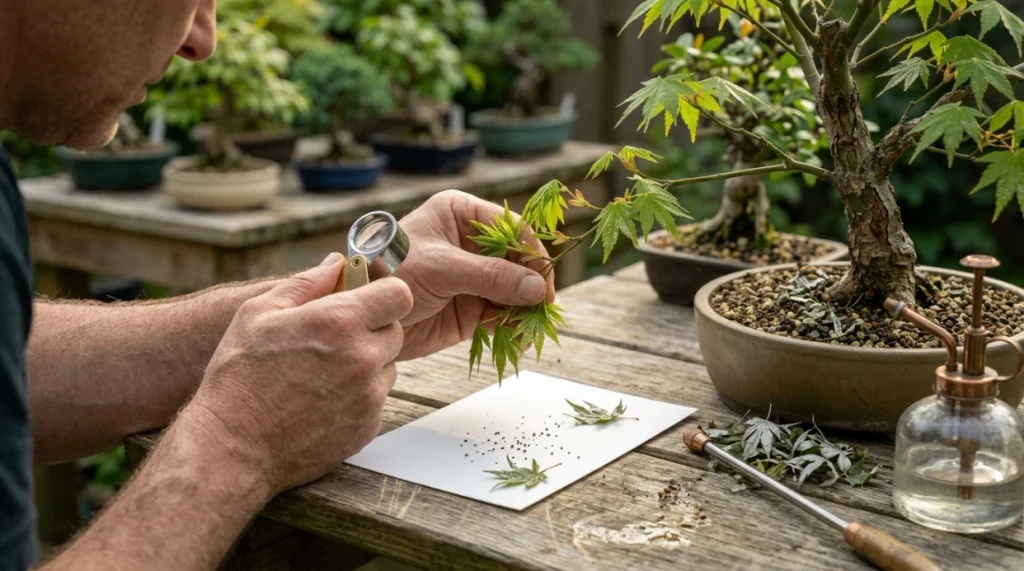
Act as soon as you confirm live thrips or convincing fresh damage. Early action keeps a small pest problem from becoming a collection-wide infestation.
- Isolate the bonsai: Move it away from healthy trees while maintaining proper growing conditions.
- Confirm the pest: Use a white-paper test and magnification instead of treating from symptoms alone.
- Inspect nearby plants: Check any bonsai or houseplant that touched or sat close to the affected tree.
- Remove debris: Clean fallen leaves and loose plant material around the pot and bench.
- Rinse when suitable: Dislodge exposed insects without eroding the bonsai substrate.
- Monitor new growth: Fresh scars or distortion can reveal continued activity.
Avoid automatically removing every damaged leaf. A scarred leaf may still photosynthesize and support a stressed bonsai.
Pro tip: If removing infested shoots would change an important branch or silhouette, use restraint. Ask an experienced grower or local bonsai club before making irreversible cuts.
When is a pesticide appropriate?
If physical controls are not enough, choose a product specifically labeled for the plant, growing location, and target pest. The University of Minnesota’s indoor plant pest guidance notes that insecticidal soaps work by direct contact and often require repeat applications.
Horticultural oils and other labeled products may also suppress exposed thrips. Product suitability varies by bonsai species, temperature, formulation, and application conditions.
- Follow the pesticide label exactly.
- Never increase the concentration for faster results.
- Do not combine products unless the labels permit it.
- Avoid spraying heat-stressed or drought-stressed foliage.
- Continue inspecting because protected eggs may survive an initial treatment.
Do not expect damaged foliage to turn green again after the insects are gone. Judge success by clean new growth and the absence of fresh feeding scars.
Section Takeaway: The first confirmed thrips are your signal to isolate, inspect, clean, and monitor. Escalate to a labeled treatment only when simpler controls are not enough.
Frequently Asked Questions
Can you completely prevent thrips on bonsai?
No method can guarantee that an outdoor or newly purchased bonsai will never encounter thrips. You can greatly lower the risk by quarantining new plants, inspecting fresh growth, reducing plant-to-plant contact, cleaning debris, and monitoring for adults.
How often should I inspect bonsai for thrips?
Check regularly throughout active growth, with extra attention during warm periods or after adding new plants. For vulnerable trees, I find a quick inspection about twice weekly practical because it catches changes before damage becomes widespread.
What is the earliest sign of thrips on a bonsai?
Early clues include silvery or pale scarring, tiny dark fecal specks, and distorted tender leaves. Because these symptoms can have other causes, tap suspicious foliage over white paper and look for slender moving insects before treating.
Do yellow sticky traps prevent thrips?
Yellow sticky traps help detect flying adult thrips and may catch some of them, but they are mainly monitoring tools. Eggs and immature stages can remain on the plant or in protected locations, so traps cannot replace inspection and sanitation.
Are blue sticky traps better for thrips?
Blue traps can be attractive to certain thrips species, while yellow traps detect thrips along with several other flying plant pests. Either can be useful for monitoring, especially when positioned close to canopy level.
Should I repot a bonsai to prevent thrips?
Routine repotting is not a thrips-prevention method. Some thrips developmental stages can occur in soil or debris, but disturbing a healthy root system without another reason may create more stress than benefit.
Does neem oil prevent thrips on bonsai?
A neem-based product should not be used as automatic preventive insurance. If a formulation is labeled for thrips and your type of plant, it may form part of a treatment program after pests are confirmed, but coverage and label directions still matter.
Thrips prevention becomes much easier when you stop thinking about pests only after damaged leaves appear. Quarantine newcomers, inspect tender growth, keep your growing area clean, and react quickly to the first confirmed insects.
Make that short inspection part of your normal bonsai routine. Healthy new growth without fresh silver scars is the result you are looking for.
