
How to Prevent Root Rot in Bonsai

Quick Answer
To prevent root rot in bonsai, keep the root zone moist but well aerated rather than constantly saturated. Check the substrate before watering, use a free-draining bonsai mix, keep drainage holes open, and adjust watering for weather, species, pot size, and season. A good starting point is to follow sound bonsai watering practices instead of watering on a fixed calendar.
The Most Important Prevention Steps
- Check first: Feel the substrate before adding more water rather than assuming the tree needs watering.
- Drain freely: Water should pass through the root mass and escape from the drainage holes.
- Use structure: Granular bonsai substrate helps preserve the air spaces healthy roots need.
- Watch the season: A tree usually uses less water during cool, cloudy, or dormant periods.
- Avoid standing water: Don’t leave an ordinary bonsai pot sitting in a water-filled saucer.
- Inspect early: Persistent wetness, weak growth, yellowing, and soft roots deserve attention.
One Rule I Keep in Mind
- Water according to the tree and substrate in front of you, not according to yesterday’s schedule.
Preventing root rot in bonsai comes down to managing the balance between water and oxygen around the roots. Bonsai pots are shallow, so small mistakes in watering, soil structure, or drainage can affect the whole root system quickly.
I’ve learned to trust the substrate more than the calendar. In this guide, I’ll show you how to prevent bonsai root rot before yellow leaves, weak growth, or damaged roots force you into emergency care.
In This Guide
- What Actually Causes Root Rot in Bonsai?
- How Should You Water Bonsai to Prevent Root Rot?
- What Soil and Drainage Setup Helps Prevent Root Rot?
- How Do Season, Species, and Placement Change Root-Rot Risk?
- When Should You Repot to Protect Bonsai Roots?
- What Early Root-Rot Warning Signs Should You Watch For?
- Frequently Asked Questions
What Actually Causes Root Rot in Bonsai?
Root rot develops when roots deteriorate in unhealthy root-zone conditions, especially when the substrate remains saturated and poorly aerated. Disease organisms can also become involved, but continuously wet soil is one of the most important risk factors.
Root-rot prevention means maintaining enough moisture for the tree while preserving air spaces around the roots. Healthy roots need both.
Simple definition: Root rot is the decline and death of root tissue associated with conditions such as prolonged saturation, poor aeration, damaged roots, and sometimes root-infecting pathogens.
A common mistake is assuming that water itself is the problem. Water is essential; the trouble starts when the root zone stays oxygen-starved for too long.
Several conditions can create that environment:
- Watering too frequently: New water is added while the root ball is still sufficiently wet.
- Compacted substrate: Small particles collapse together and reduce air spaces.
- Blocked drainage: Water cannot leave the pot efficiently.
- Weak root activity: A stressed or recently root-pruned tree may use water slowly.
- Cool conditions: Evaporation and plant water use can fall sharply.
- Oversized wet root mass: Too much moisture remains around too few active roots.
Some pathogens also thrive in wet conditions. The University of Illinois Extension notes that Phytophthora, a fungus-like water mold, is associated with saturated soils and that correcting drainage is an important part of management.
You can read the university’s overview of Phytophthora root and crown rot for more context on why saturated conditions matter.
That’s why prevention is broader than simply “water less.” You need the right relationship between watering, substrate structure, drainage, temperature, and root activity.
How Should You Water Bonsai to Prevent Root Rot?
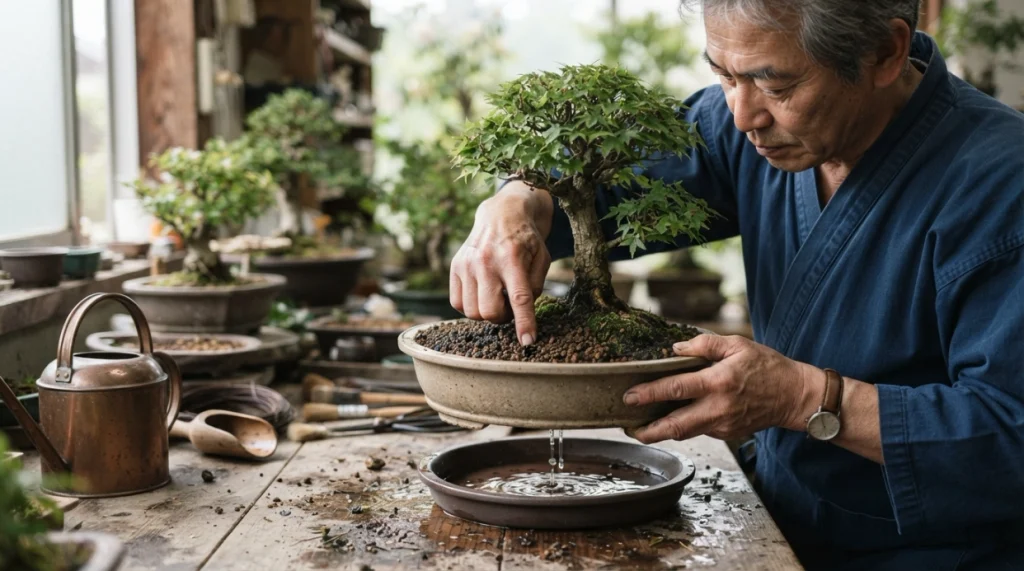
Water only after checking whether the bonsai needs it, then water thoroughly enough to wet the root mass. Avoid light daily splashes and fixed schedules.
For beginners, checking roughly 1 cm, or about 0.4 inch, into the surface can help you judge moisture. The exact drying point still varies by species and substrate.
Check before every watering
I usually start with the surface and then check just beneath it. A dark surface after rain can be misleading, while the opposite can happen with a dry crust over wetter soil.
Use several clues together:
- Feel the substrate below the surface.
- Notice whether the pot feels unusually heavy.
- Watch how quickly the previous watering drained.
- Consider recent rain, heat, wind, and humidity.
- Look at the tree’s current growth activity.
A tree growing strongly during warm, windy weather may dry quickly. The same bonsai can stay moist much longer during a cool, cloudy week.
When you water, water the whole root mass
Once the tree needs water, apply enough to wet the root zone evenly. Water should emerge from the drainage holes rather than pooling indefinitely on top.
Bonsai Empire recommends thorough watering instead of watering according to a rigid daily routine. Their guidance also emphasizes checking actual soil moisture first.
Shallow watering can create another problem. The upper roots receive moisture while dry pockets remain deeper in the container.
Don’t confuse good drainage with underwatering
Fast-draining soil does not mean you should give the tree tiny amounts of water. It means excess moisture should escape while the substrate still retains enough water for the roots.
A well-structured root zone gives you more control. You can water thoroughly without forcing the tree to sit in stagnant, airless soil.
Empty ordinary drainage trays
Indoor bonsai are often placed on saucers to protect furniture. That’s fine, but don’t let the pot remain submerged in accumulated drainage water.
If you’re using a humidity tray, the pot itself should normally sit above the standing water. This lets drainage continue normally.
Section Takeaway: Preventing root rot isn’t about starving a bonsai of water. Check moisture first, then water completely and let excess water leave the pot.
What Soil and Drainage Setup Helps Prevent Root Rot?
A good bonsai substrate holds useful moisture while maintaining drainage and aeration. Dense garden soil and broken-down organic mixes can stay wet too long in a shallow container.
Bonsai growers commonly use granular materials such as akadama, pumice, and lava rock because the particles help preserve air spaces. The ideal ratio depends on species, climate, pot size, and how often you can water.
Think about structure, not just ingredients
The most important feature is how the mix behaves after repeated watering. Particles should not quickly collapse into a dense mass.
Bonsai Empire’s guide to bonsai soil and substrate emphasizes drainage, moisture retention, and aeration as key qualities of a useful mix.
| Factor | Lower-Risk Setup | Higher-Risk Setup | What to Check |
|---|---|---|---|
| Substrate | Granular mix with lasting air spaces | Fine, compacted soil | Does water soak through evenly? |
| Drainage holes | Open and protected with suitable mesh | Blocked by compacted material | Does excess water leave freely? |
| Moisture check | Check roughly 1 cm below the surface as a beginner reference | Water automatically every day | Is the substrate still wet? |
| Pot position | Drainage holes unobstructed | Pot standing in retained water | Can water escape underneath? |
Don’t copy one soil ratio blindly
You may see example mixes such as equal parts akadama, pumice, and lava. Treat those as starting points rather than universal formulas.
A hot, dry location may need more water retention. A wet, humid climate may call for stronger drainage and careful watering.
Particle size matters too. Tiny broken particles fill gaps between larger grains, which can reduce aeration over time.
I pay close attention to how a mix behaves after a season of use. If drainage becomes noticeably slower, I start asking whether the substrate is breaking down or the roots are filling the pot.
Section Takeaway: The safest bonsai soil is not simply the fastest-draining mix. It should balance moisture retention with enough structure and air space for healthy roots.
How Do Season, Species, and Placement Change Root-Rot Risk?
A watering routine that works in July may be wrong in November. Root-rot prevention requires you to adjust care whenever the tree’s water use changes.
Temperature, sunlight, wind, humidity, species, foliage density, and pot size all affect drying speed.
Warm, windy weather increases water use
A vigorously growing deciduous bonsai can dry surprisingly fast on a hot, breezy day. Smaller pots also have less moisture reserve.
During these conditions, checking only every few days may be too infrequent. Observe the tree daily even if it doesn’t require water each time.
Cool and cloudy conditions slow drying
During cooler weather, evaporation slows and many trees use less water. Dormant temperate bonsai can remain moist much longer than they do during active growth.
That means autumn and winter watering often requires more restraint. Never assume that yesterday’s summer schedule still applies.
Indoor bonsai still need airflow and light
Tropical species such as ficus may grow indoors, but weak light can slow their water use. A pot that dried in two days near a bright summer window may stay moist longer during winter.
Don’t solve this by withholding water indefinitely. Improve the overall growing conditions and keep checking the substrate.
- More light and active growth: Usually increases water demand.
- Higher temperatures: Often increase drying.
- Wind and airflow: Can speed moisture loss.
- High humidity: Can slow evaporation.
- Dormancy: Usually reduces water use.
- Dense foliage: Can increase transpiration during active growth.
The safest routine is responsive. I treat watering as a daily observation task, not a daily watering task.
When Should You Repot to Protect Bonsai Roots?
Repot when the root system or old substrate is beginning to interfere with drainage, aeration, or healthy root growth. Don’t repot healthy trees simply because you’re worried about root rot.
Over time, roots fill the container and some substrates break down. Both changes can alter how water moves through the pot.
Watch how water behaves
Slow penetration, uneven drainage, or a dense root mass can indicate that the root environment needs attention. Water sometimes runs around a compacted root ball instead of soaking through it evenly.
Repotting allows you to refresh the growing medium and inspect the roots. Bonsai Empire’s bonsai repotting guide notes that timing and frequency vary with the tree, root development, and substrate.
Use the right seasonal window
For many temperate bonsai, early spring around bud swelling is a common repotting period. Tropical species and other trees may require different timing.
Don’t perform major root work just because a few leaves have turned yellow. Yellowing can have many causes, including watering stress, light problems, pests, seasonal change, or nutrient issues.
Keep drainage holes functional
During repotting, confirm that drainage holes are open. Mesh can keep larger substrate particles inside without sealing the hole itself.
Secure the tree properly so movement doesn’t repeatedly damage new roots. Then use a substrate appropriate for the species and your climate.
Pro tip: Root pruning is irreversible. If you’re unsure how much live root tissue can safely be removed, ask an experienced grower or local bonsai club before cutting.
Repotting is maintenance, not a substitute for correct watering. Fresh soil can still become unhealthy if you keep it saturated.
What Early Root-Rot Warning Signs Should You Watch For?
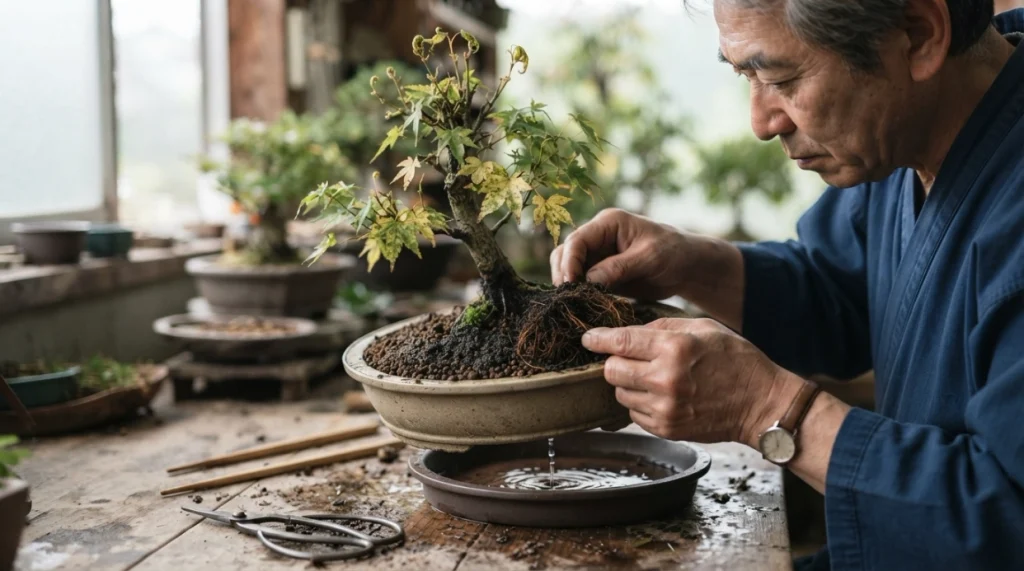
Persistent wetness combined with declining growth deserves investigation. No single leaf symptom can confirm root rot by itself.
The goal is to spot a changing pattern before much of the root system is damaged.
Check the root environment first
- Substrate stays wet much longer than normal.
- Water drains unusually slowly.
- The soil has become dense or muddy.
- The pot remains heavy for an unusually long period.
- Drainage holes appear clogged.
Then watch the tree
- New growth becomes weak or sparse.
- Leaves yellow outside a normal seasonal pattern.
- Foliage wilts despite wet substrate.
- Branches begin to die back.
- The tree continues declining despite otherwise suitable care.
Roots provide stronger evidence than foliage alone. Healthy roots vary by species, but concerning roots may become unusually dark, soft, limp, or deteriorated rather than firm.
Be especially cautious with conifers. Visible decline can appear after the original stress occurred, so repeated emergency changes may create even more stress.
If you suspect an infectious root disease, keep tools and contaminated soil away from healthy trees. Clean equipment after working with questionable roots.
The National Bonsai & Penjing Museum is also a useful reminder that bonsai are living woody plants requiring continual horticultural care, not static decorative objects.
Frequently Asked Questions
Can you overwater a bonsai even if the pot has drainage holes?
Yes. Drainage holes help, but compacted soil, poor substrate structure, blocked holes, cool conditions, or watering too frequently can still keep the root zone saturated for too long.
Should bonsai soil stay wet all the time?
No. Bonsai roots need moisture and oxygen. The substrate should retain enough water for the tree while still allowing excess water to drain and fresh air to return to the pore spaces.
How dry should bonsai soil be before watering?
There isn’t one universal dryness level for every species. Beginners can check around 1 cm below the surface and water when the substrate is becoming slightly dry, while also considering the tree, weather, and soil mix.
Does yellow foliage always mean root rot?
No. Yellow leaves can result from watering problems, low light, seasonal changes, pests, nutrient issues, or other stress. Check moisture, drainage, recent care changes, and root condition before diagnosing root rot.
Can a bonsai recover from early root damage?
Recovery is possible when enough healthy root tissue remains and the underlying problem is corrected. Improve drainage and watering practices first, then avoid stacking extra stresses such as unnecessary pruning or heavy fertilization onto a weak tree.
Should I immediately repot a bonsai that stays wet?
Not always. First check drainage holes, recent weather, watering frequency, and substrate condition. Emergency repotting can stress an already weak tree, so major root work should be reserved for situations where the benefits clearly outweigh the risk.
What is the easiest way to prevent root rot in bonsai?
The simplest habit is to check the substrate before every watering. Combine that with a free-draining bonsai mix, unobstructed drainage holes, seasonal adjustments, and regular observation of the tree’s growth.
Healthy bonsai roots come from balance. Give your tree enough water to stay hydrated, but build the potting system so excess moisture can escape and oxygen can return.
As of 2026, that remains the approach I trust most: observe the tree, inspect the substrate, and adjust before a small moisture problem becomes serious root damage.
