Bonsai Dieback: Causes and Solutions

Quick Answer
Bonsai dieback is the progressive death of shoots, twigs, branches, or roots, often starting at the tips. Common causes include severe water stress, unhealthy roots, poor drainage, unsuitable light or temperature, pests, disease, winter injury, and physical damage. Before cutting anything, compare the symptoms with a reliable bonsai pest and disease guide and inspect the whole tree.
Common causes to check first
- Water stress: Severe drying or persistently wet substrate can damage fine roots and lead to branch loss.
- Root trouble: Compacted substrate, poor drainage, root decay, or root injury can restrict water uptake.
- Environmental stress: Excessive heat, freezing, weak light, or abrupt exposure changes can kill vulnerable growth.
- Pests: Scale, spider mites, borers, and other pests can weaken foliage or individual branches.
- Disease: Root diseases, vascular diseases, and cankers can produce progressive branch dieback.
- Physical damage: Tight wire, broken branches, severe pruning, or root work can interrupt living tissue.
How to confirm the problem
- Trace the damage from the dead tip toward healthy tissue, then check soil moisture, roots, bark, foliage, recent care changes, and pests before choosing a treatment.
Branch dieback can be frightening because the visible damage often appears after the original stress began. The good news is that losing one twig doesn’t automatically mean the entire bonsai is dying.
I approach dieback as a symptom rather than a diagnosis. Finding the cause first prevents unnecessary watering, spraying, fertilizing, or emergency repotting.
In This Guide
What Is Bonsai Dieback and What Does It Look Like?
Bonsai dieback means shoots, branches, or roots progressively die, commonly beginning at their tips. It is a symptom that can have several unrelated causes.
The NC State Extension gardening glossary defines dieback as progressive death that generally begins at the tips of shoots, branches, or roots.
That distinction matters. A brown leaf is not automatically dieback, and normal seasonal leaf loss is different from a branch progressively dying toward the trunk.
- Tip dieback: New shoots or twig ends turn brown while tissue farther down remains alive.
- Branch dieback: An entire branch loses foliage, dries, and stops producing healthy growth.
- Crown decline: Multiple areas of the canopy weaken instead of one isolated twig.
- Root dieback: Fine roots lose function or decay, eventually causing symptoms above the soil.
How can you tell whether a branch is dead?
Look for several clues rather than relying on leaf color alone. Dead twigs often become brittle, dry, and unable to produce buds during their normal growing period.
A cautious scratch test can help on many woody species. Lightly scrape a tiny area of bark and look for living green tissue beneath it.
- Green tissue: The section is probably still alive.
- Brown, dry tissue: That specific section may be dead.
- Mixed results: Move gradually toward the trunk to find the boundary between dead and living wood.
Do not repeatedly scratch important branches. One tiny test area is normally enough for a preliminary check.
What Causes Branch Dieback in Bonsai?
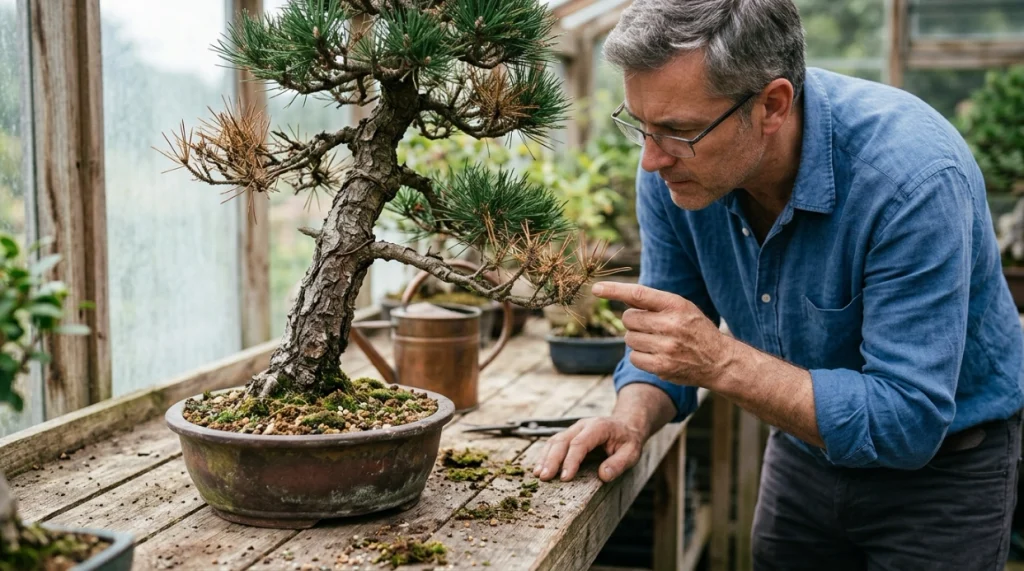
Bonsai branch dieback can come from the roots, foliage, environment, vascular system, or direct injury. Water and root-zone problems deserve early attention because a shallow container leaves less margin for prolonged mistakes.
In 2026, the basic diagnostic rule remains simple: identify the pattern before treating the symptom. Several problems can produce almost identical brown foliage.
1. Underwatering and severe dehydration
A small bonsai pot can dry quickly during heat, wind, or active growth. Severe dehydration may kill fine roots first, followed by leaves and tender branch tips.
Dry substrate, crispy foliage, wilting, and sudden deterioration after hot weather support this possibility. Repeated drought can cause more lasting damage than one mildly dry afternoon.
2. Overwatering, poor drainage, and root problems
Roots need oxygen as well as moisture. Substrate that stays saturated for long periods can create unhealthy root conditions and encourage some root diseases.
UC Statewide IPM guidance on Phytophthora root and crown rot notes that prolonged wet conditions and poor drainage are important risk factors for susceptible woody plants.
- Soil remains wet much longer than expected.
- The tree wilts despite having wet substrate.
- New growth weakens or stops.
- Leaves yellow before branches decline.
- Visible roots become dark, soft, or deteriorated.
3. Cankers and vascular disease
Cankers are localized dead areas in bark or woody tissue. A canker that surrounds a twig can interrupt water movement and kill growth beyond that point.
Look for sunken, discolored, cracked, or unusually dark bark near the base of a dying branch. Species matters because different trees are vulnerable to different pathogens.
4. Pests
Scale insects, spider mites, aphids, borers, and other pests can weaken bonsai. Heavy infestations may contribute to shoot or branch decline.
- Sticky residue: Check for aphids, scale, or mealybugs.
- Fine webbing: Inspect for spider mites.
- Raised bumps: Examine stems for scale insects.
- Holes or frass: Investigate possible boring insects.
5. Environmental and mechanical damage
Freezing, excessive heat, sun scorch, salt buildup, insufficient light, and sudden environmental changes can damage growth. Wire left too long can also injure expanding branches.
Recent aggressive pruning, broken branches, or root work should also be part of your diagnosis. The timing of the damage can reveal more than the appearance alone.
| Dieback pattern | Possible cause | What to check |
|---|---|---|
| Dry tips after hot weather | Drought or heat stress | Substrate moisture, exposure, recent watering |
| Wilting with wet soil | Root dysfunction or root disease | Drainage, soil structure, root condition |
| One branch dies beyond a lesion | Canker or physical injury | Bark discoloration, wire marks, wounds |
| Speckled foliage with webbing | Spider mites | Leaf and needle undersides |
| Several areas decline together | Root, environmental, or systemic problem | Whole-tree care history and root zone |
Section Takeaway: Dieback has many possible causes, so the pattern matters. Root-zone stress, water problems, disease, pests, and recent physical damage should all be considered before treatment.
How Do I Diagnose Bonsai Dieback?
Start with the tree’s recent history. Ask what changed before the first symptoms appeared.
I use the same order each time: environment, water, roots, foliage, branches, then recent interventions. This keeps an obvious watering problem from being mistaken for a mysterious disease.
- Identify the species. A juniper, Japanese maple, ficus, pine, and azalea do not have identical needs.
- Map the damage. Note whether one tip, one branch, one side, or the entire canopy is declining.
- Check moisture. Determine whether the root ball is dry, appropriately moist, or staying saturated.
- Watch drainage. Water should move through the substrate rather than remaining pooled for long periods.
- Inspect foliage. Look for webbing, sticky residue, spots, insects, distorted growth, or unusual discoloration.
- Inspect branches. Check for tight wire, wounds, sunken lesions, cracks, or damaged bark.
- Review recent work. Consider repotting, root pruning, wiring, fertilizing, relocation, or major styling.
Should you immediately inspect the roots?
Not usually. Removing a weak tree from its pot can disturb functioning fine roots when the problem may be visible elsewhere.
Root inspection becomes more reasonable when drainage has failed, the tree wilts in wet soil, or serious root deterioration is strongly suspected.
- Persistently saturated substrate
- Unpleasant odor from the root zone
- Tree becoming loose because roots have deteriorated
- Dark, soft roots visible near drainage holes
- Rapid decline that cannot be explained above the soil
If disease is suspected, sanitation matters. University of Minnesota Extension plant-disease guidance emphasizes early identification, clean tools, removal of diseased material, and moisture management.
Section Takeaway: Diagnose from the entire pattern, not one brown leaf. The care history and distribution of damage often narrow the possibilities faster than emergency treatment.
How Do You Stop Bonsai Dieback and Help a Tree Recover?
The best treatment is to remove or correct the cause while reducing additional stress. There is no single product that reverses every form of bonsai dieback.
Correct watering without overcorrecting
If the tree became too dry, rehydrate the root ball thoroughly and then return to moisture-based watering. Do not keep saturated soil constantly wet afterward.
If the substrate already stays wet, stop adding water automatically. Improve drainage and allow the root zone to move toward an appropriate moisture level for the species.
Stabilize the growing environment
- Give the species suitable light.
- Protect a weakened tree from extreme heat or drying wind.
- Avoid abrupt placement changes unless the current location is harmful.
- Keep outdoor species outdoors when their biology requires seasonal conditions.
- Improve airflow if foliage stays damp for long periods.
The U.S. National Arboretum’s National Bonsai & Penjing Museum describes bonsai as living woody plants that require continual horticultural care as well as pruning and training.
Pause fertilizer when the tree is severely stressed
Fertilizer does not repair dead roots or reopen damaged vascular tissue. Heavy feeding can create another stress while a weak tree is trying to stabilize.
Resume an appropriate feeding program when the tree shows healthy active growth. Match the fertilizer schedule to the species and season.
Treat confirmed pests or disease appropriately
Isolate an affected bonsai when a contagious pest or disease is possible. Identify the problem before applying pesticides or fungicides.
Use only products labeled for the target pest, plant, and growing location. Follow every label direction rather than increasing concentration for faster results.
Give recovery time
A tree can stop deteriorating before it looks attractive again. Dead branches will not revive, but healthy buds elsewhere may produce new growth.
Recovery may take weeks or an entire growing season depending on species and damage. Avoid repeatedly changing treatments while waiting for a response.
Section Takeaway: Stabilize first and style later. Correct the confirmed cause, reduce stress, and judge recovery by healthy new growth rather than expecting dead tissue to turn green again.
Should You Prune or Repot a Bonsai With Dieback?
Pruning dead wood can be useful, but timing matters. Repotting should only happen when the root zone genuinely needs intervention.
When should dead branches be pruned?
First confirm the branch is dead. Then trace it back carefully without cutting farther into living wood than necessary.
- Remove branches that are completely dead and becoming a hygiene problem.
- Use clean, sharp tools.
- Avoid major redesign while the tree is severely weak.
- Disinfect tools when infectious disease is suspected.
- Do not mistake dormant growth for dead wood.
Pro tip: Cutting live woody tissue is irreversible. On valuable bonsai or uncertain branches, ask an experienced grower or local bonsai club before making a major cut.
When is emergency repotting justified?
Yellow leaves or one dying twig do not justify an automatic repot. Repotting adds root disturbance to a tree that is already stressed.
Root work may become necessary when the substrate has collapsed, drainage is failing, or severe root decay is confirmed.
- Preserve as many firm, functioning roots as possible.
- Remove only clearly dead or decayed tissue when intervention is necessary.
- Use a clean, free-draining substrate suited to the species and climate.
- Avoid combining severe root pruning with heavy top pruning or styling.
Pro tip: Root pruning can permanently weaken a sick bonsai. For severe root disease or a valuable specimen, get experienced help before performing emergency root work.
How Can You Prevent Bonsai Dieback?
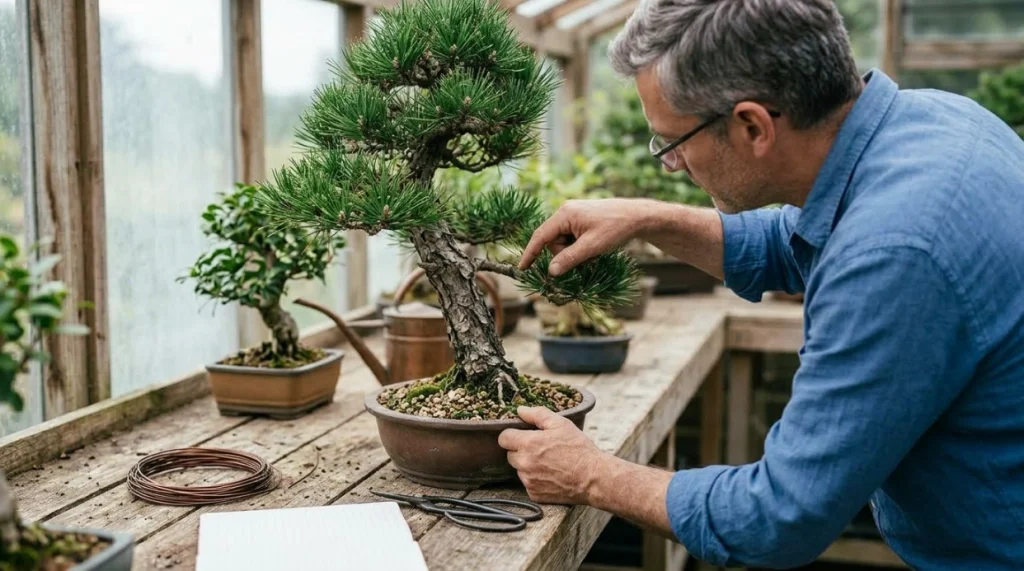
Prevention comes from consistent observation rather than one special product. A grower who notices small changes has more options than one who discovers a completely dead branch.
- Check moisture frequently: Water according to actual substrate condition rather than a rigid calendar.
- Maintain drainage: Keep drainage holes open and replace badly degraded substrate at the proper repotting time.
- Match the species: Learn its light, temperature, dormancy, and moisture needs.
- Inspect weekly: Look beneath leaves, inside branch forks, along bark, and around the soil surface.
- Watch wire: Remove or adjust training wire before it cuts deeply into expanding branches.
- Keep tools clean: Clean pruning tools, especially after working on diseased material.
- Avoid stacking stresses: Do not combine severe root work, heavy pruning, wiring, and environmental changes on a weak tree.
New bonsai also deserve close inspection before joining a collection. Quarantining a suspicious tree can prevent insects or disease from spreading.
Keep notes if a tree has recurring problems. Watering changes, repotting dates, freezes, heat waves, pest outbreaks, and fertilizer applications can reveal patterns months later.
Bonsai Dieback FAQ
Can a bonsai recover from branch dieback?
Yes, if enough healthy roots, trunk tissue, and living branches remain. The dead portion will not recover, but the tree may produce new buds and shoots after the underlying stress is corrected.
Why is only one branch on my bonsai dying?
Localized dieback can result from a damaged branch, tight wire, canker, pest activity, shading, or another problem affecting that branch’s vascular tissue. Inspect from the dead tip toward the trunk and compare it with healthy branches.
Does brown foliage mean my bonsai is dead?
No. Brown foliage can occur while the trunk and other branches remain alive. Check buds, flexible twigs, bark tissue, roots, and the pattern of damage before deciding the entire tree is dead.
Should I fertilize a bonsai with dieback?
Not as an emergency treatment. Fertilizer cannot repair dead roots or cure a canker, and heavy feeding may stress an already weak root system. Stabilize water, light, roots, and any pest or disease problem first.
Should I cut off every brown bonsai branch immediately?
No. Confirm that the branch is truly dead before pruning it. Dormant branches or stressed branches can appear lifeless temporarily, so unnecessary cutting may remove tissue that could have recovered.
Can overwatering cause bonsai branches to die?
Persistently saturated substrate can reduce root health and contribute to root disease. Damaged roots may no longer supply enough water and minerals to the canopy, eventually causing yellowing, wilting, weak growth, and branch dieback.
How long does bonsai dieback recovery take?
Recovery depends on the cause, species, season, and extent of damage. Mild stress may improve once healthy growth resumes, while serious root or branch damage can require an entire growing season or longer to assess.
Final Takeaway
Bonsai dieback is a warning sign, not a single disease. Start by determining where the damage began and whether water, roots, environment, pests, disease, or physical injury explains the pattern.
Once the cause is clearer, make the smallest useful correction and give the tree time to respond. Careful diagnosis protects more bonsai than aggressive emergency treatment.
