Why Does My Bonsai Have Dead Branches?
Quick Answer
Dead branches on a bonsai usually point to watering stress, damaged roots, poor light, pruning or wiring injury, pests, disease, or normal loss of shaded growth. Before cutting anything, confirm whether the branch is actually dead using a light bark-scratch test and compare the symptoms with a reliable bonsai troubleshooting guide.
Most common causes of dead bonsai branches
- Underwatering: Fine roots dry out, reducing water flow to leaves and branch tips.
- Wet soil: Poor drainage can weaken roots and cause sections of the canopy to decline.
- Low light: Shaded interior branches may weaken while stronger outer growth continues.
- Physical damage: Tight wire, broken bark, or aggressive pruning can interrupt sap flow.
- Pests or disease: Cankers, insects, and other problems can cause isolated branch dieback.
- Weather stress: Frost, intense heat, wind, or sudden environmental changes can kill tender growth.
What to check first
- Check soil moisture, light exposure, root condition, bark color, branch flexibility, recent pruning, and any visible pests before changing your routine.
A dead branch can be alarming, especially when the rest of the bonsai still looks healthy. I’ve learned that branch dieback is usually a symptom rather than the problem itself.
The key is finding out why that branch stopped receiving enough water, energy, or healthy vascular flow. This guide walks through the checks I use before reaching for pruning shears.
In This Guide
- Why Do Bonsai Branches Die Even When the Tree Looks Healthy?
- How Can I Tell If a Bonsai Branch Is Really Dead?
- What Causes Branch Dieback on a Bonsai?
- What Should I Do With Dead Bonsai Branches?
- Can a Bonsai Recover After Losing Branches?
- How Can I Prevent More Branches From Dying?
- Frequently Asked Questions
Why Do Bonsai Branches Die Even When the Tree Looks Healthy?
A bonsai can lose one branch while the rest of the tree remains alive because each branch depends on its own functioning vascular connection. A local problem may therefore affect one section before the whole tree shows stress.
Branch dieback means part of a branch has stopped living because its tissues can no longer maintain normal water, nutrient, and energy movement.
Sometimes the cause is straightforward. A dry root ball can deprive fine feeder roots of moisture, followed by wilting and dieback higher in the tree.
Other cases develop slowly. Roots sitting in poorly aerated, waterlogged soil may weaken until individual branches lose vigor.
Natural growth patterns matter too. Trees tend to favor stronger growing tips, a pattern called apical dominance.
Dense foliage can also shade interior branches. If a weak inner branch receives little light for months, the tree may eventually stop supporting it.
- One dead twig: Often suggests a local issue or naturally weak growth.
- Several branches on one side: Check roots, light exposure, bark injury, and localized disease.
- Dieback throughout the canopy: Investigate watering, root health, temperature stress, or a major pest problem.
- Rapidly spreading dieback: Treat it as a warning sign and diagnose promptly.
This distinction matters because removing the dead wood alone does not solve an underlying root or watering problem.
How Can I Tell If a Bonsai Branch Is Really Dead?
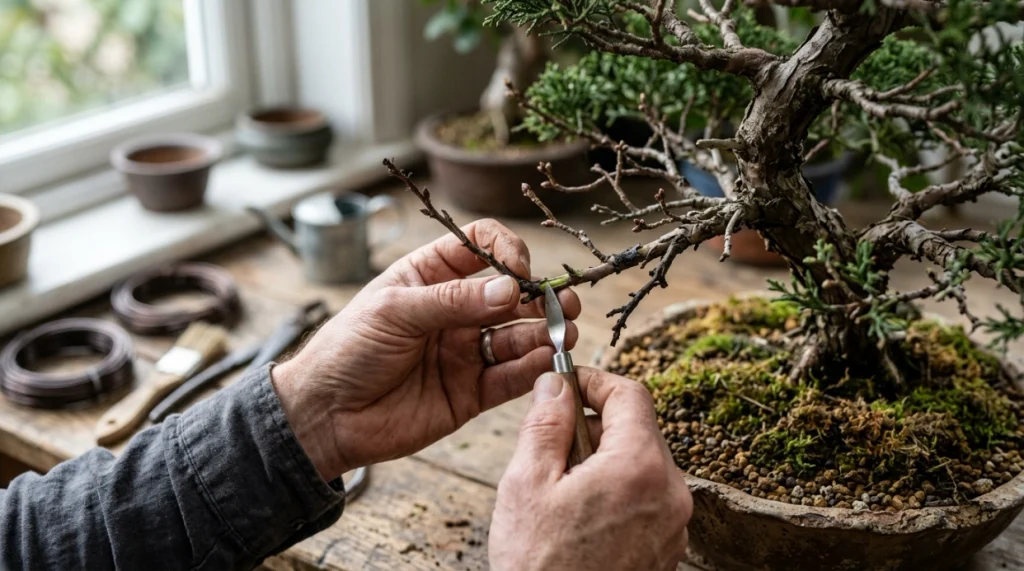
Do not assume a bare branch is dead simply because it has no leaves. Deciduous species naturally lose foliage during dormancy, while stressed trees may delay budding.
The simplest check is a careful scratch test. Lightly scrape a tiny patch of outer bark with a fingernail or clean tool.
- Green or moist tissue: The branch is still alive at that point.
- Brown and dry tissue: That section is probably dead.
- Mixed results: Test closer to the trunk to locate the transition between dead and living wood.
Flexibility provides another clue. Living young twigs usually bend somewhat, while completely dead twigs often feel brittle and snap easily.
Look for buds before pruning. Slightly swollen buds can show that a leafless branch is preparing to grow.
Work from the tip toward the trunk
If the tip appears dead, test progressively closer to the branch base. Sometimes only the final inch or two has died.
This approach prevents you from removing living wood unnecessarily. It also shows how far the dieback has progressed.
When I troubleshoot a questionable branch, I mark the first point where I find healthy green tissue. That gives me a clear boundary before making any cut.
What Causes Branch Dieback on a Bonsai?
The most useful clue is the pattern of damage. Watering problems, root trouble, shade, wiring, pests, and disease tend to leave different combinations of symptoms.
| Possible Cause | Typical Clues | First Check |
|---|---|---|
| Underwatering | Dry soil, crisp foliage, weak branch tips, sudden decline | Check moisture below the soil surface |
| Poor drainage or root stress | Persistently wet soil, yellowing, weak growth, slow decline | Check drainage holes and soil structure |
| Insufficient light | Weak interior growth while outer shoots remain strong | Compare light reaching inner and outer branches |
| Wire or mechanical damage | Bark indentation, swelling, cracking, or dieback beyond an injured point | Inspect every wired or bent branch |
| Pests or disease | Webbing, scale, holes, discoloration, lesions, or localized wilting | Inspect bark, leaf undersides, and branch junctions |
| Weather injury | Damage after frost, extreme heat, drying wind, or sudden exposure | Review recent temperature and placement changes |
Watering and root problems
Bonsai pots contain a small volume of soil, so moisture conditions can change quickly. However, watering on a rigid schedule can be just as risky as forgetting to water.
Check the soil itself. Water thoroughly when the tree needs moisture, then allow excess water to leave through open drainage holes.
Low light and crowded growth
Interior branches can weaken when dense outer foliage blocks sunlight. This is common on trees allowed to grow strongly without periodic canopy management.
Proper bonsai pruning helps control dominant growth and improves light distribution through the canopy.
Pests and disease
Inspect the affected branch closely before blaming watering. Look for scale insects, fine webbing, holes, abnormal bark, dark lesions, or wilting confined to one branch.
Some fungal cankers can girdle woody branches and cause dieback. Penn State Extension describes sunken or discolored bark and wilting beyond infected areas among possible canker symptoms.
You can review its guidance on branch-dieback cankers when similar symptoms appear.
Section Takeaway: Diagnose the pattern before treating the tree. A dead branch caused by dry roots needs a different response from one damaged by wire, shade, or disease.
What Should I Do With Dead Bonsai Branches?
Once you are certain a branch is dead, you can usually remove it without harming the living portion of the tree. First decide whether you want a clean pruning cut or intentional deadwood.
Remove unwanted dead branches cleanly
- Confirm the branch is dead back to your intended cutting point.
- Use clean, sharp bonsai shears or an appropriate branch cutter.
- Avoid cutting into healthy trunk tissue unnecessarily.
- Inspect the cut area for discoloration, decay, or insect activity.
- Sanitize tools before moving to another tree when disease is suspected.
Large structural cuts deserve more planning than small dead twigs. Species, season, wound size, and tree vigor all influence how a bonsai responds.
Pro tip: If the cut involves substantial live wood or an important structural branch, consult an experienced grower or local bonsai club before making an irreversible cut.
Consider whether deadwood belongs in the design
On some conifers, dead branches can be developed into jin, which means intentionally preserved dead branch wood. Shari describes deadwood running along part of the trunk.
These techniques are common on junipers and some other conifers. They are not automatically appropriate for every species.
The American Bonsai Society is also a useful starting point for finding educational resources and local clubs when you need hands-on guidance.
Can a Bonsai Recover After Losing Branches?
Yes, a bonsai can recover after branch loss if enough healthy roots, trunk tissue, and foliage remain. The dead section itself will not come back, but the living tree can produce new growth.
Your first goal should be stability. Avoid piling several stressful treatments onto an already weakened tree.
- Identify the likely cause. Check moisture, drainage, light, pests, bark damage, and recent work.
- Correct the environment. Give the species suitable light, airflow, temperature, and watering.
- Pause heavy styling. Avoid major wiring, defoliation, or structural pruning during recovery.
- Watch new growth. Healthy buds and extending shoots are better signs than instant cosmetic improvement.
- Resume normal feeding carefully. Fertilize when the tree is actively growing and healthy enough to use nutrients.
I often see growers react to dieback by repotting immediately. That can create another major stress event when the roots may already be struggling.
Repot only when the root zone or soil condition gives you a genuine reason. Emergency work should solve a diagnosed problem, not simply respond to fear.
How long does recovery take?
There is no universal recovery timetable. Species, season, root health, and the severity of stress all affect the pace.
A mildly stressed tree may push healthy growth during the same growing season. A badly weakened specimen may need a full growing cycle or longer to rebuild strength.
The U.S. National Arboretum describes bonsai as living woody plants requiring continual watering, fertilizing, pruning, and training. Its National Bonsai & Penjing Museum also highlights how ongoing care maintains these living trees over time.
Section Takeaway: Recovery depends on preserving what is still alive. Stabilize the tree first, then return to styling after healthy growth resumes.
How Can I Prevent More Branches From Dying?
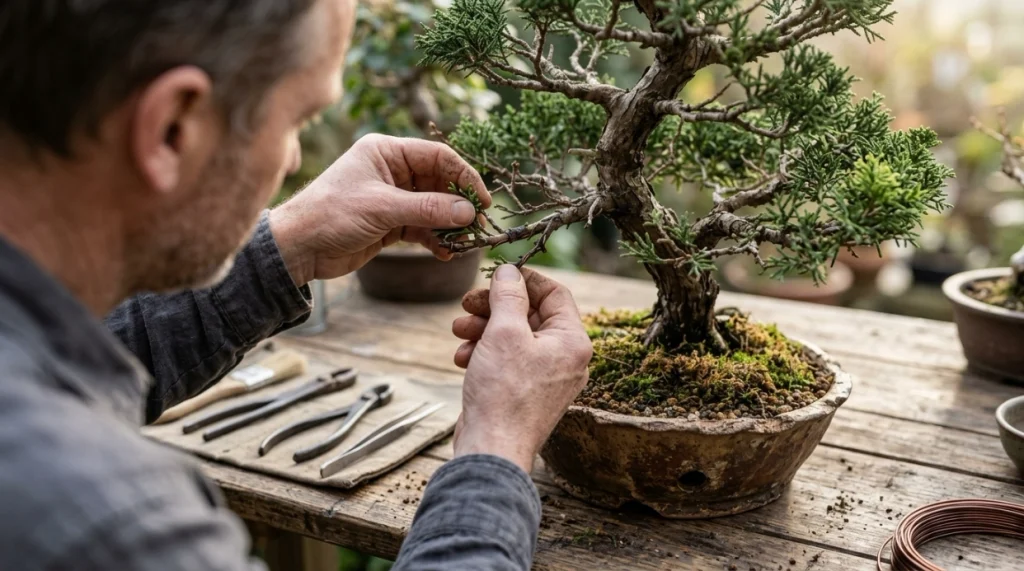
The best prevention is consistent observation. Bonsai problems become harder to correct when they go unnoticed for weeks.
Check moisture instead of following a calendar
Feel the soil and observe how quickly the pot dries. Weather, pot size, species, soil composition, and season all change water use.
A tree may need frequent watering during hot active growth and far less during cool conditions. The soil should guide the decision.
Keep drainage and airflow healthy
Water should move through the substrate rather than sit around roots indefinitely. Bonsai soil also needs air spaces that support healthy root function.
- Keep drainage holes open.
- Watch for compacted or broken-down soil.
- Avoid leaving the pot standing in water unless the species or situation specifically requires it.
- Repot according to root development and species needs rather than a rigid calendar.
Inspect wire frequently
Branches can thicken surprisingly fast during active growth. Wire that was safe a few weeks earlier may begin cutting into bark.
Check wired branches regularly and remove wire before it becomes deeply embedded. Do not unwind it carelessly if doing so risks breaking the branch.
Protect weak interior growth
Strong outer shoots can shade weaker branches. Selective maintenance pruning can improve light penetration while preserving the tree’s intended silhouette.
I pay special attention to small branches that matter to the final design. Losing an insignificant shoot is inconvenient, but losing a carefully positioned primary branch can set development back for years.
Inspect the tree every week during active growth
- Look under leaves for mites, scale, and other insects.
- Check bark for lesions, cracks, swelling, or discoloration.
- Watch for branches that suddenly wilt while neighboring growth stays healthy.
- Check wired areas for indentation.
- Compare soil moisture with recent weather.
- Note changes in leaf color, bud activity, and shoot strength.
As of 2026, the fundamentals have not changed: healthy bonsai depend on species-appropriate light, watering, drainage, root care, pruning, and seasonal protection.
Section Takeaway: Prevention comes from noticing small changes early. A weekly inspection can reveal moisture, wire, pest, or light problems before an entire branch is lost.
Frequently Asked Questions
Should I cut dead branches off my bonsai?
Yes, confirmed dead branches can usually be removed if they do not contribute to a planned deadwood design. Check for living tissue first, then use clean, sharp tools and avoid removing healthy wood unnecessarily.
Can a dead bonsai branch grow back?
The dead portion cannot return to life. However, the tree may produce new buds or shoots from living tissue nearby if the species can bud from that area and the tree remains healthy.
Why are only the lower branches on my bonsai dying?
Lower or interior branches may weaken when stronger upper growth blocks their light. Root problems or species-specific growth habits can also contribute, so check light exposure and overall tree health before pruning.
Can overwatering cause bonsai branches to die?
Persistently wet, poorly aerated soil can damage roots and weaken the tree. When roots cannot function properly, foliage and branches may decline even though the soil appears to contain plenty of water.
Why did a branch die after wiring?
Wire may damage a branch if it becomes too tight, cuts deeply into bark, or accompanies an overly aggressive bend. Inspect wired bonsai frequently during active growth because branch thickness can increase quickly.
Should I fertilize a bonsai with dying branches?
Do not treat fertilizer as an emergency cure. First correct watering, light, drainage, pest, or root problems, then resume an appropriate feeding routine once the tree shows stable, healthy growth.
Does one dead branch mean my whole bonsai is dying?
No. A single dead branch may result from local shading, damage, or natural branch weakness while the rest of the tree stays healthy. Multiple branches dying rapidly deserves a more urgent investigation.
The main lesson is simple: do not prune first and diagnose later.
Confirm what is dead, study the pattern, and check the roots, water, light, wire, pests, and recent weather. Once you correct the real cause, your bonsai has the best chance to stabilize and continue developing.
