Best Soil for Cherry Blossom Bonsai: Recipe and Ratios

This post contains affiliate links. As an Amazon Associate, OurBonsai earns from qualifying purchases at no extra cost to you. Read our disclosure.
In this guide
- Why soil matters so much for cherry blossom bonsai
- Best soil for cherry blossom bonsai: 3 recipes
- What each ingredient does
- Particle size and sifting
- Soil pH for cherry blossom bonsai
- When and how to repot a cherry blossom bonsai
- Watering cherry blossom bonsai in a gritty mix
- Soil and flowering
- Common soil mistakes with cherry blossom bonsai
- FAQ: best soil for cherry blossom bonsai
- Final thoughts
The best soil for cherry blossom bonsai is a gritty, fast-draining mix that never stays soggy, such as two parts akadama, one part pumice and one part lava rock, sifted to remove dust. Flowering cherries belong to the Prunus genus, and their roots are more prone to rot in wet, airless soil than many other bonsai species. Good soil is the single best defense against that problem, and it also helps the tree build the energy it needs for a strong spring display.
Cherry blossom bonsai are usually Japanese flowering cherry (Prunus serrulata) or related ornamental cherries. They are outdoor trees that need sun, seasons and a cold winter rest. Below you will find soil recipes for different climates, what each ingredient does, the right pH and how to repot safely.
Why soil matters so much for cherry blossom bonsai
Cherries have relatively thick, fleshy roots compared with species like maples or elms. In dense or waterlogged soil, those roots lose oxygen quickly and become vulnerable to root rot fungi. Once rot sets in, branches die back, leaves yellow and flowering fails. Ornamental cherries are also known for being shorter lived and less forgiving than many trees, as noted in the Wikipedia article on Prunus serrulata.
A good bonsai soil prevents these problems by:
- Letting excess water drain away within seconds
- Keeping air pockets around the roots at all times
- Holding enough moisture in porous particles to keep roots from drying out
- Staying open for two to three years without breaking down
You can read more about why bonsai soil beats potting soil in our comparison of bonsai soil vs regular soil.
Best soil for cherry blossom bonsai: 3 recipes
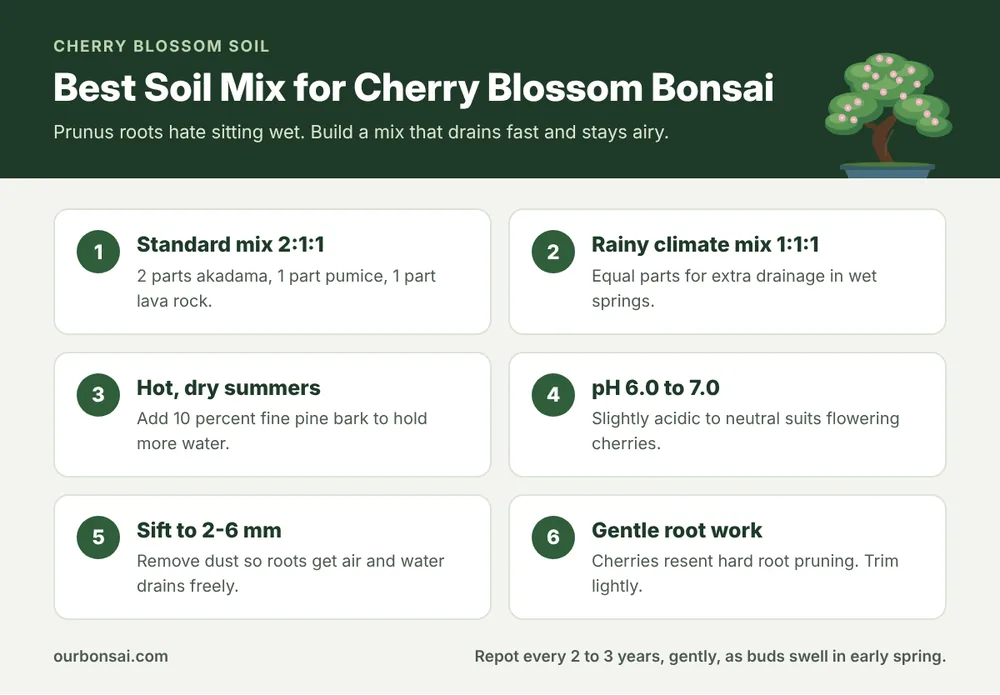
Standard mix (most climates)
- 2 parts akadama
- 1 part pumice
- 1 part lava rock
A balanced mix that drains fast but holds enough water for a flowering tree in spring and summer.
Rainy or cool climate mix
- 1 part akadama
- 1 part pumice
- 1 part lava rock
If your spring and autumn are long and wet, a more open mix keeps roots from staying wet for days after rain.
Hot, dry summer mix
- 2 parts akadama
- 1 part pumice
- 1 part lava rock
- About 10 percent fine composted pine bark
Where summers are hot and dry and you can only water once a day, a little organic matter helps the soil hold more water.
What each ingredient does
| Ingredient | Role | Notes for cherries |
|---|---|---|
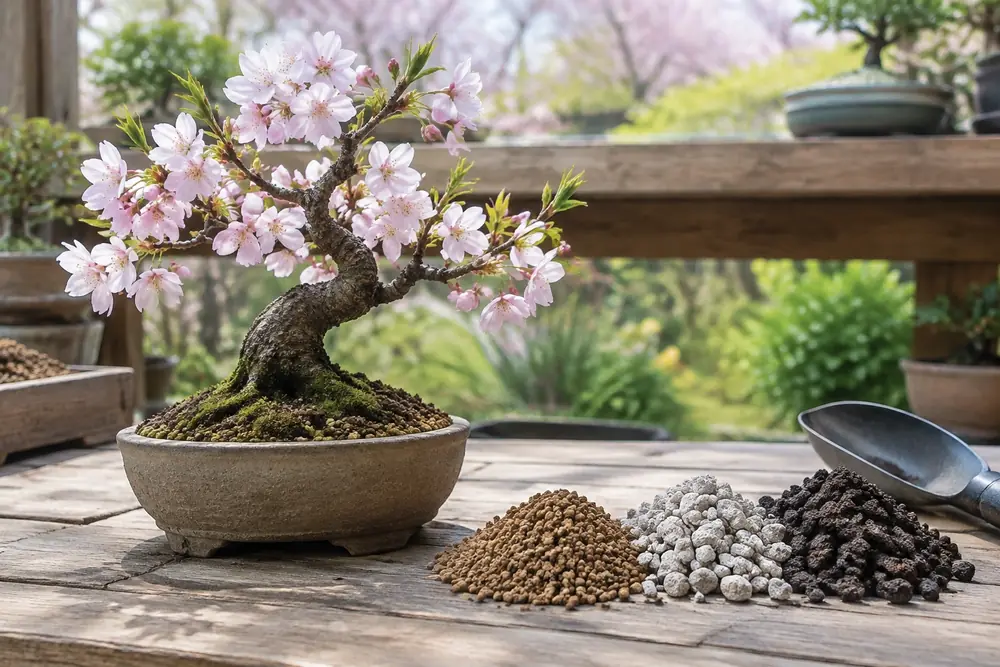
| Akadama | Holds water and nutrients, supports fine roots | Breaks down in 2 to 3 years |
| Pumice | Adds air, holds water in its pores | Light, does not break down |
| Lava rock | Open structure, fast drainage | Keeps the mix airy, good against rot |
| Pine bark (optional) | Extra water retention | Use sparingly, only in dry climates |
For pre-mixed options, our reviews of Heron’s bonsai soil mix and Tinyroots premium bonsai soil cover two good choices. Our bonsai soil mix ratio guide shows how to adjust ratios for any species. If you mix your own, a bag of bonsai lava rock adds the drainage cherries need.
Particle size and sifting
Use particles of about 2 to 6 mm for most cherry bonsai, slightly smaller for very small trees. Always sift out the dust. Fine dust fills the gaps between particles and turns an airy mix into a dense, wet one, exactly the conditions that cause rot in Prunus. A simple set of sieves does the job, and our list of the best bonsai soil scoops includes tools that make the work easier.
Soil pH for cherry blossom bonsai
Flowering cherries grow best in slightly acidic to neutral soil, about pH 6.0 to 7.0. An akadama-based mix sits comfortably in this range. You only need to worry if your water is very hard and leaves white crust on the soil. In that case, flush the pot occasionally with rain water.
When and how to repot a cherry blossom bonsai
Repot cherry bonsai every two to three years, in early spring as the buds begin to swell. Some growers prefer to repot just after flowering, to avoid losing the season’s blooms. Either works, but avoid repotting in summer or autumn.
- Water the tree the day before.
- Remove the tree from its pot and gently comb out old soil from the outside and bottom of the root ball.
- Trim only damaged, dead or very long roots. Cherries resent hard root pruning, so remove no more than about a quarter of the roots.
- Check for rot. Healthy roots are firm and light brown inside. Cut away any soft, dark sections with clean tools.
- Add a thin drainage layer, then fresh mix.
- Position the tree, secure it with wire, and work soil into the roots with a chopstick.
- Water thoroughly and keep the tree in a sheltered, lightly shaded spot for two to three weeks.
Do not fertilize for about a month after repotting. Our guide to the best bonsai repotting tools covers the tools that make this job easier.
Watering cherry blossom bonsai in a gritty mix
A fast-draining mix changes how you water. Because excess water runs straight out, you can water thoroughly without fear of drowning the roots, but the soil also dries faster than dense potting soil.
- Spring: as leaves and flowers open, water use rises fast. Check daily and water when the top is just dry. Water the soil, not the blossoms, so the petals last longer.
- Summer: in hot weather, a cherry in a small pot may need water every day, sometimes twice. A little afternoon shade helps in very hot climates.
- Autumn: water use falls as leaves color and drop. Keep checking daily, but expect to water less often.
- Winter: the tree is dormant and bare. Water only when the soil starts to dry, on mild days, and protect the pot from hard frost.
The combination of gritty soil and thorough watering is what keeps cherry roots both moist and airy. If water starts to sit on the surface or drain slowly, the soil is breaking down and it is time to plan a repot.
Soil and flowering
Healthy roots are directly linked to good flowering. Cherries set next year’s flower buds in summer. A tree whose roots struggle in wet, airless soil through summer will form fewer buds and may drop them in winter. Good soil, steady watering and regular feeding after flowering (with a fertilizer that is not too high in nitrogen) give the best display the following spring.
Common soil mistakes with cherry blossom bonsai
- Using regular potting soil. It stays wet and is the main cause of root rot in cherries.
- Not sifting. Dust blocks air and drainage.
- Too much organic matter. Peat or compost holds too much water around fleshy roots.
- Hard root pruning. Cherries recover slowly from heavy root loss.
- Repotting too often. Every two to three years is enough. Too frequent repotting weakens flowering.
- Saucers full of water. Always empty them after watering.
FAQ: best soil for cherry blossom bonsai
Can I use cactus soil for a cherry blossom bonsai?
It drains better than potting soil, but most cactus mixes contain a lot of peat and sand. A gritty bonsai mix is much better for long-term health.
Do cherry blossom bonsai need acidic soil?
Slightly acidic to neutral is ideal, around pH 6.0 to 7.0. Strongly acidic soil like pure kanuma is not needed.
How often should I repot a cherry blossom bonsai?
Every two to three years, in early spring as buds swell or just after flowering.
Is akadama necessary for cherry bonsai?
No, but it helps. A pumice and lava mix with a little bark also works well, as long as it drains fast.
Final thoughts
The best soil for cherry blossom bonsai is a sifted, gritty mix of akadama, pumice and lava rock that drains fast and keeps roots airy. Adjust it to be more open in rainy climates or slightly more water-retentive in hot ones, repot gently every two to three years, and avoid anything that stays soggy. Healthy roots are what give you a full display of spring blossoms. For other flowering species and their needs, see our guide to flowering indoor bonsai tree care.