Jade Bonsai Yellow Leaves: Why They Turn and How to Fix It

This post contains affiliate links. As an Amazon Associate, OurBonsai earns from qualifying purchases at no extra cost to you. Read our disclosure.
In this guide
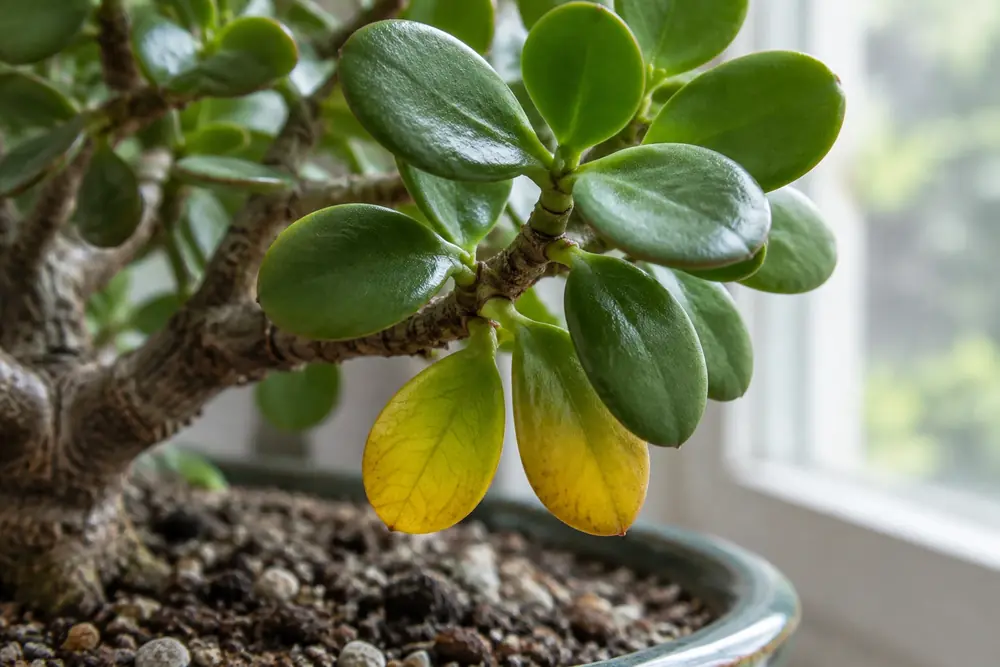
Jade bonsai yellow leaves can mean anything from completely normal leaf turnover to the early stages of root rot, so the first step is to look closely at the yellow leaves. Are they old leaves at the bottom of the branches, or new ones at the tips? Are they soft and see-through, or wrinkled and dry? Jade (Crassula ovata) stores water in its leaves, so the way a yellow leaf feels tells you a lot about what is going on at the roots.
This guide explains the six main causes of yellow leaves on a jade bonsai, how to tell them apart, and how to fix each one.
When yellow leaves are normal
Jade leaves live for a long time, but not forever. Every so often the oldest leaves at the bottom of a branch turn yellow, shrivel and drop. If that happens to one or two leaves at a time, and the tree is producing new leaf pairs at the branch tips, it is simply recycling old leaves. No action needed.
Yellow leaves need attention when they:
- Appear on many branches at once.
- Feel soft, mushy or translucent.
- Show up on new growth at the tips.
- Come with a soft or dark stem.
6 causes of jade bonsai yellow leaves
1. Overwatering
The most common cause, and the most serious. A jade kept in wet soil cannot get oxygen to its roots, and the leaves swell with water, turn yellow and become soft and translucent, sometimes almost jelly-like. They then drop. The stem may turn soft at the soil line.
Fix: stop watering and let the soil dry out completely. If the soil stays wet for more than a week, or the stem is soft, take the tree out of its pot and check for rot; our guide to root rot in bonsai explains how to treat it. Repot into a gritty mix of mostly pumice and lava. In future, water only when the soil is dry all the way through.
2. Underwatering
A jade left dry for too long uses up the water in its leaves. The leaves wrinkle, then yellow and shrivel from the bottom of the branches upward. The soil is dry and may pull away from the pot.
Fix: soak the pot thoroughly until water runs from the drainage holes. Leaves that were only wrinkled usually plump up in a few days. Fully yellow leaves will drop.
3. Not enough light
Jade wants several hours of direct sun. In low light, new growth is long, thin and pale, with big gaps between leaves, and older leaves yellow and drop because the tree cannot support them. Jade in good light, by contrast, has compact growth and often red-tinged leaf edges.
Fix: move it to your sunniest window, or outdoors in summer, increasing the sun gradually over two weeks so it does not scorch. A grow light helps in winter. Our guide to how much light a bonsai tree needs explains how much is enough.
4. Hungry soil
Gritty bonsai soil holds few nutrients, and frequent watering flushes them out. A jade that has not been fed for a long time may turn pale yellow-green all over and grow slowly. Yellowing between green veins is a classic sign of chlorosis, often from a lack of nitrogen, iron or magnesium.
Fix: feed once a month in spring and summer with a balanced fertilizer at half strength, or a fertilizer made for succulents. Do not feed a tree that is waterlogged or rotting. Our guide to bonsai fertilizer: pellets or liquid helps you choose, or browse succulent fertilizer.
5. Shock after a move or repotting
Moving a jade to a new spot, bringing it in from outdoors, or repotting it can cause a few leaves to yellow and drop as the tree adjusts. This usually settles in two to three weeks.
Fix: keep it in one bright spot, water carefully, and do not fertilize until it is growing again.
6. Pests
Mealybugs hide in leaf joints and on the undersides of leaves; scale settles on stems. Both suck sap and can cause yellowing and leaf drop. Look for white cottony tufts or small brown bumps.
Fix: dab pests with a cotton swab dipped in rubbing alcohol and repeat weekly until clear. Our guide to jade bonsai pests and diseases covers treatment in detail.
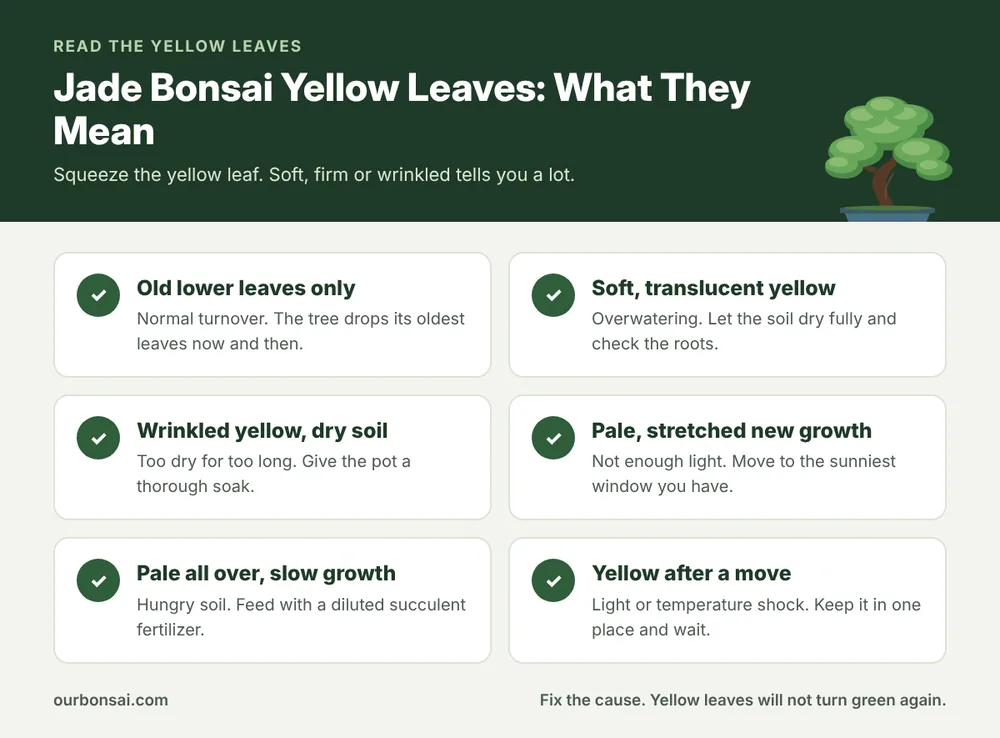
Quick diagnosis table
| Yellow leaf feels | Soil | Most likely cause |
|---|---|---|
| Soft, mushy, translucent | Wet | Overwatering, possible rot |
| Wrinkled, thin | Dry | Underwatering |
| Normal, just old and low | Normal | Natural turnover |
| Pale, on stretched new shoots | Normal | Low light |
| Pale yellow-green all over | Normal | Lack of nutrients |
Yellow leaves in winter
Winter is when most jade owners see yellow leaves, and the cause is usually a mix of two things: less light and the same watering routine as summer. In short, dim days the tree barely grows and uses very little water, so soil that dried in a week in July may stay damp for three weeks in January. Cut watering back to every two to four weeks, check the soil deep down before each watering, and put the tree in the brightest window you have. Keep it away from cold glass at night; a jade leaf pressed against frosty glass can turn yellow and mushy from cold damage alone.
Should I remove yellow leaves from my jade?
A leaf that is fully yellow will not recover, so you can gently pull it off; it will come away easily. Removing soft, rotting leaves is a good idea, because they can attract fungus. Leave leaves that are only slightly yellow; the tree may still pull nutrients from them.
How to prevent yellow leaves on a jade bonsai
- Use a fast-draining, gritty soil and a pot with good drainage.
- Water deeply, then let the soil dry out completely before the next watering.
- Give it as much sun as possible, and summer outdoors if you can.
- Feed lightly in the growing season.
- Check leaf joints for mealybugs every few weeks.
- Keep it above 45°F (7°C) and away from cold drafts.
If you want a refresher on the tree’s overall needs, our real jade bonsai tree indoor guide covers daily care.
FAQ: jade bonsai yellow leaves
Why are the bottom leaves of my jade turning yellow?
If only a few old lower leaves are yellowing and new growth is healthy, it is normal turnover. If many are yellowing and they feel soft, the tree is probably overwatered.
Can a yellow jade leaf turn green again?
No. Once fully yellow, the leaf is finished. Focus on fixing the cause so new leaves stay green.
Does too much sun turn jade leaves yellow?
A sudden move into strong sun can bleach leaves pale yellow or white in patches. Introduce more sun gradually. Gradual sun usually turns jade leaf edges red, which is healthy.
How often should I fertilize a jade bonsai?
About once a month in spring and summer at half strength. No feeding in winter unless it grows under lights.
Final thoughts
Jade bonsai yellow leaves are a message. Squeeze the leaf, check the soil, and you will usually know the cause in a minute: soft and wet means too much water, wrinkled and dry means too little, pale and stretched means not enough light. Fix that one thing, and your jade will be back to firm, glossy green.