How to Prune Fukien Tea Bonsai: Step-by-Step Guide

This post contains affiliate links. As an Amazon Associate, OurBonsai earns from qualifying purchases at no extra cost to you. Read our disclosure.
In this guide
- When to prune a Fukien tea bonsai
- Tools you need
- How to prune Fukien tea bonsai: maintenance trimming
- Structural pruning
- How to prune without losing the flowers
- How to rescue an overgrown Fukien tea
- Can you wire a Fukien tea?
- Aftercare after pruning
- Common Fukien tea pruning mistakes
- FAQ: how to prune fukien tea bonsai
- Final thoughts
Learning how to prune fukien tea bonsai is mostly about rhythm. Fukien tea (Carmona microphylla) grows steadily in warm, bright conditions and responds well to regular trimming: let a new shoot grow four to six leaves, then cut it back to one or two. Done every few weeks during the growing season, that simple routine builds a dense canopy of tiny glossy leaves. Bigger structural cuts are best saved for late spring, when the tree is strongest. And because the small white flowers form on new shoots, a little planning lets you keep flowering and shape at the same time.
This step-by-step guide covers when to prune, which tools to use, maintenance trimming, structural pruning, keeping the flowers, and aftercare.
When to prune a Fukien tea bonsai
| Type of pruning | Best time | Notes |
|---|---|---|
| Maintenance trimming | Spring to late summer, lighter in winter | Whenever shoots reach 4 to 6 leaves |
| Structural pruning | Late spring to early summer | Strongest growth, fastest healing |
| Root pruning | Late spring | During repotting, every 2 to 3 years |
| Avoid | Midwinter in low light | Slow recovery, weak regrowth |
Fukien tea is sensitive to stress. Avoid combining heavy pruning with repotting, a move to a new spot, or a big change in temperature. Do one thing at a time and let the tree settle in between.
Tools you need
- Fine, pointed bonsai scissors for reaching into the dense canopy. Our guide to the best bonsai pruning shears for beginners covers good options.
- A concave cutter for removing branches flush with the trunk; see our concave cutter review.
- Cut paste for cuts larger than a pencil. Our list of bonsai cut paste alternatives helps if you do not have any.
You can also browse pointed bonsai scissors to compare.
How to prune Fukien tea bonsai: maintenance trimming
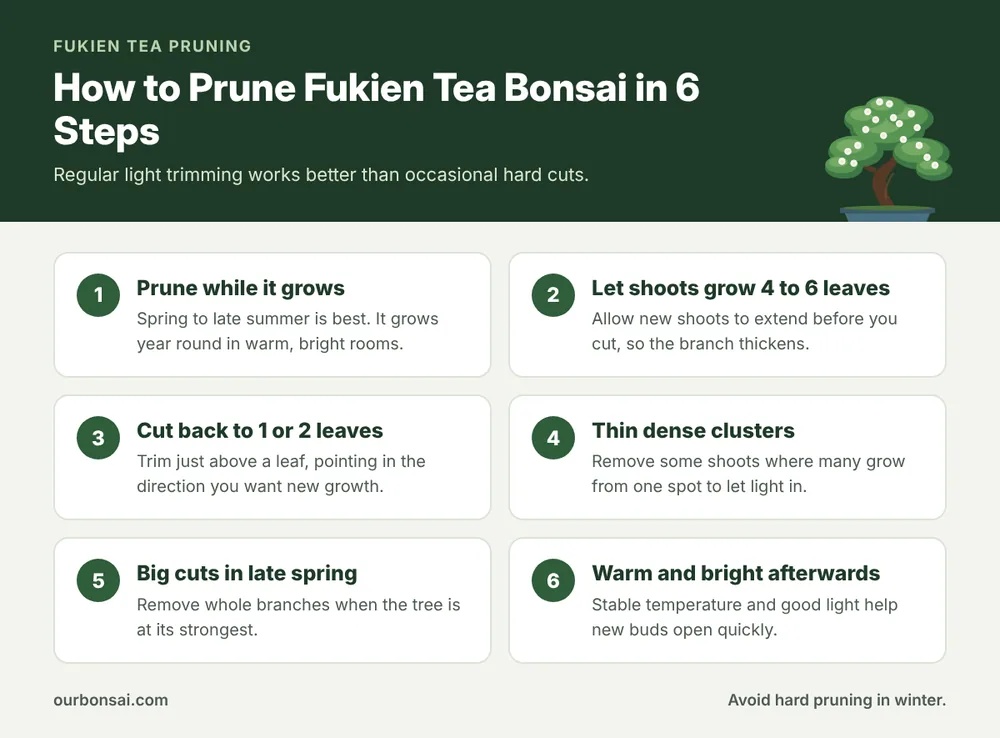
Step 1: Let new shoots extend
Leave new shoots alone until they have four to six leaves. That growth feeds the tree and slowly thickens the branch.
Step 2: Cut back to one or two leaves
Trim each shoot back to one or two leaves. Cut just above a leaf whose bud points in the direction you want the next shoot to grow, usually outward or sideways. Fukien tea back-buds well from these leaf axils.
Step 3: Follow the silhouette
Most Fukien tea bonsai are shaped as rounded or layered canopies, often in the informal upright or broom style. Trim anything that pokes outside the outline. Our guide to Fukien tea bonsai styles shows the common shapes.
Step 4: Thin crowded spots
Fukien tea often pushes several shoots from one point. Leave two and remove the rest. Thinning lets light and air into the canopy, which keeps inner branches alive and discourages pests.
Step 5: Clean up the trunk
Rub off or cut shoots growing from the trunk and the base of branches unless you want a new branch there.
Structural pruning
Once a year, in late spring, step back and look at the overall structure. Remove:
- Branches that cross or rub.
- Branches growing straight up from the top of other branches, or straight down.
- One of two branches growing from the same height (bar branches).
- Thick, coarse branches near the top that spoil the taper.
Fukien tea wood is hard, so use sharp tools and cut cleanly. Seal larger cuts. Keep heavy structural cuts to about a third of the foliage or less at one time.
How to prune without losing the flowers
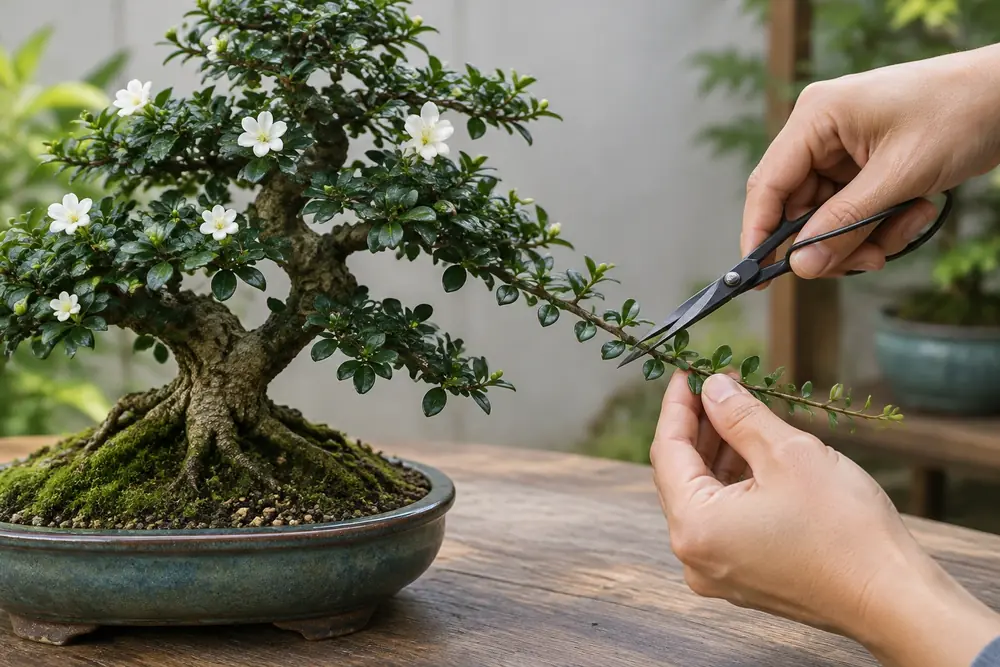
Fukien tea flowers on new shoots, and it can bloom on and off much of the year in good light. Small white flowers are followed by tiny berries that turn from green to red and almost black. If you trim every shoot very short, you remove many of the flower buds. A simple compromise:
- Leave a few shoots on the outer canopy to grow a little longer and flower.
- Trim after the flowers fade, rather than just before they open.
- Keep the strongest trimming for the top of the tree, which grows hardest, and let lower branches grow and flower more.
The Wikipedia page on Ehretia microphylla describes its small white flowers and fruit, which are a big part of the tree’s charm.
How to rescue an overgrown Fukien tea
If a Fukien tea has been left untrimmed for a season or two, it turns into a shaggy bush with long shoots and bare inner branches. Do not cut it all back in one go. Instead, spread the work over two or three sessions in late spring and summer:
- First session: cut the longest shoots back by about half and remove any obviously dead or crossing branches.
- Three to four weeks later: once new buds have opened further back on the branches, cut back again to those new buds.
- Following weeks: return to the normal routine of letting shoots grow four to six leaves and trimming to one or two.
Working in stages keeps enough leaves on the tree to feed it, so it does not go into shock and drop its foliage, which is the classic Fukien tea reaction to sudden heavy pruning.
Can you wire a Fukien tea?
Yes, but carefully. Young shoots are flexible, while older branches become stiff and brittle. Wire young branches with aluminum wire and check them every couple of weeks, because the bark marks easily. Many growers shape Fukien tea mainly by “clip and grow” pruning instead, which suits its habit of back-budding.
Aftercare after pruning
- Keep the tree in a bright spot with stable temperatures, 60 to 75°F (15 to 24°C).
- Water as usual, checking the surface daily. A pruned tree uses a little less water.
- Feed every two weeks during the growing season to fuel new growth; our best fertilizer for Fukien tea bonsai list has options.
- Do not move the tree around after pruning. Fukien tea dislikes change.
Common Fukien tea pruning mistakes
- Hard pruning in winter in low light.
- Pruning and repotting at the same time.
- Cutting every shoot as soon as it appears, so branches never thicken.
- Leaving too many shoots in one spot, creating knobby swellings.
- Trimming off every flower bud without meaning to.
FAQ: how to prune fukien tea bonsai
How often should I trim my Fukien tea bonsai?
Every few weeks during the growing season, whenever shoots reach four to six leaves.
Can I cut back a Fukien tea hard?
A healthy tree can take a hard cut in late spring, but it recovers slower than a ficus. Avoid removing more than about a third of the foliage at once.
Why did my Fukien tea drop leaves after pruning?
Usually it was combined with another stress, such as a move, cold or underwatering. Keep conditions stable and it will re-bud.
Should I remove the berries?
You can leave them for decoration, but removing them saves the tree energy. Many growers pick them off once they turn dark.
Final thoughts
Now you know how to prune fukien tea bonsai: trim little and often, cut new shoots back to one or two leaves, save structural work for late spring, and leave a few shoots to flower. Keep the tree in a stable, bright spot afterwards and it will reward you with dense, glossy foliage and white blooms. For healthy roots to support all that growth, see our guide to the top 10 best soil for Fukien tea bonsai, since the right soil makes every other part of care easier.