Bald Cypress Bonsai Styles: Best Shapes for Beginners

The best bald cypress bonsai styles copy one of two stages in the life of a wild tree. Young bald cypress grows as a narrow, conical spire, which bonsai growers recreate with the formal upright style. Very old trees in southern swamps lose their tops to wind and lightning and spread into broad, flat crowns, which is the basis of the popular flat-top style. For beginners, the flat-top on a thick nursery trunk and a forest planting of young trees give the fastest, most convincing results. Informal upright and deadwood styles are good second projects.
In this guide
Why bald cypress is styled differently
Taxodium distichum is a deciduous conifer with soft, feathery needles that fall every autumn. It grows fast in sun and water, thickens its trunk quickly, and develops a strong flare at the base, called a buttress. Those traits favor styles that show off a powerful, tapering trunk with a canopy of fine foliage.
What it does not do well is tight, cloud-like pads of the type seen on junipers and pines. Its shoots are long and soft, and fine ramification takes years. That is why most good bald cypress bonsai look like a big old tree with a simple, broad silhouette rather than a highly detailed one.
The flat-top style
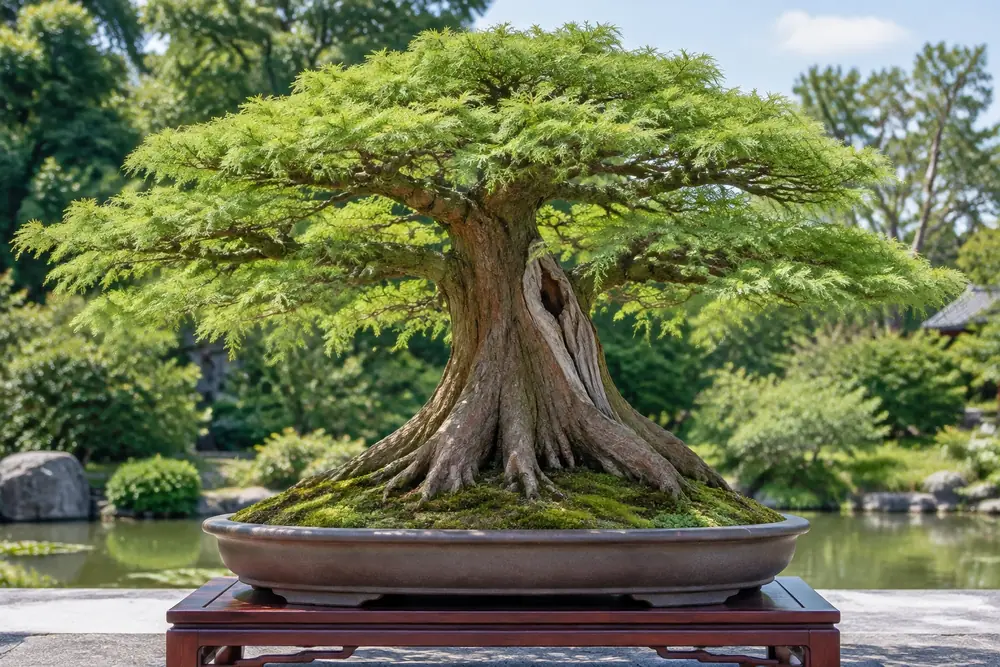
The flat-top is the signature American style for bald cypress, popularized by Louisiana bonsai artist Guy Guidry, who studied old cypress growing in the swamps around him. It has:
- A thick trunk with heavy buttressing and strong taper.
- A sudden change near the top, where the trunk divides into several branches.
- A broad, flat or slightly domed crown, often wider than the tree is tall.
- Branches that rise, then level off.
How to start: buy a nursery or field-grown tree with a thick base, at least 5 cm across. In late winter, cut the trunk at about one third to half its height, just above a few strong branches. Let those branches grow freely for a season, then wire them to radiate outward and slightly up. Over the next few years, prune the crown flat across the top and let the outer edge extend.
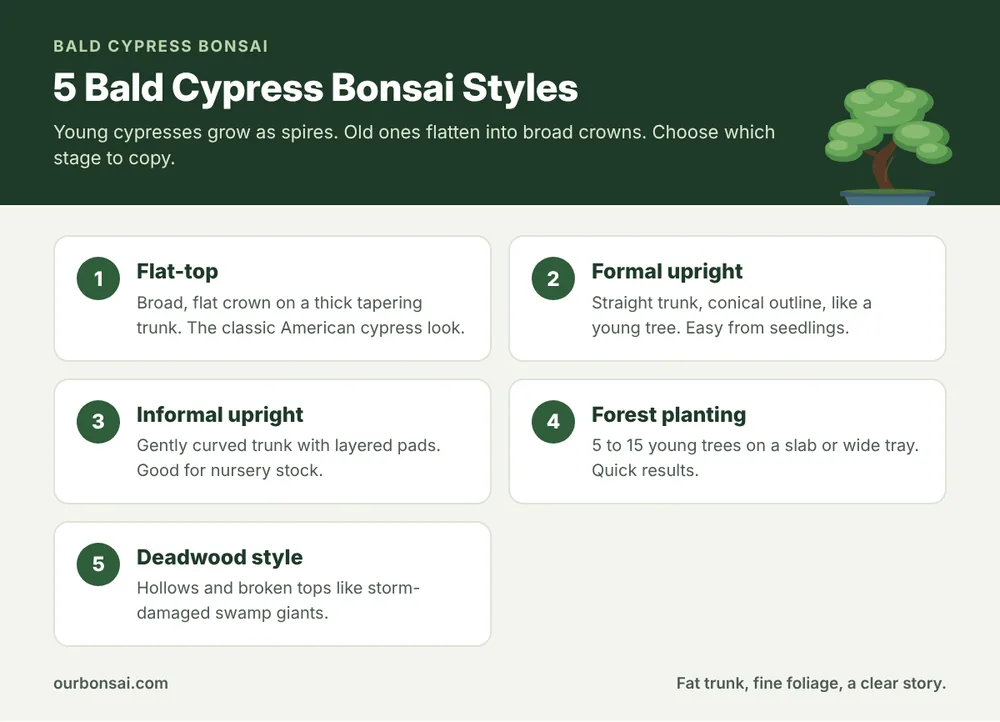
Formal upright
This style copies a young bald cypress: a straight trunk that tapers evenly to a single apex, with branches getting shorter toward the top, so the outline is a narrow cone. It is the easiest style to grow from seedlings or young nursery trees because it follows the tree’s natural habit.
Tip: bald cypress tends to push strong growth to the apex. Pinch or cut back the top shoots several times in summer to keep energy in the lower branches.
Informal upright
A gently curving trunk with branches on the outsides of the curves and a rounded or flattened top. It suits nursery trees that have a slight bend. Wire young trunks in spring, when they are flexible, and remove wire within a season because bald cypress thickens fast and wire bites in quickly.
Forest or group planting
Bald cypress grows in groups in the wild, so a forest planting looks natural. Use 5, 7, 9 or more young trees of different heights and thicknesses on a slab or wide, shallow tray. Put the thickest tree near the front, slightly off center, and group the rest around it with varying spaces.
This style gives an impressive result within 2 to 3 years. Young bald cypress are inexpensive, so it is also a cheap way to start. If you want ideas for pot choice, see our guide to large deep bonsai pots and wide trays.
Deadwood or “lightning strike” style
Old wild cypress often have hollow trunks, broken tops and stripped sections of bark. Some growers carve these features into thick bald cypress trunks with hand tools or a rotary carver, then treat the wood with lime sulfur. It is dramatic, but it needs a thick trunk to look right and carving skill to look natural. Our article on the most essential bonsai carving tool is a good start.
Building the buttressed base
Whatever style you choose, the flared base is what makes a bald cypress look old. Wild trees growing in water develop a wide, fluted buttress. In a pot you can encourage it by growing the tree in a wide, shallow container and keeping the soil wet through the summer, often with the pot standing in a shallow water tray. Many growers report a noticeably wider base after a few seasons grown this way. Spread the surface roots out evenly at each repot, and remove any that cross or dive straight down. Do not bury the base deeply; the flare needs to sit at or just above the soil line to be seen.
Bald cypress bonsai styles compared
| Style | Difficulty | Starting material | Years to presentable |
|---|---|---|---|
| Flat-top | Moderate | Thick nursery or field-grown trunk | 3 to 5 |
| Formal upright | Easy | Seedlings or young trees | 3 to 5 |
| Informal upright | Easy | Nursery trees with a bend | 3 to 4 |
| Forest planting | Easy | 5 to 15 young trees | 2 to 3 |
| Deadwood | Hard | Very thick trunks | 4 or more |
Timing your styling work
- Major cuts and trunk chops: late winter, just before bud break.
- Wiring: spring and early summer, once new shoots have firmed a little. Check every few weeks.
- Pinching and trimming: throughout summer, especially at the top.
- Repotting: at bud swell in spring. Bald cypress tolerates heavy root pruning.
Bald cypress needs full sun and plenty of water to grow fast enough to style. Our guide to watering bonsai in summer covers hot weather, and the round-up of deciduous bonsai tree types compares it with other deciduous species.
Frequently asked questions
What is the most popular bald cypress bonsai style?
The flat-top. It copies the broad crowns of old cypress in southern swamps and shows off the thick buttressed trunk.
Can bald cypress be grown as a cascade?
Technically yes, but it rarely looks convincing. Bald cypress is an upright tree that grows in flat, wet ground, so cascade and windswept styles do not match its natural character.
How fast can I style a bald cypress bonsai?
It is one of the faster species. With full sun, water and regular feeding, a nursery tree can become a presentable flat-top in 3 to 5 years.
Should I wire bald cypress in winter?
It is easier to see branches in winter, but the wood is more brittle. Most growers wire in spring and early summer and remove it before it bites.
Final thoughts
Decide whether your tree is young or old in spirit, then choose formal upright or flat-top to match, or plant a forest if you have several young trees. For buying advice, see our guide to bald cypress bonsai for sale, and for the wild tree that inspires these styles, read the Wikipedia article on Taxodium distichum.