Bald Cypress Bonsai Light Requirements: How Much Sun It Needs

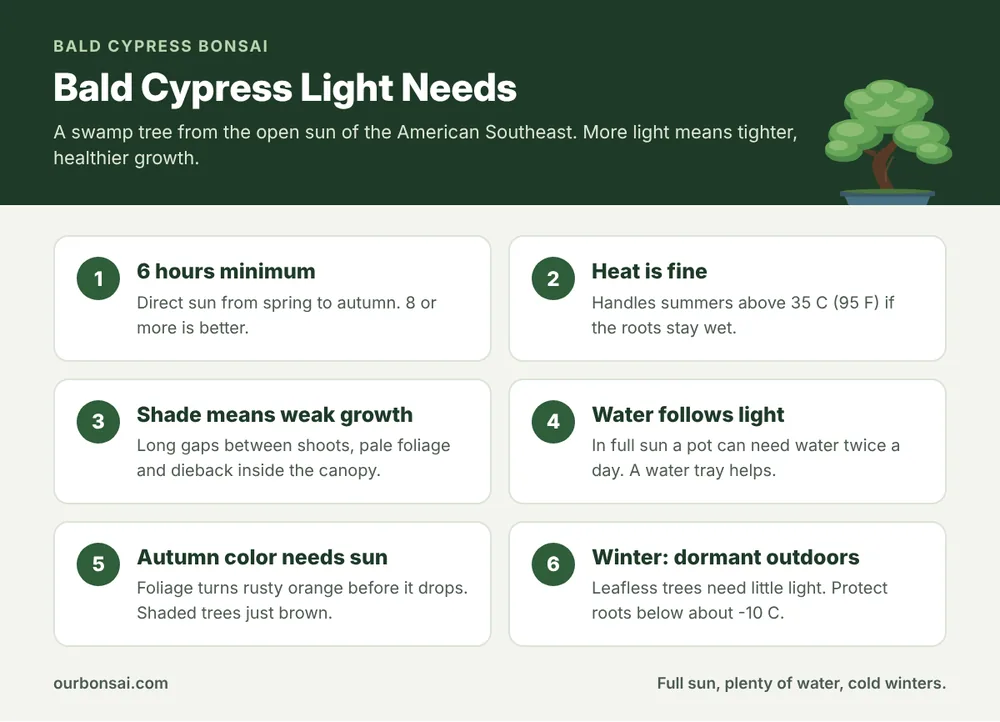
Bald cypress bonsai light requirements are simple: full sun. Give it at least 6 hours of direct sun a day from spring to autumn, and 8 or more hours if you can. Taxodium distichum grows wild in open swamps and river bottoms of the southeastern United States, where it stands in full sun and wet soil all summer, so it handles heat much better than most bonsai as long as the roots never dry out. In shade, it grows long, weak shoots with thin, pale foliage, and inner branches die back.
In this guide
- Why bald cypress needs so much sun
- Bald cypress bonsai light requirements through the year
- Signs your bald cypress is getting too little light
- Light and water go together
- Moving a shaded tree into full sun
- Can bald cypress handle afternoon sun?
- Bald cypress indoors: why it does not work
- Winter light and protection
- Frequently asked questions
- Final thoughts
Why bald cypress needs so much sun
Bald cypress is a deciduous conifer, one of the few conifers that drops all its needles every autumn. Each spring it has to build a whole new canopy from scratch. That takes a lot of energy, and in a small pot the tree has limited reserves. Strong light during the growing season lets it rebuild quickly, thicken the trunk and store enough for next year.
In its native range, from Delaware and the Mississippi River valley to Florida and Texas, it often grows in standing water with nothing taller around it. It is adapted to high light and high heat, not to forest shade. That is quite different from species like Japanese maple or azalea, which prefer some afternoon shade.
Bald cypress bonsai light requirements through the year
| Season | Direct sun | What happens | Your job |
|---|---|---|---|
| Spring (bud break) | 6+ hours | New feathery shoots extend fast | Move to full sun as soon as frosts end |
| Summer | 8+ hours | Strongest growth, trunk thickens | Keep roots wet, water once or twice a day |
| Late summer | Full sun | Shoots harden | Reduce pinching |
| Autumn | Full sun | Foliage turns rusty orange, then drops | Leave in sun for good color |
| Winter | Not important | Dormant, leafless | Keep outdoors, shelter roots in hard cold |
Signs your bald cypress is getting too little light
- New shoots stretch with long gaps between them.
- Foliage looks pale green or yellowish instead of bright green.
- Branches on the shaded side and inside the canopy die back over a season.
- The tree pushes most growth to the very top and stays weak lower down.
- Autumn color is dull brown instead of rust orange.
If you see these, move the tree to the sunniest spot you have. A south-facing open bench is ideal. If your garden only gets a few hours of direct sun, bald cypress is still possible, but expect slower development.
Light and water go together
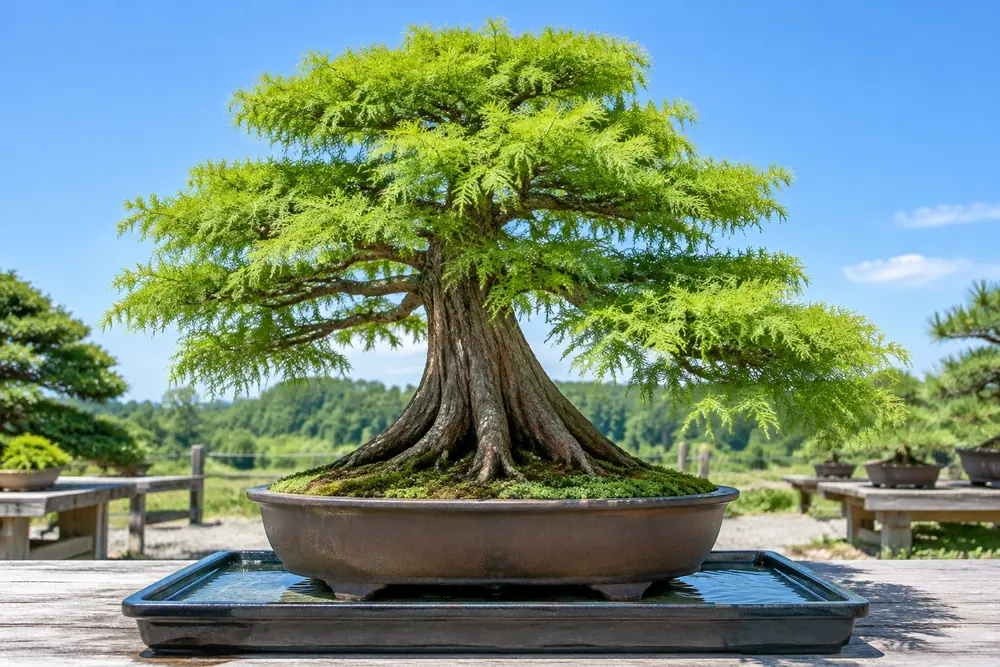
The more sun a bald cypress gets, the more water it uses. A tree in a 20 cm pot in full summer sun may need watering twice a day. Many growers set the pot in a shallow tray of water through the hottest months, so the lower part of the soil stays wet. This is one of the few bonsai species that tolerates it, because it evolved in flooded soil. Change the water every few days to stop mosquitoes breeding, and take the pot out of the tray in autumn, once growth slows.
Our guide to watering bonsai in summer covers the general method for hot weather.
Moving a shaded tree into full sun
If your bald cypress spent the summer in shade, or came from a nursery greenhouse, do not put it straight into full afternoon sun in July. Foliage that grew in low light is thinner and can scorch when the light suddenly jumps. Move it over 10 to 14 days: a few hours of morning sun first, then a little more each day. In spring, before the new needles have fully grown, you can move it into full sun at once, because the new growth will develop already adapted to bright light.
The same applies after repotting. A freshly repotted tree has fewer working roots, so give it a week or two of bright shade before returning it to full sun.
Can bald cypress handle afternoon sun?
Yes. Unlike maples and azaleas, bald cypress does not need afternoon shade in most climates. Problems in full sun nearly always come from dry roots, not from the light itself. If the foliage turns brown and crispy in summer, check the soil first. In very hot, dry climates with reflected heat from walls or paving, a little shade in the late afternoon can help small pots, but this is the exception.
Bald cypress indoors: why it does not work
Bald cypress needs outdoor light levels and a winter dormancy. Even a bright south window delivers a fraction of the light it gets outside, and a warm room stops it going dormant. Indoors, it usually declines within a year or two. If you live in an apartment, a sunny balcony is fine. For other tree ideas, see our list of types of outdoor bonsai trees, and our page on the best place for a bonsai tree helps you find the sunniest spot at home.
Winter light and protection
Once the foliage drops, light matters very little. A dormant bald cypress can spend winter in an unheated garage or a cold frame. It is hardy in the ground to around USDA zone 4 or 5, but roots in a pot are less hardy, so shelter them when temperatures fall below about -10 C (14 F). Bring it back into full sun in spring as soon as the buds start to swell.
Frequently asked questions
How many hours of sun does a bald cypress bonsai need?
At least 6 hours of direct sun a day during the growing season, and 8 or more for the best growth.
Can I grow bald cypress bonsai in partial shade?
It survives, but growth gets long and weak, and inner branches die back. Full sun gives a much better tree.
Why is my bald cypress turning brown in summer?
Usually dry roots, not too much sun. Bald cypress needs a lot of water in heat. Check the soil and consider a water tray. Some browning in autumn is normal leaf drop.
Does bald cypress need a grow light?
Not if it lives outside, which it should. Grow lights are not a substitute for outdoor sun for this species.
Final thoughts
Treat bald cypress as a sun-and-water tree: the brightest spot you have, roots that never dry out, and a cold winter outside. Get those right and it grows fast, thickens quickly and gives a fine show of rusty autumn color. For more about buying a starter tree, see our guide to bald cypress bonsai for sale, and for the species itself, Clemson Extension’s bald cypress factsheet and the Wikipedia article on Taxodium distichum are good references.