Gumpo Azalea Bonsai: Care, Styling and Growing Tips

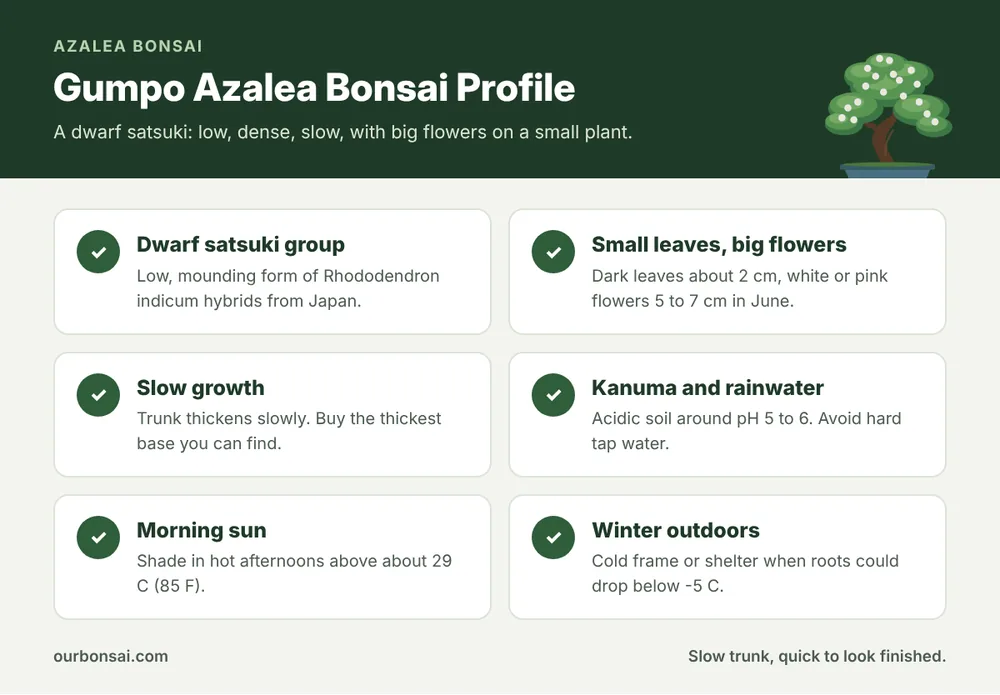
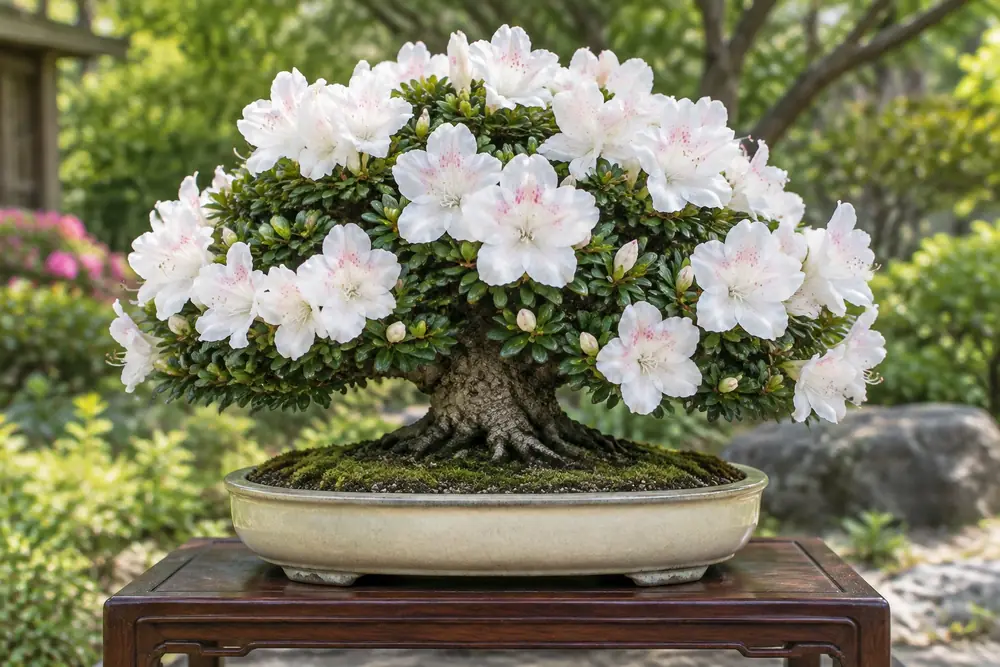
Gumpo azalea bonsai are made from dwarf satsuki azaleas, a low, mounding form of Rhododendron indicum hybrids that grows dense twigs, small dark green leaves around 2 cm long, and surprisingly large flowers of 5 to 7 cm in late May and June. ‘Gumpo White’ and ‘Gumpo Pink’ are the common forms. Care is the same as for other satsuki: kanuma soil, rainwater or soft water, morning sun with afternoon shade in hot summers, and a cold outdoor winter with root protection below about -5 C (23 F). The main trade-off is speed: Gumpo looks finished quickly but builds trunk thickness slowly.
In this guide
Why Gumpo is good bonsai material
Gumpo is sold widely as a landscape shrub, often in 1 to 3 gallon pots, so it is one of the easiest azaleas to find. Several traits suit bonsai:
- Short internodes. Leaves sit close together on the stems, so the canopy looks full even on a small tree.
- Small leaves in proportion. Smaller than most garden azaleas, which keeps a small tree looking right.
- Strong back-budding. Like other satsuki, it sprouts from old wood after hard pruning.
- Huge flower display. The flowers are large for the plant, so a 25 cm Gumpo in bloom can be almost solid white.
The downside is that it was bred to stay low and spread. You will not get a tall, slender trunk from it, and thickening the trunk in a pot takes years.
Picking a nursery Gumpo
Look at the base, not the top. The best plants have:
- A single thick stem, or several stems joined into a broad base, at least 2 cm across.
- Surface roots that spread in more than one direction when you brush the soil back.
- Branches that start low, giving you choices.
- Healthy, glossy leaves without stippling (a sign of lace bugs) or swollen pale galls.
Avoid plants with yellow leaves and wet, sour soil. They may have root rot.
Turning a Gumpo shrub into a bonsai
Work in early spring before bloom (and remove the flower buds), or right after flowering in June.
Year 1. Pick the front and the trunk line. Cut out stems that cross or run straight at the viewer. Shorten the rest to stubs; Gumpo will bud back. Repot into a training pot with kanuma, cutting about a third of the root mass.
Year 2. Let the tree grow freely after flowering to build strength. Select 3 to 5 main branches. Wire them gently with aluminum wire after flowering.
Year 3 onward. Prune right after each flowering, cutting new shoots back to two leaves. Move to a shallow bonsai pot when the structure is set.
Good styles for Gumpo are informal upright with a short trunk, broad multi-trunk (kabudachi) and semi-cascade. Low, wide pots suit its spreading habit.
Season-by-season Gumpo azalea bonsai care
| Season | Light | Water | Feeding | Work |
|---|---|---|---|---|
| Early spring | Full morning sun | Keep evenly moist | None until after flowering | Repot as buds swell |
| Flowering (late May to June) | Bright shade, out of rain | Water the soil, not the flowers | None | Enjoy, then remove spent flowers |
| Early summer | Morning sun | Daily in heat | Acid feed every 2 to 3 weeks | Main prune and wiring |
| Late summer | Morning sun, afternoon shade | Daily, sometimes twice | Lighter feed | Leave tips alone, buds forming |
| Autumn | More sun | As needed | Stop by early autumn | Tidy only |
| Winter | Bright, cold | When dry | None | Protect roots |
For more on soil, see the best soil for azalea bonsai. For feeding, our list of the best fertilizer for azalea bonsai suggests acid-friendly options.
Watering a Gumpo azalea bonsai
Gumpo’s dense canopy acts like an umbrella. Light rain often runs off the leaves and never reaches the soil, so a tree can look wet outside and still be dry in the pot. Water the soil directly with a fine rose until water runs from the holes, then wait until the kanuma surface turns pale yellow before watering again. In summer that often means once a day; in cool spring weather, every two or three days.
If the root ball ever dries out completely, kanuma can shrink from the pot wall. Sit the pot in a bucket of rainwater for 10 minutes to rewet it fully. Hard tap water, used day after day, slowly pushes the soil pH up and is the most common reason Gumpo leaves turn yellow.
Common problems on Gumpo azaleas
Azalea lace bug. Tiny insects under the leaves suck sap and leave a pale, stippled look on the upper side, with dark specks underneath. Hose the leaf undersides and use insecticidal soap early in the season. See our general guide to treating bonsai pests step by step.
Leaf gall. In cool, wet springs, a fungus (Exobasidium) causes swollen, pale, fleshy leaves or flowers. Pick them off before they turn white and release spores.
Yellow leaves with green veins. Usually hard water or alkaline soil. Switch to rainwater and an acid feed.
Root rot. Soggy soil and old, broken-down kanuma. Repot every 2 to 3 years and never leave the pot in water.
Spider mites in hot, dry weather. Look for fine webbing and dull, speckled leaves.
Gumpo vs other satsuki azaleas
Compared to standard satsuki cultivars like ‘Chinzan’ or ‘Kaho’, Gumpo is lower, slower and denser. It is easier to keep compact and less likely to get leggy, but it takes longer to thicken. For a quick shohin tree with lots of flowers, Gumpo is a great choice. For a large tree with a powerful trunk, a vigorous standard satsuki is better.
Frequently asked questions
Is Gumpo azalea good for beginners?
Yes. It is forgiving, easy to find and stays compact. Just be patient about trunk size.
Can a Gumpo azalea bonsai live indoors?
Not long term. It needs outdoor light and a cold winter to flower. Bring it in for a few days while blooming if you like, then return it outside. Read our satsuki azalea indoor care guide for the details.
When does Gumpo azalea bloom?
Late May to June in most temperate climates, later than most other azaleas.
How cold can a Gumpo azalea bonsai handle?
In the ground, it is commonly rated around USDA zone 6 or 7. In a bonsai pot, protect the roots below about -5 C (23 F).
Final thoughts
Gumpo is one of the best value azaleas for bonsai: cheap, easy to find, and quick to look like a finished small tree. Give it kanuma, soft water and shade on hot afternoons, prune after flowering, and accept that the trunk will take its time. For more on the satsuki group, see the Wikipedia page on Rhododendron indicum.