How to Treat Bonsai Pests Step by Step

Quick Answer
To treat bonsai pests, isolate the affected tree, identify the pest, remove visible insects, and apply a suitable treatment only when necessary. Inspect the foliage, branches, and soil before choosing a remedy, then repeat inspections and treatments according to the product label. The safest approach combines pest identification, good growing conditions, and targeted control rather than spraying every tree with a general insecticide.
Treatment steps at a glance
- Step 1 — Isolate: Move the affected bonsai away from other trees to reduce pest spread.
- Step 2 — Inspect: Check leaf undersides, new shoots, bark crevices, branch joints, and the soil surface.
- Step 3 — Identify: Distinguish aphids, spider mites, scale insects, mealybugs, and soil-dwelling pests before treating.
- Step 4 — Remove: Wash off suitable pests with water or carefully remove visible insects by hand.
- Step 5 — Treat: Use an appropriate, bonsai-compatible insecticidal soap, horticultural oil, or other labeled product when needed.
- Step 6 — Recheck: Inspect the tree every few days initially and repeat treatment only as directed.
Before applying a treatment
- Test the product on a small area first and watch for leaf damage.
- Avoid spraying a wilted tree, tender foliage in intense heat, or a species sensitive to the product.
- Keep treated trees away from children, pets, and beneficial insects as directed on the label.
Bonsai pests can damage foliage, weaken new shoots, and slowly reduce a tree’s vigor if left unchecked. I approach pest treatment as a diagnosis first and a treatment second, because the wrong spray can cause more trouble than a small infestation.
This guide explains how to identify common bonsai pests, choose a suitable treatment, and prevent repeat outbreaks without putting the tree’s health at unnecessary risk.
In This Guide
- How do you identify pests on a bonsai tree?
- How do you treat bonsai pests step by step?
- Which treatment works best for each bonsai pest?
- How can you treat bonsai pests safely?
- How do you prevent bonsai pests from returning?
- How do you monitor recovery and recognize serious damage?
- Frequently asked questions
How do you identify pests on a bonsai tree?
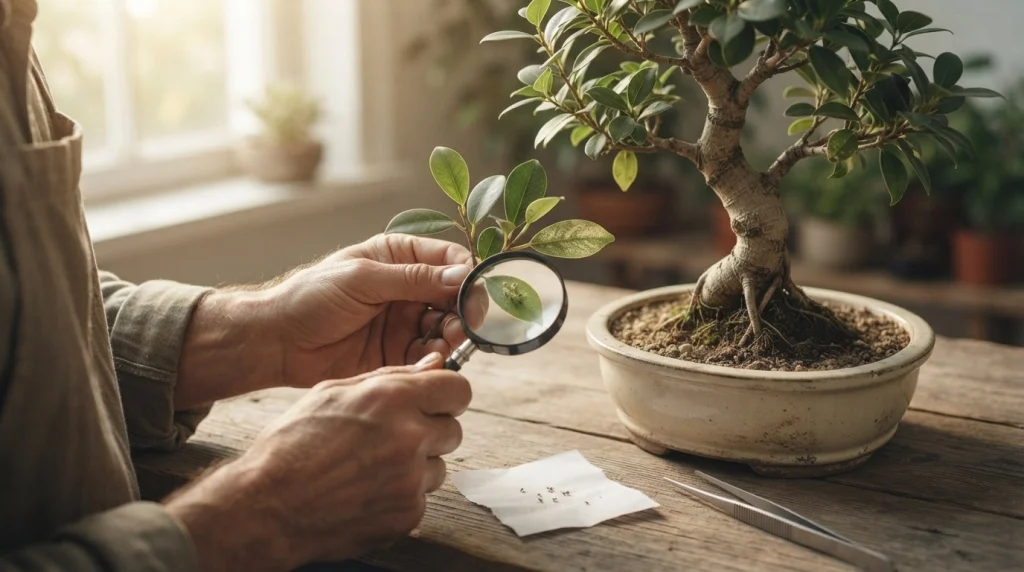
Identify the pest before choosing a treatment, because different pests respond to different control methods. Examine both the visible organisms and the damage they leave behind.
Bonsai pest treatment is the process of identifying, controlling, and monitoring organisms that feed on or damage a bonsai tree. It can involve physical removal, environmental adjustments, beneficial organisms, or a labeled pesticide suited to the pest and tree species.
What are the most common bonsai pests?
Start by inspecting the entire tree rather than concentrating on its most damaged leaves. Small pests often hide beneath foliage, along tender stems, or around the trunk and branch junctions.
- Aphids: Small, soft-bodied insects that gather on tender shoots and leaf undersides, sometimes leaving sticky honeydew.
- Spider mites: Tiny arachnids that produce pale speckles on foliage and sometimes fine webbing during heavier infestations.
- Scale insects: Stationary-looking bumps attached to stems or leaves, often protected by a waxy or shell-like covering.
- Mealybugs: Insects covered in white, cotton-like material, often found in branch joints or other sheltered spaces.
- Caterpillars: Leaf-chewing larvae that leave irregular holes, missing leaf sections, or droppings.
- Fungus gnats: Small flying insects associated with moist growing media; their larvae may be present in the soil.
These pests do not all cause the same type of damage. Spider mites, for example, may leave stippled foliage without obvious insects, while aphids commonly gather in visible clusters.
How can you distinguish pests from watering or disease problems?
Yellowing leaves, leaf drop, and weak growth do not automatically mean insects are responsible. Poor drainage, underwatering, root damage, unsuitable light, and fungal diseases can produce similar symptoms.
Use a magnifying glass and a simple white-paper test to improve your diagnosis. Tap a suspect branch gently over the paper and look for tiny moving specks, then examine the leaf undersides for eggs, cast skins, or webbing.
| Observed symptom | Possible cause | What to check next |
|---|---|---|
| Fine pale dots or bronze foliage | Spider mites | Leaf undersides and fine webbing |
| Sticky leaves and clustered insects | Aphids or soft scale | Tender shoots, stems, and leaf veins |
| White cotton-like patches | Mealybugs | Branch joints and sheltered crevices |
| Small holes or chewed leaves | Caterpillars or other chewing pests | Leaf undersides, fresh droppings, and nearby shoots |
| Tiny flies around the pot | Fungus gnats | Persistently damp growing media |
For additional identification guidance, compare your observations with the illustrated bonsai pests and diseases guide from Bonsai Empire.
Section takeaway: Confirm the likely pest before spraying. Matching the symptoms to the actual organism helps prevent unnecessary treatments and protects the tree’s remaining healthy foliage.
How do you treat bonsai pests step by step?
The safest approach starts with isolation and physical removal, followed by a targeted treatment if pests remain. Work methodically so you can judge whether the treatment is helping.
Step 1: Isolate the affected bonsai
Move the affected tree away from other bonsai and susceptible plants when practical. Keep it in a location that still meets its normal light, temperature, and airflow requirements.
Do not move an outdoor species into a dark room simply to isolate it. Instead, create distance from neighboring trees while preserving the conditions it needs to recover.
Step 2: Inspect the whole tree
Use a bright light and a magnifying glass to inspect foliage, shoots, branches, and the trunk. Look beneath leaves and around the areas where branches meet the trunk.
- Check the newest growth, where aphids often gather.
- Examine leaf undersides for mites, eggs, and fine webbing.
- Inspect bark crevices and branch joints for scale and mealybugs.
- Look over the soil surface and drainage holes if small flies or soil-dwelling pests are suspected.
Record the affected areas and take a close-up photograph if identification remains uncertain. This gives you a useful baseline for judging changes after treatment.
Step 3: Remove visible pests and damaged material
For a small infestation, careful physical removal can reduce pest numbers without exposing the whole tree to a pesticide. Choose a method that suits the tree’s foliage and the pest’s location.
- Aphids: Rinse accessible colonies from sturdy foliage with a gentle, controlled stream of water.
- Mealybugs: Remove visible insects with a damp cotton swab, taking care not to damage tender growth.
- Scale: Carefully lift accessible insects from suitable woody stems without scraping away healthy bark.
- Caterpillars: Pick off visible larvae and remove badly chewed, expendable material when appropriate.
- Spider mites: Rinse the undersides of suitable leaves thoroughly to dislodge mites and reduce webbing.
Bag heavily infested fallen leaves and discarded plant material rather than leaving them beneath the tree. Avoid aggressive pruning, particularly when the bonsai is already weak.
Step 4: Choose a treatment for the confirmed pest
If physical removal is insufficient, select a product whose label permits use on the tree species and targets the pest you identified. Insecticidal soap and horticultural oil can help control certain soft-bodied insects, scale crawlers, and mites when properly applied.
These products work through direct contact, so coverage matters. Follow the label for dilution, application, protective equipment, repeat intervals, and any restrictions on edible species or environmental exposure.
Never assume that a product marketed as natural is harmless to bonsai foliage. Some oils and soaps can injure sensitive leaves, tender shoots, or trees exposed to heat and intense sunlight.
Step 5: Apply the treatment carefully
Read the full label before mixing or spraying anything. Test a small area first, observe the tree for damage, and treat the remaining foliage only if the test is safe and the label permits it.
- Water the tree appropriately beforehand if its growing conditions require it, but avoid leaving the pot waterlogged.
- Choose a suitable application time within the product’s temperature and weather restrictions.
- Cover the pest-affected areas, including leaf undersides when the label calls for it.
- Avoid spraying open flowers, beneficial insects, or nearby plants unnecessarily.
- Keep the tree in suitable growing conditions while the treatment takes effect.
Do not increase the concentration to make the treatment work faster. Stronger mixtures can burn foliage and damage a tree without improving pest control.
Step 6: Repeat inspections and follow-up treatment
One application may not eliminate every pest or egg. Inspect the tree every few days initially, then follow the product label’s directions for any repeat application.
Watch for fresh insects, new leaf damage, or renewed webbing rather than judging success solely by whether old marks disappear. Damaged leaves may remain discolored even after the pest population has fallen.
Section takeaway: Isolate, inspect, remove, treat, and monitor. Consistent follow-up is more reliable than repeatedly switching products or applying increasingly strong mixtures.
Which treatment works best for each bonsai pest?
The best bonsai pest treatment depends on the organism, its life stage, and the tree’s sensitivity. A method that works against aphids may do little against spider mites or protected scale insects.
Use the following comparison to narrow your options before choosing a product. These are general horticultural approaches, not guarantees that every treatment will suit every bonsai species.
| Pest | First action | Possible follow-up |
|---|---|---|
| Aphids | Rinse colonies from sturdy shoots. | Labeled insecticidal soap if colonies persist. |
| Spider mites | Confirm mites and rinse foliage where suitable. | Labeled miticidal treatment or horticultural oil when appropriate. |
| Scale insects | Remove accessible insects carefully. | Labeled horticultural oil or soap, with attention to susceptible crawler stages. |
| Mealybugs | Remove visible insects and cotton-like deposits. | A suitable labeled contact treatment if the infestation continues. |
| Caterpillars | Pick off larvae and inspect for more. | A labeled caterpillar-specific control if needed. |
| Fungus gnats | Review soil moisture and drainage. | Use appropriate traps for adults and a labeled larval control if necessary. |
How do you get rid of spider mites on bonsai?
Spider mites are especially troublesome during hot, dry conditions, and they can be difficult to spot without magnification. Their feeding often creates tiny pale dots before leaves turn bronze, yellow, or brown.
Start by checking the undersides of leaves and rinsing suitable foliage thoroughly. Correct water stress, reduce dust around the growing area, and use a product specifically labeled for mites if the infestation persists.
Remember that spider mites are arachnids, not insects. An ordinary insecticide may not control them and can sometimes worsen an outbreak by harming their natural predators.
How do you remove scale insects and mealybugs?
Scale insects and mealybugs often hide in places where sprays have difficulty reaching them. Removing visible insects first reduces the number that a follow-up treatment must control.
For scale, look for the small crawling young called *crawlers*, which are often more vulnerable to contact treatments than adults with protective coverings. Mealybugs may require repeated inspections because individuals can remain hidden in tight branch joints.
What should you do about pests in bonsai soil?
Small flying insects around a pot may indicate fungus gnats, particularly when the growing medium stays wet for long periods. Adult flies are annoying, but the larvae and the underlying moisture conditions deserve attention.
- Check whether the soil remains wet longer than expected.
- Confirm that drainage holes remain open and the pot drains freely.
- Adjust watering according to the species, weather, and soil condition rather than following a fixed daily schedule.
- Use sticky traps to monitor adult fungus gnats, not as the only treatment for larvae.
- Consider a labeled biological or other larval control if identification confirms fungus gnats and the problem persists.
Do not repot a tree solely because you notice a few flying insects. Repotting can stress a bonsai, so reserve it for situations where the roots, soil condition, or severity of the problem justify the intervention.
For further guidance on recognizing and managing mites, the University of California Integrated Pest Management spider mite resource explains their symptoms, monitoring, and control options.
Section takeaway: Match the treatment to the pest and its life stage. If you cannot identify the organism confidently, obtain an identification before escalating to stronger pesticides.
How can you treat bonsai pests safely?
Safe treatment protects the tree while reducing unnecessary exposure to people, pets, beneficial insects, and the surrounding environment. The most important safeguards are correct identification, label compliance, and careful application.
Can you use neem oil or insecticidal soap on bonsai?
Neem-based products and insecticidal soaps can help control certain pests, but they are not interchangeable and do not work equally well against every organism. Their suitability depends on the formulation, target pest, bonsai species, and application conditions.
Check the product label for the exact intended use. Do not assume that a homemade soap mixture or a concentrated essential oil is equivalent to a registered horticultural product.
Neem products also differ in their active ingredients and modes of action. Some act mainly through contact, while others contain compounds that affect insect feeding or development.
What precautions should you take before spraying?
Bonsai foliage can be delicate, especially on trees with fresh spring growth or fine needles. Certain oils and soaps may injure sensitive species, so test first and follow every label restriction.
- Check the weather: Avoid application when conditions exceed the product’s temperature limits or when the label warns against intense sunlight.
- Check the species: Confirm that the product is suitable for the tree you are treating.
- Check compatibility: Never combine products or apply them in sequence unless their labels permit it.
- Protect yourself: Wear the protective equipment specified on the label and avoid inhaling spray mist.
- Protect wildlife: Prevent drift onto flowering plants, pollinators, ponds, and other sensitive areas.
- Store correctly: Keep pesticides in their original containers, away from children and pets.
Some oil products can injure plants when applied too close to sulfur treatments. Follow the specific label restrictions on mixing and application intervals rather than relying on a universal waiting period.
Should you prune infested bonsai branches?
Pruning may help when a small number of shoots are heavily infested, but removing too much foliage can weaken an already stressed tree. Remove only material that can be sacrificed without compromising the bonsai’s structure or recovery.
Use clean tools and dispose of infested cuttings promptly. Avoid major styling cuts, heavy wiring, or unnecessary root work while the tree is struggling with a serious pest problem.
Pro tip: If treatment would require substantial live-wood removal or irreversible structural pruning, consult an experienced bonsai grower or local bonsai club before cutting.
When should you seek expert help?
Ask an experienced grower, horticulturist, or local extension service for help when symptoms do not match a recognizable pest or when the tree continues to decline after appropriate treatment.
Expert identification is particularly valuable for conifers, rare specimens, and trees with extensive dieback. Some mites and other tiny pests are difficult to identify without specialized equipment.
For evidence-based pest management, consult the University of Minnesota Extension’s yard and garden resources alongside bonsai-specific guidance.
Section takeaway: A treatment is only useful if the tree tolerates it and the application targets the correct pest. Prioritize the label, test cautiously, and avoid unnecessary chemical combinations or major styling work during recovery.
How do you prevent bonsai pests from returning?

Preventing repeat infestations starts with regular inspections and suitable growing conditions. Healthy bonsai can still attract pests, but early detection makes problems easier to manage.
How often should you inspect your bonsai?
Check your trees at least once a week during active growth, increasing the frequency when a pest has appeared or conditions favor an outbreak. Inspect new purchases before placing them near an established collection.
I recommend making inspection part of routine watering rather than treating it as a separate chore. A quick look at fresh shoots, leaf undersides, and branch joints can reveal trouble before widespread damage develops.
- New growth: Look for aphids, distorted leaves, and unusual discoloration.
- Foliage undersides: Check for mites, eggs, and early feeding damage.
- Branches and trunk: Look for scale, mealybugs, sticky deposits, and suspicious bumps.
- Soil and pot: Check for persistent dampness, flying insects, and drainage problems.
How do watering, light, and airflow affect bonsai pests?
Water stress can make a tree less able to tolerate pest damage, while persistently wet soil can encourage fungus gnats and root problems. Good care means matching watering to the species and conditions, not keeping every bonsai constantly moist or deliberately dry.
Most outdoor bonsai need suitable outdoor light, seasonal temperature changes, and airflow. Tropical indoor species have different requirements, so don’t change a tree’s environment drastically just because you suspect pests.
Use these preventive habits throughout the growing season:
- Provide the light and temperature appropriate for the species.
- Water thoroughly when needed, allowing excess water to drain freely.
- Keep the growing area reasonably clean and remove fallen foliage.
- Avoid excessive fertilizer that encourages vulnerable, overly soft growth.
- Inspect nearby plants and tools when an infestation appears.
- Introduce beneficial insects or predatory mites only when appropriate for the pest and growing environment.
Should you quarantine new bonsai?
Yes, separating newly acquired trees is a sensible precaution. Keep new arrivals apart from your established collection for a few weeks when practical, inspect them repeatedly, and extend separation if you discover pests.
A quarantine period is not a guarantee that a tree is pest-free. Some pests and eggs are difficult to detect during a single inspection, so continue checking even when the tree initially looks healthy.
Keep pruning tools clean between trees, especially when pests or suspected disease are present. Cleanliness helps reduce accidental transfer, although it does not replace proper pest identification and treatment.
Section takeaway: Regular inspections, appropriate watering, and careful quarantine reduce the chance of major outbreaks. Prevention works best when it becomes part of normal bonsai care.
How do you monitor recovery and recognize serious damage?
A treated bonsai needs time to recover, and the first signs of success are usually fewer live pests and less fresh damage. Old leaf spots, webbing, and yellowed foliage may remain visible after treatment.
What should you check after treatment?
Use the same inspection points you used when diagnosing the infestation. Compare new photographs with your original observations to determine whether the problem is improving.
- Live pest numbers: Check whether fewer active pests remain on affected shoots.
- New damage: Look for fresh stippling, distorted growth, chewing, or sticky deposits.
- New foliage: Observe whether emerging leaves or needles develop normally.
- Tree vigor: Monitor growth, soil moisture, and the condition of remaining foliage.
- Treatment injury: Watch for sudden discoloration or leaf scorch after applying a product.
Inspect every few days initially, but follow the pesticide label for the appropriate treatment interval. Do not spray again simply because damaged leaves have not recovered their original appearance.
How long does bonsai pest treatment take?
Light infestations may improve after physical removal or an appropriate initial treatment, while established infestations can require repeated monitoring and label-directed applications. The timeline depends on the pest species, its life cycle, the severity of the infestation, and the tree’s condition.
Scale insects may require particular patience because protected adults and newly emerging crawlers can respond differently to treatment. Spider mites can also rebound quickly under favorable conditions, making follow-up inspections important.
Keep records of the pest identified, the treatment used, application dates, and observed changes. These notes help you avoid unnecessary repeat applications and recognize patterns if the problem returns.
When is a bonsai infestation an emergency?
Rapid decline, extensive dieback, or a heavy infestation affecting most of the canopy deserves prompt attention. A severely weakened tree may have a pest problem alongside root damage, watering stress, or disease.
Seek professional identification when the tree continues to deteriorate despite a correctly applied, suitable treatment. Avoid stacking several pesticides in quick succession because the combined effects may injure the tree.
If the bonsai is valuable or has extensive structural damage, consult an experienced bonsai professional before removing major branches or disturbing the roots. Recovery should take priority over cosmetic refinement.
Section takeaway: Measure progress by fewer live pests and healthier new growth, not by the immediate disappearance of old symptoms. If the tree keeps declining, reassess the diagnosis rather than automatically increasing treatment strength.
Frequently asked questions
1. What is the fastest way to get rid of bonsai pests?
The quickest first step is to isolate the tree, identify the pest, and remove accessible insects or mites with a suitable physical method. If pests remain, use a product labeled for that pest and tree species. Follow-up inspections are essential because one treatment may not eliminate every life stage.
2. Can I use dish soap to treat bonsai pests?
Ordinary dishwashing liquid is not the same as formulated insecticidal soap. Household detergents can damage leaves, needles, and tender shoots, especially at excessive concentrations. Choose a labeled insecticidal soap when appropriate, test a small area first, and follow the product instructions.
3. Why do bonsai pests keep coming back?
Pests may return because eggs or protected individuals survived, nearby plants remain infested, or the original treatment did not target the correct organism. Some pests also reproduce quickly under favorable conditions. Reinspect the tree, confirm the diagnosis, and follow the recommended treatment schedule.
4. Can bonsai recover from a serious pest infestation?
Many bonsai can recover if the infestation is controlled before severe damage occurs and the tree retains healthy living tissue. Recovery depends on the species, root health, remaining foliage, and growing conditions. Severe branch dieback or continuing decline warrants an expert assessment.
5. Should I remove every damaged leaf from an infested bonsai?
No. Removing all damaged foliage can reduce the tree’s ability to produce energy and recover. Remove heavily infested or dead material when appropriate, but preserve healthy leaves and needles. Choose pruning based on the species, severity of damage, and the tree’s current vigor.
6. Is neem oil safe for every bonsai species?
No product is automatically safe for every bonsai. Neem formulations vary, and some trees may suffer foliage injury from oils or other sprays. Check the label, confirm that the product is suitable for the species and target pest, and test a small area before treating the whole tree.
7. Should I repot my bonsai to get rid of pests?
Repotting is not a general solution for pests on leaves and branches. Consider it only when the problem involves the growing medium or roots and repotting is justified by the tree’s condition. Root disturbance can add stress, so consult an experienced grower if you are unsure.
Final takeaway: Treat bonsai pests early and carefully
Successful bonsai pest control begins with observation, not a bottle of pesticide. Identify the organism, isolate the affected tree, remove accessible pests, and select a treatment that suits both the pest and the species.
Keep inspecting after treatment, correct avoidable growing problems, and protect beneficial organisms whenever possible. A measured, consistent approach gives your bonsai a better chance of returning to healthy growth without unnecessary stress.
If you are unsure what is attacking your tree, take clear photographs of the affected foliage, the pests themselves, and the overall bonsai. An experienced bonsai grower or horticultural specialist can help confirm the diagnosis before you try a stronger treatment.