How to Treat Bonsai Diseases Step by Step

Quick Answer
To treat bonsai diseases, identify the symptoms, isolate the affected tree when infection is possible, correct watering and growing conditions, and remove infected material with clean tools when appropriate. Fungal leaf spots, powdery mildew, root rot, and bacterial infections need different responses, so confirm the likely cause before applying a treatment. Use guidance from a trusted horticultural resource such as Bonsai Empire’s bonsai care resources to help assess species-specific needs.
Steps to treat a diseased bonsai
- Check the symptoms: Look for leaf spots, white growth, blackened shoots, wilting, and damaged roots.
- Isolate the tree: Separate it from nearby bonsai if a contagious disease is suspected.
- Inspect the environment: Check drainage, soil moisture, airflow, light, and recent weather.
- Remove affected material: Prune clearly infected leaves or branches only when appropriate, disinfecting tools between cuts.
- Choose targeted treatment: Use a fungicide or other plant-health product only when the suspected cause and label support it.
- Monitor recovery: Track new growth, soil moisture, and the spread of symptoms over the following days and weeks.
How to avoid making the problem worse
- Don’t increase watering simply because a wilted bonsai looks thirsty; inspect the root zone first.
- Don’t repot, heavily prune, fertilize aggressively, or apply several chemicals at once without a clear reason.
When a bonsai starts losing leaves, developing dark spots, or showing unhealthy shoots, it’s tempting to reach for a treatment immediately. I’ve found that a more reliable approach begins with careful observation rather than guessing.
This guide explains how to recognize common bonsai diseases, narrow down their causes, select appropriate treatments, and prevent recurring problems. The aim is to protect the tree while avoiding unnecessary interventions that can add stress.
In This Guide
- How can you identify a disease on a bonsai tree?
- Which diseases commonly affect bonsai trees?
- How do you treat bonsai diseases step by step?
- Which treatment is appropriate for each bonsai disease?
- How do you treat bonsai root rot and other serious problems?
- How can you prevent bonsai diseases from returning?
- Frequently asked questions
How can you identify a disease on a bonsai tree?

A bonsai disease is a disorder caused by a pathogen, such as a fungus, bacterium, or virus, that interferes with normal plant growth. Similar symptoms can also result from watering errors, unsuitable light, root damage, or nutrient problems, so symptoms alone don’t always establish a diagnosis.
Start by checking the entire tree, including the trunk, undersides of leaves, branch junctions, soil surface, and visible roots. The pattern and speed of damage often provide more useful clues than one discolored leaf.
What symptoms should you look for?
- Yellowing leaves: May indicate excess moisture, poor drainage, nutrient problems, natural seasonal changes, or root disease.
- Brown or black spots: Can point to fungal or bacterial leaf disease, especially when spots enlarge or appear on multiple leaves.
- White powdery growth: May indicate powdery mildew, particularly when a dusty coating spreads across leaves and shoots.
- Wilting despite wet soil: Raises concern about damaged roots or root rot because the tree may no longer absorb water properly.
- Blackened shoots or branch dieback: Can indicate infection, root stress, cold damage, or injury to the affected branch.
- Sticky residue or fine webbing: Suggests a possible pest problem rather than a disease alone.
How can you distinguish disease from a care problem?
Look for a pattern before deciding on treatment. Disease may produce spreading lesions, fungal growth, or localized dieback, while environmental problems often affect several leaves or branches in a similar way.
| Observation | Possible cause | First check |
|---|---|---|
| Spreading leaf spots | Fungal or bacterial disease | Spot shape, leaf wetness, recent weather |
| Yellow leaves with soggy soil | Overwatering or root damage | Drainage holes and soil moisture |
| White, dusty coating | Possible powdery mildew | Whether the coating spreads on leaves or shoots |
| Sudden leaf drop after moving indoors | Light or temperature change | Species needs and recent environmental changes |
| Wilt with dark, soft roots | Possible root rot | Root firmness, odor, and drainage |
These clues help narrow the possibilities, but they aren’t definitive tests. For a valuable tree or a rapidly worsening condition, seek a diagnosis from a qualified plant-health professional or bonsai specialist.
Section takeaway: Diagnose the pattern, inspect the growing conditions, and rule out basic care problems before treating a suspected infection.
Which diseases commonly affect bonsai trees?
Bonsai can develop many of the same diseases as full-sized trees and shrubs. The most likely problem depends on the species, local climate, air circulation, watering habits, and whether foliage stays wet for long periods.
Fungal leaf spot
Fungal leaf spot often appears as small brown, tan, reddish, or black lesions on foliage. Some spots develop pale centers or darker borders, and severe infections can cause premature leaf drop.
Remove fallen infected leaves, avoid overhead watering when practical, and improve airflow without exposing shade-loving species to excessive direct sun. Because several fungi can produce similar symptoms, use a fungicide only when the suspected disease and product label justify it.
Powdery mildew
Powdery mildew produces a pale, powder-like coating on leaves or young shoots. Unlike many other fungal problems, it can develop without leaves remaining continuously wet, although conditions vary by pathogen and host.
Separate an affected tree when practical, remove heavily infected material if doing so won’t weaken the bonsai, and improve air circulation. A labeled fungicide may help manage susceptible infections, but the product must be suitable for the tree species and intended use.
Rust and needle diseases
Rust diseases may produce yellow, orange, reddish, or brown pustules, depending on the pathogen and host. Conifers can also develop needle discoloration, banding, spotting, or premature needle loss from several different fungal diseases.
Identify the tree species before choosing a treatment. Junipers, pines, and other conifers have different disease risks, and normal seasonal needle shedding can resemble a problem when viewed without context.
Root rot and stem cankers
Root rot can develop when persistently wet growing conditions favor destructive root pathogens. Affected bonsai may wilt, yellow, lose vigor, or develop dark, soft roots, although waterlogging can damage roots even without a confirmed pathogen.
Stem cankers are damaged or discolored areas of bark or woody tissue that may expand and cause branches to die back. These problems deserve prompt attention because advanced damage can interrupt water movement and permanently affect the tree’s structure.
Are pests the same as bonsai diseases?
No. Aphids, scale insects, spider mites, and other pests are living organisms that damage the tree directly or spread certain pathogens, while diseases arise from infectious agents or other pathological processes.
Check for insects, eggs, webbing, honeydew, and unusual growths before selecting a product. If you find pests, follow an appropriate pest-management approach rather than assuming a fungicide will solve the problem.
Section takeaway: Leaf spots, mildew, rust, root rot, and cankers require different responses; identify the likely problem before selecting a treatment.
How do you treat bonsai diseases step by step?
The safest treatment plan starts with diagnosis and ends with monitoring. Work through these steps in order, adjusting them to the species, severity of symptoms, and time of year.
Step 1: Isolate the affected bonsai
If you suspect an infectious disease, move the tree away from nearby bonsai when you can do so without exposing it to unsuitable light or temperature. Keep its normal growing requirements in mind while reducing the risk of spreading contaminated material.
Use separate tools where possible, avoid splashing water between plants, and wash your hands after handling suspicious tissue. Don’t move an outdoor temperate tree into a warm room simply to isolate it.
Step 2: Record the symptoms
Photograph the whole tree and take close-ups of damaged leaves, shoots, bark, and any visible fungal growth. Record when the symptoms started and whether the tree was recently repotted, pruned, fertilized, or moved.
Check the undersides of leaves and the junctions between branches and the trunk. A magnifying lens can reveal small pests or structures that are difficult to see unaided.
Step 3: Check watering and drainage
Inspect the soil before changing your watering routine. Bonsai roots need both moisture and oxygen, and persistently saturated soil can cause root damage that resembles infection.
- Confirm that the pot’s drainage holes are open.
- Check whether the soil remains wet for unusually long periods.
- Look for compacted substrate or water that runs around, rather than into, the root ball.
- Compare the tree’s current conditions with the needs of its species.
Don’t respond to every wilted leaf by watering more often. If the root system is damaged, additional water may worsen the underlying problem.
Step 4: Remove infected material carefully
When infected leaves or dead shoots can be removed safely, use clean, sharp tools and avoid unnecessary cuts into healthy wood. Collect fallen diseased leaves rather than leaving them beneath the pot.
Clean and disinfect tools between trees and, when appropriate, between cuts through suspected infected tissue. Follow the disinfectant’s directions, including the required contact time, and allow tools to dry before using them again.
Pro tip: Major branch removal and root pruning can permanently change a bonsai. If you’re unsure how much living tissue to remove, consult an experienced grower or local bonsai club before making irreversible cuts.
Step 5: Select a targeted treatment
Choose a product only after narrowing down the likely cause. A fungicide may help with a susceptible fungal disease, but it won’t correct waterlogging, repair dead roots, or treat every leaf spot.
- For suspected fungal disease: Choose a labeled fungicide appropriate for the identified disease and host plant.
- For suspected bacterial disease: Prioritize sanitation and diagnosis; chemical options are limited and depend on the specific disease and local regulations.
- For suspected viral disease: Seek expert identification because many viral infections have no curative treatment.
- For environmental damage: Correct the growing conditions instead of applying an unnecessary pesticide or fungicide.
Always follow the product label for application rate, protective equipment, temperature limits, repeat applications, and environmental precautions. Never mix treatments unless the labels explicitly allow it.
Step 6: Support recovery without overcorrecting
After treatment, give the bonsai stable, species-appropriate light, temperature, moisture, and airflow. Avoid forcing recovery with heavy fertilizer, severe pruning, or repeated repotting.
Damaged leaves may remain discolored even after the underlying problem is controlled. Judge progress by whether symptoms continue spreading and whether healthy growth resumes, rather than expecting old foliage to become green again.
Step 7: Monitor the tree
Check the tree daily at first, especially if the disease is spreading quickly. Take follow-up photographs every few days and record changes in foliage, soil moisture, and new growth.
Some diseases require repeated treatment according to the product label, while others need a longer period of observation. If symptoms continue spreading despite appropriate care, reconsider the diagnosis and seek professional help.
Section takeaway: Isolate, inspect, correct the environment, remove affected material when appropriate, and apply only a targeted treatment. Monitor the results before adding more interventions.
Which treatment is appropriate for each bonsai disease?
The right treatment depends on the suspected pathogen and the tree’s condition. Sanitation and better growing conditions are useful starting points for many problems, but severe or confirmed infections may need specific management.
| Problem | Initial response | When to seek targeted help |
|---|---|---|
| Fungal leaf spot | Remove fallen infected foliage and reduce prolonged leaf wetness. | Spots spread rapidly or repeated defoliation occurs. |
| Powdery mildew | Improve airflow and remove heavily affected material if safe. | New growth remains infected or symptoms worsen. |
| Rust or needle disease | Identify the host species and examine the pattern of damage. | Needle loss or branch dieback progresses. |
| Root rot or root decline | Correct waterlogging and check drainage without disturbing roots unnecessarily. | Roots are extensively soft, dark, or decomposed. |
| Stem canker | Photograph the lesion and avoid spreading contaminated material. | The lesion expands or a major branch begins dying. |
| Bacterial or viral disease suspected | Isolate the tree if infectious spread is possible and obtain an accurate diagnosis. | Symptoms are unusual, persistent, or rapidly progressive. |
Should you use a homemade remedy?
Be cautious with vinegar, dish soap, baking soda mixtures, essential oils, and other homemade sprays. Concentrations that appear harmless can burn delicate leaves, damage bark, or interfere with the tree’s normal functions.
Don’t assume a natural ingredient is automatically safe. If you consider a treatment, confirm that it is suitable for the plant and intended problem, and test only as directed by reliable product guidance.
What do horticultural fungicides actually do?
Fungicides are products designed to prevent or manage susceptible fungal diseases. Some protect healthy tissue, while others have activity against particular stages of an infection; none should be assumed to cure every fungal problem.
Product selection matters because different active ingredients target different organisms. For reliable guidance on disease management, consult a reputable source such as the American Phytopathological Society and seek local advice when the diagnosis remains uncertain.
In 2026, the safest approach remains diagnosis-led treatment rather than routine spraying. Product registrations and permitted uses differ by country, so verify local requirements before applying any chemical.
Section takeaway: Match the intervention to the disease. Sanitation, suitable growing conditions, and accurate diagnosis should guide decisions about chemical treatments.
How do you treat bonsai root rot and other serious problems?
Root rot deserves special attention because damaged roots can prevent a bonsai from absorbing enough water and nutrients. Recovery depends on how much healthy root tissue remains, the underlying cause, and whether the tree can tolerate corrective work.
How do you recognize root rot?
Look for several symptoms together rather than relying on yellow leaves alone. Persistently wet soil combined with wilting, poor growth, dark soft roots, or a rotten smell raises concern about root deterioration.
Healthy roots vary in color by species and age, so color alone isn’t a reliable diagnosis. Firmness, the condition of the root surface, odor, drainage, and the tree’s overall health provide better clues.
When should you inspect or repot the roots?
Don’t pull a bonsai out of its pot every time it looks unhealthy. Root disturbance can destroy fine roots and add stress, especially when the tree is already declining.
Consider a careful root inspection when symptoms strongly suggest serious root damage, drainage has failed, or the growing medium has deteriorated substantially. If possible, get experienced advice about timing and the amount of root removal required.
Pro tip: Repotting and root pruning are significant interventions. Ask an experienced grower or local bonsai club for guidance before cutting roots from a valuable or severely weakened tree.
What if the bonsai has extensive root damage?
Recovery becomes less certain when large portions of the root system have died. Focus on preserving viable roots and correcting the conditions that caused the decline rather than immediately performing extensive pruning.
- Stop leaving the pot standing in water.
- Ensure the drainage holes function properly.
- Maintain the species’ appropriate moisture requirements.
- Avoid heavy fertilizing while the tree is severely stressed.
- Delay major styling and unnecessary branch removal.
- Seek professional diagnosis if the decline continues.
Repotting into fresh, suitable bonsai substrate may help when degraded or waterlogged soil is contributing to the problem. However, fresh soil alone cannot guarantee that an infectious root pathogen has been eliminated.
How should you handle severe cankers or suspected viral infections?
Expanding lesions, rapidly dying branches, unusual growth distortions, and persistent decline may require specialist diagnosis. Photograph the affected areas and note the tree species, recent care, and speed of symptom development.
Some infections cannot be cured with available treatments. Depending on the disease, a specialist may recommend removing affected tissue, preventing spread, or discarding a severely infected plant to protect the rest of the collection.
Section takeaway: Protect the roots that remain, correct drainage problems, and avoid aggressive work without a clear diagnosis. Severe or rapidly progressive symptoms deserve expert attention.
How can you prevent bonsai diseases from returning?
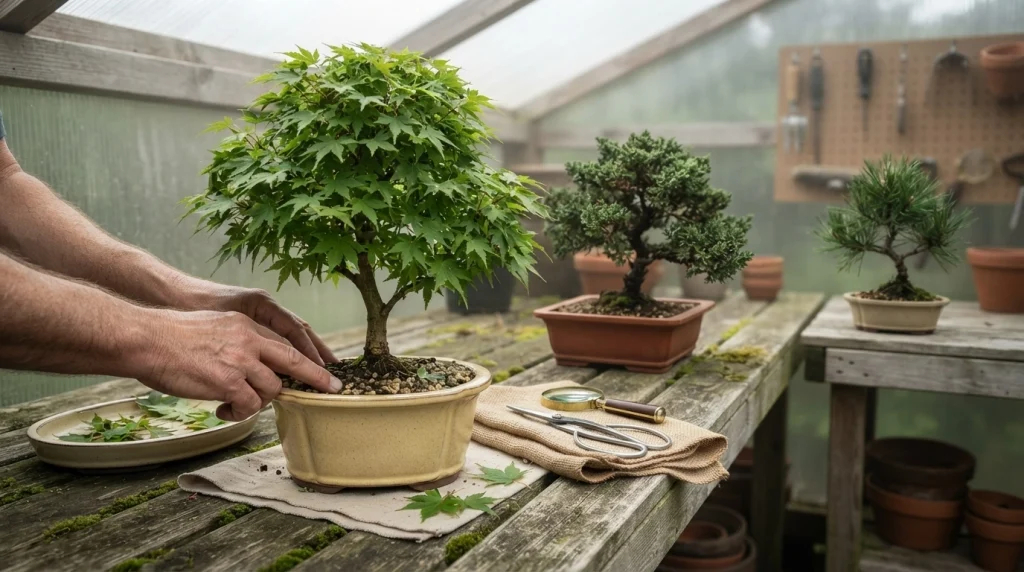
Prevention begins with steady care, clean working practices, and regular inspection. Healthy growing conditions reduce many disease risks, although even a vigorous bonsai can become infected.
Use a simple inspection routine
Check your bonsai whenever you water it and carry out a more detailed inspection weekly during active growth. Early changes are easier to investigate before widespread leaf loss or branch dieback develops.
- Foliage: Examine leaf surfaces, undersides, tips, and young shoots.
- Branches: Look for cankers, dead tips, unusual discoloration, and fungal growth.
- Trunk and roots: Check for soft areas, damaged bark, and visible root deterioration.
- Growing medium: Watch for persistent saturation, poor drainage, and decomposing debris.
- Nearby trees: Look for similar symptoms that might suggest a shared problem.
Improve watering, soil, and airflow
Water according to the tree’s needs rather than a rigid calendar. Species, pot size, soil composition, wind, sunlight, and seasonal conditions all affect how quickly a bonsai uses water.
Use a well-draining substrate suited to the species and climate. Keep drainage holes clear, remove fallen diseased foliage, and arrange trees so air can circulate around their canopies.
Watering at the soil surface can reduce unnecessary leaf wetness for susceptible species. Avoid keeping foliage wet for long periods when the tree is vulnerable to a leaf disease.
Keep tools clean and quarantine new trees
Contaminated tools and infected plant debris can help spread certain pathogens. Clean tools after working on suspicious tissue, remove debris from work surfaces, and use an appropriate disinfectant according to its directions.
Keep newly acquired bonsai separate from your collection while you inspect them for pests and disease. A quarantine period of roughly two weeks is a useful starting point, but extend it when symptoms or a particular pest’s life cycle warrant closer monitoring.
Avoid stressing the tree unnecessarily
A struggling bonsai needs stable care, not a series of drastic changes. Correct obvious environmental problems first and avoid combining major root work, heavy pruning, and aggressive treatment unless a clear need justifies them.
For species-specific advice, consult the Bonsai Empire guide to bonsai pests and diseases and the University of Minnesota Extension’s plant disease management guidance.
Section takeaway: Regular inspections, suitable watering, free-draining soil, clean tools, and thoughtful quarantine form the foundation of long-term bonsai disease prevention.
Frequently asked questions about treating bonsai diseases
Can a bonsai tree recover from a disease?
Yes, many bonsai recover when the cause is identified early and appropriate treatment is provided. Recovery depends on the disease, the species, and how much healthy foliage, trunk, and root tissue remains. Some advanced infections or severe root problems may be irreversible.
Should I remove all diseased leaves from my bonsai?
No. Remove clearly infected or dead leaves when appropriate, but don’t strip the tree of large amounts of foliage. Healthy leaves support recovery through photosynthesis, and excessive defoliation can further weaken an already stressed bonsai.
How often should I apply fungicide to a diseased bonsai?
Follow the product label for the specific disease, tree species, application rate, and repeat-treatment interval. There is no universal spraying schedule for all bonsai diseases. Some problems require cultural changes rather than chemicals, and fungicides may protect healthy tissue without curing existing damage.
Can overwatering cause bonsai root rot?
Overwatering and poor drainage can deprive roots of oxygen and contribute to root decline, while certain root pathogens can cause infectious rot. Check soil moisture, drainage, root condition, and species requirements before deciding which problem is present.
Can I treat bonsai diseases with neem oil?
Neem-based products are not universal disease treatments. Their permitted uses and effectiveness depend on the formulation and target organism, and some products can injure sensitive foliage under unsuitable conditions. Use a product only when its label supports the intended application.
Should I keep a diseased bonsai indoors?
Not necessarily. Many temperate bonsai need outdoor conditions and seasonal dormancy, while tropical species may require protection from cold. Isolate a potentially infectious tree without disregarding its species-specific light, temperature, and seasonal needs.
When should I ask a bonsai expert for help?
Seek help when the tree deteriorates rapidly, major branches die back, root rot appears extensive, or symptoms persist despite correcting care problems. Clear photographs, the species name, watering history, and recent treatment records can help a specialist narrow down the cause.
Final Takeaway
Learning how to treat bonsai diseases step by step comes down to one essential habit: identify the cause before choosing the treatment. Leaf spots, mildew, root rot, cankers, pests, and environmental stress can look similar but require different responses.
Start with careful inspection, isolate the tree if infection is suspected, correct watering and drainage, and remove affected material only when appropriate. Use targeted treatments safely, monitor new symptoms, and seek experienced help when the tree continues to decline.
With consistent observation and species-appropriate care, you can catch many problems early and give your bonsai a better chance of recovery.