Best Places to Buy Bonsai Trees Online (and What Each Is Good For)

As an Amazon Associate we earn from qualifying purchases. See our affiliate disclosure.
In this guide
- The Options at a Glance
- 1. Amazon: Best for a First Tree
- 2. Grower Websites: Best for Choice
- 3. Etsy and Small Growers: Best for the Unusual
- 4. Specialist Nurseries: Best for Specimens
- 5. Bonsai Clubs and Shows: Best for Advice
- 6. Garden Centres and Nursery Stock: Best for Raw Material
- Live Trees We Would Order From Amazon
- How to Buy a Bonsai Online Without Regret
- Frequently Asked Questions
- Final Verdict
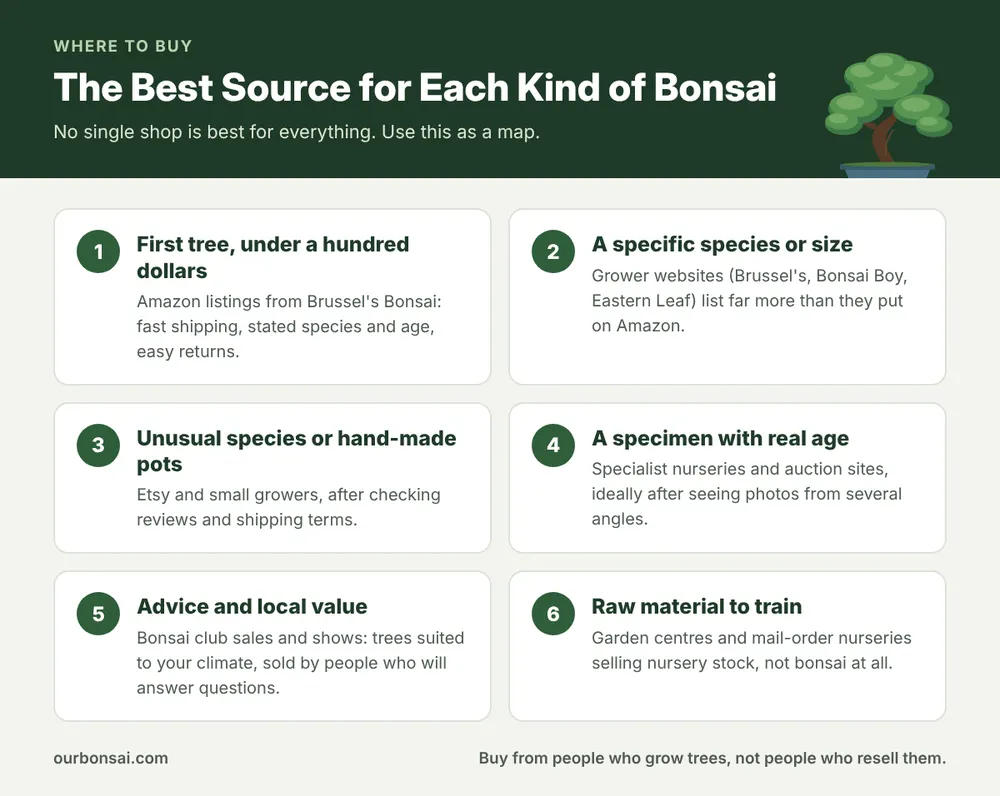
Quick answer: for a first bonsai, the best place to buy online is Amazon, as long as you buy a listing from a real nursery such as Brussel’s Bonsai: you get a named species, a stated age, fast shipping and simple returns. For a wider choice of species and sizes, go to the growers’ own websites. For specimen trees, use specialist nurseries and look for photographs from several angles. And if you can get to one, a bonsai club sale beats all of them for advice.
Buying a living tree you cannot see is a leap of faith, so the question is really about trust: who grows the tree, how honestly the listing describes it, and what happens if it arrives damaged. Below we compare the main online sources on those points, then list the live trees we would actually order from Amazon. Amazon listings were checked on November 1, 2026; stock and prices change. We have no commercial relationship with any of the nurseries named, apart from Amazon affiliate links.
The Options at a Glance
| Source | Best for | Strengths | Watch out for |
|---|---|---|---|
| Amazon (nursery sellers) | First trees, gifts | Fast shipping, stated species and age, easy returns | Resellers and artificial trees mixed into results |
| Grower websites | Specific species, sizes | Widest range, seasonal availability, care support | Shipping cost, longer lead times |
| Etsy and small growers | Unusual species, pots | Variety, hand-made pots, direct contact | Inconsistent quality, vague shipping terms |
| Specialist nurseries | Specimens, pre-bonsai | Real age, trained trees, expert sellers | High prices, one-of-a-kind stock sells fast |
| Bonsai clubs and shows | Advice, local climate | Trees suited to your area, sellers who teach | Not online, seasonal |
| Garden centres (nursery stock) | Raw material | Cheap, thick trunks | Not bonsai; years of work needed |
1. Amazon: Best for a First Tree
Amazon is where most people buy their first bonsai, and that is fine with one rule: filter by seller. Brussel’s Bonsai, the largest bonsai nursery in the United States, lists a core range on Amazon and ships from its own greenhouses in Mississippi. Every listing names the species, states the age and height, says whether the tree is for indoors or outdoors, and lists shipping restrictions. Love My Bonsai lists older specimen trees in the same way. Smaller sellers vary, and search results mix in artificial and “preserved” trees that are not alive, so read titles carefully.
The advantages are practical: fast shipping, a short guarantee window, and a returns process that does not depend on the goodwill of a tiny shop. The disadvantage is range. Brussel’s sells far more species and sizes on its own site than on Amazon. Our guide to the best live bonsai trees on Amazon covers the listings worth buying.
2. Grower Websites: Best for Choice
Brussel’s Bonsai, Bonsai Boy of New York and Eastern Leaf are the three mail-order growers most US hobbyists have bought from, and each sells a much deeper catalogue through its own website than through Amazon: more species, larger sizes, flowering and fruiting trees, and seasonal stock. Growers’ sites usually include care sheets for every species and will answer questions about a particular tree.
Expect to pay separately for shipping, to wait a little longer, and to accept a seasonal shipping policy: most growers will not ship tropical trees in freezing weather or temperate trees in high summer heat. That caution is a good sign, not a bad one.
3. Etsy and Small Growers: Best for the Unusual
Etsy is where you find things the big nurseries do not carry: unusual species, collected material, hand-made pots and accent plants. Many sellers are hobbyists with a surplus, and some are excellent. Treat it like buying from an individual: read recent reviews that mention live arrival, check how the seller packs trees, ask when they ship, and avoid listings that do not state the species or show the actual tree you will receive. Stock photos are a warning sign for live plants.
4. Specialist Nurseries: Best for Specimens
When you want a tree with real age, you are buying from specialist nurseries and bonsai dealers, either through their own sites, through auction platforms, or, as with Love My Bonsai, through Amazon. The important habits here are the same ones a collector would use in person: ask for photographs of the front, back and base, confirm the pot is included, find out when it was last repotted, and check the return policy, since live specimens are often excluded from standard returns. See our guide to the best premium bonsai trees for what to expect at this level.
5. Bonsai Clubs and Shows: Best for Advice
Not online, but worth a paragraph because it is the best way to buy a bonsai, full stop. Most regions have a bonsai society that holds an annual show with a sales area, and many clubs run member sales. You buy trees that already grow well in your climate, from people who will tell you how to keep them, and prices are usually lower than mail order because nobody is paying for shipping. The history of bonsai is a club tradition as much as a commercial one. If you are new, a show visit will also calibrate your eye for what a good tree looks like before you spend money online.
6. Garden Centres and Nursery Stock: Best for Raw Material
Experienced growers buy many of their trees as ordinary landscape plants: a five-gallon juniper, a boxwood, a trident maple seedling. These are not bonsai and will take years to become one, but the trunks are often thicker than anything sold as a starter bonsai, and the price is a fraction. Mail-order nurseries sell suitable young trees too. Our guide to the best trees to make bonsai from covers this route.
Live Trees We Would Order From Amazon
If Amazon is your choice, these are the listings we would start with. Each comes from a nursery that names the species and states the age.
Brussel’s Golden Gate Ficus, Small (Best First Tree)
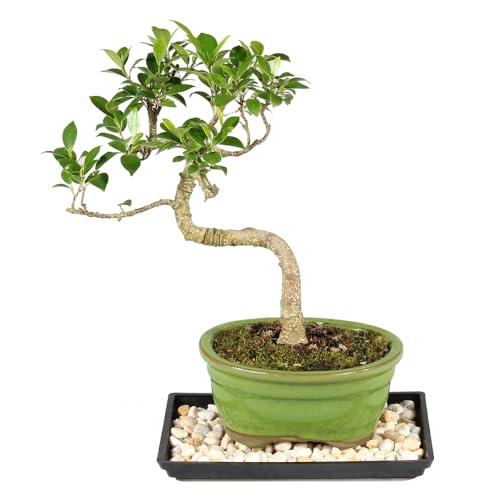
| Species | Ficus microcarpa |
|---|---|
| Age / height | 4 years, 5 to 8 in |
| Where it lives | Indoors |
| In the box | Ceramic pot, humidity tray |
The standard beginner bonsai: forgiving of indoor air, tolerant of missed waterings, quick to recover from pruning, and shipped ready to display. Our Golden Gate ficus review covers care.
Brussel’s Chinese Elm, Small (Best Outdoor Starter)

| Species | Ulmus parvifolia |
|---|---|
| Age / height | 5 years, 6 to 8 in |
| Where it lives | Outdoors; tolerates a cool bright room in winter |
The outdoor species most teachers recommend first, with tiny leaves and a fast response to pruning. See the Chinese elm care guide.
Brussel’s Dwarf Jade, Large (Easiest Care)

| Species | Portulacaria afra |
|---|---|
| Age / height | 6 years, 10 to 14 in |
| Where it lives | Indoors, sunny window |
A succulent that survives neglect, with a woody trunk at six years. The safest live tree to send as a gift. Our dwarf jade review has more.
Brussel’s Green Mound Juniper, Large (Classic Look)

| Species | Juniperus procumbens ‘Nana’ |
|---|---|
| Age / height | 7 years, 14 to 18 in |
| Where it lives | Outdoors only |
The picture-book bonsai at a good size. It must live outside; see our green mound juniper review.
Brussel’s Brazilian Rain Tree (Something Different)

| Species | Chloroleucon tortum |
|---|---|
| Age / height | 5 years, 10 to 14 in |
| Where it lives | Indoors in winter, sun outdoors in summer |
Leaves that fold at night and a trunk that fissures young. A good second tree for someone who already has a ficus.
Love My Bonsai 20-Year Mikawa Yatsubusa Japanese Maple (A Specimen From Amazon)

| Species | Acer palmatum ‘Mikawa Yatsubusa’ |
|---|---|
| Age / height | 20 years, about 24 in |
| Where it lives | Outdoors, deciduous |
Proof that Amazon is not only for starters: a twenty-year-old dwarf maple in a proper ceramic pot, from a specialist seller.
How to Buy a Bonsai Online Without Regret
Decide indoor or outdoor before you shop
Tropicals (ficus, jade, schefflera) live indoors; temperate trees (juniper, elm, maple, pine, azalea) live outdoors. Shops will sell you either; only you know where it will sit. Our guide to the most popular indoor bonsai trees helps.
Buy in the shipping season
Spring and early autumn are safest. Growers themselves recommend shipping when nights stay above 50°F along the route. If you must buy in winter, choose expedited shipping and be home to receive it.
Read what ships, not what is pictured
“Pot may vary” is standard. “Photo is representative” is standard for young trees and a red flag for expensive ones. For anything over a couple of hundred dollars, ask for photos of the exact tree.
Have the basics ready
A spot with the right light, a watering can and a willingness to leave the tree alone for two weeks after arrival. Our list of beginner mistakes covers the first month, and our picks under $100 are a sensible place to start.
Frequently Asked Questions
Is it better to buy a bonsai online or in a store?
In person is better if you have a bonsai nursery or club nearby, because you can see the tree and get advice. Online is fine when you buy from a grower that names the species and age and ships in the right season.
Is Amazon a good place to buy a bonsai tree?
Yes, if you buy from a nursery seller such as Brussel’s Bonsai or Love My Bonsai. Avoid vague listings and check that the tree is live rather than artificial or preserved.
What is the most reputable online bonsai nursery?
Brussel’s Bonsai is the largest in the US and ships widely. Bonsai Boy and Eastern Leaf are also long-established mail-order growers. Reputation matters less than whether the listing is honest about species, age and shipping.
Can bonsai trees be shipped safely?
Yes. Nurseries pack the pot and soil securely and trees typically arrive within a few days. Some leaf drop afterwards is normal. Extreme heat or cold during transit is the main risk.
Should I buy a bonsai from Etsy?
It can be a good source for unusual species and pots. Check recent reviews that mention live arrival, confirm the species, and avoid stock photos for live plants.
How much should a first bonsai cost?
Thirty to sixty dollars buys a healthy 3 to 5 year old tree from a nursery. Spend more only once you know you can keep a tree alive for a year.
Final Verdict
For a first tree, buy from a nursery seller on Amazon: the Brussel’s Golden Gate Ficus indoors or the Brussel’s Chinese Elm outdoors. For a specific species, go to the growers’ own sites. For a specimen, use a specialist and ask for photos. And whichever route you take, find your local bonsai club: it is the cheapest and best bonsai education there is.