Best Bonsai Trees Under $50: 9 Real Trees for Beginners

As an Amazon Associate we earn from qualifying purchases. See our affiliate disclosure.
In this guide
- Our Top Picks at a Glance
- 1. Brussel’s Dwarf Jade, Medium (Best Overall Value)
- 2. Brussel’s Ginseng Ficus, Small (Best Indoor Tree in a Pot)
- 3. Brussel’s Golden Gate Ficus, Small (Best for Beginners)
- 4. Brussel’s Chinese Elm, Small (Best Outdoor Tree)
- 5. Brussel’s Satsuki Azalea, Small (Best Flowering)
- 6. Brussel’s Trident Maple, Medium (Best for Learning Styling)
- 7. Brussel’s Green Mound Juniper, Small (Classic Look)
- 8. Brussel’s Hawaiian Umbrella in a Grower Pot (Best for Low Light)
- 9. My Shelfie Green Mound Juniper Starter (Cheapest Way to Start)
- Also Worth a Look
- How to Get the Most From a Cheap Bonsai
- Frequently Asked Questions
- Final Verdict
Quick answer: the best bonsai tree under $50 is the Brussel’s Medium Dwarf Jade: a 4-year-old, 8 to 12 inch indoor tree that is almost impossible to kill and costs less than most houseplants. If you want a more traditional-looking indoor tree, the Brussel’s Small Ginseng Ficus comes in a ceramic pot with a tray. For outdoors, the Brussel’s Small Chinese Elm is the best starter you can buy at this price.
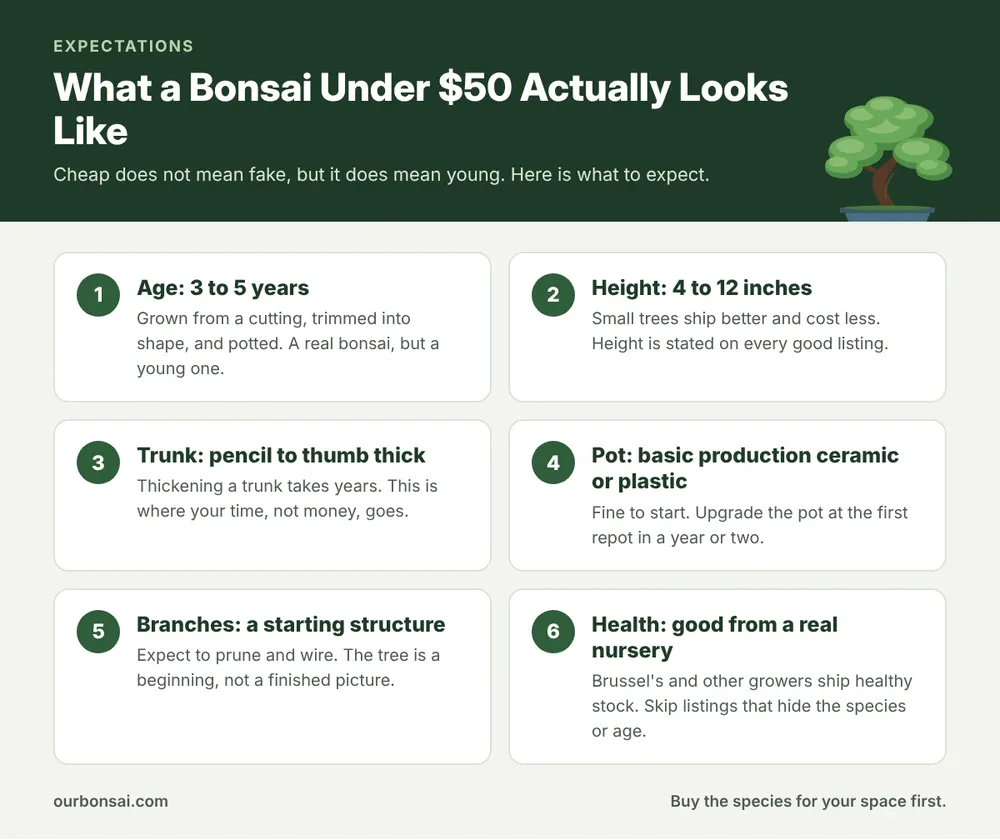
Fifty dollars is a sensible budget for a first bonsai, because the first bonsai is the one you learn on. At this price you get a healthy 3 to 5 year old tree from a real nursery, often already in a bonsai pot. You do not get a thick trunk or refined branching; that part is up to you, and it is the hobby. All nine trees below were under $50 on Amazon when we checked on November 1, 2026. Prices change, so confirm before ordering.
Our Top Picks at a Glance
| Tree | Indoor/Outdoor | Age and size (per listing) | Best for |
|---|---|---|---|
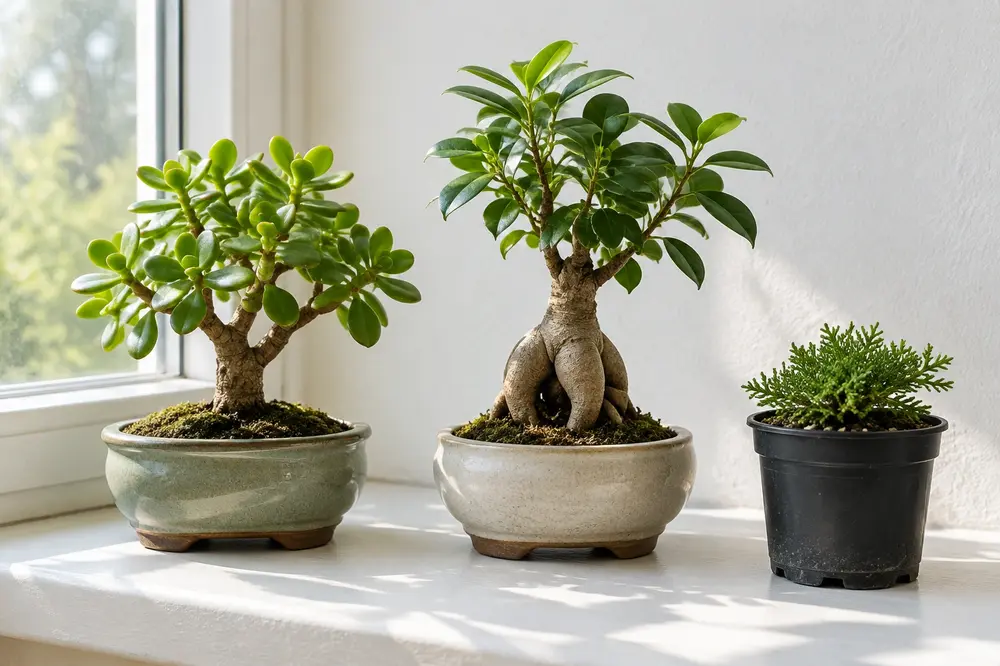
| Brussel’s Dwarf Jade (Medium) | Indoor | 4 yrs, 8-12 in | Best overall value |
| Brussel’s Ginseng Ficus (Small) | Indoor | 4 yrs, 6-8 in | Best indoor tree in a pot |
| Brussel’s Golden Gate Ficus (Small) | Indoor | 4 yrs, 5-8 in | Best for beginners |
| Brussel’s Chinese Elm (Small) | Outdoor | 5 yrs, 6-8 in | Best outdoor tree |
| Brussel’s Satsuki Azalea (Small) | Outdoor | 5 yrs, 5-8 in | Best flowering |
| Brussel’s Trident Maple (Medium) | Outdoor | 5 yrs, 8-12 in | Best for learning styling |
| Brussel’s Green Mound Juniper (Small) | Outdoor | 3 yrs, 4-6 in | Classic look |
| Brussel’s Hawaiian Umbrella, grower pot | Indoor | 5 yrs, 8-12 in | Best for low light |
| My Shelfie Green Mound Juniper starter | Outdoor | 2-inch pot | Cheapest way to start |
1. Brussel’s Dwarf Jade, Medium (Best Overall Value)

| Species | Portulacaria afra (dwarf jade) |
|---|---|
| Age / height | 4 years, 8 to 12 in |
| Where it lives | Indoors, bright window |
| In the box | Bonsai pot, care instructions |
| Grown in | Mississippi, USA |
This is the tree we would hand to anyone who says they kill plants. Dwarf jade is a succulent: it stores water in its leaves, so a missed week does nothing to it, and it grows quickly enough in good light that you can practise pruning within months. Brussel’s medium size arrives at 8 to 12 inches, which is a lot of tree for the money.
The one rule is not to overwater. Let the soil dry fully between waterings and never leave the pot standing in water. Our dwarf jade bonsai review has the full routine.
Pros
- Very hard to kill
- Largest tree on this list for the price
- Grows fast, so pruning gives quick results
Cons
- Needs strong light to stay compact
- Soft branches do not hold wire well
Best for: first-time owners and anyone who forgets to water.
2. Brussel’s Ginseng Ficus, Small (Best Indoor Tree in a Pot)

| Species | Ficus microcarpa, ginseng form, grafted |
|---|---|
| Age / height | 4 years, 6 to 8 in |
| Where it lives | Indoors, bright light |
| In the box | Ceramic pot, humidity tray, care guide |
The ginseng ficus gives you the thickest trunk you will find under $50, because the swollen root base is grown that way before the small-leaf top is grafted on. Brussel’s version is four years old, 6 to 8 inches tall, and arrives in a ceramic pot with a humidity tray.
Care is simple: bright light, water when the top of the soil is dry, and keep it away from cold draughts and heating vents. Some leaf drop in the first fortnight is normal while it adjusts.
Pros
- Thick trunk for the price
- Ceramic pot and tray included
- Easy ficus care
Cons
- The bulbous look divides opinion
- Graft unions may be visible
Best for: people who want a substantial-looking desk tree now.
3. Brussel’s Golden Gate Ficus, Small (Best for Beginners)
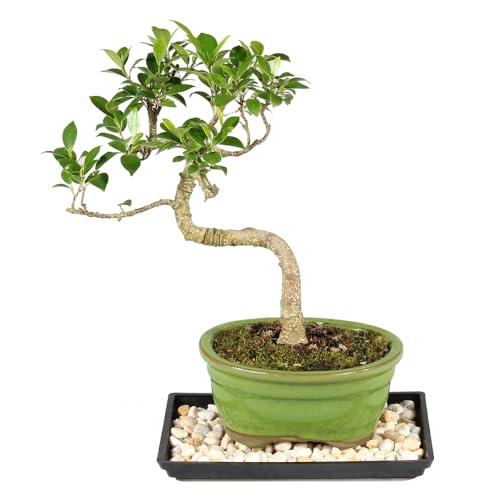
| Species | Ficus microcarpa (Golden Gate) |
|---|---|
| Age / height | 4 years, 5 to 8 in |
| Where it lives | Indoors, bright light |
| In the box | Ceramic pot, humidity tray |
If you would rather have a traditional trunk than a bulbous one, the Golden Gate ficus is the better buy. It has a twisting trunk, small dark leaves, and the same forgiving nature as every Ficus microcarpa: it back-buds after pruning, tolerates dry indoor air and recovers from most mistakes.
It sat just over the line on some days we checked, so watch the price. See our full Golden Gate ficus review.
Pros
- The standard beginner bonsai for good reason
- Pot and tray included
- Responds well to pruning
Cons
- Price hovers near the limit
- Small at 5 to 8 inches
Best for: beginners who want a classic-looking indoor tree.
4. Brussel’s Chinese Elm, Small (Best Outdoor Tree)

| Species | Ulmus parvifolia |
|---|---|
| Age / height | 5 years, 6 to 8 in |
| Where it lives | Outdoors; tolerates a cool bright room in winter |
| In the box | Ceramic pot, care guide |
Chinese elm is the species most experienced growers recommend as a first outdoor bonsai. Its leaves are tiny, it branches finely, it heals cuts fast and it is more tolerant of being brought indoors for short spells than juniper. Five years old at this price is good value.
Our Chinese elm care guide covers watering, light and the autumn leaf drop that worries new owners every year.
Pros
- Excellent response to pruning
- Five years old
- More flexible on placement than juniper
Cons
- Needs to be outside most of the year
- Loses leaves in autumn
Best for: anyone with a balcony or garden who wants to learn pruning.
5. Brussel’s Satsuki Azalea, Small (Best Flowering)

| Species | Rhododendron indicum (satsuki) |
|---|---|
| Age / height | 5 years, 5 to 8 in |
| Where it lives | Outdoors, afternoon shade in summer |
The only tree under $50 that will cover itself in flowers. Satsuki azaleas bloom in late spring and have naturally fine, dense branching. They need acidic, free-draining soil and consistent moisture, and they dislike hard tap water, so they take a little more attention than a ficus or elm.
If you are happy to learn one or two extra rules, the reward is worth it. Start with our satsuki azalea review.
Pros
- Spectacular spring flowers
- Fine branching from the start
Cons
- Fussier about soil and water
- Outdoor only
Best for: growers who want colour and will read the care sheet.
6. Brussel’s Trident Maple, Medium (Best for Learning Styling)

| Species | Acer buergerianum |
|---|---|
| Age / height | 5 years, 8 to 12 in |
| Where it lives | Outdoors; needs winter dormancy |
Trident maple is the species bonsai teachers use to demonstrate technique, because it does everything quickly: trunks thicken, wounds heal, buds appear on old wood and the surface roots spread into a wide base. At 8 to 12 inches and five years old, this is the most tree you can get for styling practice under $50.
It drops its leaves in autumn and must spend winter outdoors or in an unheated shelter. Our trident maple review explains the seasonal routine.
Pros
- Fastest species here to develop
- Great autumn colour
- Medium size at a small price
Cons
- Bare in winter
- Needs cold dormancy
- Leaves can scorch in hot sun
Best for: hobbyists who want to prune, wire and develop a tree.
7. Brussel’s Green Mound Juniper, Small (Classic Look)

| Species | Juniperus procumbens ‘Nana’ |
|---|---|
| Age / height | 3 years, 4 to 6 in |
| Where it lives | Outdoors only |
| Ships to | Not CA, AK or HI |
This is the smallest and youngest Brussel’s tree on the list, but it is the one that looks most like the bonsai in people’s heads. Green mound juniper is hardy, wires easily and forms the classic foliage pads with a little pinching.
It will not survive indoors. Keep it on a sunny patio or balcony all year, protect it from hard freezes, and it will do well. Read our green mound juniper review first.
Pros
- The traditional bonsai appearance
- Hardy and easy to wire
Cons
- Only 4 to 6 inches
- Dies slowly indoors
- Shipping restrictions
Best for: outdoor growers who want the classic image on a budget.
8. Brussel’s Hawaiian Umbrella in a Grower Pot (Best for Low Light)

| Species | Schefflera arboricola (dwarf) |
|---|---|
| Age / height | 5 years, 8 to 12 in |
| Where it lives | Indoors, tolerates lower light |
| In the box | Plastic grower pot, soil, care sheet |
Hawaiian umbrella is the bonsai for rooms without a sunny window. It tolerates ordinary indoor light better than any other species here and is very forgiving of watering. This listing ships a 5-year-old tree in a plain plastic grower pot, which is why it is so cheap.
Plan to buy a bonsai pot and repot in spring. Schefflera cannot be wired in the normal way, so shaping is done by pruning. Our Hawaiian umbrella review covers it.
Pros
- Copes with low light
- Five years old at a starter price
- Forgiving of watering
Cons
- Plain grower pot
- Cannot be wired
Best for: offices and darker rooms.
9. My Shelfie Green Mound Juniper Starter (Cheapest Way to Start)

| Species | Juniperus procumbens ‘Nana’ |
|---|---|
| Size | 2-inch nursery pot |
| Where it lives | Outdoors |
| Use | Pre-bonsai material or ground cover |
This is not a bonsai yet. It is a healthy young juniper in a two-inch nursery pot, the kind of material hobbyists buy to grow their own bonsai from the ground up. If you want to learn wiring and pruning without worrying about ruining a finished tree, two or three of these are a cheap classroom.
Pot it up into a slightly larger container with gritty soil, let it grow for a season, then start styling. Our guide to wiring bonsai branches is a good next read.
Pros
- Very cheap
- Ideal practice material
- Hardy outdoors
Cons
- Not a trained bonsai
- Years from looking like one
Best for: people who want to grow a bonsai rather than buy one.
Also Worth a Look
- Arcadia Garden Products Ginseng Ficus, 6 in grower pot: a greenhouse-grown ginseng ficus in a plastic pot, a good budget alternative to the Brussel’s version if you already have a pot.
- GingerGlow Dwarf Jade in a 4 in pot: raw Portulacaria afra material to train yourself, usually cheaper than a shaped tree.
- Brussel’s Medium Satsuki Azalea: a slightly larger azalea that dipped under the limit when we checked.
How to Get the Most From a Cheap Bonsai
Put it in the right place on day one
Indoor species (ficus, jade, schefflera) go in the brightest window you have. Outdoor species (elm, juniper, maple, azalea) go outside, full stop. This decision alone accounts for most early failures. If you are unsure how much light your room gets, see how much light a bonsai needs.
Do nothing for two weeks
No pruning, no repotting, no fertiliser. Water when the soil surface dries and let the tree recover from shipping.
Learn watering before anything else
Check the soil with a finger every day. Water thoroughly when the top is dry, until it runs from the drainage holes, and then wait again. Our guide to watering bonsai in summer explains why a fixed schedule does not work.
Upgrade the pot later, not now
Production pots are fine for the first year. Repot in spring once you know the tree is settled, into a pot that suits it. That is also the time to improve the soil, which on budget trees is often heavier than ideal; see bonsai soil vs regular soil.
Ready to spend a little more? Our guide to the best bonsai trees under $100 covers older, larger trees.
Frequently Asked Questions
Can you buy a real bonsai for under $50?
Yes. Brussel’s Bonsai sells 3 to 5 year old trees of several species below that price, many already in a ceramic pot. They are young trees, not specimens.
What is the best cheap bonsai for beginners?
Indoors, a dwarf jade or a ficus. Outdoors, a Chinese elm. All three forgive the usual beginner mistakes.
Are $20 bonsai trees worth it?
At that price you are usually buying a rooted cutting or a seedling in a nursery pot rather than a trained tree. They are fine as practice material if you know that going in.
Why do cheap juniper bonsai die?
Almost always because they were kept indoors. Juniper needs outdoor sun and a cold winter. Keep it outside and it is one of the hardiest bonsai there is.
Do I need to buy soil and a pot as well?
Not immediately. Most Brussel’s trees arrive potted. Plan to repot into better soil and a nicer pot in a year or two.
How long until a cheap bonsai looks impressive?
With regular pruning and good light, a dwarf jade or trident maple changes noticeably within a year. Thick trunks take many years regardless of what you paid.
Final Verdict
Buy the Brussel’s Medium Dwarf Jade if you want the safest, biggest tree for the money, the Brussel’s Small Ginseng Ficus if you want a potted indoor tree that looks the part, and the Brussel’s Small Chinese Elm if the tree will live outside. Then spend the money you saved on a good pair of bonsai scissors.