Can You Prune Bonsai in Winter? What to Cut and When

Can you prune bonsai in winter? Yes, and for deciduous trees late winter is the best time of year for structural pruning: cut 2 to 4 weeks before the buds begin to swell, on a day above freezing, when the bare branches are easy to see and the tree is about to grow and close the wounds. The exceptions matter, though. Maples bleed sap from big cuts as spring approaches, pines and junipers are better worked in late autumn or spring, and no tree should be cut while its wood is frozen below 0 C (32 F).
In this guide
Why winter works for structural pruning
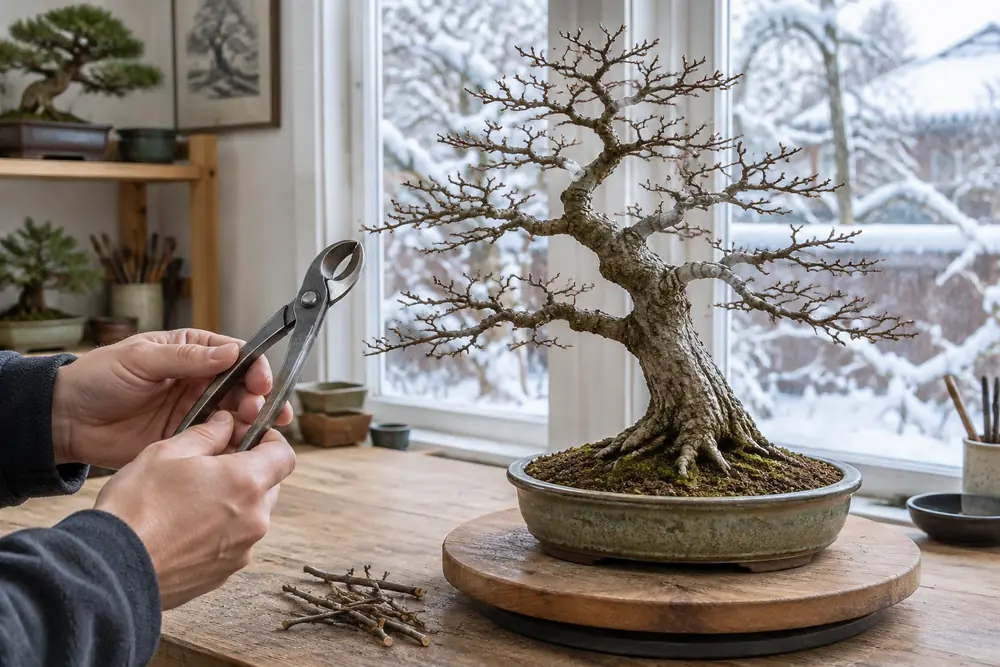
With the leaves gone, an elm or hornbeam shows its whole skeleton. Bar branches (two branches leaving the trunk at the same height), crossing limbs, branches growing straight up or down, and thick sections in the wrong place are all obvious. In summer you would be guessing through a canopy.
Timing also helps healing. The tree has stored its sugars in the trunk and roots over autumn. If you prune just before spring, that energy goes straight into new shoots and into the callus that rolls over each cut. A cut made in early December sits open for three months with no growth to seal it, which is why growers who prune deciduous trees in winter tend to do it in the last few weeks of dormancy.
For background on how timing changes through the year, see when to prune deciduous bonsai.
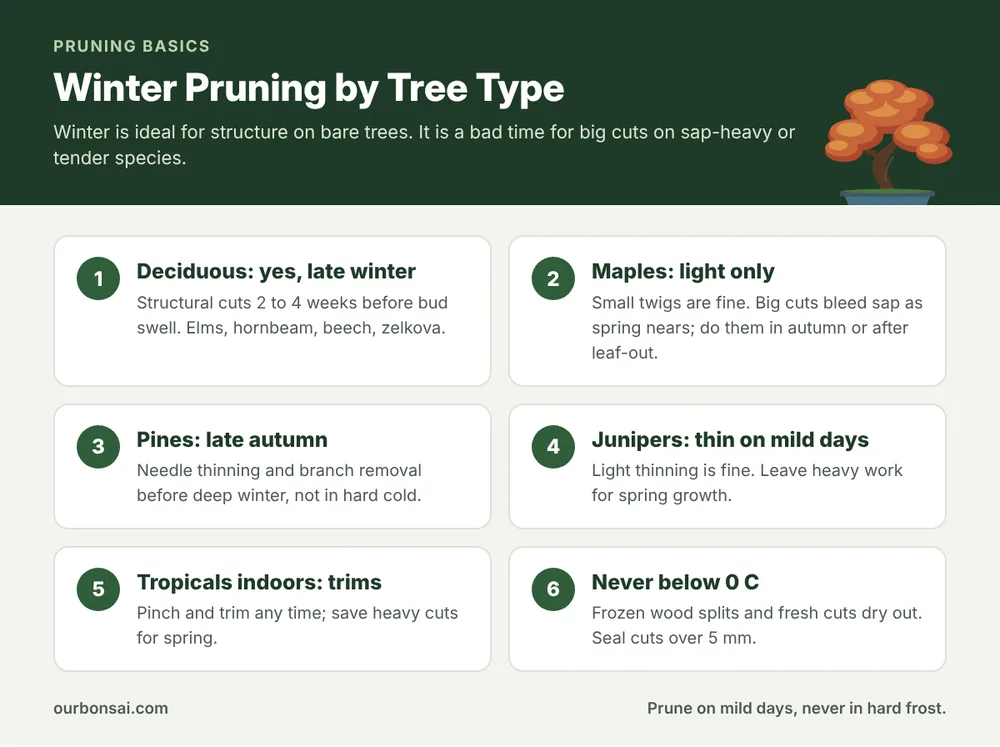
Species-by-species winter pruning guide
| Tree | Winter pruning? | Best window | Notes |
|---|---|---|---|
| Chinese elm, zelkova | Yes | Late winter | Cuts close fast; good for trunk chops |
| Hornbeam, beech | Yes | Late winter | Leave a short stub on beech, it dies back |
| Trident maple | Light | Late winter, small cuts | Heavy cuts better after leaves harden |
| Japanese maple | Light | Twigs only | Large cuts bleed sap as buds swell |
| Larch, ginkgo | Yes | Late winter | Ginkgo heals slowly; avoid big wounds |
| Japanese black pine | Not deep winter | Late autumn | Needle plucking and branch selection in Oct to Nov |
| Juniper | Light | Mild days | Thin only; heavy work in spring |
| Ficus, jade, schefflera indoors | Light trims | Any time | Heavy cuts in spring when growth is strong |
What you can cut in winter, and what to leave
Good winter jobs on deciduous trees:
- Removing one of each pair of bar branches.
- Cutting back long, thick branches to a smaller side shoot (this keeps taper).
- Taking out crossing branches and branches that point toward the front viewer.
- Shortening twigs so each ends in two buds pointing outward.
- Cutting dead wood out completely.
Leave these for another season:
- Major trunk chops on maples and other heavy bleeders.
- Cutting all the foliage off a pine or juniper. Evergreens need their needles to feed the tree through winter.
- Pruning a tree that was repotted in the same season and is already weakened.
- Any work on a tree you suspect has root damage from frost. Wait until it leafs out.
How to make clean winter cuts
- Pick a mild day. Above about 2 to 4 C (36 to 39 F), dry, with no hard frost forecast for a few days.
- Use sharp tools. A concave cutter leaves a slightly hollow wound that heals flat. For branches over 1 cm, a fine pruning saw is cleaner. Our concave cutter review covers what to look for.
- Cut in stages on thick branches. Remove most of the branch first, then make the final cut flush or slightly concave.
- Seal cuts over about 5 mm. A bonsai cut paste stops the edges drying out in cold wind. If you do not have one, see our cut paste alternatives.
- Keep the tree sheltered afterward. Put it back in the cold frame or sheltered spot so fresh cuts are not hit by drying wind.
Can you prune bonsai in winter if it lives indoors?
Tropical bonsai like ficus, Fukien tea and schefflera are not dormant indoors, but they grow slowly in winter light. Light maintenance pruning is fine: trim shoots back to two or three leaves once they have five or six. Hold back on heavy structural cuts, defoliation and root work until spring, when the tree has enough light to recover quickly. If your indoor tree has gone leggy over winter, that is a light problem, not a pruning problem. More light will tighten the growth; pruning alone will not.
Mistakes that cost branches
- Pruning in hard frost. Frozen wood can split along the grain and the cut dries out before it heals.
- Cutting flush on beech or hornbeam. Leave a short stub that you remove once the tree is growing.
- Removing too much at once. A good rule is no more than about a third of the branch mass in one session.
- Forgetting the roots. If you plan to repot in spring, go lighter on top pruning so the tree is not hit twice.
- Big maple cuts in late winter. Sap pressure rises before buds open and a large wound can weep for days.
Frequently asked questions
Is it better to prune bonsai in winter or spring?
For structural pruning of deciduous trees, late winter just before buds open is usually best. For shaping new shoots, pinching and maintenance, spring and summer are better. Pines are an exception: much of their work is done in summer and autumn.
Can I prune my juniper bonsai in winter?
Lightly. Thinning out a few crowded shoots on a mild day is fine. Heavy pruning, especially into old wood with no green, should wait for spring growth. Junipers do not back-bud well from bare wood at any time of year.
What happens if I prune a bonsai too early in winter?
Cuts made in December stay open for months. Edges can dry back and branches may die back to the next bud. It is not usually fatal on vigorous species like elm, but it is wasted healing time.
Should I use cut paste on winter pruning cuts?
On cuts larger than about 5 mm, yes. Cold, dry wind pulls moisture from the wound edges. Paste keeps them moist so the callus can form when growth starts.
Final thoughts
So, winter pruning is not only allowed, it is the best structural pruning window for most deciduous bonsai. Wait for the last weeks of dormancy, pick a mild day, and know which species to leave alone. For the bigger picture on timing, our guide on when to start pruning bonsai helps, and Clemson Extension’s tree pruning factsheet explains why late-winter cuts heal fastest on full-size trees too.