Fertilize Bonsai Winter Guide: When to Feed and When to Stop

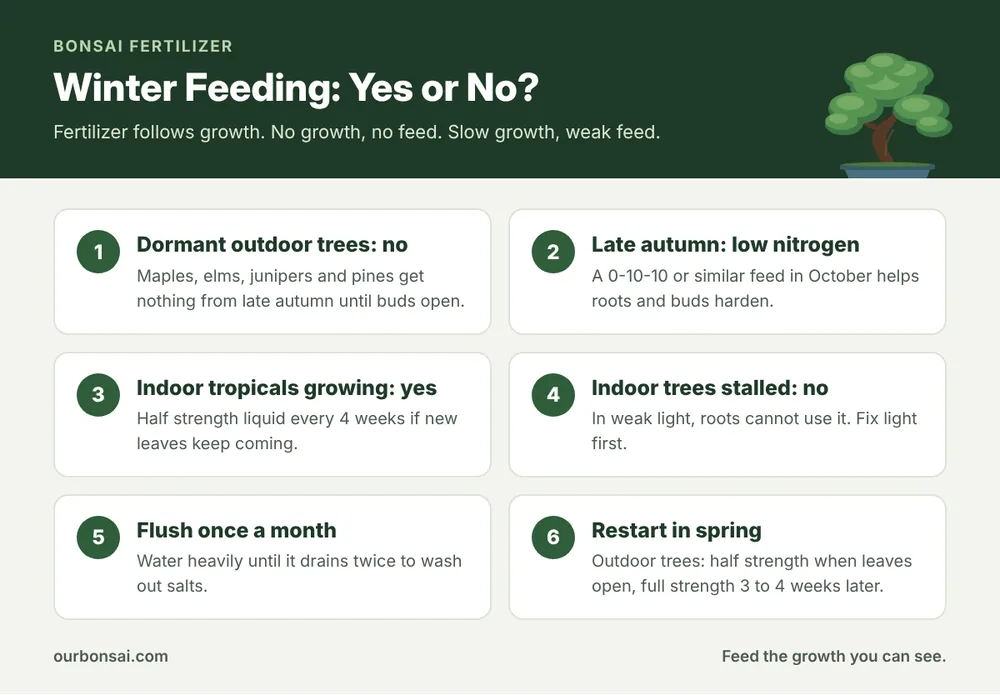
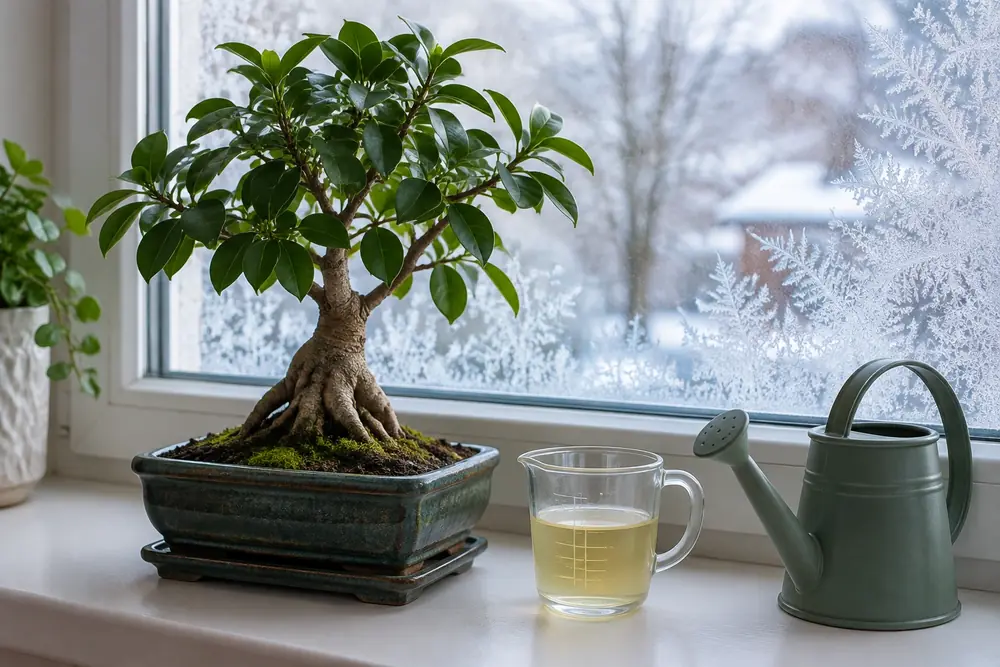
Should you fertilize bonsai winter months? For dormant outdoor trees like maple, elm, juniper and pine, no: stop feeding by late autumn and restart only when the buds open in spring. For indoor tropical bonsai such as ficus, jade or schefflera, the answer depends on growth. If the tree is still putting out new leaves under good light, feed at half strength every 4 weeks. If it has stalled on a dim windowsill, do not feed until it starts growing again.
In this guide
Why dormant trees should not be fed
Fertilizer is not food in the way people think. A tree makes its own sugars from light. Fertilizer supplies mineral nutrients like nitrogen, phosphorus and potassium that roots take up along with water, and that uptake depends on active roots and active growth.
In winter, a dormant maple has no leaves, very little root activity, and cold soil. Nutrients you add just sit in the pot. Rain and watering leach some away; the rest builds up as dissolved salts. In the shallow soil of a bonsai pot, a buildup of salts can burn the fine root tips that the tree needs for its first spring growth. So winter feeding of dormant trees has no benefit and a real risk.
There is a second reason. Nitrogen pushes soft new growth. A warm spell in a fed tree can trigger shoots that the next frost kills.
Late autumn: the last feed of the year
Many growers give one or two low-nitrogen, higher-potassium feeds in early to mid autumn, after the summer feeding program ends. Fertilizers labeled something like 0-10-10 or 3-12-12 are common for this. The idea is to support root growth and bud formation without pushing new shoots. Stop completely once the leaves color and drop, usually by late October or November.
Our comparison of pellet vs liquid bonsai fertilizer explains which type suits autumn, because organic pellets keep releasing nutrients for weeks after you put them on. Remove leftover pellets from the soil surface of outdoor trees by the end of autumn.
How to fertilize bonsai winter indoors
Indoor trees are a different story. A ficus in a heated room at 20 C under a grow light is not dormant. It is growing, just more slowly than in summer.
Use this simple test: has the tree produced new leaves in the last 4 weeks? If yes, feed. If no, do not.
When you do feed:
- Use a balanced liquid fertilizer such as 10-10-10 or a bonsai-specific liquid.
- Dilute to half the label rate. Lower light means slower uptake.
- Water the tree first with plain water so the roots are moist. Fertilizer on dry roots can burn.
- Feed every 4 weeks, not every 1 to 2 weeks as in summer.
- Flush monthly. Water heavily, wait 10 minutes, and water heavily again so excess salts run out the drainage holes.
Our pick list of the best liquid fertilizer for bonsai covers products that dilute easily.
Winter feeding by species
| Tree | Winter feeding | Restart |
|---|---|---|
| Japanese maple, trident maple | None | Half strength as leaves unfold |
| Chinese elm outdoors | None | When buds open |
| Chinese elm kept indoors | Half strength monthly if growing | Full strength in spring |
| Juniper, pine | None | When new growth starts, usually April |
| Ficus, schefflera | Half strength every 4 weeks if growing | Full program in spring |
| Jade | None or one very weak feed | Late spring |
| Fukien tea | Half strength every 4 to 6 weeks if growing | Spring |
| Bougainvillea, pomegranate (cool rest) | None | Spring |
Signs you have overfed in winter
- White crust on the soil surface or the pot rim.
- Brown, crispy leaf edges on indoor trees, starting with older leaves.
- Sudden wilting even though the soil is damp.
- Long, weak, pale shoots in low light (nitrogen without enough light).
If you see these, stop feeding and flush the soil with plenty of plain water, letting it drain fully. Brown tips will not turn green again, but new leaves should come in clean. For more on reading leaf color, our guide to bonsai leaves turning light green and brown helps tell feeding problems from watering problems.
What about trees in a mild climate?
If you live somewhere winters stay above freezing most nights, such as USDA zone 9 or 10, many outdoor trees never fully stop. Olives, bougainvillea and pomegranate may keep a few green leaves and grow a little on warm weeks. In that case, use the same test as for indoor trees. If you see new shoots, give a weak, balanced feed once a month. If nothing has moved for several weeks, hold off. Hardy temperate species like Japanese maple still need their rest even in a mild area, so leave them unfed until spring whatever the weather does.
Water quality matters more in winter too. Hard tap water adds its own minerals, and with less rain to flush the pots those minerals build up. Using rainwater where you can, or flushing once a month, keeps the soil clean.
When to start feeding again in spring
For outdoor trees, wait until the buds have opened and the first leaves are unfolding. Start at half strength for the first 2 to 3 weeks, then move to full strength. Feeding a tree that was repotted in late winter should wait a further 4 to 6 weeks, because cut roots are easy to burn.
Pines and junipers wake later than deciduous trees. Start them when the new shoots (candles on pines) begin to extend.
Frequently asked questions
Can I put fertilizer pellets on my bonsai in winter?
Not on dormant outdoor trees. Organic pellets release slowly as they are watered and warmed, so they can feed at the wrong time. Put them on in spring after growth starts.
Should I fertilize a bonsai I just got as a winter gift?
Not right away. A new tree has already been moved, often from a warm shop into a different home. Let it settle for 3 to 4 weeks, check what species it is, and then follow the indoor or outdoor rule above.
Does Miracle-Gro work for indoor bonsai in winter?
A general houseplant feed works if you dilute it to half strength or weaker and use it only on actively growing trees. See our notes on Miracle-Gro fertilizer for bonsai trees for the details.
Is it bad to fertilize a bonsai in December?
For outdoor dormant trees, yes, it is wasted at best and harmful at worst. For an indoor ficus still growing under a grow light, one half-strength feed in December is fine.
Final thoughts
The rule is easy to remember: feed the growth you can see. Outdoor trees asleep in the cold get nothing until spring. Indoor trees get a little if, and only if, they are still growing. For the full year round program, see our guide to the best bonsai plant food, and for the basics of how plant nutrients work, the Wikipedia article on fertilizer is a clear starting point.