Cold Frame Bonsai Shelter: How to Build One for Winter

This post contains affiliate links. As an Amazon Associate, OurBonsai earns from qualifying purchases at no extra cost to you. Read our disclosure.
In this guide
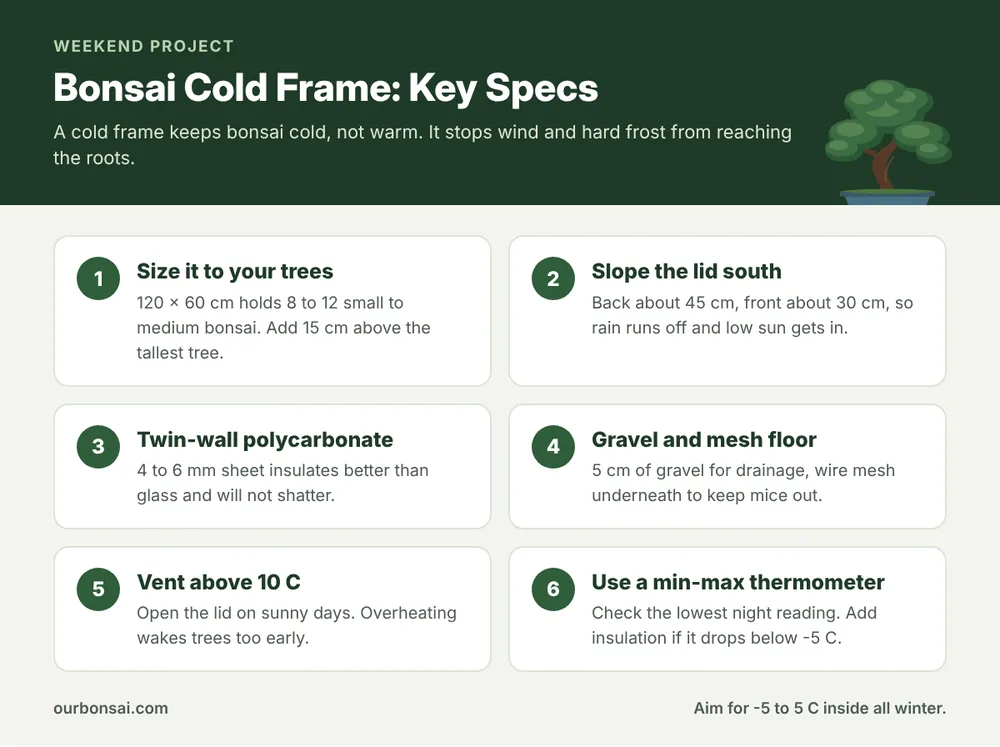
A cold frame bonsai shelter is a low, bottomless box with a clear sloping lid that keeps pots out of wind and hard frost while the trees stay cold and dormant. A frame about 120 cm long and 60 cm deep, 45 cm high at the back and 30 cm at the front, holds 8 to 12 small or medium bonsai and can be built in an afternoon from untreated timber and a 4 to 6 mm twin-wall polycarbonate sheet. The goal inside is roughly -5 to 5 C (23 to 41 F) through winter: cold enough for dormancy, never cold enough to freeze the root balls solid.
Why bonsai need a cold frame at all
A maple or juniper growing in the ground has tons of soil around its roots. The same species in a 5 cm deep bonsai pot has almost none. Branches of a hardy tree can survive -20 C, but roots are far less hardy, and many growers treat about -5 C as the point where pot-grown trees need help. Wind makes it worse, because it dries evergreen foliage while the frozen roots cannot replace the water.
A cold frame solves both problems. It blocks the wind, traps a little ground heat, and slows down temperature swings. Unlike a heated greenhouse, it does not warm the trees enough to break dormancy, which is what hardy species need to grow well the following spring.
Materials list
- Timber: untreated pine, cedar or larch boards, 2 cm thick and 15 to 20 cm wide. Avoid creosote and older treated wood that can leach chemicals into the pots.
- Lid: one sheet of twin-wall polycarbonate, 4 to 6 mm, cut to about 125 x 65 cm so it overhangs slightly. Old glass windows work too, but they are heavy and break.
- Lid frame: 4 battens about 3 x 4 cm.
- Hinges: two strong T-hinges for the back edge.
- Prop stick or a notched batten to hold the lid open at different heights.
- Galvanized wire mesh (hardware cloth), 6 to 12 mm, for the floor.
- Gravel about 5 cm deep, plus bark mulch.
- A min-max thermometer. This is the one item that makes the frame safe to use.
- Screws, a saw, a drill and outdoor wood stain if you want it to last longer.
Step-by-step build
- Pick the spot. A sheltered position facing south (north in the Southern Hemisphere), close to the house wall if possible. A wall adds a little warmth and blocks wind.
- Cut the sides. Back panel 120 cm long and 45 cm high. Front panel 120 cm by 30 cm. Two side panels 60 cm long, cut on a slope from 45 cm down to 30 cm.
- Screw the box together with small corner posts inside each corner for strength. Check it sits level.
- Lay the mesh on the ground under the frame and fold it 10 cm up the inside walls. Mice love dormant bark in winter.
- Add gravel, about 5 cm. Pots sit on the gravel so water drains away and roots never stand in a puddle.
- Build the lid frame from the battens, fix the polycarbonate with washers and screws, and leave the flutes running downhill so condensation drains.
- Hinge the lid to the back panel and fit a prop or notched stay.
- Hang the thermometer inside at pot height, out of direct sun.
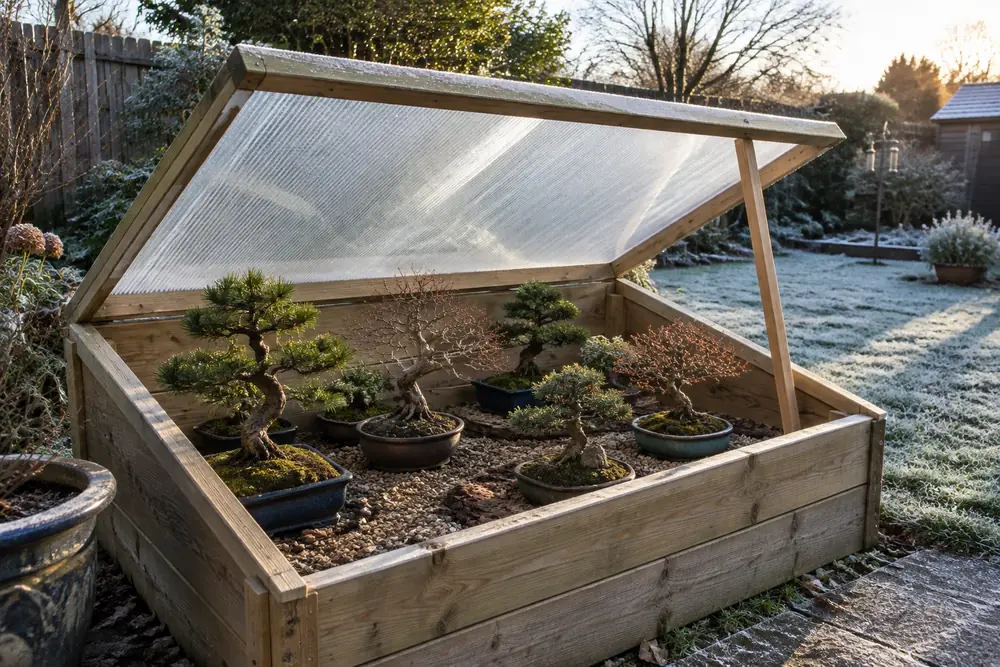
Placing trees inside a cold frame bonsai shelter
Put the tallest trees at the back and the smallest at the front, so all of them catch the low winter sun through the lid. Leave a hand’s width between pots for air movement. Packing them tight invites gray mold on fallen leaves.
For extra protection, fill the spaces between the pots with bark chips or perlite up to the rim. This mulch works like the soil around a tree in the ground and cuts temperature swings in the root ball. Our article on types of outdoor bonsai trees can help you decide which species need the frame first.
| Species group | Needs the frame from | Notes |
|---|---|---|
| Trident maple, Japanese maple | About -2 to -5 C | Roots are tender; shelter early |
| Japanese black pine, juniper | About -5 to -10 C | Need light, so a clear lid suits them |
| Chinese elm, hornbeam, beech | About -5 to -10 C | Beech often keeps dry leaves; that is normal |
| Larch, hawthorn, native species | Below about -10 C | Very hardy, but small pots still freeze |
Tropical species such as ficus, jade and Fukien tea do not belong in a cold frame at all. They stay inside the house. See our guide on how to care for a bonsai tree inside.
Venting: the rule most people get wrong
On a sunny day a closed frame can reach 20 C or more even when the air outside is near freezing. That is the main risk. Buds swell, sap moves, and the next frosty night damages the soft tissue.
- Open the lid a few centimeters whenever the inside reaches about 10 C (50 F).
- Open it fully on mild days above 8 C outside.
- Close it in the late afternoon before the temperature drops.
- On grey, cold days, leave it shut.
If you cannot check the frame daily, a cheap automatic vent opener (the wax-cylinder kind sold for greenhouses) does the job. You can find them by searching greenhouse automatic vent opener.
Watering and checks through the winter
Trees in a cold frame dry out slowly, and rain does not reach them. Check once or twice a week by pushing a chopstick into the soil. Water when the top 2 to 3 cm is dry, in the morning, on a day above freezing. Conifers in winter sun dry faster than bare deciduous trees, so check them first.
Once a week, look for:
- Gray fuzzy mold on fallen leaves or moss. Remove dead leaves promptly.
- Gnawed bark at the base of trunks (rodents).
- Water pooling on the gravel. Improve drainage if it stays.
- The overnight low on the thermometer. If it went below about -8 C, drape horticultural fleece or old blankets over the lid at night.
Our winter watering guide for indoor trees is for tropical species, but the “check, don’t count days” method applies here too.
Cheap alternatives if you cannot build one
- Unheated garage or shed with a window. Fine for leafless deciduous trees. Conifers need light.
- Sink pots in a garden bed up to the rim and mulch over the surface.
- A plastic mini-greenhouse with zip doors works in mild areas, but it overheats fast and gives little frost protection.
- Styrofoam boxes with the tree’s pot packed in bark: good for one or two small trees on a balcony.
Frequently asked questions
Does a cold frame need heating?
No. Heating defeats the purpose. The frame only has to keep roots above about -5 C. In very cold regions (USDA zone 5 and colder), some growers add a soil heating cable set to just above freezing, but most people in milder zones never need it.
When should bonsai go into the cold frame?
After the first few light frosts have hardened the trees, usually late November or December in temperate climates. Bring them out again in spring once nights stay above about 0 C and buds are opening.
Can I use a cold frame for repotted trees?
Yes, and it is one of the best uses. Trees repotted in late winter have damaged roots and are more sensitive to frost for several weeks. Keep them in the frame until nights are safe.
Will a cold frame stop pests?
It slows down most outdoor pests, but aphids and scale can survive in a sheltered frame. Inspect trees before moving them out in spring. Our step-by-step pest treatment guide covers what to do.
Final thoughts
A cold frame is the cheapest upgrade most outdoor bonsai collections can get. Keep it simple, vent it on sunny days, and watch the thermometer rather than guessing. For general winter rules, see our bonsai care guide, and for background on the design itself the Wikipedia article on cold frames is a good read.