How to Wire Bald Cypress Bonsai Without Damaging It

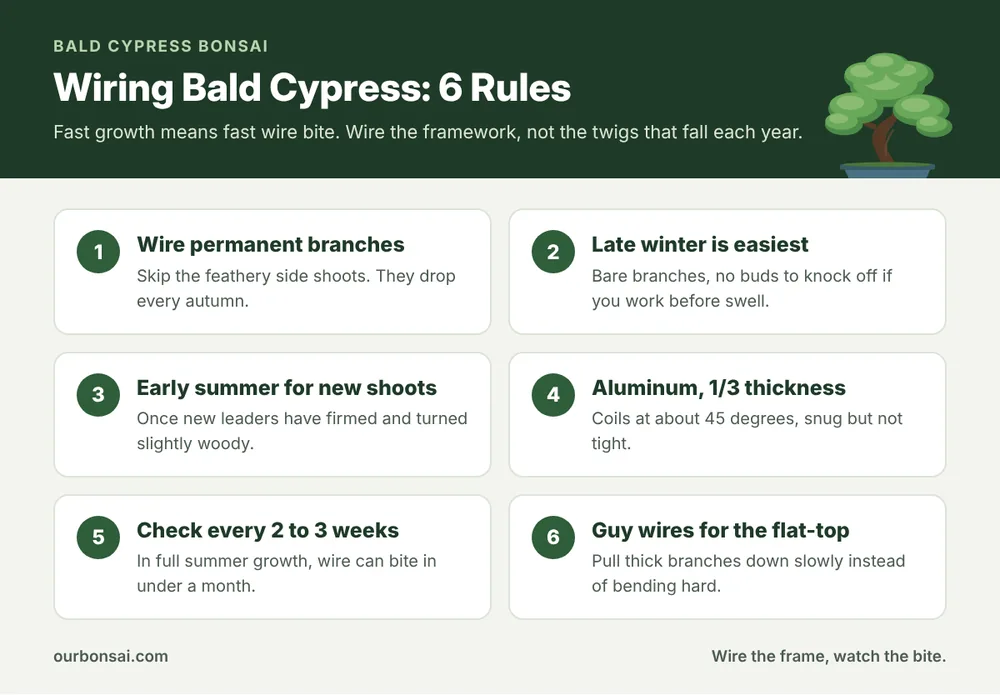
Here is how to wire bald cypress bonsai in brief: wire only the permanent branches and trunk, never the small feathery shoots that fall off every autumn; do the main wiring in late winter before the buds open or in early summer once new leaders have firmed; use aluminum wire about one third the thickness of the branch, coiled at 45 degrees; and check every 2 to 3 weeks in summer, because bald cypress thickens fast and wire can bite into the bark in under a month.
In this guide
What makes bald cypress different to wire
Two things set it apart from most conifers.
First, Taxodium distichum is deciduous, and it sheds not just needles but whole small side shoots. Each autumn, the thin green branchlets that carry the feathery foliage turn rusty and fall off as a unit. Only the buds and woody shoots along the main branches stay. If you spend an hour wiring those soft branchlets in summer, the work literally falls on the ground in October. So wire the woody framework only.
Second, it grows fast in sun and water. A healthy tree in a training pot can add noticeable thickness to its branches in one summer. That speed is great for development, but it means wire left on too long cuts deep spirals into the bark. These scars can take years to grow out.
Best time to wire
| Time | Good for | Notes |
|---|---|---|
| Late winter (before bud swell) | Main branch structure | Easy to see the framework; work on mild days |
| At bud swell | Avoid | Buds knock off easily |
| Early summer | New leaders and branch extensions | Once shoots turn slightly brown and woody at the base |
| Mid to late summer | Light adjustments | Watch closely for bite |
| Autumn | Not ideal | Shoots are dropping; growth slowing |
Many growers wire the main structure in late winter, remove the wire in early or mid summer before it bites, and rewire new leaders at that point if needed.
Tools and wire
- Annealed aluminum wire in sizes from about 1.5 to 4 mm for most trees. Copper is fine for thicker branches if you are comfortable with it.
- Wire cutters with a rounded nose for cutting close to the bark.
- Raffia for wrapping thick branches before heavy bends.
- Guy wires with soft padding and hooks or screws in the pot rim or a training box.
Our guide to the best Japanese bonsai tool kit covers cutters and pliers.
How to wire bald cypress bonsai, step by step
- Plan the shape. For a flat-top, branches rise from the trunk at a shallow angle, then level out to form a broad crown. For an upright tree, branches angle slightly down with tips raised.
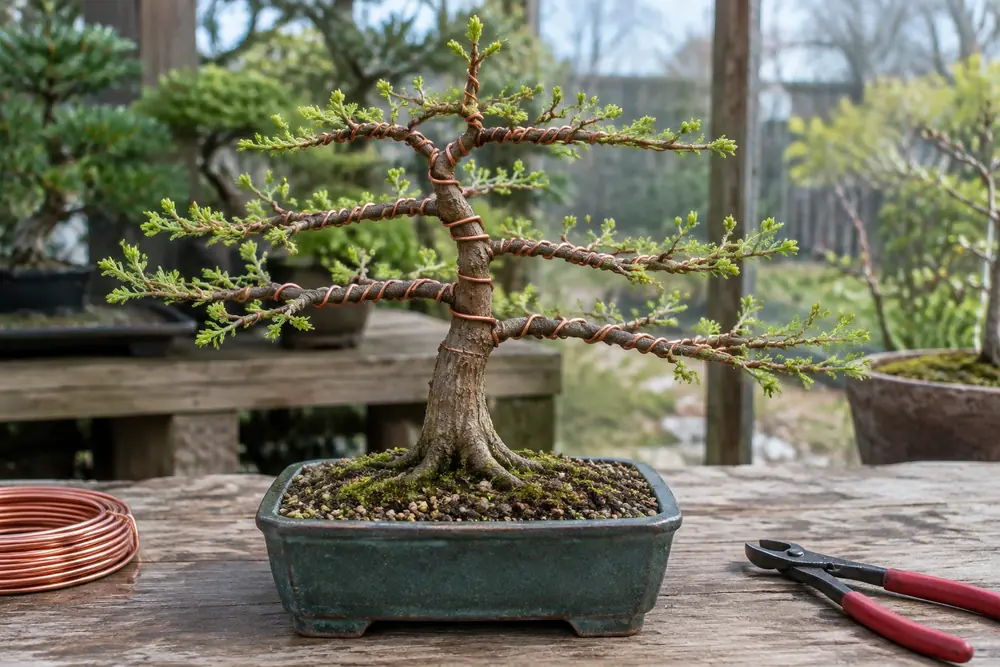
- Choose the wire. Hold it against the branch. It should be about one third the branch thickness and able to hold the bend.
- Anchor first. Wire two branches with one piece, crossing the trunk, or anchor round the trunk for single branches.
- Coil at 45 degrees. Keep the spacing even along the branch. Wire beside buds, not over them.
- Bend slowly. Support the outside of the curve with your thumbs. Young bald cypress branches are fairly flexible; older ones are stiffer and can crack at the junction with the trunk.
- Set the tip slightly upward. This keeps the branch growing strongly.
- Leave the soft branchlets unwired. Shape the foliage by pinching and trimming instead.
For the general logic of styles, our guide to types of bonsai explains the main shapes.
Guy wires for thick branches
On a flat-top or a mature tree, the main branches may be thicker than a finger. Coiled wire on these needs very heavy gauge and still risks splitting the junction. A guy wire is gentler. Loop soft tubing around the branch, run wire down to a hook on the pot or training box, and tighten a little every week or two. The branch moves slowly as it grows, and you avoid both cracks and wire scars.
How long to leave the wire on
In late winter and spring, wire can usually stay on until early summer. Once the tree is growing strongly in June and July, check every 2 to 3 weeks. As soon as the bark starts to swell around the wire, remove it.
Always cut wire off in short sections. Unwinding pulls on the bark and can snap a branch. If a branch springs back after the wire is removed, rewire it, coiling in the opposite direction so the new wire does not sit in the old marks.
Aftercare once a tree is wired
A freshly wired tree needs nothing special, but a few habits help. Keep it in full sun and keep the roots wet, because strong growth is what sets a branch in its new position. Feed normally through the growing season. Do not let the pot dry out in the days after heavy bending, since stressed branches lose water faster. If you notice a small crack at a bend, wrap it with grafting tape and leave the wire on; most cracks close within a few weeks of active growth. Branches usually hold their new shape after one growing season, sometimes two on older wood.
Mistakes to avoid
- Wiring the feathery branchlets. They fall off in autumn.
- Forgetting the wire in July. Bald cypress can scar badly in a few weeks of strong growth.
- Sharp bends at the trunk junction. Older branches can split here.
- Wiring right after a hard repot. Give the tree about 4 weeks to settle first.
- Wiring in frost. Cold wood is more brittle.
Frequently asked questions
Can I wire bald cypress in summer?
Yes, especially new leaders once they have firmed at the base. Check the wire often, because summer growth is fast.
Should I use copper or aluminum wire on bald cypress?
Aluminum is easier and gentler for most branches. Copper holds better on thick branches but needs more care when applying and removing.
How do I get a flat top on my bald cypress?
Cut the trunk at the height you want the crown, let several branches grow from just below the cut, then wire or guy-wire them outward and slightly up. Trim the top flat each summer.
What causes wire scars on bald cypress?
Leaving wire on through fast summer growth. Check every few weeks and remove wire as soon as the bark swells.
Final thoughts
Wire the bones, not the feathers, and keep an eye on the calendar. With late winter wiring of the framework and quick removal before summer bite, bald cypress shapes easily and grows into its new form within a season or two. For more about the species, see our guide to bald cypress bonsai for sale, our list of deciduous bonsai tree types, and the Wikipedia article on Taxodium distichum.