Bald Cypress Bonsai Indoor vs Outdoor: Can It Live Inside?

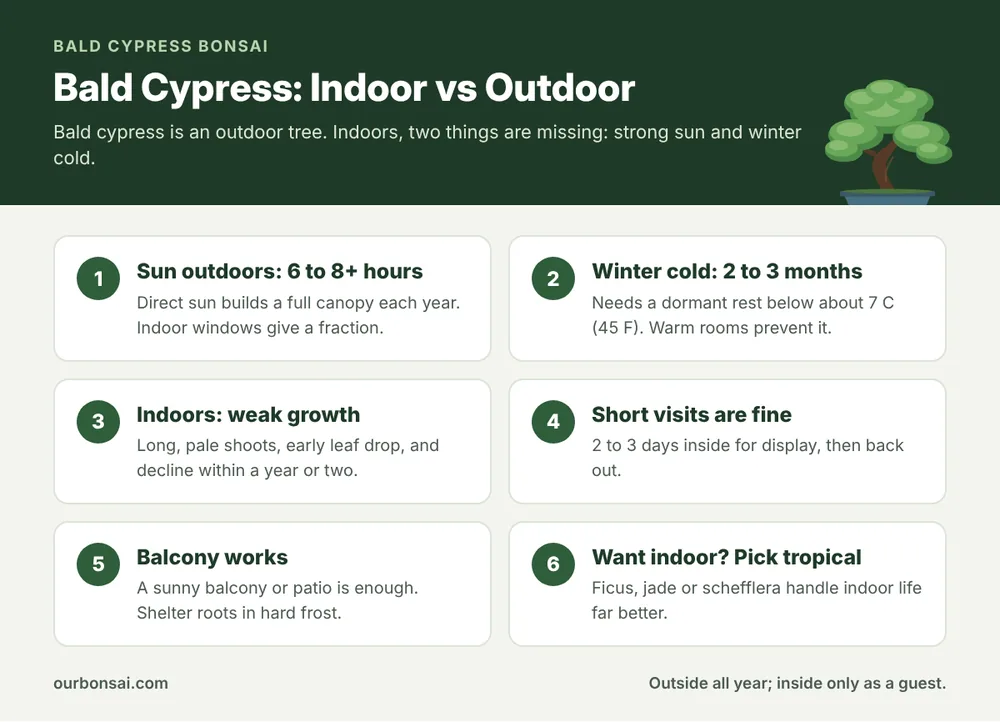
Can a bald cypress bonsai indoor setup work? Not long term. Taxodium distichum needs at least 6 hours of direct sun a day while it grows, ideally 8 or more, and a winter dormancy of roughly 2 to 3 months below about 7 C (45 F). A room cannot give it either. Kept inside, it grows long, pale, weak shoots, drops needles early, and usually declines within one or two years. It is fine to bring a bald cypress inside for 2 to 3 days to display it, but its home should be a sunny garden, patio or balcony all year.
In this guide
- Why bald cypress is an outdoor tree
- What goes wrong with a bald cypress bonsai indoor
- What about a grow light?
- Growing bald cypress without a garden
- A year outdoors at a glance
- Short indoor visits
- If you want an indoor bonsai instead
- Signs your indoor bald cypress needs to go outside now
- Frequently asked questions
- Final thoughts
Why bald cypress is an outdoor tree
Bald cypress grows wild across the southeastern United States, in swamps and along rivers, often in open water with nothing to shade it. It is adapted to strong summer sun, heat and wet roots. It is also a deciduous conifer: each autumn it drops all its needles and goes dormant through the winter, then regrows a complete canopy in spring.
That yearly cycle depends on two outdoor signals. Shortening days and falling temperatures in autumn trigger dormancy. A long spell of cold through winter satisfies its chilling need so it can break bud evenly in spring. A warm, bright living room gives neither signal clearly.
What goes wrong with a bald cypress bonsai indoor
| Indoor factor | Effect on bald cypress |
|---|---|
| Light through glass is far weaker than full sun | Long gaps between shoots, thin pale needles, inner branches die |
| No winter cold | Tree never fully rests; spring growth weak and uneven |
| Warm, dry heated air | Spider mites thrive, needles brown at tips |
| Smaller water use in low light | Soil stays wet, risk of root rot |
| No wind or rain | Weak shoots, dust buildup on needles |
The decline is slow at first, which is why many owners think the tree is doing fine through its first indoor summer. The problems show in the second year, when the tree runs out of stored energy.
What about a grow light?
A strong grow light can keep a bald cypress alive indoors during the growing season, but it does not solve the winter problem. The tree still needs a cold dormancy. If you must keep it indoors in summer, you would need a powerful full-spectrum LED close to the canopy for 14 hours a day, plus a cold space such as an unheated garage for 2 to 3 months in winter. At that point, keeping it outside is simpler and gives a far healthier tree. Our grow light guide for bonsai explains what strong lights can and cannot do.
Growing bald cypress without a garden
You do not need a yard. A balcony, terrace or sunny windowsill box on the outside of a window works well if it gets at least 6 hours of direct sun.
- Water daily in summer. Balcony pots dry fast in wind and sun. A shallow water tray under the pot during the hottest months helps.
- Shelter in hard frost. Bald cypress is hardy in the ground to about USDA zone 4 or 5, but roots in a pot are more exposed. Below about -10 C (14 F), move it against the building wall, wrap the pot, or put it in an unheated stairwell or storage room until the cold snap passes.
- Use a larger pot. More soil buffers both heat and cold.
Our page on the best place for a bonsai tree has more on choosing a spot in a small space.
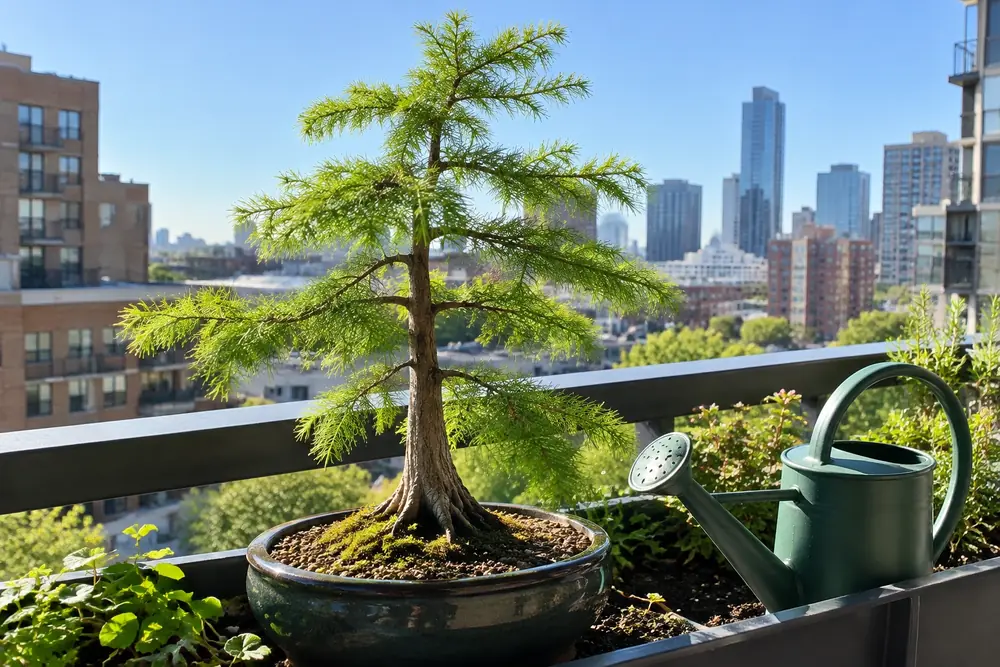
A year outdoors at a glance
Spring: move to full sun as buds open, start feeding once new shoots are a few centimeters long, and repot if needed as the buds swell. Summer: water daily or twice daily, use a water tray in heat, pinch strong shoots at the top. Autumn: stop feeding, take the pot out of the water tray, and enjoy the rusty color as the needles drop. Winter: keep it dormant outdoors or in an unheated space, water only when the soil starts to dry, and shelter the roots in hard frost. That rhythm is exactly what an indoor room cannot copy.
Short indoor visits
Bringing a bald cypress inside for a party, a show, or just to enjoy its autumn color is fine. Keep visits to 2 or 3 days, put it in the brightest spot, keep it away from heaters, and water normally. Avoid bringing a dormant tree into a warm room in late winter, because warmth can wake its buds early, and they may be damaged when it goes back out into frost.
If you want an indoor bonsai instead
If your home has no outdoor space with sun, choose a tropical species that handles indoor conditions:
- Ficus (Ficus retusa, microcarpa, Golden Gate): the most forgiving indoor bonsai.
- Dwarf schefflera: copes with lower light than most.
- Jade (Crassula or Portulacaria): likes dry air and sun from a south window.
- Fukien tea: small leaves and flowers, but fussier about warmth and humidity.
Our list of most popular indoor bonsai trees compares them, and how to take care of a bonsai tree inside covers the basics.
Signs your indoor bald cypress needs to go outside now
- New shoots are long and pale with big gaps between needles.
- Needles are browning from the inside of the canopy.
- Fine webbing or speckling on needles (spider mites).
- The tree did not drop its needles in autumn, or dropped them in midsummer.
Move it outside gradually over 10 to 14 days in spring or summer, starting with morning sun, to avoid scorching needles that grew in low light.
Frequently asked questions
Is bald cypress an indoor or outdoor bonsai?
Outdoor. It needs full sun and winter cold.
Can I keep a bald cypress bonsai indoors in winter?
Only in an unheated, cold space such as a garage, shed or cold frame, kept roughly between -5 and 7 C. A heated room prevents dormancy.
How long can a bald cypress stay indoors?
A few days at a time is safe. Weeks indoors start to weaken it, and months usually lead to decline.
Why are bald cypress sold as indoor bonsai?
Some shops and online sellers label many young trees as indoor bonsai because they sell better that way. Always check the species and its natural habitat before deciding where to keep it.
Final thoughts
Bald cypress is a tree of sun, water and seasons. Keep it outside, water it generously in summer, protect the roots in hard frost, and it will grow fast and strong. If you want a tree for the living room, choose a tropical species. For more on buying and starting a bald cypress, see our guide to bald cypress bonsai for sale, and for the wild tree, the Wikipedia article on Taxodium distichum.