Types of Bald Cypress Bonsai: Best Varieties to Grow

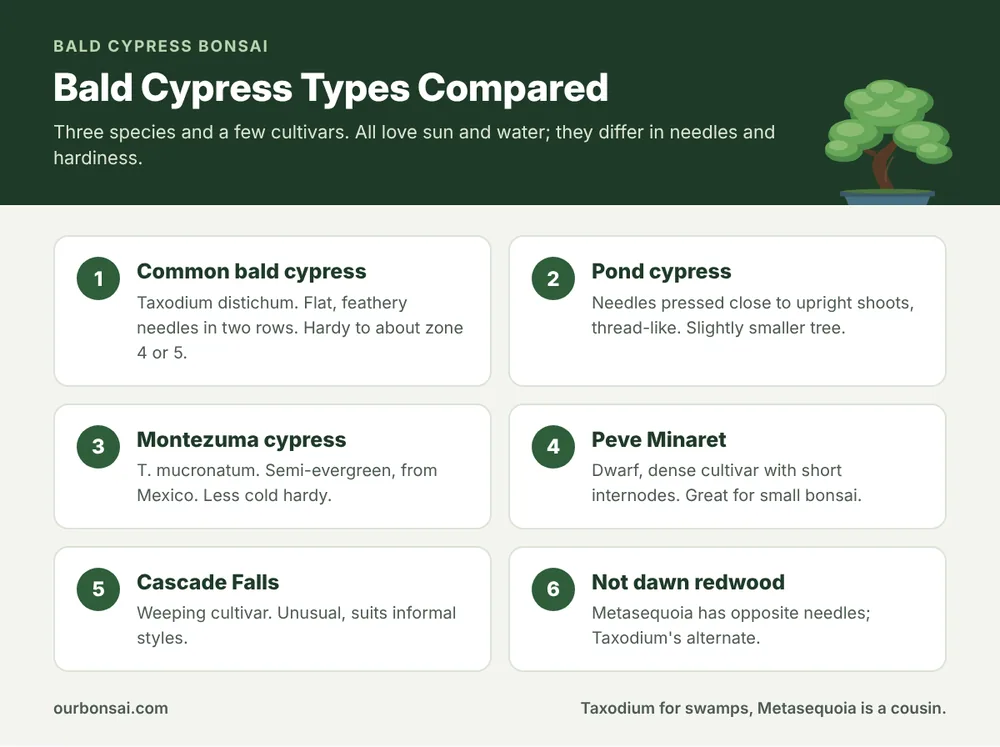
The main types of bald cypress bonsai come from three trees in the genus Taxodium: common bald cypress (Taxodium distichum), pond cypress (often listed as Taxodium ascendens or T. distichum var. imbricarium), and Montezuma cypress (Taxodium mucronatum). Common bald cypress is the most widely grown and the hardiest, to about USDA zone 4 or 5. Pond cypress has slender, thread-like shoots. Montezuma cypress is semi-evergreen and suited to warm climates. A few cultivars, especially the dwarf ‘Peve Minaret’, are also popular for smaller trees.
In this guide
Common bald cypress (Taxodium distichum)
This is the tree most people mean. It grows wild from Delaware south to Florida and west to Texas, especially in the swamps and river bottoms of the Mississippi valley. Its needles are flat, soft and arranged in two rows along small side shoots, which gives a feathery look. In autumn the needles turn orange-brown and drop with the side shoots.
For bonsai, it is valued for:
- Fast growth and quick trunk thickening in sun and water.
- A natural flared, buttressed base.
- Tolerance of heavy root pruning and wet soil in summer.
- Reliable autumn color.
Most nursery and field-grown bonsai stock in the United States is this species. Our guide to bald cypress bonsai for sale covers what to look for when buying.
Pond cypress
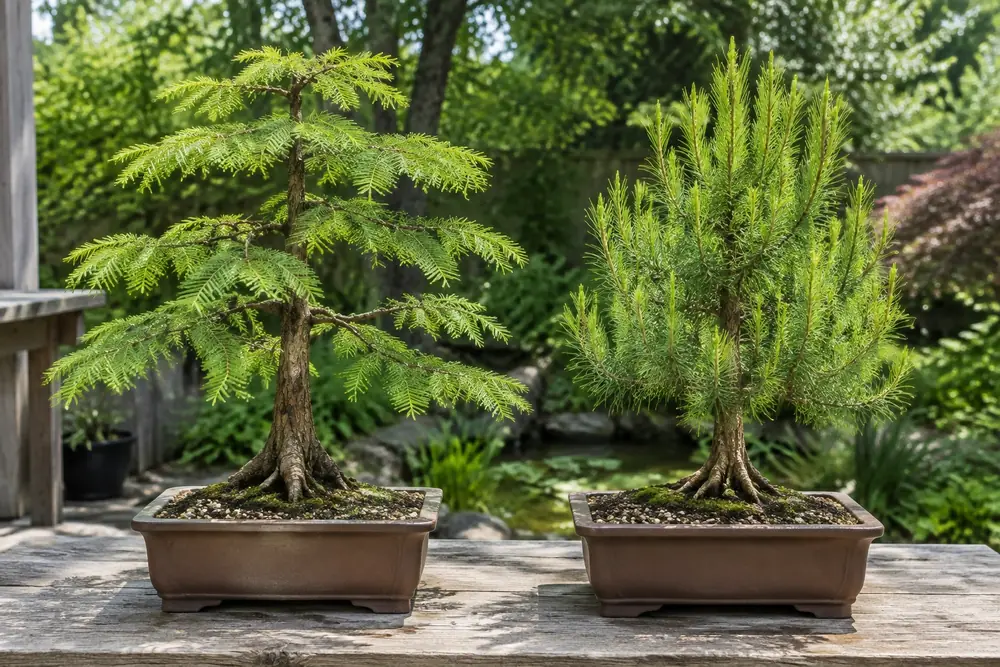
Pond cypress grows in shallower, more nutrient-poor ponds and wetlands in the southeastern United States. Botanists disagree on whether it is a separate species or a variety of bald cypress. For growers, the difference is visible: its needles are short and awl-shaped and press closely against upright shoots, so each shoot looks like a green thread rather than a feather.
Pond cypress tends to be a little smaller and more upright, with bark that is often more deeply furrowed. It makes elegant, slender bonsai and can give a fine, delicate texture. Care is the same as for common bald cypress.
Montezuma cypress (Taxodium mucronatum)
Montezuma cypress is native to Mexico and the far south of Texas. It is the national tree of Mexico, where it is called ahuehuete, and it includes the famous Tule tree in Oaxaca, which has one of the widest trunks of any tree on earth.
Differences from bald cypress:
- Semi-evergreen in mild climates; it may hold some foliage through winter.
- Less cold hardy, roughly USDA zones 8 to 10. In a pot, protect it from frost.
- Does not need a long cold rest, so it suits growers in warm regions where common bald cypress may not get enough chill.
- Often produces finer, weeping branch tips.
If you live in Florida, southern California or similar climates, Montezuma cypress can be a better choice than common bald cypress.
Cultivars used for bonsai
| Cultivar | Type | Growth | Bonsai notes |
|---|---|---|---|
| ‘Peve Minaret’ | Dwarf bald cypress | Slow, dense, short internodes | Excellent for small and medium trees |
| ‘Cascade Falls’ | Weeping bald cypress | Pendulous branches | Unusual informal or weeping styles |
| ‘Shawnee Brave’ | Narrow upright | Columnar | Suits formal upright |
| Seed-grown species | Variable | Fast | Cheapest; good for forests and flat-tops |
Seed-grown trees of the species are the best value for most beginners. They grow fast, thicken quickly and develop strong buttresses. Cultivars are worth looking for when you want a small, compact tree or a particular habit.
Bald cypress vs dawn redwood
Dawn redwood (Metasequoia glyptostroboides) is often confused with bald cypress. Both are deciduous conifers with soft, feathery foliage and orange autumn color, and both make good bonsai. The quick test is needle arrangement: on dawn redwood, needles sit directly opposite each other along the shoot; on bald cypress, they alternate. Dawn redwood also prefers moist but not flooded soil and comes from China, not North America. See our Brussels dawn redwood bonsai review for a closer look at that species.
How to tell the types of bald cypress bonsai apart
Nursery labels are often missing or wrong, so it helps to know the field marks. Look at a summer side shoot first. If the needles stand out flat on both sides like a feather, it is common bald cypress. If they lie pressed along the shoot so it looks like a green cord, and the shoots point upward, it is pond cypress. If the tree keeps a fair amount of green foliage through a mild winter and the branch tips droop, it may be Montezuma cypress. Check the bark too: pond cypress often shows deeper, more furrowed bark at a younger age.
In winter, all three look similar when leafless. Wait until spring growth to be sure.
Growing bald cypress from seed
Seed is cheap and easy to collect from the round, wrinkled cones that break apart in autumn. The seeds have a resinous coat, so many growers soak them for a day or two, then give them 60 to 90 days of cold, moist stratification in the refrigerator before sowing in spring. Germination can be uneven. Seedlings grow fast in sun with wet soil and can reach 30 to 60 cm in the first year, which makes seed a practical way to raise material for a forest planting.
Which type should you grow?
- Cold climate (zone 7 and colder): common bald cypress or pond cypress.
- Warm climate (zone 9 and warmer): Montezuma cypress, or common bald cypress if you can give some winter chill.
- Small space or small trees: ‘Peve Minaret’.
- Forest planting on a budget: seed-grown common bald cypress.
All types need full sun, a lot of water in summer, and a gritty, free-draining soil. Our bonsai soil mix ratio guide gives starting mixes, and the deciduous bonsai tree types list compares bald cypress with other deciduous species.
Frequently asked questions
Is pond cypress the same as bald cypress?
They are very closely related, and some botanists treat pond cypress as a variety of bald cypress. For bonsai, they differ mainly in needle shape and texture. Care is identical.
Which bald cypress type is best for beginners?
Seed-grown common bald cypress. It is cheap, forgiving and fast.
Can Montezuma cypress survive frost?
Light, brief frost, yes. In a pot, protect it from anything below about -2 to -5 C (23 to 28 F).
Does ‘Peve Minaret’ make a good bonsai?
Yes. Its short internodes and dense growth give a fine canopy quickly. Trunk thickening is slower than the species.
Final thoughts
Most growers will do best with common bald cypress, but pond cypress and Montezuma cypress widen the options for texture and climate. Choose by hardiness first, then by the look you want. For more on the genus, see the Wikipedia article on Taxodium.