How Many Hours of Grow Light Does a Bonsai Need?

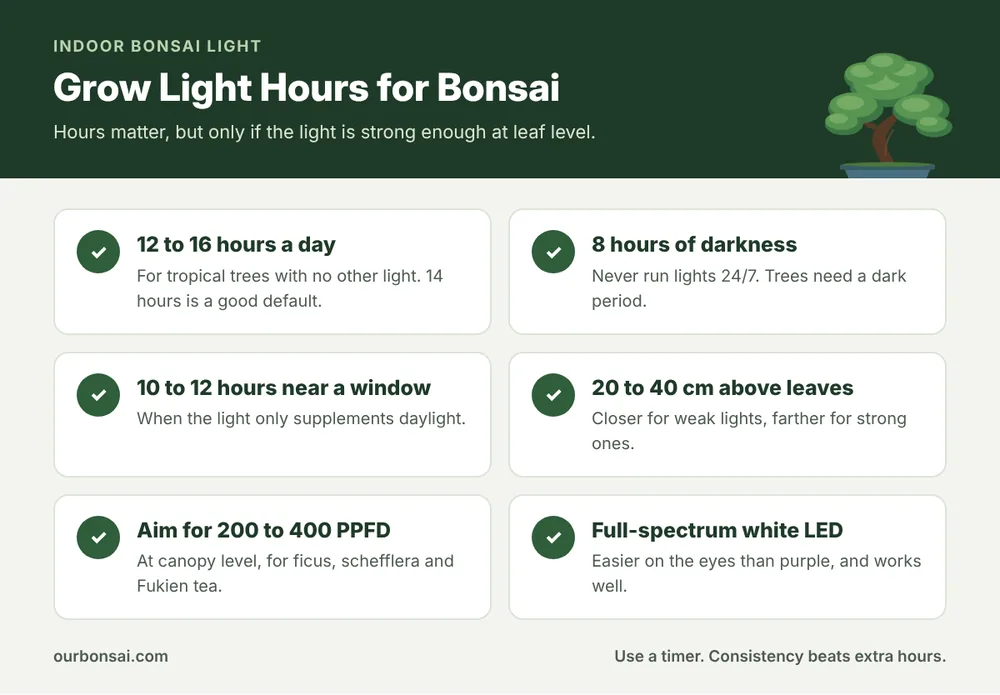
How many hours of grow light does a bonsai need? For an indoor tropical bonsai such as ficus, schefflera, Fukien tea or jade with little or no window light, run the grow light for 12 to 16 hours a day, with 14 hours being a sensible default, and give the tree at least 8 hours of darkness. If the light only supplements a bright window, 10 to 12 hours is usually enough. Hours are only half of the answer, though. The light also has to be strong enough at the leaves: a full-spectrum LED hung roughly 20 to 40 cm above the canopy, delivering around 200 to 400 µmol/m²/s, is a good target for most indoor bonsai. Put it on a plug-in timer so the schedule never changes.
In this guide
Why hours and intensity go together
Plants respond to the total amount of light they receive in a day, sometimes called the daily light integral (DLI). It combines how bright the light is and how long it is on.
A rough way to think about it:
- A weak light 60 cm above the tree for 16 hours can give less total light than a strong light 25 cm above it for 10 hours.
- Doubling the distance between light and leaves cuts the intensity at the leaves to roughly a quarter or less.
- Running a light longer does not fully make up for a light that is too weak or too far away.
So if your bonsai is still stretching toward the window with long, pale shoots and large leaves after weeks under a light, the answer is usually to move the light closer or buy a stronger one, not to add more hours.
How many hours of grow light does a bonsai need in different setups?
| Setup | Daily grow light hours | Notes |
|---|---|---|
| No window light at all (shelf, basement) | 14 to 16 | Strong light needed, 300 to 400 PPFD at canopy |
| North window or dim room | 12 to 14 | Light does most of the work |
| East or west window | 10 to 12 | Supplement, mostly in autumn and winter |
| Bright south window, winter | 8 to 10 | Extends the short winter day |
| Bright south window, summer | Often none | Daylight is usually enough |
Our guide to how much light a bonsai tree needs explains how window direction and season change the picture.
Does the species matter?
Somewhat. All the common indoor bonsai are tropical or subtropical, and none of them are true low-light plants.
- Ficus, schefflera: tolerate a range. 12 to 14 hours under a decent LED keeps them compact.
- Fukien tea, serissa: prefer bright, steady light. 14 hours with good intensity helps them keep their leaves and flower.
- Jade, portulacaria: succulents that like high intensity. Hang the light closer rather than running it longer.
- Brazilian rain tree: folds its leaves at night and in low light. 12 to 14 hours of bright light helps.
Temperate trees like juniper, maple and pine should not be grown indoors under lights. They need outdoor sun and a cold winter. If you want a tree that copes with lower light, see our list of bonsai trees for low light.
Why not leave the light on 24 hours?
Plants use the dark period for processes that matter, including moving sugars made during the day and regulating growth. Continuous light can cause leaf yellowing, stress and weaker growth in many species, and some species respond to day length for flowering. It also wastes electricity. Keep at least 8 hours of darkness, and keep the schedule consistent from day to day.
Choosing and positioning the light
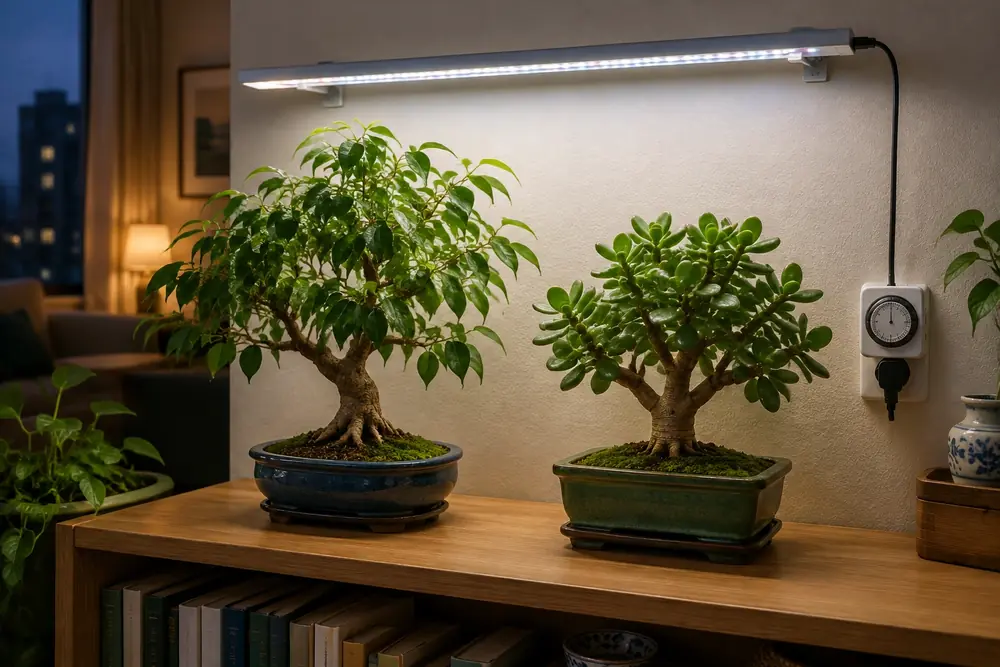
Type. Full-spectrum white LEDs are the easiest choice. They are efficient, run cool, and the light looks normal in a living space. Purple “blurple” lights work but are unpleasant to live with. Our reviews of indoor grow lights for bonsai and of a bonsai light lamp compare some options.
Distance. Start at about 30 cm above the canopy and adjust. Signs the light is too close: bleached or brown patches on the top leaves. Signs it is too far: long gaps between leaves and shoots leaning toward the light.
Coverage. A single small clip-on light covers one small tree. For a shelf of trees, use a bar or panel that spans the whole shelf.
Timer. A basic plug-in timer costs very little and removes the human error of forgetting to switch the light on or off.
Signs your bonsai needs more light
- New shoots with long gaps between leaves (leggy growth).
- New leaves larger and thinner than older ones.
- Inner and lower leaves yellowing and dropping.
- The tree leaning toward the window or light.
- No flowering on species that normally bloom indoors.
If you see these, first move the light closer, then add an hour or two if needed.
Signs of too much light
Rare indoors, but possible with strong panels:
- Pale, bleached or crisp patches on leaves closest to the light.
- Leaves curling or cupping upward.
- Soil drying out much faster than usual.
Raise the light or shorten the schedule by an hour or two.
Frequently asked questions
Can a bonsai live under a grow light only?
Yes, tropical species can live entirely under good grow lights if intensity and hours are right. Many indoor collections in basements do exactly that.
Is 8 hours of grow light enough?
Only as a supplement to a bright window. On its own, 8 hours is usually too little for tropical bonsai, unless the light is very strong.
Should I reduce grow light hours in winter?
No. Winter is when indoor bonsai need grow lights most. Keep the schedule steady all year.
Do I need a special bonsai grow light?
No. Any decent full-spectrum LED grow light works. “Bonsai” lights are usually ordinary lights with a smaller form factor.
Final thoughts
Twelve to sixteen hours a day on a timer, with eight hours of darkness, is the right range for most indoor bonsai under lights. Get the distance and intensity right first, then fine-tune the hours. For background on how grow lights work and what spectrum means, see the Wikipedia article on grow lights, and for the rest of indoor care, our guide on how to take care of a bonsai tree inside.