Bonsai Pot Size Guide: How Big Should It Be?

A good starting rule for bonsai pot size is: make the pot’s length about two thirds of the tree’s height, and the pot’s depth about equal to the diameter of the trunk just above the roots. A tree 30 cm (12 in) tall with a 3 cm trunk would sit well in a pot about 20 cm long and 3 to 4 cm deep. If the canopy is wider than the tree is tall, size the pot to about two thirds of the canopy width instead. These proportions are for finished trees. Trees still in development grow faster in larger, deeper training pots, and flowering, fruiting and cascade trees need extra depth.
In this guide
Why pot size matters
Pot size affects both how the tree looks and how it lives.
Too small, and the soil dries out within hours on a hot day, the roots have nowhere to grow, and the tree weakens. Fruit and flowers drop.
Too large, and the soil stays wet for days because there are not enough roots to use the water. That leads to root rot, especially in winter. A big pot also makes a small tree look lost.
The classic proportions sit in the middle: enough soil to buffer water and temperature swings, small enough that roots fill it within a year or two.
The bonsai pot size rules in detail
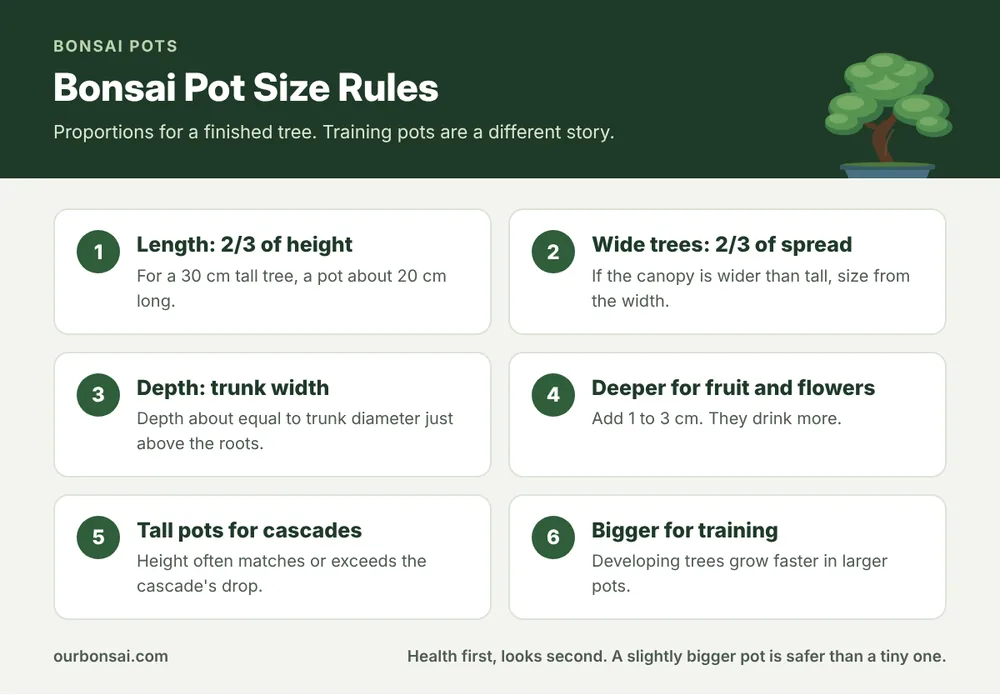
Length. About two thirds of the tree’s height for upright trees. For trees that are wider than tall, such as broad deciduous trees or spreading junipers, use about two thirds of the canopy width.
Depth. About the same as the trunk diameter measured just above the root flare. A thick-trunked tree needs a deeper pot to look balanced and to hold enough soil.
Width (front to back). For oval and rectangular pots, the width is usually set by the shape, so focus on length and depth.
Placement. In oval and rectangular pots, the tree is usually planted slightly off-center and slightly behind the midline. In round and square pots, it usually sits in the center.
Examples
| Tree | Height | Trunk width | Suggested pot |
|---|---|---|---|
| Small juniper | 20 cm (8 in) | 2 cm | About 13 to 15 cm long, 2 to 3 cm deep |
| Chinese elm, informal upright | 30 cm (12 in) | 3 cm | About 20 cm long, 3 to 4 cm deep |
| Trident maple, broad canopy | 35 cm tall, 45 cm wide | 5 cm | About 30 cm long, 5 cm deep |
| Ficus, thick trunk | 40 cm (16 in) | 8 cm | About 27 cm long, 7 to 8 cm deep |
| Fruiting pomegranate | 30 cm (12 in) | 3 cm | About 20 cm long, 5 to 6 cm deep |
| Semi-cascade juniper | 25 cm | 3 cm | Round or square, about 12 to 15 cm deep |
These are starting points. If a tree is heavy in foliage or lives in a hot, sunny spot, go a little larger. If you are shopping for something specific, our reviews of a 12-inch oval bonsai pot and a 10-inch unglazed pot give real dimensions to compare.
When to break the rules
Developing trees. If you want the trunk to thicken, use a larger, deeper pot or a training pot. Roots with space grow more, and a tree with more roots grows more top. Many growers keep trees in training pots for years before moving them into a display pot. Our review of 8-inch training pots covers one popular type.
Flowering and fruiting trees. Azalea, pomegranate, citrus and crabapple use a lot of water when in flower or fruit. Add 1 to 3 cm of depth to the standard proportion.
Cascade and semi-cascade. These go in tall pots so the falling trunk has room. The pot height often matches or exceeds the length of the cascade. See our guide to tall bonsai pots for cascade styles.
Forest and group plantings. Usually very shallow, wide trays or slabs, much longer than the two-thirds rule suggests.
Hot climates and beginners. A pot slightly larger and deeper than ideal is a forgiving choice. It holds more water and is less likely to dry out on a day you forget.
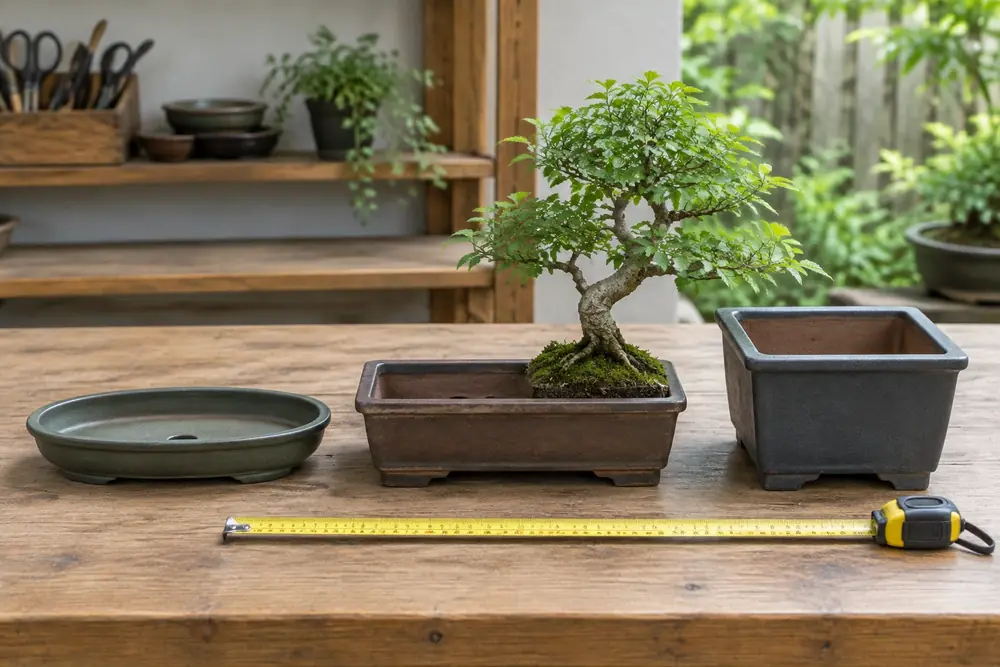
Shape and depth by tree type
- Conifers (pine, juniper): unglazed brown, gray or dark red pots, medium depth, often rectangular.
- Deciduous trees (maple, elm, zelkova): shallower oval or rectangular pots, glazed or unglazed.
- Flowering trees: glazed pots in colors that complement the flowers, slightly deeper.
- Tropical indoor trees: medium-depth pots with large drainage holes; deep enough to buffer drying indoors.
Whatever the shape, check that the pot has good drainage holes and wire holes. Our guide to ceramic bonsai pots with drainage explains what to look for.
Moving to a smaller pot
Going from a large nursery or training pot into a small bonsai pot is a big change. Do it in steps:
- Reduce roots by about a third and move to a pot one size smaller.
- Wait 2 to 3 years until roots fill it.
- Reduce again and move to the final pot.
Trying to fit a big root ball into a tiny pot in one go means cutting too many roots at once.
Frequently asked questions
What size pot does a beginner bonsai need?
Most beginner trees are 15 to 30 cm tall and do well in a pot 12 to 20 cm long and 4 to 6 cm deep. Slightly larger is safer than slightly smaller.
Can a bonsai be in too big a pot?
Yes. Soil that never dries out leads to root rot. If you must use a large pot, use a fast-draining mix and water only when the surface dries.
Does pot size limit how big a bonsai grows?
It slows growth, along with pruning. A tree in a small pot stays smaller mainly because its roots and shoots are regularly trimmed.
How deep should a pot be for an indoor bonsai?
Usually a little deeper than an outdoor tree of the same size, 5 to 8 cm for most small indoor trees, because indoor watering tends to be less frequent.
Final thoughts
Start with two thirds of the height for length and the trunk’s width for depth, then adjust for the tree’s stage, flowers or fruit, style and your climate. A pot that fits keeps roots healthy and frames the tree. For more on how pots fit into bonsai display traditions, see the Wikipedia article on bonsai, and for maker’s marks on Japanese pots, our guide to Japanese bonsai pot chop marks.